NAIOP Policy and Trends Watch

The Commercial Real Estate Development Association

NAIOP Policy and Trends Watch

My Top Ten Predictions for 2015

2015It is that time of year when we try to look forward and plan accordingly. For the commercial real estate industry coming off a rather good year, we have to wonder if we are at the top or still growing?

Here are my predictions for the coming year:
1. Foreign buyers will outspend domestic investors for Boston and Cambridge properties and will make a dent in some communities along 128 (e.g. Burlington and Waltham). They will also be a major buyer of Boston condos.

2. Boston properties will be seeing a record number of office properties changing hands with some of those properties having already transferred ownership within the last 3 years.

3. No surprise that office rental rates in Boston and the surrounding areas will be increasing. I predict a minimum of 10% over this year. Apartment rents will continue to rise with some resistance in the newest buildings.

4. The Wynn Casino construction project will not be starting in 2015.

5. There will be one speculative office building announced in Cambridge, that’s it.

6. Design firms will have their busiest year renovating spaces and providing greater efficiency for existing tenants.

7. Construction costs are going to be up substantially, especially in downtown Boston, with greater difficulties getting multiple competitive subcontractor bids.

8. Boston will experience a major hurricane this coming Fall with substantial flooding due to storm surge.

9. The Federal Reserve will finally raise rates.

10. Boston will be selected by the US Olympic Committee to represent the US bid for the Summer Olympics.

Next governor needs transportation vision

This article originally appeared in the online CommonWealth Magazine.
The below version includes post-election updated information.

By most accounts, the Patrick transportationadministration and the Legislature have moved the needle forward on the issue of transportation. They know that investing in transportation infrastructure is critical to our state’s economy, quality of life and industrial competitiveness.

However, many aspects of the Commonwealth’s transportation system have already approached capacity constraints with increasing delays on congested highways and transit systems. At the same time, demand has increased and is predicted to continue over the coming years with no major increases in capacity coming soon. Without additional investments in our infrastructure, further declining services, increased travel times, and a degraded environment will be the future of the Massachusetts transportation system.

In 1970, Governor Frank Sargent created the Boston Transportation Planning Review that analyzed and redesigned the entire area-wide transit and highway system. It provided a blueprint for transportation policy and investment that we have been effectively following for the last 40 years.

In 2013, the Massachusetts Department of Transportation outlined the investments needed to stabilize today’s transportation system and proposed designing a system for the 21st century. Working together, the Massachusetts Legislature and the Patrick administration created and provided funding for a transportation plan that responded to years of deferred maintenance, underfunded transit operating costs, and delayed mass transit and regional transportation improvements. The funding focused primarily on bringing the Commonwealth’s existing transportation infrastructure into a state of good repair.

Unfortunately, the funding that was put in place fell short of what is needed to truly meet the existing and future transportation needs of the Commonwealth’s residents and businesses. What has been missing from the conversation of late is visionary thinking and a more expansive understanding of why investments in transportation are so important to the future of our state. With one of the highest housing costs in the nation, a solid transportation network that can expand access to a larger and more affordable housing market is critical to the success of our economic development centers.

Across the country – from the Research Triangle in North Carolina to the Texas Medical Center in Houston – state governments and private industry are investing in systems and incentives designed to replicate the Commonwealth’s innovation economy. Though Massachusetts has strengths in higher education, strong academic medical centers, and a historic commitment to innovative technologies, transit and access are weak links and a potential liability for recruiting and retaining a qualified workforce – and the companies that create those jobs.

As Governor-elect Baker begins to outline the issues that will be critical for the next four years, we assert that a top priority should be the establishment of a new long-range statewide visioning and planning effort for transportation. This will require strong leadership to take the bold steps necessary to establish a vision and make it a reality. To successfully implement such an initiative, we’d propose a few guidelines:

• Connectivity is key: With several strong innovation, life science, and health care clusters that are major economic engines for Massachusetts, creating a reliable network of roads and transit is necessary for improving the flow of ideas and people.

• Out-of-the-box thinking is vital: Aligning transportation programs with energy and environmental goals, focusing on seamless connections between air and rail, bus and subway, and making transportation information an integral part of our hand-held knowledge system are all planning efforts that can begin early in a governor’s term and be implemented over the next decades.

• Embracing multiple modes of transportation and access is essential: A 21st century statewide plan must include not only roads, bridges, and public transit, but also bicycle and pedestrian needs, as well as enhanced information sharing through technology.

• Public private partnerships can extend the reach: Innovative partnerships between the public and private sectors must be part of a long-term plan that addresses the needs of businesses and residents alike.

Long-term planning and continued investments in a modern, integrated, multi-modal network are critical to our global competitiveness. Massachusetts cannot lose out to those states that know that transportation investment equals economic growth.

David Begelfer is CEO of NAIOP, the commercial real estate development association, and Marilyn Swartz-Lloyd is CEO of MASCO.

Developers take steps to reinvent suburban office parks

The following article was written by Jay Fitzgerald and appeared in the July 27, 2014 edition of The Boston Globe:

When the exodus to the suburbs got underway more than a half-century ago, employers followed, and the office park was born. But today, as younger workers return to the city, and employers again follow the labor, these isolated campuses of low-slung buildings, parking lots, and company cafeterias face challenges, from new competitors to aging facilities to high vacancy rates.

As a result, owners and developers across Eastern Massachusetts are seeking to reinvent the suburban office park, taking a page from urban revitalization that transformed old mill and factory buildings into mixed-use developments of housing, retail, and office spaces. In communities such as Burlington and Marlborough, developers are adding restaurants, hotels, and other amenities, as well as housing, to compete with the “live, work, play” attraction of the city.

In Marlborough, for example, Atlantic Management Inc. of Framingham purchased the former Hewlett-Packard campus three years ago to launch a more than $200 million rehab of the 110-acre site, which dates back to the 1960s. The project is well underway, with Atlantic refurbishing the two office buildings, while AvalonBay Communities of Virginia, which purchased 26 acres at the site, builds 350 luxury apartments.

Atlantic Management also plans to develop a 153-room hotel and 50,000 square feet of retail and restaurant space that may one day include a farmers market. Already, this redevelopment of the Marlborough Hills office park has attracted a major corporate tenant, Quest Diagnostics of New Jersey, which plans to locate more than 1,000 lab workers there later this year.w

“The number-one challenge for many companies is how to attract talent,” said Joseph Zink, chief executive of Atlantic Management.“Companies need to attract talent and this is one way to do it. I think we’re going to see more of this in Massachusetts.”

Suburban office parks across the nation are trying to respond to tenants insisting on more amenities, said David Begelfer, chief executive of NAIOP Massachusetts, a real estate trade group. In Massachusetts, there’s no precise figure on how many office parks are undertaking renovations large and small, Begelfer said, but “it’s dozens of them and they’re easily spending billions of dollars.”

“The market is demanding it,” he said.

Commercial real estate specialists say the trend in office park redevelopment is driven by two forces. First, property owners need to renovate aging, outdated buildings, some of which are a half-century old. Second, they must meet increasing competition from Boston, Cambridge, and other nearby urban communities.

Along Interstate 495, the vacancy rate for Class A offices is hovering at nearly 18 percent, compared with 11.5 percent in Boston and less than 6 percent in Cambridge. Commercial rents are depressed. Offices lease for only $20 per square foot in the region, less than half of what similar space fetches in Boston and Cambridge, according to Jones Lang LaSalle, a commercial real estate firm.

The site of the former headquarters of data storage giant EMC Corp. in Hopkinton is an extreme case of a struggling suburban property. The 160,000-square-foot building, just off I-495, has sat empty for 13 years, ever since EMC moved to newer offices elsewhere in town, said Steven Zieff, a partner with Hopkinton’s Crossroads Redevelopment LLC.

Crossroads has an option to buy the 38-acre property, which also includes four one-story buildings, and hopes to redevelop the site into a mixed-use complex of housing, retail stores, restaurants, and office space.

“People are looking for something different,” said Zieff. “It’s the entire ‘live, work, play’ environment that people want. They don’t want to go to just an office park with a cafeteria and parking lots.”

Along Route 128, the situation is not nearly as dire, with the office vacancy rate between Woburn and Needham running at 6.4 percent, below Boston’s. Rents near that stretch of the highway are rising as the economy continues to improve, averaging about $34 per square foot, about $20 less than office space in Boston and Cambridge.

But office park owners still feel pressure from intensifying competition with cities. In recent years, a number of suburban companies have moved to Boston or Cambridge, including ad firm Allen & Gerritsen, which moved to the Seaport District from Watertown. Biogen Idec soon will move from a Weston office campus to a new headquarters under construction in Kendall Square.

At the 13-building New England Executive Park in Burlington, the vacancy rate is 10 percent, with tenants that include tech firms BAE Systems, Charles River Systems, and Black Duck Software. Still, National Development, the park’s owner, is convinced it needs improvements to stay competitive.

Later this year the firm plans to start a major overhaul that includes demolishing an office building — all 13 buildings were built between 1969 and 1986 — and constructing 300,000 square feet of new development. The new additions will include a 170-room hotel, three full-service restaurants, and new retail and office space.

“We’re seeing this great rush to the city [by tenants],” said Ted Tye, managing partner at the Newton-based National Development. “What that’s doing is forcing suburban properties to stay on their toes. And we’re responding to that.”

National Development, however, won’t add housing to its New England Executive Park mix. Tye said he’s not convinced that housing within office parks is a smart idea. Some towns might end up getting financially hurt because commercial and industrial properties are usually taxed at higher levels than residential properties, he said.

He added that it’s also hard to duplicate urban settings within suburban parks if they’re not near public transit and don’t have easy pedestrian access to offices. “This is a source of some disagreement within the industry,” he said of housing’s role in office park redevelopment.

In contrast, Nordblom Co., owner of Northwest Park in Burlington, is a firm believer in “live, work, play.” Three years ago, it launched a massive $500 million project to redevelop about half the 285-acre office park to include 600,000 square feet of retail space, 300 new apartments, a 225-room hotel, and 3.5 million square feet of new or refurbished offices.

Todd Fremont-Smith, senior vice president of Nordblom, said the redevelopment, which could take another 10 years to complete, has already attracted new office tenants, a steakhouse restaurant called The Bancroft, and a new Wegman’s supermarket, which opens in October.

“By mixing the uses, you have a more dynamic environment — and it’s more rentable,” Fremont-Smith said. “People are seeking urban-like amenities where they work. I think we’re going to see more of this at both office and industrial parks. People want it.”

View the original article here.

Boston’s Game-Changing CRE Developments on Display at 2014 NAIOP MA Bus Tour

The following blog post was submitted by David Fleming, Principal at PACE Communications Group, a marketing firm that works with CRE companies to promote properties and help lease space.

Elisif_20140514_6876The 2014 NAIOP Massachusetts Bus Tour,“Changing the Game in Boston Real Estate” lived up to its name as attendees got an up close look at game-changing development projects across the city. The tour covered dozens of new and redevelopment projects in Allston, Brighton, the Fenway, Back Bay, the South End, and the Seaport/Innovation District.

Here are just a few highlights:

Game-Changer in Brighton: NB Development’s Boston Landing

Elisif_20140514_6950The tour kicked off in Brighton as attendees watched a presentation on NB Development’s exciting new Boston Landing project. NB Development Group managing director Jim Halliday, HYM Investment Group founder Tom O’Brien, founding principal of Elkus Manfredi Architects, David Manfredi, and others provided an overview of the spectacular transit-oriented, mixed-use project.

When complete, Boston Landing will feature 650,000 square feet of office, 180 hotel rooms, 65,000 square feet of retail, a world-class indoor track facility, a dedicated MBTA commuter rail station, and significant public space. A game-changer in Brighton, for sure.

Skanska & WS Development Star at Seaport Square

Elisif_20140514_7068At the Boston Innovation/Seaport District, attendees visited another game-changer, Seaport Square. Here, Skanska USA is building three projects totaling close to 1.2 million square feet. Project partner WS Development is responsible for bringing the ground level retail to each building.

Brian Sciera of WS Development explained the company’s mission at Seaport Square is to create energy and excitement where buildings meet the street. To WS Development, energy means retail. And, fashion retail, in particular.

“The backbone of any good retail district is its fashion component,” said Sciera. “Fashion brings that energy to the street by driving interaction between people and buildings.”

Sciera said WS Development is in discussion with several well-known retailers, but was not at liberty to disclose names.

The Skanska USA buildings at Seaport Square are:

  • 101 Seaport: located on Parcel L1 across from the Boston Innovation Center, the office tower will be the new Boston headquarters for PwC
  • 121 Seaport: located onParcel L2,the 17-storybuilding willconsist of 400,000 RSF of office space and ground level retail
  • Watermark Seaport: located on Parcel K, the project will consist of a six-story building and 17-story residential tower, including 346 luxury rental units and 25,000 square feet of retail (Watermark Seaport is a JV with Twining Properties)

Fenway’s Other Big Papi: Samuels & Associates

Elisif_20140514_7119When you’re talking about development in the Fenway Triangle, you’re talking Samuels & Associates. With more than $1 billion invested in the neighborhood, Samuels is Fenway’s other Big Papi.

Just down Boylston Street from The Trilogy and 1330 Boylston, the NAIOP tour buses rolled by Samuels’ latest two projects: The Van Ness and The Verb. The Van Ness is a 22-story, 320-unit apartment building that’s under construction and will be home to downtown Boston’s first Target. And, recently underway, The Verb is a 43,000-square-foot boutique hotel project at the site of the former Howard Johnson’s.

At the Landmark Center, bus tour attendees were treated to lunch by area favorite Tasty Burger. Samuels’ Joel Sklar and Peter Sougarides were onhand to discuss the company’s Landmark Center expansion project, which they described as a complete “rethinking of the former Sears building.” In addition to renovating the interior, updating infrastructure, and removing the above ground parking garage, Samuels plans to create a “world class food market” anchored by Wegman’s.

By adding the Landmark Center expansion to development projects The Van Ness and The Verb, Fenway’s other Big Papi has struck again.

A Game-Changing Tour

Elisif_20140514_7224Highlighted by Boston Landing, Seaport Square, and the new Fenway Triangle projects, NAIOP Massachusetts’ “Changing the Game in Boston Real Estate” bus tour lived up to its name—and then some.

Highlights from Boston: The Investment World’s Newest Heavyweight

Elisif_20140417_6337This post was submitted by T.J Winick, Vice President at Solomon McCown.

Event Photos  |  Curbed article  |  Banker & Tradesman article  |  Recap Video

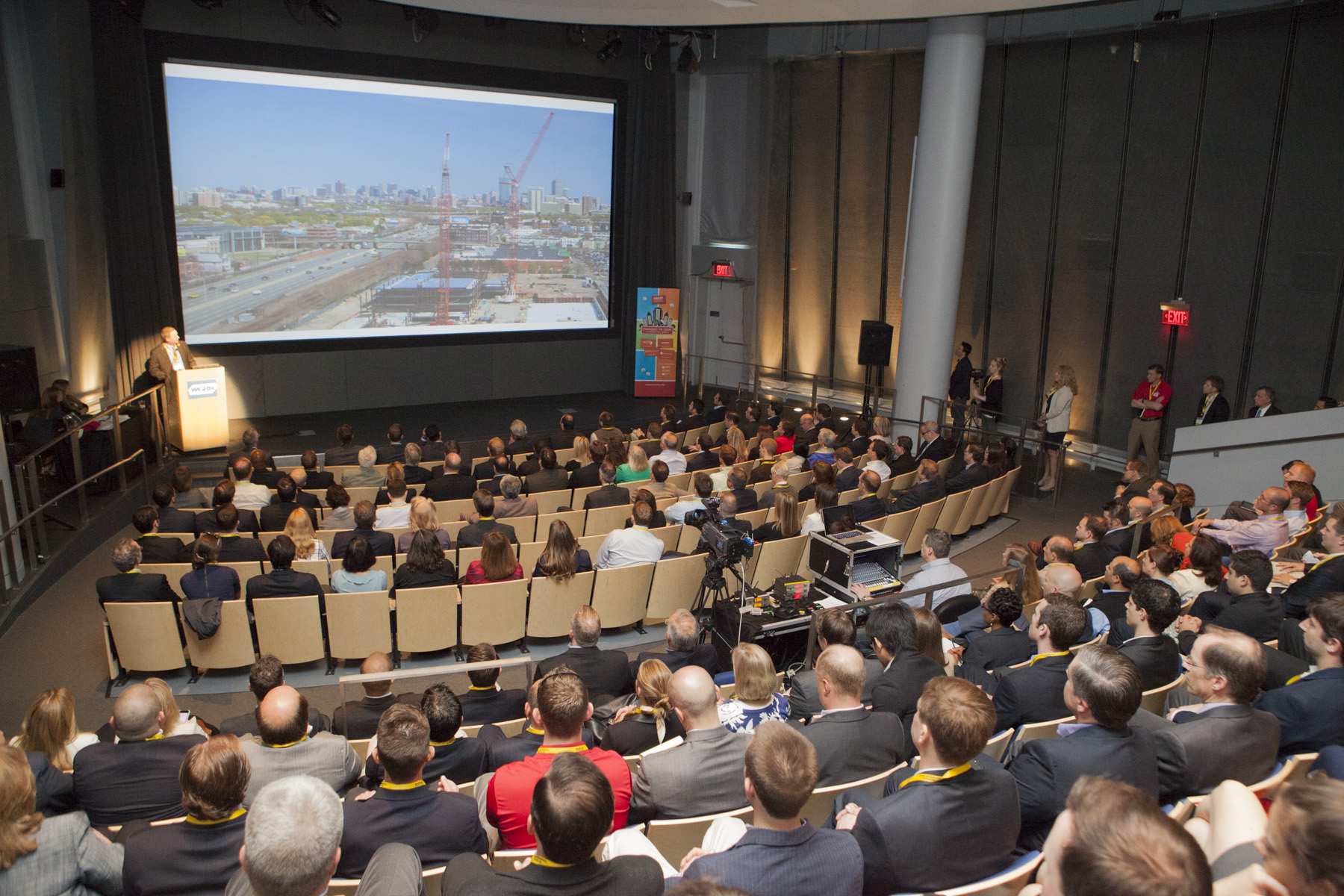
NAIOP’s recent event, Boston – The Investment World’s Newest Heavyweight, assured us once again that Boston is in the city to invest in when it comes to commercial real estate.

Throughout the event, panelists including Charles River Realty Investors President Brian Kavoogian, Cushman & Wakefield New England Area President Rob Griffin, AEW Managing Director Bob Plumb, DivcoWest CEO Stuart Shiff, and Blackstone Principal Jacob Werner touted Boston’s young and vibrant workforce along with its high level of innovation, top-notch schools and universities, and impressive CRE market. “[Here in Boston] it’s a very well educated labor force that draws from traditional financial services, technology and a growing biotech business,” said Werner.

The city is the 5th largest office market in the U.S. and is currently second only to San Francisco in terms of CRE vacancies. While panelists made several favorable comparisons between Boston and the “City by the Bay”, San Francisco is, unquestionably, the leader in development. It has a total of 3.5 million square-feet under construction at the moment, compared with Boston’s 2 million square-feet. San Francisco’s overall rental rates are overall back at 2007 levels while Boston remains approximately 20 percent below 2007 rates; in fact, Boston’s rental rates are still considered “cheap.” However, based on the city’s similarities (coastal, hubs of innovation) and with the belief that San Francisco is a bellwether, Boston’s CRE outlook remains bullish. “There’s real scarcity in [Boston] and scarcity is how you ultimately create value,” noted Kavoogian.

Another area of comparison: Massachusetts trails only California when it comes to NIH Funding. According to Cushman’s Griffin, Massachusetts General Hospital alone receives more NIH dollars than 90% of states. He also noted how the biotech and biopharmaceutical sectors continue to add more and more jobs and create new drugs. “If you’re a global investor and you look at Boston,” said Plumb, “you’ve got all the ingredients for job growth.” And the Boston area’s hottest markets for start-ups (Boston, Cambridge, and Waltham) have experienced an impressive 318 new deals as the market has bounced back. “Focusing on those markets that are both gateway and technology-related markets has been appealing to us,” said Shiff.

In addition to those three markets, there is also hope for Boston’s Central Business District (CBD) despite all the Seaport District’s development. The CBD is currently experiencing 15 percent in rent growth. The panel felt that once the CBD integrates more residential and retail projects into its urban dynamic, it will become “gold”.

Although the panel’s take was overwhelming positive, they did caution listeners to keep a couple of things in mind: Boston has 25,000 new apartments (many which are luxury) inside Route 128 currently under construction. It’s crucial the region creates jobs that meet those rents and attracts a suitable workforce. Also, in terms of capital markets, the industry needs to start thinking about rising interest rates–which are likely to increase as the economy continues to slowly improve.

We Need Jobs, But Also Skilled Workers

computer_handsThe Boston Globe recently reported that “the state’s tech sector is growing fast, but a shortage of qualified workers is preventing Massachusetts from becoming the capital of the nation’s innovation economy”, according to the 2014 State of Technology Report released by the Mass Technology Leadership Council. “Creating the jobs isn’t the hard part – filling them is the hard part,” said Tom Hopcroft, chief executive of MassTLC. “We can’t find enough people with the skills to fill all of these tech jobs.”

These are not the only types of jobs that remain open according to this Boston Globe graphic, which shows that it is not just the high end tech jobs that are having trouble finding workers.

So, what is worse – not having the jobs, or not being able to provide the workers for those companies that are expanding? It should be the former.  Trying to create new jobs is not only difficult, but there is actually no proven way to do it.  If what we have is a gap in training, or the proper transportation to access trained workers, we should be able to remedy that.

Local and state government should be partnering with local community colleges, vocational schools, and universities to work directly with those businesses that are fortunate enough to be growing and hiring.  If we don’t fix this imbalance expeditiously, we may have bigger problems.  Companies will begin expanding elsewhere and, then not having any local jobs to fill would be a lot worse.

Highlights of NAIOP’s You Can’t Get There from Here

Elisif_20140207_3248This post was submitted by Allyson Quinby, Account Supervisor at Solomon McCown.

View event photos  |  Read Curbed article  |  Watch event video

Real estate professionals gathered at NAIOP’s “You Can’t Get There from Here” event to discuss one of the top priorities in Boston right now: improving transportation. It was exciting to hear about all the projects that are in the works, upgrades to the system already underway, and new technology that will allow commuters to get from point A to point B more efficiently.

The audience was fortunate enough to hear from Secretary of Transportation Richard Davey, who served as the keynote speaker, followed by a panel of experts including Michael Cantalupa of Boston Properties, Donald Cooke of VHB, Marilyn Swartz-Lloyd of MASCO and Yanni Tsipis of Colliers International.

Secretary Davey explained how MassDOT will make numerous improvements to the city’s existing infrastructure with a $12.4 billion Capital Investment Plan that aims to make the lives of commuters easier and spur economic development. The much-needed green line extension to Somerville and Medford as well as the South Coast Rail extension to Fall River and New Bedford will make a huge difference for those who live outside Boston. These new public transit lines will deliver an option that’s much less expensive than driving, which means fewer cars on the road and a significant reduction in traffic congestion and of greenhouse gases (something the Secretary said was a major initiative for MassDOT).

Additionally, a Silver Line Gateway will provide a new route from Logan International Airport to Chelsea to service one of the greatest transit-dependent populations in Greater Boston. Secretary Davey called it a “game changer.” As panelist Michael Cantalupa further noted, transportation plays a vital role in any city’s development. As Boston continues to boom with new office buildings and other high-rise projects, it’s critical these new developments remain accessible through increased transportation options.

Secretary Davey assured the audience that money is being invested in the system’s aging infrastructure, which means the need for new transit cars will finally be addressed. In fact, the state will purchase new Red/Orange Line cars and make upgrades to signal systems in an effort to eliminate the on-going problem of constant breakdowns. Millions will also be poured into the state’s highway system. For example, the alignment of the I-90 Turnpike Allston Interchange will reconfigure ramps and straighten the highway to simplify the roadway, as well as allow more room for development.

Diesel Multiple Unit (DMU) Service is another initiative MassDOT will be implementing. The service will allow more affordable cars to utilize our existing commuter rail line that runs from the South Bay Rail Yard to the South Boston Waterfront. This will open up whole new possibilities for those looking to travel from the Seaport District to Back Bay, a route for which there is currently no efficient method of transportation.

It’s no secret here in Eastern Massachusetts that traffic has a paralyzing effect on local transportation on a daily basis. So it was welcome news to hear that MassDOT is collecting and analyzing years of data to deliver real-time traffic technology. This will not only inform commuters where traffic is, but how bad it will be at what time and why. Secretary Davey announced that by the end of 2014, the real-time traffic message signs that have appeared on major highways will be instituted across the Commonwealth; making Massachusetts the first state in the country to do so.

While the planned investments are exciting, a proposed ballot question could prevent many of these important projects from moving forward. Under the landmark transportation legislation passed last year, the gas tax will be indexed to inflation in the coming years. This will be only a penny or two per gallon at most, but will provide the funding needed to ensure these projects are a reality. The proposed ballot question would repeal the gas tax indexing and would eliminate this crucial source of funding. NAIOP and other business groups are strongly opposed to the ballot question and will be working to fight this initiative in the coming months.

Transportation impacts all of us, and it was fascinating to hear Secretary Davey and the featured panelists give us a sneak peak of what’s in store for the city of Boston and throughout Massachusetts.

Dueling Visions for Boston’s Future – Mayoral Candidates Q&A

The Boston Mayoral election upon us.  No matter who wins the race, either City Councilor John Connolly or State Representative Marty Walsh, we are all in for a dramatic change after the 20 year term of Tom Menino.

With the city experiencing one of its greatest growth spurts, businesses will want to know what this choice will mean for them starting January 1st.

I sat down with George Donnelly and Jon Chesto, Boston Business Journal’s editors,and Sam Tyler President of the  Boston Municipal Research Bureau‘s Sam Tyler, to interview these two candidates separately, questioning them on their competing visions of what’s best for business, economic growth and Boston’s future.

Q&A with John Connolly

Q&A with Martin Walsh

Don’t forget to vote next Tuesday, November 5th!

The Changing Face of Downtown Boston

The following blog post was submitted by Ally Quinby, Account Executive at Solomon McCown.

Real estate professionals gathered last week to discuss the significant transformation happening in our city’s core. The office, retail and residential sectors are all growing and working together to create a true 24/7, live, work, play environment in downtown Boston.

Even with the boom in the Seaport, Downtown is seeing an influx of new office tenants who want to be in the heart of the city. David Greaney of Synergy Investments told us that of the 70 leases his firm has completed this year, 59 of them were located downtown. And these tenants are looking at more than just the office space. Mark Smith said that Equity includes the amenities of the surrounding area on tours with potential tenants. He also told the room that tenants want comfortable, communicative environments.

All these companies have employees who want to be within walking distance of work. Despite the thousands of apartment units that are planned and currently being constructed, Bill McLaughlin of AvalonBay Communities said that the demand is there because young people aspire to live in the city; we are well-positioned to absorb the deliveries we will see in the next five to six years.

Retail is growing too. Andrea Matteson of CBRE/Grossman Retail Advisors highlighted Walgreens, Equinox, Scholars and the coming Legal Seafoods as game changers who have helped Downtown Crossing look better than ever. She said that first floor tenants are key in providing character for downtown buildings.

Foreign investment and continued development make Boston one of the U.S.’s most dynamic cities, and our panelists agreed that downtown is going to be an integral part of Boston’s growth in the coming years.

The Seaport’s Time Has Come

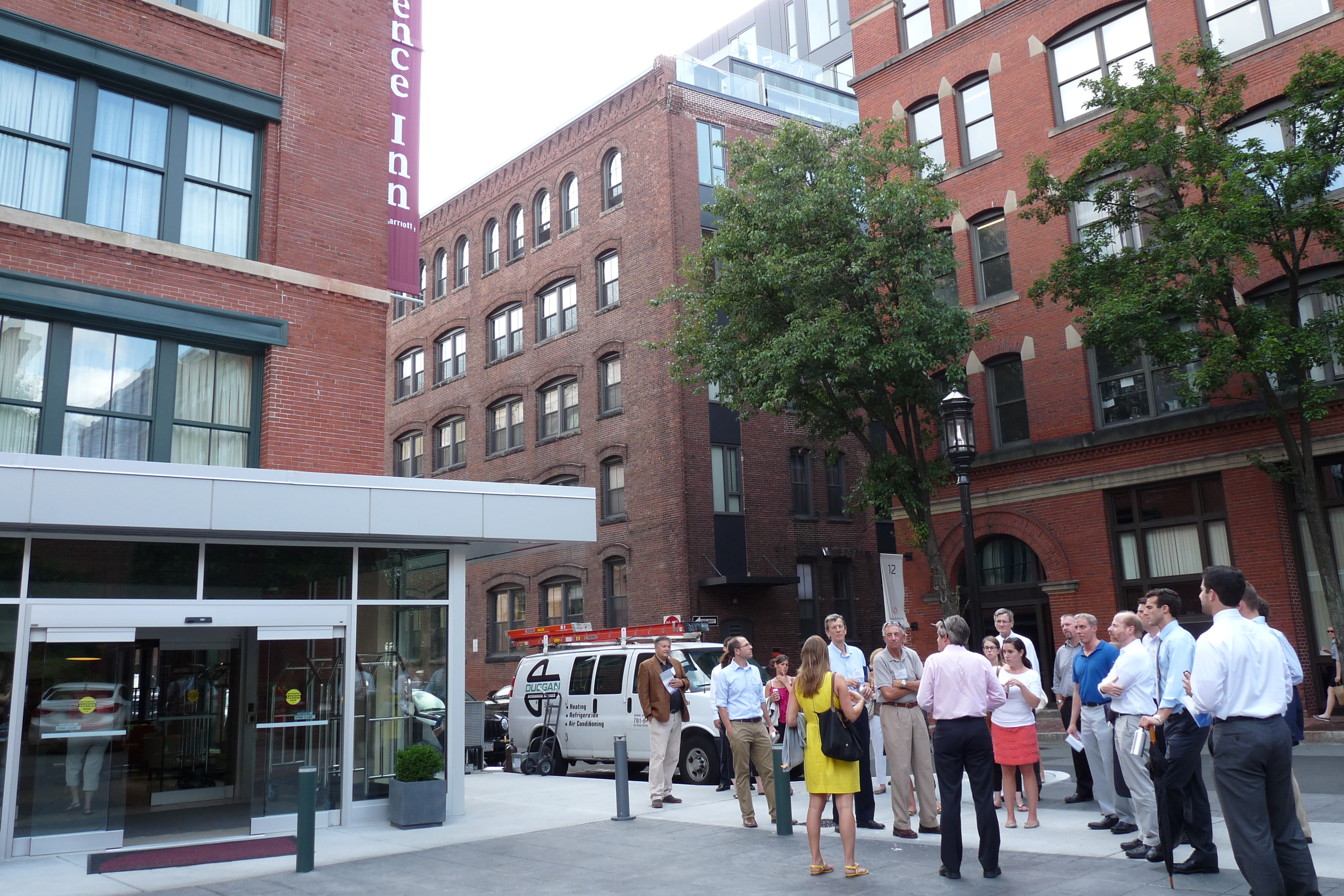
P1090057For many years, the transformation of the Boston Seaport District into a vibrant mixed-use market seemed to always be decades away. For those of us who participated in the NAIOP Seaport Walking Tour, we know that this massive area across Fort Point Channel is finally living up to the hype.

David Manfredi, Principal at Elkus Manfredi, began the program by describing the development over the last 10 years, which includes 2.3 mm sq. ft. of office, 750 new residences, 1,700 hotel rooms, 40 restaurants & cafes, 3 acres of parks, and the ICA and the convention center. This transformation was enabled, in part, by the massive public sector investment in infrastructure and the success of the pioneering development, including the Federal Court House and the Boston Convention and Exhibition Center.

000_0007
Anyone who has been down by the waterfront recently knows there is an enormous amount of construction currently underway, including another 1.8 mm sq. ft. of office, 1,100 apartments, 120 hotel rooms, 30k sq. ft. of retail and many more restaurants, and .5 acre of park space. Highlights include:

• Residences at 399 Congress
• Watermark Seaport apartments
• Boston Wharf Tower apartments
• 411 D Street apartments
• Pier 4 Apartments
• Waterside Place mixed use
• Marriott Residence Inn
• A Loft & Element Hotels
• Tavern Rd, Blue Dragon restaurants
• Bee’s Knees store
• One Channel Center (State Street Bank)
• Block L1 Seaport Sq. (Price Waterhouse)
• 49, 51 and 63 Melcher Street offices
• Vertex at Fan Pier
• Channel Center park
• Q park
• District Hall Innovation Center

Upcoming construction includes yet another 1.1 mm sq. ft. of office, 700 residences, 750 hotel rooms, 300k sq. ft. of retail and many more restaurants, as well as an expansion of the BCEC.

Thousands of new employees will be working in this district, with a likely significant number choosing to live in the area, and all of them spending at least some time in the many restaurants and shops along the waterfront. The need for diversity, options and vitality in this mixed-use area is clear. There is probably more happening in the Seaport District right now than in any other area in Massachusetts (or in any other major metropolitan area across the country, for that matter), and it doesn’t look like it will be slowing down anytime soon.

View photos from the event.