Highlights of NAIOP’s You Can’t Get There from Here

Elisif_20140207_3248This post was submitted by Allyson Quinby, Account Supervisor at Solomon McCown.

View event photos  |  Read Curbed article  |  Watch event video

Real estate professionals gathered at NAIOP’s “You Can’t Get There from Here” event to discuss one of the top priorities in Boston right now: improving transportation. It was exciting to hear about all the projects that are in the works, upgrades to the system already underway, and new technology that will allow commuters to get from point A to point B more efficiently.

The audience was fortunate enough to hear from Secretary of Transportation Richard Davey, who served as the keynote speaker, followed by a panel of experts including Michael Cantalupa of Boston Properties, Donald Cooke of VHB, Marilyn Swartz-Lloyd of MASCO and Yanni Tsipis of Colliers International.

Secretary Davey explained how MassDOT will make numerous improvements to the city’s existing infrastructure with a $12.4 billion Capital Investment Plan that aims to make the lives of commuters easier and spur economic development. The much-needed green line extension to Somerville and Medford as well as the South Coast Rail extension to Fall River and New Bedford will make a huge difference for those who live outside Boston. These new public transit lines will deliver an option that’s much less expensive than driving, which means fewer cars on the road and a significant reduction in traffic congestion and of greenhouse gases (something the Secretary said was a major initiative for MassDOT).

Additionally, a Silver Line Gateway will provide a new route from Logan International Airport to Chelsea to service one of the greatest transit-dependent populations in Greater Boston. Secretary Davey called it a “game changer.” As panelist Michael Cantalupa further noted, transportation plays a vital role in any city’s development. As Boston continues to boom with new office buildings and other high-rise projects, it’s critical these new developments remain accessible through increased transportation options.

Secretary Davey assured the audience that money is being invested in the system’s aging infrastructure, which means the need for new transit cars will finally be addressed. In fact, the state will purchase new Red/Orange Line cars and make upgrades to signal systems in an effort to eliminate the on-going problem of constant breakdowns. Millions will also be poured into the state’s highway system. For example, the alignment of the I-90 Turnpike Allston Interchange will reconfigure ramps and straighten the highway to simplify the roadway, as well as allow more room for development.

Diesel Multiple Unit (DMU) Service is another initiative MassDOT will be implementing. The service will allow more affordable cars to utilize our existing commuter rail line that runs from the South Bay Rail Yard to the South Boston Waterfront. This will open up whole new possibilities for those looking to travel from the Seaport District to Back Bay, a route for which there is currently no efficient method of transportation.

It’s no secret here in Eastern Massachusetts that traffic has a paralyzing effect on local transportation on a daily basis. So it was welcome news to hear that MassDOT is collecting and analyzing years of data to deliver real-time traffic technology. This will not only inform commuters where traffic is, but how bad it will be at what time and why. Secretary Davey announced that by the end of 2014, the real-time traffic message signs that have appeared on major highways will be instituted across the Commonwealth; making Massachusetts the first state in the country to do so.

While the planned investments are exciting, a proposed ballot question could prevent many of these important projects from moving forward. Under the landmark transportation legislation passed last year, the gas tax will be indexed to inflation in the coming years. This will be only a penny or two per gallon at most, but will provide the funding needed to ensure these projects are a reality. The proposed ballot question would repeal the gas tax indexing and would eliminate this crucial source of funding. NAIOP and other business groups are strongly opposed to the ballot question and will be working to fight this initiative in the coming months.

Transportation impacts all of us, and it was fascinating to hear Secretary Davey and the featured panelists give us a sneak peak of what’s in store for the city of Boston and throughout Massachusetts.

Climate Change Preparedness: Commonwealth’s Investment an Important Step in Collaborative Process

DB_testimonyAt Governor Patrick’s press conference today at the New England Aquarium, he announced  Climate Change Preparedness Initiatives funded by a $50 million state investment. Following Mayor Marty Walsh and Secretary Rick Sullivan, I spoke at the event representing the business community.

Climate change can have significant impacts affecting the overall economy; directly, by damaging structures, and indirectly, by compromising transportation systems, communications, and utilities.  There is no question that an increasing number of extreme weather events combined with future sea level rise require local and state agencies, building owners, lenders, insurance underwriters, and tenants to consider how to prepare for and respond to such events.

The business community believes that preparing for storm related events should be a shared responsibility between the public and private sectors. A primary role for city and state governments should be to ensure the continuity and protection of public infrastructure and public safety.  Stakeholders should be at the table with state and local decision makers early on in the process to prioritize short-term and long-term public and private responses. The business community, and the community at large, need to have a clear understanding of the government’s responsibilities for infrastructure and critical services.

Especially with New York City’s experience with Hurricane Sandy, we feel that Best Management Practices developed in other cities should be shared among public and private sector stakeholders, and their applicability to the Commonwealth should be carefully considered.

Finally, both costs and risks need to be evaluated when the public and private sectors consider climate change-related investments and improvement. With scarce resources, there will need to be a balance of adequate planning and a risk-based, cost-benefit analysis in order that funds are prudently expended.

Along with other business groups, we look forward to a true collaboration with state and local governments to safeguard all our valued resources.

Boston Still Riding the Wave for Growth

Although recent article in The Boston Globe, “Rents soaring in city’s Innovation District”, gives the impression that the Seaport is competing head-on with Back Bay, one needs to look closely at the two markets. The majority of the increases in rents from Class A, high-rise space are from existing properties in the Back Bay, while it is the newly constructed buildings in the Seaport that are contributing to its high rental rates.

Obviously, any tenant committing to newly built office space will be paying a premium to occupy the space, due to the high costs of land and construction.  More telling is the solid rental increases within the existing office building environment occurring in the Back Bay with renewals and new leases.

There is no question that the Innovation District is now on the map and is a credible locational choice for growing businesses.  However, the Back Bay is the established work/play/live neighborhood that will continue to be attractive to a full range of businesses. As time goes on, demand for space (and rents) will be more similar in those districts as well as in the “new” downtown market (formerly referred to as the Financial District).

The good news is that Boston is still riding a wave of growth and construction, setting it apart from most other CBD’s in the country.

A New Day for Boston: NAIOP Welcomes Mayor Walsh

martin_j_walshNAIOP Massachusetts was proud to support yesterday’s inaugural events welcoming Boston’s 54th Mayor, Martin J. Walsh. The day was filled with inspirational speeches, musical performances and hope for the future.

During his inaugural address at Boston College, Mayor Walsh outlined his priorities including creating jobs, improving public safety, ending gun violence, and strengthening Boston’s schools.

NAIOP looks forward to working with Mayor Walsh and his team on the many issues affecting the commercial real estate industry and economic development overall. Among other things, NAIOP will provide input on the proposed changes to the Boston Redevelopment Authority, the need for more affordable and middle-income housing, and improved workforce training programs.

Congratulations Mayor Walsh!

New Construction for Greater Boston?

At the recent NAIOP/SIOR Annual Market Forecast, there was talk about the possibilities of speculative commercial development in Boston.  There was a consensus that we will continue to see new construction in the suburbs, Cambridge and Boston due to falling CONSTRUCTION_BLOGvacancies, raising rents, building obsolescence, and limited blocks of space available for large users.

The key stumbling block is whether tenants will pay a premium price over the rents available with existing vacant spaces (especially in areas where rents have not grown as quickly, like Boston’s Financial district.) The new buildings will have the greatest challenges in holding down rents due to the rapid rise in construction costs (with Boston having one the highest union labor wages.)

It is said that “time is money”, so a possible solution is to accelerate the speed of construction. Take a look at the following YouTube video of a 30-story tall hotel built in 360 hours (complete with room furnishings!)

A Scalpel, Not an Axe for the BRA

Ed Glaeser just penned an op-ed in The Boston Globe entitled “Fix BRA; don’t break it.”

With all the campaign talk about the Boston Redevelopment Authority’s problems, it is sometimes easy to forget what it does well, and all that it has accomplished for the benefit of the City, its businesses and residents. Sometimes, a scalpel is preferable to an axe!

Glaeser’s short list of do’s and don’ts are right on target:

  • Above all, don’t make it harder to build.
  • Don’t imitate other cities blindly.
  • Don’t give neighborhoods a veto.
  • Don’t create an agency that has too many objectives.
  • Don’t make a fetish of agency independence.
  • Do increase independent oversight.
  • Do set up clear rules.

Mayor-elect Walsh is very fortunate to be coming into office with a healthy business  environment.  Projects under construction or permitted and ready to go and are at an all-time high.  The key is to maintain predictability and keep this momentum going.  By working with developers and the community leaders that have valid concerns about growth in all of the neighborhoods, reasonable changes can be made to the permitting process.

The goals of that discussion should be to provide permitting rules that are transparent, consistent, timely, and predictable.  We have a great City and we all benefit from thoughtful, well planned growth.

Dueling Visions for Boston’s Future – Mayoral Candidates Q&A

The Boston Mayoral election upon us.  No matter who wins the race, either City Councilor John Connolly or State Representative Marty Walsh, we are all in for a dramatic change after the 20 year term of Tom Menino.

With the city experiencing one of its greatest growth spurts, businesses will want to know what this choice will mean for them starting January 1st.

I sat down with George Donnelly and Jon Chesto, Boston Business Journal’s editors,and Sam Tyler President of the  Boston Municipal Research Bureau‘s Sam Tyler, to interview these two candidates separately, questioning them on their competing visions of what’s best for business, economic growth and Boston’s future.

Q&A with John Connolly

Q&A with Martin Walsh

Don’t forget to vote next Tuesday, November 5th!

Climate Change Preparedness: A Shared Responsibility

Climate change can have significant impacts affecting the overall economy; directly, by damaging structures, and indirectly, by compromising transportation systems, communications, and utilities. An increasing number of extreme weather events and future sea level rise may lead to more frequent and extensive flooding along the coast and inland waterways.  In response, local and state agencies, building owners, lenders, insurance underwriters, and tenants are now considering how to prepare for and respond to such events.

NAIOP has developed guiding principles regarding climate change preparedness and the commercial real estate industry:

  • Preparing for storm related events should be a shared responsibility between the public and private sectors. The primary role for city and state governments should be to ensure the continuity and protection of public infrastructure and public safety. (Having a “climate change proof” building in the middle of a flooded neighborhood, without power or adequate transportation, provides no real public or private benefit.)  Stakeholders should be at the table with state and local decision makers early on in the process to prioritize short-term and long-term public and private responses.
  • Best Management Practices developed in other cities should be shared among public and private sector stakeholders, and their applicability to the Commonwealth should be carefully considered.
  • Not all properties will be affected by climate change in the same way. Owners should have the flexibility to make decisions based on the needs of the individual properties, ownership, tenancy, and product type. Tenants will have varying expectations for building accessibility during and after severe weather events. (e.g., Institutional owners, such as hospitals, may be more likely to make significant investments in order to prevent a shutdown of any kind, while commercial offices may not need the same investments since a safe shutdown and simple return to service would be sufficient).
  • Both costs and risks need to be evaluated by the ownership when considering climate change-related investments or upgrades to buildings, as well as regulatory changes (e.g., if the costs are high and the risks are low, owners cannot be expected to incur unsustainable expenses that result in uncompetitive rents).
  • A combination of incentives and regulatory flexibility may be needed to make the investments in storm preparedness measures viable for the commercial real estate industry (e.g., Zoning changes that would allow for increased building heights, exceptions from gross floor area calculations, or allowing fuel tanks to be stored on a floor above the basement.)
  • The real estate industry, through the actions of owners, investors, lenders, and insurance carriers, will lead to appropriate property preparation and responses to existing and projected weather trends. Regulatory mandates from the government are not the best way to address this issue, because they inappropriately assume industry inaction, and lack the necessary flexibility to accommodate building and site specific variables.

This is an important issue, but the solution should not be aimed solely at commercial building owners.  If we are all affected by the challenges, we should all be doing our part to protect our residents and businesses.

Infrastructure: A Winning Investment for the City

The City of Boston is on a roll with an enormous volume of new construction in many of its neighborhoods. Much of that development was dependent on the ability of the owner to provide funds for local public infrastructure. Unfortunately, that reality can, at times, delay a worthwhile project for many years, missing out on a strong market.

However, a city can be the catalyst for an area, by investing ahead of the market and setting the stage for growth. Through city investments, it can also enhance the efforts for attracting new companies to the area.

A good example is the Seaport/Innovation District. The city can play a very important role by investing in the basic streetscape of this area. Here is a photo of Seaport Boulevard, the main artery running through this district:

seaportblvd

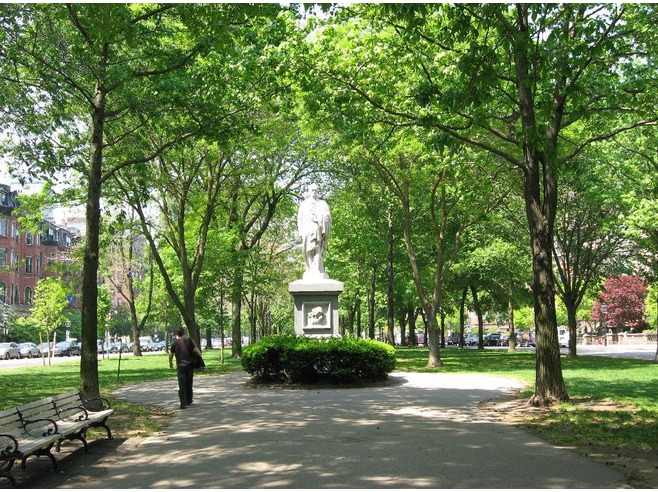
Now, imagine the impact of creating public spaces similar to Commonwealth Avenue or Park Avenue in New York City:

parkave commaveBoston is a world class city and it has the very unique advantage of 100 acres of prime real estate being developed adjacent to its downtown market, allowing it to expand its residences, offices, and shopping. As a result, tens of millions of dollars will make their way into the city’s coffers.

Now is the time for Boston to make a solid investment by making Seaport Boulevard a true boulevard with a wide, tree lined sidewalk with trees, benches and art. Let’s make this area the envy of every other city and a true attraction for families, tourists, and businesses, alike.

The Changing Face of Downtown Boston

The following blog post was submitted by Ally Quinby, Account Executive at Solomon McCown.

Real estate professionals gathered last week to discuss the significant transformation happening in our city’s core. The office, retail and residential sectors are all growing and working together to create a true 24/7, live, work, play environment in downtown Boston.

Even with the boom in the Seaport, Downtown is seeing an influx of new office tenants who want to be in the heart of the city. David Greaney of Synergy Investments told us that of the 70 leases his firm has completed this year, 59 of them were located downtown. And these tenants are looking at more than just the office space. Mark Smith said that Equity includes the amenities of the surrounding area on tours with potential tenants. He also told the room that tenants want comfortable, communicative environments.

All these companies have employees who want to be within walking distance of work. Despite the thousands of apartment units that are planned and currently being constructed, Bill McLaughlin of AvalonBay Communities said that the demand is there because young people aspire to live in the city; we are well-positioned to absorb the deliveries we will see in the next five to six years.

Retail is growing too. Andrea Matteson of CBRE/Grossman Retail Advisors highlighted Walgreens, Equinox, Scholars and the coming Legal Seafoods as game changers who have helped Downtown Crossing look better than ever. She said that first floor tenants are key in providing character for downtown buildings.

Foreign investment and continued development make Boston one of the U.S.’s most dynamic cities, and our panelists agreed that downtown is going to be an integral part of Boston’s growth in the coming years.