
Seaport, the hottest neighborhood in Boston – Part Two

In yesterday’s post I looked at the history of Boston’s Seaport Area and the new Innovation District, with insights from last week’s “Windows on the Waterfront” program. Today I finish up with a closer look at residential and retail activity, Liberty Wharf, and what to expect next as projects make the move from drawing board to construction site.

The Silver Line helped Boston's Seaport become a viable destination to work, shop, play, and live.

Interest in residential use dates back to artists’ lofts in Fort Point Channel, which  eventually led to Beacon Partners’ development of Channel Center with over 200 new condominiums.   Then came the award-winning FP3 residences and restaurants developed by Berkeley Investments.

It was Liberty Wharf, though, that brought a whole new group of visitors to the Seaport with its 70,000 sq. ft. office and retail development that includes Legal Harborside, Del Frisco’s, Temazcal Tequila Cantina, and Jerry Remy’s Sports Bar & Grille. Two-hour waits and a vibrant neighborhood buzzing with excitement are the result. Ed Nardi, working with Massport and the Jimmy’s Restaurant family was able to produce a concept that not only satisfied stakeholders, but far surpassed their expectations.  Hot off this success, Cresset recently committed to purchasing another property in the area for redevelopment.

In an excellent overview of the neighborhood’s history and future promise, architect David Manfredi gave the NAIOP audience a summary of the last 10 years of development in the area:

  • Work:    2.3 million square feet of new office space
  • Live:       750+ new residences
  • Play:      +4.7 acres of new public park and the extended Harborwalk
  • Visit:      1,639 guest rooms
  • Learn:   ICA & BCEC
  • Dine:     40 restaurants, cafes, food venues
  • Shop:    Louis

What’s coming next?

  • 1,160,000 square feet of innovation space
  • 1,500+ residences
  • BCEC expansion
  • More restaurants, cafes, food venues
  • 360,000+ square feet retail

New apartments are arriving with John Drew and HYM Development at Waterside Place, Steve Karp with Hanover Company at Pier 4, and John Hynes at Seaport Square. Innovation centers for start-up companies will be built by Drew and Hynes. And retail is finally on the drawing board for Waterside Place and a major joint venture with W/S Development at Seaport Square.  Who will get the first supermarket?  Both companies report they are currently in talks with grocery chains.

The hotel question still lingers.  With the Waterfront Renaissance Hotel in foreclosure, it is clear the market is not ready for a new hotel right now.  Some feel the elephant in the room is the BCEC expansion and that new hotel(s) will be dependent on the deal cut with the convention center.

As for the office market, as Charles Reid from Boston Global Investors indicated, there are a lot of parking lots right now and it will take some time before the Financial District feels the pinch as the Seaport lots get transformed into new development.  Other than build-to-suits (e.g. Vertex), spec development is highly unlikely in the near future.  However, there are some large blocks of space coming up for renewal in downtown – it’s possible one of those businesses could decide to relocate to a new state-of-the-art building in the Innovation District.

The bottom line is that the Innovation District has come a long way from the days when Anthony’s, Jimmy’s, and the No Name were the only major draws to cross the Fort Point Channel.  And while it may be a long way from its final build-out, there is no doubt this hot new neighborhood is here to stay.

Seaport: The Hottest Neighborhood in Boston

If attendance is any indicator, the record-breaking 700 registrants at NAIOP’s “Windows on the Waterfront” event confirmed that the newly-rebranded Innovation District in the Boston Seaport district is indeed hot.  This is the year when the long-awaited neighborhood became a reality, spurred in large part by two key events – Vertex’s initial commitment to lease two buildings ( 1.1 million sq. ft.)  on Fan Pier, and Cresset’s opening of Liberty Wharf to the wild acclaim of restaurant and bar aficionados.

Windows on the Waterfront

An aerial shot from David Manfredi's presentation

However, as the NAIOP audience learned, that is just the beginning for development in this area. In an outstanding overview of the neighborhood, David Manfredi described the “promise” of this new district as:

  • A vibrant, new mixed use neighborhood
  • A neighborhood driven by innovation
  • A place to live, work, play, shop, dine, learn and visit

Helping developers fulfill that promise are several massive infrastructure improvements over the past decade, including: access to a redeveloped highway system that includes the Big Dig; an upgraded Logan Airport; expanded water transit; and the construction of the Silver Line.  Add to that the Boston Convention and Exhibition Center (BCEC), the Federal Court House, the beginning of a local park system and Harborwalk, the ICA relocation, and the city’s energetic branding of the Innovation District, and it’s hard to imagine why anyone wouldn’t want to be there!

At the event, Mayor Menino indicated that the city did not want the development of this area to be rushed, avoiding a cold, uninviting commercial zone.  He wanted, and now sees forming, a 24-hour, mixed use area that will attract both families and entrepreneurs.

Despite the large amount of available, buildable land adjacent to downtown (rare for most cities), the redevelopment of this enormous land mass has taken quite a while to get moving.  Early in the last decade, Seaport Place developed 1 million sq. ft. of office space and a full service hotel.  Another 600,000 sq. ft. came along with Manulife’s headquarters.  The next few years were fairly quiet for commercial development, until Joe Fallon built the first office building on Fan Pier, a speculative 526,000 sq. ft. tower at One Marina Park Drive.  Fallon had previously developed the 465 unit Park Lane apartments and partnered on the convention center’s Westin Waterfront hotel.  Soon after, the 470 room Renaissance Hotel was built.

Read more about the city’s hottest neighborhood in Part Two tomorrow – use the buttons at right to subscribe by email or RSS.  Among the topics: residential and retail uses, Liberty Wharf, and what’s next for the Seaport/Innovation District.

Commercial Real Estate Bubble?

Is the investment market for core commercial properties cooling a bit? If so, what does this mean for Boston?

According to Pensions and Investments newsletter, the California Public Employees’ Retirement System (CalPERS) is considering dropping its real estate allocation to 8% from 10% by year end.

The buying pressure for core “trophy” properties from pension funds, foreign investors, REITs, and private investment pools are pushing acquisition pricing back to the pre-recession highs.  Locally, 33 Arch Street traded at a sub 5 cap rate ($530/sf.)  Earlier, Boston Properties acquired the Hancock Tower at an initial 4.6 cap ($475/sf.) Most recently, Landmark Center was purchased by Samuels for $530.5 million ($558/sf.)

The Blackstone Group told investors it had raised another $4 billion for its latest real estate fund with a target of $10 billion.  It has already invested/committed $4.4 billion to real estate deals during the first six months of this year.  Blackstone believes that the opportunities lie with the relatively low prices and the sluggish global economy.

At some point, investors will need to ask whether these investments have been worth the high prices paid for them.  Will they achieve the projected rental increases and vacancy decreases that the investments were based on, if the economy continues to remain sluggish with nominal job growth?

According to Colliers’ Boston office , although the vacancy rate in Boston only dropped from 16.6% to 16.3% during the second quarter, the Back Bay submarket showed an overall 8.0% vacancy, with class A space at a very low 5.8%.  Rents have improved with Class A asking rents averaging slightly above where they were before the rental spike that occurred in mid-2007. However, Boston Class B space and the suburban markets are another story. Vacancy rates are still high with the Route 128 submarket at 19.3% and Route 495 at 25.6%. With Boston class B space discounted 30% off class A space and suburban rents having dropped 20%, properties in these markets are clearly going to be challenged for some time.

The good news is that Massachusetts is actually doing better than the rest of the nation, but even here there may be fears of another bubble – especially in light of recent market events.  Could we have a “double-dip” downturn in commercial real estate?  If the world economy does not show some initial stabilization followed by real growth, we may see some of these recent property acquisitions reselling at a loss. Only time will tell.

Development Opportunities May Arise Out of Anglo Irish Sale

As I discussed in today’s Boston Herald, the announcement of the sale of Anglo Irish Bank’s portfolio to Lone Star Funds, JP Morgan Chase and Wells Fargo, means that some of the Boston market’s premier development projects will be changing hands.  Although the bulk of the performing loans will be acquired by the two traditional banking companies, much of the action will come from Lone Star’s share of the nonperforming loans.

Anglo Irish was the go to bank for much of the development action over the past decade.  It provided funding to the region’s top developers for some of the best located projects.  Unfortunately, the 2008 downturn and the continuing recession put a chill on all speculative developments across the country.

The big question is who will get the rights to start these developments when the market begins to improve?  Will it be the existing borrower negotiating a deal to stay with the project or will it be a new player?  It seems clear that Westwood Station will be the latter with a transfer that came close before the whole portfolio was put on the market.

The Greater Boston market has not recovered, but there are pockets of demand that will justify some new development occurring over the next 12-24 months and it is very likely that some of that product will come from this newly sold portfolio.

The Risks and Rewards of Waterfront Development

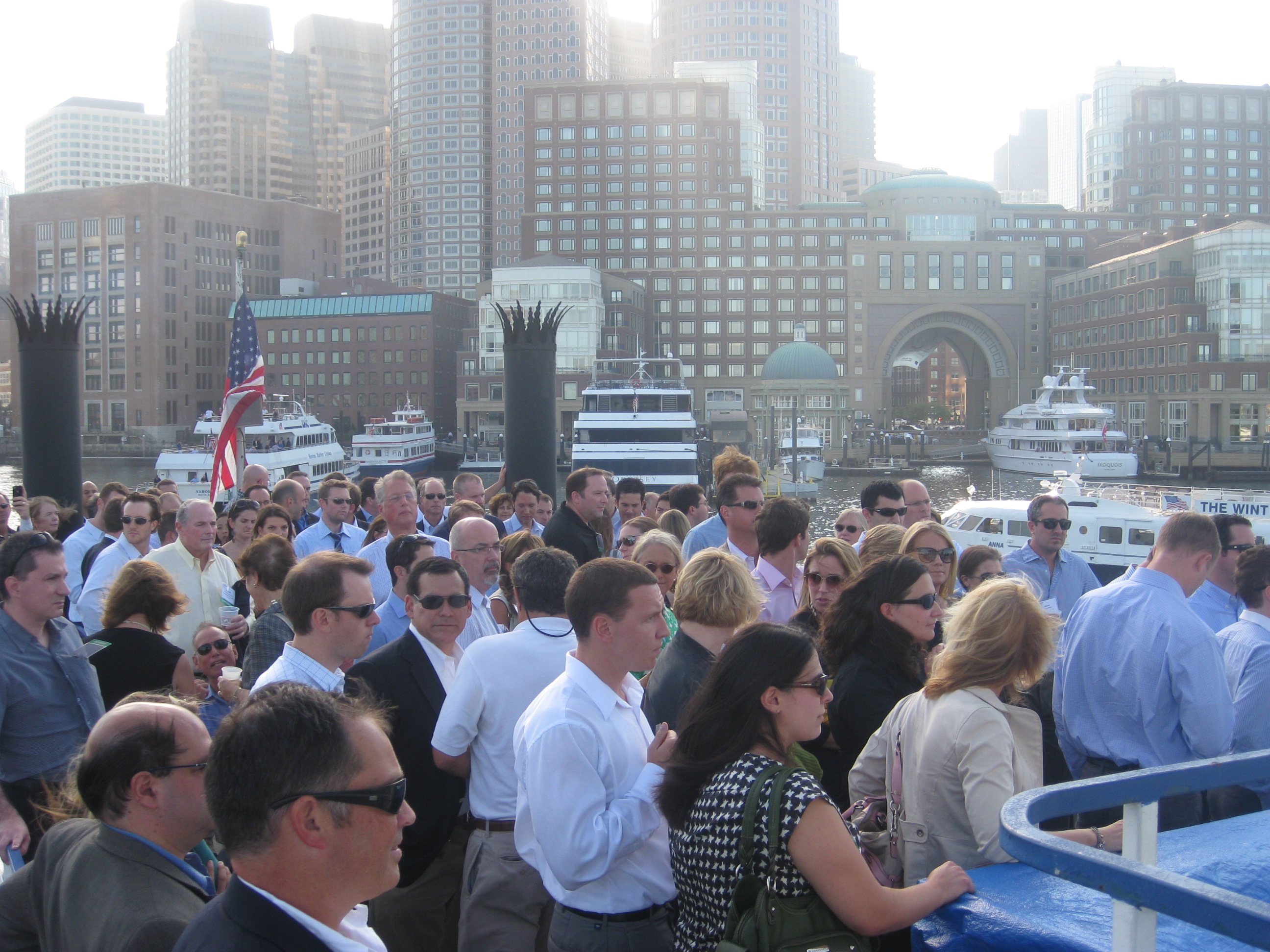
On August 17th, NAIOP had its first “Boston by Sea” Harbor Cruise along the waterfront, featuring commentary by Barry Hynes of FHO Partners, Lowell Richards of MassPort, and Kairos Shen of the BRA.

Besides the unique view of the many waterfront development projects, what stood out for me was the extreme difficulty of permitting and building projects on the water, as exemplified by the many projects that have failed financially, in some cases bankrupting the developers.

Attendees get the scoop on the Boston waterfront of the past, present and future

For all its benefits (views, access, etc.), waterfront development has plenty of obstacles and costly surprises for those who want to build.  There is the Chapter 91 law that regulates most of the city’s coastal areas, the Municipal Harbor Planning process, Boston’s Article 80 permitting process, input and review from neighborhood Impact Advisory Groups, pier piling replacement, and, frequently, costly hazardous waste issues.  To top that off, there is the developer’s dilemma of timing the project to match market demand.  With all of the uncertainty associated with getting a project financed and approved in a timely manner, it is difficult to know in advance if there will be the necessary demand for the completed product at a price that will justify the costs.

That can result in prime development locations lying fallow.  During our waterfront tour, we saw a number of development sites in East Boston that have still not started, even though they were planned for construction 5-10 years ago.  Portside at Pier One, New Street, Clippership Wharf, and Hodge Boiler Works have languished for years.  Most were fully permitted.  However, there is talk that Portside at Pier One, proposed by Roseland Property Company, may begin a first phase.

Many properties have changed hands numerous times before being developed.  Prime examples are Fan Pier and the former McCourt assemblage, both having remained primarily parking lots for three decades until the current owners purchased the land.

Clearly there have also been several successful projects.  Without question, Rowes Wharf stands out as one of the premier mixed use development projects in all of Boston.  It also looks like the “tide has turned” for Boston’s Seaport/Innovation Zone, which has many development projects underway.  With one office building up, Joe Fallon and Cornerstone are now starting construction on two more buildings for Vertex.  A hotel is in the works for Pier 4 with New England Development, and an adjacent apartment project is being proposed by Hanover.

Liberty Wharf has transformed the neighborhood with its restaurants – making it the new place to be any night of the week.  In addition, The Drew Company’s project is getting closer with a key residential component and Seaport Square is expected to move forward with a major retail development handled by John Hynes and WS Development (developers of the enormously successful Legacy Place in Dedham.)

Despite the uncertainties in the financial markets, the Seaport area seems to have found the necessary momentum to attract businesses, residents, shoppers, and tourists.  If the developers and the city can keep up the pace, soon the Seaport will no longer evoke memories of failed developments and abandoned plans.  Instead, it can stand as an example of what can be achieved with vision and persistence.

(Editor’s Note: Hear more about the Seaport at NAIOP’s “Windows on the Waterfront”, Sept. 21, featuring Seaport developers John Drew, John Hynes III, Stephen Karp, along with David Manfredi, John P. Fowler, and special guest Mayor Thomas Menino.)

Millenials and the Alternative Workplace: The Future of the Commercial Real Estate Industry

At a recent NAIOP Massachusetts program, a panel of leading professionals discussed the changing workplace that is being driven, in part, by a new demographic – the Millennials.

As Martha (Marty) O’Mara, PhD, CRE, Managing Director of Corporate Portfolio Analytics, said about this influential category, “they are no longer our kids, but our co-workers.”

This shift is bound to have an impact as they enter the workforce, and Marty’s presentation outlined some surprising facts about this group:

  • Only 15% of Millennials (age 19-29) say having a high-paying career is their top priority.  They place parenthood (52%) and a successful marriage (32%) much higher.
  • 63% have graduated from college, or plan to graduate.
  • Most in the workforce have already experienced bouts of unemployment.
  • Only 61% grew up in a household with both parents.
  • 38% have a tattoo.
  • 8/10 sleep with their cellphone.

They are a powerful market driver and their communication and work style preferences (consuming “experiences” rather than “things”, for example) are already shaping the commercial real estate industry.   

Marty’s bottom line:  “Don’t let a Boomer make a real estate decision.”  More and more companies are recognizing this and designing an “Alternative Workplace” as they plan for the future.

In a short slideshow, Marc Margulies, Margulies Perruzzi Architects shared the key elements of the new Alternative Workplace:

  • Few/no high wall cubicles
  • Multiple workplace environments
  • Density at 165 RSF/person
  • Amenity-rich
  • Dynamic

A panel of experts including Marty and Marc, as well as Bob Richards of Richards Barry Joyce & Partners; Janet Nicholas of Dassault Systèmes; and Greg Lewis of Shire Human Genetic Therapies, then discussed what all of this really means.  

Highlights and things to think about:

  • The Alternative Workplace is designed to support diverse demographics and to be conducive to multiple work styles (mobility being an important element.) 
  • Producing a corporate community that increases productivity through collaboration and interactivity is accomplished through a dramatic change from the historically private spaces (individual worksettings ) to ”neighborhoods” (more collaborative community spaces).
  • The new term is “benching,” providing bench space that can be shared, moved, configured.  The amount of space per employee can change based on the users from a 1.3:1 ratio that efficiently utilizes vacant space due to normal absenteeism, to up to 3:1 for a group that has higher sales and/or consulting staff that travels.
  • Lastly the “town common” area has plenty of amenities.  Picture this as the Kendall Square within the company where different specialties come together as a community in a social, casual area.  These tend to be food oriented, nature focused, bright, and inspirational.

Many of these changes are already being seen in the new designs and renovations of firms throughout the region, but this is just the tip of the iceberg, according to O’Mara and the other speakers.  Big changes are on the horizon for anyone involved in corporate real estate, and those changes will create countless opportunities for the firms who are ready.

Did you attend Wednesday’s program? Share your key takeaways and questions in the comments below!

Massachusetts Needs Regulatory Reform to be Competitive

A MassBenchmarks report from the University of Massachusetts shows the national economy grew by 3.2 percent in the 4th Quarter of last year, while the state’s grew by only 1.8 percent.  This comes after a stellar performance in Massachusetts with the local economy and job growth outpacing the nation since the 4th Quarter of 2009.

The take-away from this is something we already knew: Massachusetts is a unique place, but we are not so special that we can coast our way to recovery ahead of the nation.  Although this may be an economy “pausing to catch its breath,” as the report suggests, the real risk is that just like the recession of 2000, we end up falling short. 

Consider this a wake-up call.  We cannot afford to be complacent; we must go on the attack, doing everything in our power to make this region more competitive, more business friendly, and more efficient. 

If we are to be truly competitive, we must confront the cost of doing business in Massachusetts.  This includes the direct costs of operations (taxes, fees, insurance, utility costs), but also includes indirect costs of time and resources necessary to comply with the complex, multiple layers of regulations, policies, rules and guidance affecting all employers throughout the state.       

With fewer resources available, now is the time for government to do more with less.  We must be more efficient with resources within our regulatory agencies, and we must allow businesses to focus on job growth rather than wasting time managing redundant and often-outdated or ineffective regulations and rules.  For many years, cost-benefit analyses have been required of all agencies for new regulations, but this has never been taken seriously. The attitude seems to be that businesses are “lucky to be here” and can easily afford any regulatory imposition placed on them.  Government has the responsibility to protect the public, but to ignore the costs and the impacts they have on the economy is not protective of a public that is dependent on job revenue to fund its operations.

Things are improving, however.  In Governor Patrick’s second inaugural speech, he specifically mentioned this issue and the importance of job growth.  During the past 18 months, the Governor and his agency heads took a top-down review of new regulations, and we applaud them for that effort.  Now we call upon them to go further by reviewing our existing regulations to ensure that they are doing the job that they were intended to do; that they are consistent with the statutes authorizing them; that they are the most cost effective and efficient means to their goals; and that there are not better ways to accomplish what they do (e.g. privatization or self-certification).

We may never be the lowest-cost state, but let’s develop the reputation of being a state that understands the needs of business and works actively to make interactions with government as smooth and cost effective as anywhere else.

Commercial Real Estate Icons on the Leading Edge of Philanthropy

Bill and Joyce Cummings

In an age when many Wall Street and other corporate leaders take such pride in reaching even greater heights of personal wealth, it is refreshing to hear about a different type of competition. There is a growing group of the wealthiest individuals in this country who are now competing to see who will become members in a new club of billionaires – those promising to give away half or more of their wealth before they die.

The “Gates/Buffet Giving Pledge” already has nearly 70 members in this prestigious, exclusive club. And now they have two new members – Bill and Joyce Cummings, the founders of Cummings Properties, headquartered in Woburn, Massachusetts.

Not that this should come as a surprise to anyone that knows this couple and their history of giving. Over the past 25 years, the Cummings Foundation has grown to be one of the largest philanthropic foundations in the state.

Bill and Joyce are shining examples of local entrepreneurs who believe in a strong economy that does not forget about those amongst us who are less well off. They have long been leaders, even in an industry that prides itself on its charitable giving and community service, and they certainly have raised the bar with this pledge. (Globe article here)

NAIOP Massachusetts is proud to have Cummings Properties on our Board of Directors, and we offer our heart-felt congratulations to Bill and Joyce for the well-deserved recognition they are receiving.

It’s a bright time for solar

If there ever was a time to consider investing in solar photovoltaic (PV) projects in Massachusetts, it is now. There are a number of federal and state financial incentives that may not be around for long. 

  1. First, the developer can take advantage of a Federal U.S. Treasury “Cash Grant” based on 30% of the total value within 60 days of the project becoming operational.  This benefit expires on the end of this year. Or, as an alternative, the owner can take a Federal Investment Tax Credit of 30% of the project value. Tax credit can be carried back 1 year and carried forward 20 years.  This incentive expires December 31, 2016.
  2.  Second, the owner can benefit from a 100% bonus depreciation. This is based on the total value in the year that the project is placed into service. This will also expire the end of this year, but will continue for another year with a 50% bonus depreciation.
  3.  Lastly, project developers can benefit from the Massachusetts solar renewable energy certificates (SRECs.)  The market for SRECs is currently trading at more than $500/MWH (there is a $300 floor.) This is value priced annually.

Maybe this is the right thing to do for the environment; but it looks like, for now, it is the smart thing to do for your bottom line.

Public Access – Yes, Vacant Space – No

I recently testified before the Legislature’s Joint Committee on the Environment, Natural Resources and Agriculture in support of one of NAIOP’s top legislative priorities, An Act to Revitalize the Commonwealth’s Waterfronts (SB371). The bill would address an issue that waterfront owners in Massachusetts have been grappling with for years – facilities of public accommodation (FPA) requirements under Chapter 91, the state’s program for regulating all activities and development on the Commonwealth’s tidelands and other waterways.

Under existing state regulations, the state Department of Environmental Protection requires the ground floor of many waterfront properties to be leased only for uses allowing full public access. Unfortunately, the FPA requirements do not vary by location and do not take into consideration local land use, density, market demand or proximity to street and pedestrian traffic.

Planning studies, including one completed in 2006 by the Boston Redevelopment Authority (BRA), have shown that the required FPA space in existing and proposed projects greatly exceeds the potential demand for such space.  Many of the ground floor FPA areas within existing projects are vacant or have had trouble attracting successful users, some for as long as ten years.  Except for hotels and restaurants, which are defacto public spaces, very few non-maritime projects in the City of Boston have successfully achieved the FPA requirements.  If such projects cannot be successful in downtown Boston, then they have little chance of succeeding in Boston’s other neighborhoods or in other coastal cities and towns where there are fewer pedestrians, less transit and much less density.

The resulting vacant space represents a significant loss of local property taxes.  In these challenging times, this revenue could make a big difference for our schools and communities.  There is no question that the existing FPA requirements impede investment and economic development in waterfront areas.

On behalf of NAIOP, Senator Anthony Petruccelli of East Boston filed the bill to reform the existing FPA requirements.  He is quite familiar with the many projects in his community that have not been able to move forward due to these onerous requirements.  None of these changes would limit public access to the waterfront.  Furthermore, the bill would allow local zoning to regulate interior ground floor use rather than the arbitrary requirement in place under existing law.  It empowers a community to determine what is best for its waterfront. 

This is not a new issue, but it is something that can no longer be ignored.  Now is the time for the legislature and DEP to make the changes necessary to promote economic development while preserving the public’s access to the waterfront.