Strategies for Today and Predictions for Tomorrow

The following blog post was submitted by Ally Quinby, Account Executive at Solomon McCown.

NAIOP Massachusetts’ Smart Money in Real Estate event, on September 19, gathered together a distinguished panel of Boston’s real estate professionals to discuss the state of today’s market, as well as their predictions for the future.

To set the table for the event, NAIOP MA disseminated a poll to members regarding their current perceptions and future predictions. Doug Poutasse, Executive Vice President, Head of Strategy and Research at Bentall Kennedy, and moderator of the panel, leveraged the results from the poll during the discussion.

In regards to real estate investment, Jeff Furber, CEO of AEW Capital Management, listed the four qualities investors are seeking currently: Safety, Income, Control and Liquidity. Tier 1 core costal markets like Boston have been a major beneficiary of this fact due to the lack of risk associated with investing in stable regions.

Similarly, Jon Davis, CEO of The Davis Companies, believes there are many value-add opportunities in healthier cities, “Here in Boston, we are transforming neighborhoods. Take Kendall Square and the Fort Point Channel; there is so much vibrancy in these areas.”

According to one panelist, what the Boston area is lacking is supply of retail space. Despite the recent buzz around grocery-anchored retail centers, Tom DeSimone, Executive Vice President of WS Development, believes centers like this are “overplayed” and the increase in food sold outside grocery stores across the country, in retail shops like Wal-Mart, will be a problem in the future. In agreement, Mark Weld, Managing Director of Clarion Partners, said, “Distressed debt is aggregating in grocery-anchored retail centers across the country that people thought were on the path to growth.”

Looking forward, all the panelists agreed the looming effects of sequestration raise many questions for real estate professionals across the country. Despite the increased activity seen in markets like Boston, New York, San Francisco and Washington, D.C., uncertainty of this type has its effects. According to Jon Davis, “cleaning up from sequestration is the single biggest risk” we are facing today. There is no indication of whether or not Congress is going to be able to come together.

General sentiment among the panelists regarding the economic future was mild, noting there will not likely be significant improvement or dramatic decline in the state of the market.  Instead, all panelists agreed success today—and in the future—will rely heavily on partnering with the right people for leverage. Especially in times like these, what matters is one’s character and ability to execute.

Governor Patrick signs Jobs Bill into law

The “Jobs Bill” – An Act Relative to Infrastructure Investment, Enhanced Competitiveness & Economic Growth in the Commonwealth – was signed into law August 7, 2012 by Governor Patrick.

As I was quoted in the Governor’s press release: “This bill is the result of a close collaborative effort by the House, Senate, Governor’s economic team, and the business community. Although the Commonwealth has fared better than most of the country, this wide-ranging bill creates a welcoming environment for innovation and growth. Combined with the ongoing, system-wide regulatory review process, Massachusetts continues to be attractive for business expansion.”

A summary of the various sections of the bill is available for review.  NAIOP is most pleased with the extension of the Permit Extension Act (Section 173 of Chapter 240 of the Acts of 2010).  Permits in effect or existence at any time between August 15, 2008  and August 15, 2012 will be extended by a total of 4 years (an addition of two years to the previous extension and four years for permits issued during the past two years). The extension will preserve state and local permitting decisions, allowing permitted projects to move forward without costly and time consuming delays to reissue permits. This impacts  all properties: commercial, housing, business expansions, universities, hospitals, and infrastructure projects.

In addition, the bill creates a new Local Infrastructure Development Program (Chapter 23L) that gives municipalities another tool for leveraging private funding to finance infrastructure improvements that are needed to support economic growth. It would fund infrastructure for homeowners and commercial projects without using local or state funds.  This is strictly a local municipal option to assist property owners who desire to finance infrastructure (e.g. roads, water, sewer, alternative energy, etc.)  The MassDevelopment-issued bonds would be secured and paid back by betterment liens on the benefited real estate.

Another win is the expansion of the successful I-cubed (Infrastructure Investment Incentive) program, which increases the number of projects per community from two to three. It also increases the available funding for the program from $250 million to $325 million.  It will add parking garages to the definition of public infrastructure improvements, and will include the taxes generated from construction jobs and purchases as part of the calculation for new state tax revenues.  I-cubed, which originally passed in 2006, was designed to finance significant new public infrastructure improvements necessary to support major new private development.

The Act will also streamline the current District Improvement Financing (DIF) program, by eliminating the required EACC review of DIF districts and development plans, which will make the program more accessible to cities and towns.

Although the Governor did veto the Brownfields tax credit extension, we are confident that the internal review of this program will result in its extension prior to its expiration a year from now.

This fall, NAIOP will be presenting a special Governmental Affairs educational seminar on this important economic development bill, as well as an update on the many regulatory changes occurring throughout the Administration’s various Departments. Keep an eye out for details!

Out front on climate change

This article appeared in the Summer 2012 issue of Commonwealth Magazine.

Massinc’s recent research report, Rising to the Challenge: Assessing the Massachusetts Response to Climate Change, was billed as “the first independent assessment of state action on climate change.” We, at NAIOP Massachusetts, believe that it missed an opportunity to provide a more complete, non-partisan account. Although it is acceptable to inquire into the progress that the state is making to reduce greenhouse gas emissions as required by statute, this report is by no means a sufficient analysis of the issue.

The Massachusetts Global Warming Solutions Act, passed in 2008, required the state’s secretary of energy and environmental affairs to set a greenhouse gas reduction goal of between 18 and 25 percent for the year 2020 (one of the most ambitious in the nation). Ian Bowles, who was the secretary at the time, chose to set that target at 25 percent. The secretary was required to submit an action plan to the Legislature that could assist in meeting this goal; however, there was no requirement that the plan be followed or that other means could not be used to achieve this target.

We have no argument with the statute’s basic premise that climate change is a serious global problem and there need to be international and national plans in place to reduce greenhouse gas emissions in a timely manner. But we feel that questions need to be raised regarding the practical challenges of emissions reductions—where and how they can best be achieved, at what cost, and over what period of time?

Climate change is not a local issue. One state’s reduction in greenhouse gas emissions will have little impact on how that state will be affected by global climate change. Any other expectation is un­realistic. However, pursuing policies that could unintentionally hinder growth will most definitely put the Commonwealth at a competitive disadvantage when it comes to attracting or retaining jobs.

MassINC’s stated goal was to uncover the facts and reach independent conclusions based on evidence. Its approach was developed from the perspective that the state has committed to achieving ambitious greenhouse gas reduction goals, and that there should be a dialogue about the best way to do so. Unfortunately, the report comes up somewhat short. Rather than offering a dialogue, the report simply checks off which measures in the plan have or have not been completed to date. It accepts these recommended measures as the only path to achieving the required reductions and lacks any qualitative critique of these mitigation methods.

A comprehensive assessment of this issue would include a serious discussion of the economic and financial impacts that will result from recommendations of the state plan. This includes a cost/benefit analysis of any presumed impacts on businesses and residents. However, the only mention of cost impact in MassINC’s report is general statements from environmental advocacy groups indicating that these measures are fully balanced by the savings they will produce. The groups also imply that the costs would be less detrimental as valued against the cost of building a new power plant, which is a very unsuitable standard by which to judge individual policies. In addition, many of the policies outlined in the plan would have dramatic impacts on the economic development goals of the Commonwealth and should be questioned accordingly

The report is also lacking more substantive examination of the controversial decision to fund many of the alternative energy and efficiency programs with increased electricity costs for ratepayers. What are the impacts of the plan’s recommendations? What are the associated costs to those existing businesses that are dependent on high energy consumption? Are these investments the right ones for the Commonwealth? Does the growth of new jobs created by the grants and incentives justify the jobs lost due to high energy costs?  Besides the anecdotal evidence, what are the firm data regarding these investments and the return in terms of jobs, tax revenue, and economic development?

Also overlooked is the question of whether the aggressive greenhouse gas target for Massachusetts will significantly alter the projected impacts of climate change in the Commonwealth. The report describes projected climate change threats that include a rise in sea level, more frequent severe storms, and temperature spikes in the summers. If the Commonwealth is successful in meeting (and even exceeding) its greenhouse gas reductions at a substantial cost to the public, does anyone credibly believe such reductions would meaningfully reduce potential climate change impacts?

The Massachusetts Department of Energy Resources needs to be more open and transparent with its decisions to pursue mitigation plans. These should be grounded in sound economic cost-benefit analyses using data from its regulated industry stakeholders. Advancing policies without reliable data and analysis of their impact could cause the state to make decisions that have unintended negative consequences on our future economic growth.

Critical first steps would be to educate the marketplace, provide additional support to make these methods financially attractive, and recognize that the state of the economy is an important determinant of when to require greater efficiency measures. We should be researching whether there are more cost effective ways to get to the appropriate goals before we accept and mandate the most expensive solutions.

Increased energy efficiency in new development and existing buildings is a prime target for achieving the 2020 target goals. But it is important to keep in mind that not all markets around the Common­wealth are created equal. Statewide energy mandates for all building types will create a disincentive to develop new properties in areas where the markets cannot absorb the increased costs. Unfortunately, many of the “one-size-fits-all” government proposals do not account for varied building types or tenant energy requirements, and they rarely take into account actual investment/payback ratios.

The more stringent energy efficiency requirements disregard the mismatches between who pays the cost of an option (owner) and who gains the benefit (tenant), making it difficult to justify economically the investment in the first place. There is also too much emphasis being put on regulating the energy efficiency of the building shell. Much of a building’s energy use actually falls within the tenant spaces and therefore is not directly influenced by mandates for increased energy code efficiency. However, with appropriately scaled tax incentives, owners could receive financial benefits for the upfront investment and tenants could see reductions in their operating costs.

On a national basis, rather than using regulatory mandates, President Obama has announced the Better Buildings Initiative, an innovative economic development program using tax incentives to make existing buildings more energy efficient through retrofit projects. The amount of the incentive would grow with increased energy savings, encouraging ambitious projects and also rewarding more moderate retrofits that achieve meaningful levels of energy savings.

Since Massachusetts has among the highest energy costs in the nation, it makes good business sense to reduce a property’s controllable operating costs, especially if it can help to also reduce greenhouse gas emissions. Becoming more energy efficient is an important consideration in today’s commercial real estate industry. Many developers, owners, and tenants understand that it makes economic sense to find ways to increase initial capital investments for energy efficient technology and design elements that will result in a reasonable payback of energy savings.

As a result, the market is becoming more responsive to the need for energy efficiency, especially with volatility in energy costs, and a more educated and demanding tenant base. We have already seen that, without regulatory requirements, more buildings are now built as LEED-certified “green buildings.” Before the state moves toward aggressive mandates, policy makers should consider incentive-based solutions. Doing so could leverage and support private investments in order to help businesses reach higher levels of energy efficiency. MassINC should follow-up its report with a more critical look at the existing, proposed mitigation measures, as well as other alternatives, which could lead the Commonwealth down the right path to our greenhouse gas reduction goals.

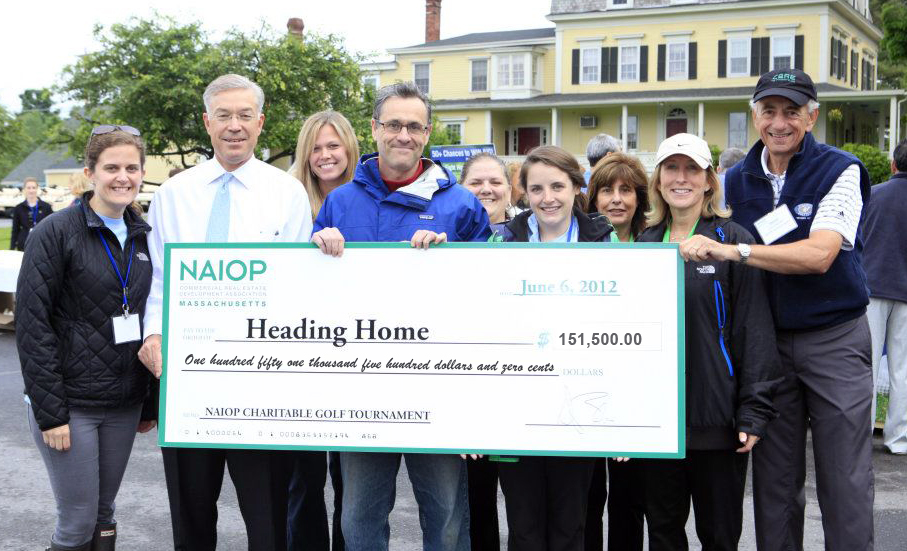
NAIOP Raises $151,500 for Heading Home

This post was submitted by Marc Margulies, principal at Margulies Perruzzi Architects and president of Heading Home’s Board of Directors

On June 6th, NAIOP Massachusetts held its 24th Annual Charitable Golf Tournament to benefit Heading Home, raising $151,500 to support programs to end homelessness in Greater Boston. This record-breaking sum is the largest in the tournament’s history, bringing the total donated to Heading Home to more than $1.85 million. The commercial real estate community should be proud
that its steadfast commitment to Heading Home reaps real rewards for homeless families.

In 2011, Heading Home helped more than 2,000 homeless people in Greater Boston by providing them a place to call home and opportunities for self-sufficiency. Two-hundred and fifty units of housing have been created since 2006, with 61 new units created in the past year alone.  More than 400 volunteers annually commit their time and energy to Heading Home, and the commercial real estate community provides a large number of those volunteers. The monies raised by NAIOP will continue to support Heading Home’s programs to end homelessness locally.

Andrew Hoar, president of CB Richard Ellis/New England and chair of the 2012 NAIOP Massachusetts Charitable Events Committee, led the effort to make this record-breaking donation possible. Andy has been on the Heading Home Board of Directors since 2007, and he, his wife, and his firm are longtime contributors to the organization. Andy’s efforts this year hit the fundraising goals out of the park!

Another ardent Heading Home supporter who deserves special recognition is NAIOP Massachusetts CEO, David Begelfer. David has been actively involved in the struggle to end homelessness for more than 24 years, and started the annual NAIOP golf tournament to support Heading Home. In 2010, David received the Bob Ray Partnership Award from the Massachusetts Housing and Shelter Alliance for his commitment to ending homelessness. His support of Heading Home, including serving on the organization’s Advisory Council, has been unwavering through the years.

Since the first NAIOP Golf Tournament that raised $5,000 for Heading Home, the commercial real estate industry has continued to come together to show support for homeless families and individuals. Thank you to NAIOP’s member volunteers, staff, and generous donors who helped to raise this record-breaking donation for Heading Home. It is only through their support that the tournament is able to raise funds needed to help Heading Home accomplish its goal of ending family homelessness.

View pictures from the event.

Boston’s parking freeze needs to be thawed

This Letter to the Editor appeared in the June 14, 2012 edition of Boston Business Journal.

To the editor:
The viewpoint expressed in your recent article titled “Seaport Squeeze” piqued my interest. I find it worrisome that the Seaport area will soon transition from servicing commuter parking for downtown Boston, to an area servicing parking for its new residents and businesses.

We should all be a bit more concerned about the results of this impending transition. The parking freeze was initially proposed in the early 1970s for downtown Boston and Logan Airport. Subsequently, parking freezes were adopted in Cambridge, East Boston and other parts of Boston. With the growth of the office market over the past three decades, many workers have certainly taken advantage of Boston’s mass transit system, but those who commute by car benefit from the low-cost parking in the undeveloped Seaport area.

With a parking inventory freeze in the Seaport, long-term availability of satellite surface parking is at odds with the construction of high-rise apartments and offices. As the amount of commuter parking diminishes, the stress on businesses in the Financial District, to keep their commuting employees, increases. Mass transit cannot absorb all these commuters. At some point, companies that have relied upon employees that commute to work may be forced to look elsewhere for office space.

There are two areas that need attention. Firstly, Boston businesses are highly dependent on the MBTA and the legislature needs to act, not just with a short-term fix, but with a multiyear plan to reduce the T’s burdensome debt, and increase the long-deferred investments to enhance, expand, and improve ridership capacity and satisfaction.

Secondly, a myriad of programs have been implemented nationwide to reduce parking and transportation demand that do not depend on freezes. Even the city of Cambridge has abandoned its parking freeze approach and implemented a Vehicle Trip Reduction programs to address parking, traffic and air-quality issues.

Maybe the time has come to take reevaluate the city’s parking freeze policy, which is one of the very few left in this country.

David Begelfer
CEO of NAIOP Massachusetts

Getting Real in Affordable Housing

The following blog post was submitted by Anne Baker, Account Executive at Solomon McCown.


It’s all about perception versus reality.

That was the takeaway message from NAIOP’s Affordable Housing: Challenges and Initiatives panel on May 23.  The panel included Howard Cohen, Chief Executive Officer at Beacon Communities; Lawrence Curtis, President at WinnDevelopment; Tony Fracasso, Senior Vice President at MassDevelopment; Bart Mitchell, President & CEO at The Community Builders, Inc.; Jeanne Pinado, Chief Executive Officer at Madison Park Development Corporation; and was moderated by Solomon McCown CEO Helene Solomon.

The meeting was kicked off by Aaron Gornstein, the newly appointed undersecretary for the Department of Housing and Community Development (DHCD).   Gornstein outlined his plans for DHCD, emphasizing that the agency is planning ahead for growth in the state.  Streamlining the permitting process, giving support to promising communities, marketing the opportunities available to developers and building needed infrastructure are all essential elements of Gornstein’s affordable housing plans.

But while some may only see affordable housing as a social issue, Gornstein was clear that the high cost of living in Massachusetts has serious long-term ramifications for whether businesses decide to locate here and that the construction of affordable housing creates needed jobs.

False perceptions were also a constant theme throughout the panel discussion. The public is not aware that family homelessness is a relatively recent problem and that it’s easily solved through the construction of affordable housing, Pinado said.  Mitchell and Fracasso both emphasized the creative financing options that are available to affordable housing developers who are looking for them.

Curtis argued passionately that while the construction of affordable housing is important, it alone can solve the housing gap in Massachusetts; we must work together for the preservation of existing low-income and affordable housing.  Cohen also noted that while many upscale communities fight affordable housing developments out of a fear for negative impacts on their school systems, there is little evidence to suggest that is reality. It’s all about overcoming how local communities often approach affordable housing and making the case that inclusion will benefit us all.

View video of Affordable Housing panelists.

NAIOP Bus Tour: 10 Facts Learned on the Trial Run

The following blog post was submitted by Duncan Gratton, Senior Managing Director, Principal at Cassidy Turley FHO.

This year marks the 10th Anniversary of NAIOP’s Bus Tour, and as the Vice President of the Bus Tour Committee, I had a hand in planning and designing it. The 2012 Bus Tour, What’s Big and Breaking in Greater Boston, is a fast-paced live market update on some of the most dynamic markets in the area, including Boston’s Seaport, Fenway, Longwood and Cambridge.

The actual date of the Bus Tour is May 2, but this week – along with Bus Tour Captains and NAIOP staff – I went on a dry run of the route. We saw a lot of projects breaking ground and learned several interesting facts from the knowledgeable Bus Tour Captains! Here are the ten I found most interesting:

  1. The largest private construction project in the US is located at Fan Pier. The Vertex buildings are 1,100,000 SF and $900,000,000!
  2. Three of the largest academic/medical clusters in the US are located in Boston. They are:MGH/Partners

    Longwood Medical/Harvard

    Boston Medical Center/Boston University

  3. Kendall Square in Cambridge was supposed to be the original site of NASA. After JFK was assassinated, Lyndon Johnson became President and being from Texas, he chose Houston as the new location.
  4. Boston University is one of the largest landlords in Back Bay/Fenway. They control over 1,000,000 SF of commercial and non-academic real estate.
  5. There are three new life science buildings under construction in Kendall Square (Pfizer, Novartis and Broad Institute) and two new office buildings (Biogen Idec). All are 100% leased.
  6. Rents in Kendall Square and the Seaport District have jumped over 10% in the last 12 months.
  7. New apartment construction is booming – at least six new projects are underway or about to start in Boston!
  8. New Balance has announced plans for four new buildings at Brighton Landing, including a new 250,000 SF world headquarters building. In addition, they are planning a 345,000 SF sports facility that will include a hockey rink and track.
  9. Harvard is constructing an ‘Innovation Lab’ in the former WGBH buildings on Western Avenue in Allston.
  10. Boston University has announced that construction will commence this summer on a new lacrosse stadium on Babcock Street, thanks in part to a $3,000,000 donation from New Balance.

I hope you will join us on May 2 to learn more about What’s Big and Breaking in Greater Boston. Get a sneak peek of what’s in store.

The Future of Multifamily

This blog post was submitted by Allyson Quinby, Account Executive at Solomon McCown & Company.

On Wednesday, April 4, industry experts gathered at Boston’s Seaport Hotel to discuss the future of Boston’s apartment market at NAIOP’s Future of Multifamily breakfast program. The panel featured experts in the industry including, Raymond Torto, Chief Global Economist at CBRE; Kent Larson, Principal Research Scientist at MIT Media Lab; Julie Smith, President of The Bozzuto Group; Simon Butler, Executive Vice President at CBRE New England; and James Gray, Principal at ADD Inc,  as moderator. View panelist video.

Torto kicked off the panel and set the table for the discussion by explaining that from 2007 to 2012, there was an influx of graduating students in Boston. That, compounded with the fact that more individuals chose renting over homeownership skyrocketed Boston to the 7th largest multifamily market in the country—and counting.

Butler expanded on the supply side of the multifamily trend. According to Butler, Greater Boston’s supply of multifamily housing will continue to increase over the next three years.  Currently, there are only a handful of residential construction projects underway in Boston and Cambridge metro areas. However, by 2014 these projects will be completed and almost double that number will be in the pipeline.

Smith addressed the demographic of individuals influencing the multifamily boom. Similar to Baltimore, New York and DC, Boston’s market is made up of single people, divorcees, and those in the 25-40 age group moving into the urban area and opting to rent over buying. Additionally, there is a demographic of individuals between the ages of 50 and 60—frequently empty-nesters—who are moving into luxury apartments. While varying in age, these demographics both expect hotel-like lobbies, energy-efficient appliances, common spaces and fitness centers all within a 30-minute commute to work.

Larson rounded out the panel by wowing the audience with his answer to the growing demand for personalized, high-quality and affordable units. Through the use of robotic walls, smaller apartments can now have multiple functions turning a full dining room into a bedroom with a touch of a button. MIT is providing the technology for these transformable environments that meet the popular need for spaces that can serve as the home and the workplace.

The factors that sustain the multifamily boom are just as interesting as the factors that led to this real estate trend. Rooted in job growth and urbanization, and perpetuated by the growing number of individuals opting to rent over homeownership, the emerging multifamily trend requires architects, developers and marketers to develop new strategies for building and filling these units.

What the Future Holds for Cambridge, MA – The Innovation Capital of the World

This blog post was submitted by Allyson Quinby, Account Executive at Solomon McCown & Company.

NAIOP Massachusetts’ “Cambridge: Ready, Set, Go!” breakfast event on February 15 featured a well-versed panel of real estate executives who spoke on “What’s new and what’s next for this hot market.”  Mary Lentz, McCall & Almy, moderated the expert panel that included Tom Andrews, Alexandria Real Estate Equities; Michael Cantalupa, Boston Properties; Shawn Hurley, Skanska USA Commercial Development; Steven Marsh, MIT Investment Management Company; and Thomas O’Brien, The HYM Investment Group.

View photos and event presentation slides.

Marsh noted how the world is changing every day, and that the U.S. along with many other superpowers such as China and India, continues to look for new ways to compete. For example, the U.S. aggressively leads the way when it comes to innovation, and as Marsh discussed, Cambridge has long been the epicenter of innovation productivity.

Due to Vertex’s move to Boston’s Seaport district, many in the real estate industry worry that the Cambridge market no longer holds the same stature it once did. However, NAIOP’s expert panelists assured us that we are in a natural state in Cambridge, and as stated by Cantalupa, “If you can afford to be next to MIT, you will be.” The lab market is steady, and many developers like Skanska USA Commercial Development are currently taking time to re-evaluate outdated space to create real estate opportunities that will fit all types of tenant needs in the future.

Home to two of the finest institutions of higher education in the world, Harvard and MIT, the panelists argued that Cambridge has gained and will maintain a prominent reputation. Companies in the life-sciences, technology, bio-pharmacology, education and innovation sectors, along with many startups, have found their homes in Cambridge. Due to the competitive advantage that comes with a Cambridge address, real estate firms have experienced a tremendous amount of success leasing space in this market. As the panelists noted, there is still an active demand and we continue to see new development activity in this market today.

Marsh and Andrews also spoke about the importance of proximity for lab space to MIT and other academic buildings. It is crucial that all facilities continue to collaborate, creating an environment that fosters innovation. Hurley also noted how mixed-use space needs to continue to be developed; it is important that we connect lab to retail and public spaces.

O’Brien discussed the next generation workforce and the need to build corporate and residential spaces that attract young professionals. His firm is developing the NorthPoint neighborhood, a mixed-use campus with flexibility – one that allows people to live and work in the same place.

Cantalupa and Hurley spoke on how real estate developers need to build flexible buildings that can adjust to market demands. Hurley noted how Skanska’s plan behind 150 Second Street was to deliver a Class-A, highly flexible property with a sustainable design that had features all tenants could enjoy. The building was also designed to accommodate either one or multiple tenants.

As stated by Marsh (and I agree), “Cambridge is special – it goes well beyond real estate” – and it is here that we want to continue the innovation story.

Note from NAIOP: Learn more about the dynamic Cambridge market by attending our 10th Anniversary Bus Tour, Big & Breaking in Greater Boston. Cambridge, along with Fenway, Longwood, Boston’s Seaport and Allston will be featured during this fast-paced and informative live market update bus tour.

The Uptick in Tech – part two

This blog post was submitted by Ben Breslau, Managing Director, Americas Research at Jones Lang LaSalle.

The third impact of technology on our markets is through the workplace. Here the confluence of demographics and improving technology is enabling and inspiring progressive companies to redesign how we think of space. Employees are clearly more mobile, as technology allows the flexibility to work from anywhere and on any device. But even within the space, tenants are harnessing more open, collaborative, flexible, efficient, and sustainable workplaces.

The driving force for tenants in the past was typically cost, but now in addition to driving efficiency the space itself is being looked at as a way to enable productivity as well as recruit top talent. These trends likely mean lower demand for commodity office space, and a redefinition of the characteristics driving space demand. Office space is not going away, but the target is moving.

One question that I always get is whether the tech boom is just the tech bubble 2.0. Is it sustainable? We recently did an analysis of technology P/E ratios as compared to the dot com bubble and found that valuations remain near the lows of the last 15 years. Today’s tech companies are cash rich and startups have been funded more conservatively. I won’t pretend to know what they all do, but many are making products that enhance and improve the lives of people and the productivity of businesses.

We think this tech wave is still in its early to mid stage with plenty of room to run.