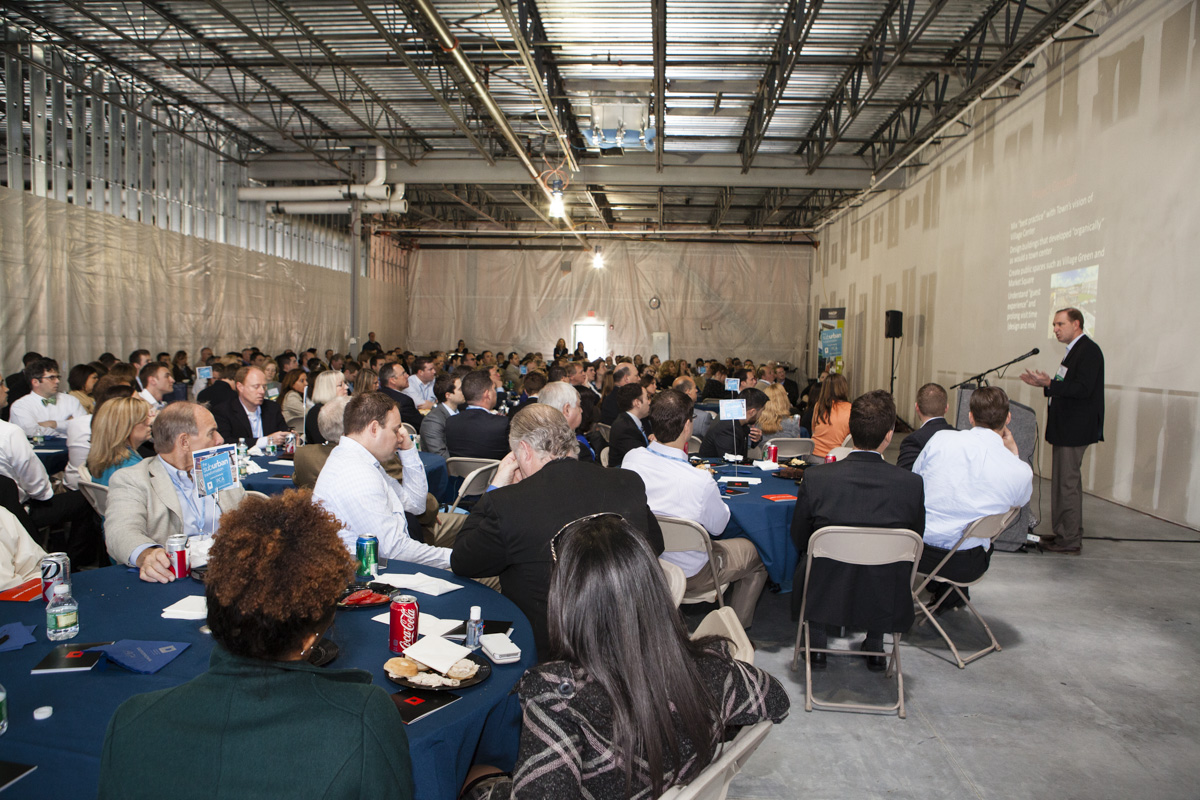
2013 Bus Tour Recap: The Suburban Transformation

The following blog post was submitted by David Fleming, Principal at PACE Communications Group, a marketing and PR firm that specializes in commercial real estate and retail.Elisif_20130501_0150

Three signs that spring has finally arrived in Boston: 1) green grass on the Esplanade, 2) the Red Sox back at Fenway Park, and 3) NAIOP MA’s Annual Bus Tour. The 11th edition of the tour took place on Wednesday as more than 250 people aboard five buses toured properties along what is suddenly one of the hottest stretches in commercial real estate in the region: the Route 128 Corridor from Needham to Lynnfield. Here’s a summary:
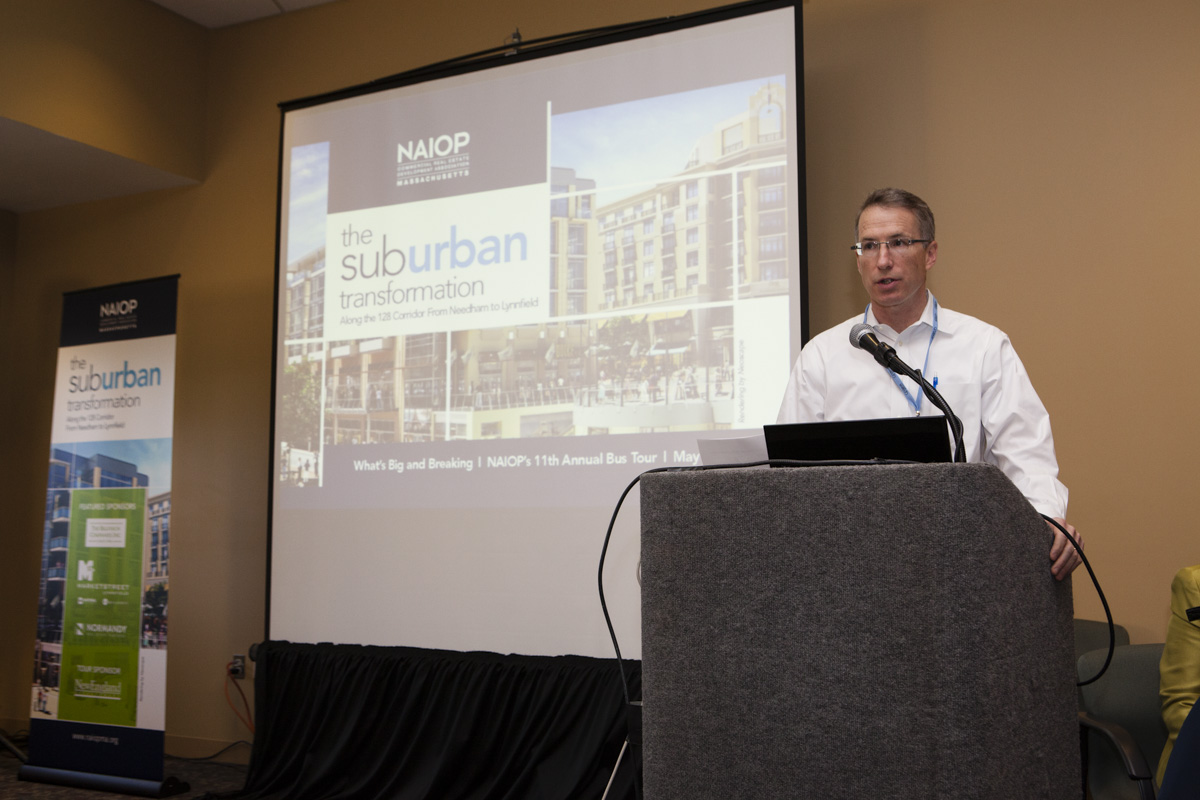
Elisif_20130501_0115Kickoff at Needham Crossing

  • Needham’s Economic Development Director Devra Bailin, discussed efforts to rebrand the former New England Business Center as Needham Crossing
  • Justin Krebs and Mark Roopenian described two of Normandy Real Estate Partners’ projects along the route:
    • Center 128, which will redevelop Needham’s former New England Business Center into an 825,000-square-foot “super-park,” including a Marriott Residence Inn Hotel
    • Station at Riverside, which will transform MBTA’s Riverside Station into a mixed-use development featuring 295 apartments, a 10-story 225,000 square foot office building, and a 20,000 square foot retail village
    • Mike Wilcox of The Bulfinch Companies discussed development at Needham Crossing and the branding and leasing efforts at Atrium Center. Wilcox concluded with an exciting Atrium Center video that you can see here.
    • In his market overview, Jeremy Grossman of CBRE/Grossman Retail Advisors noted the “flight to quality” among retailers, New Urbanism, the continued expansion of restaurants, the intensifying battle among grocers, and the strengthening of regional markets such as Chestnut Hill, Lynnfield, and Northborough as key trends
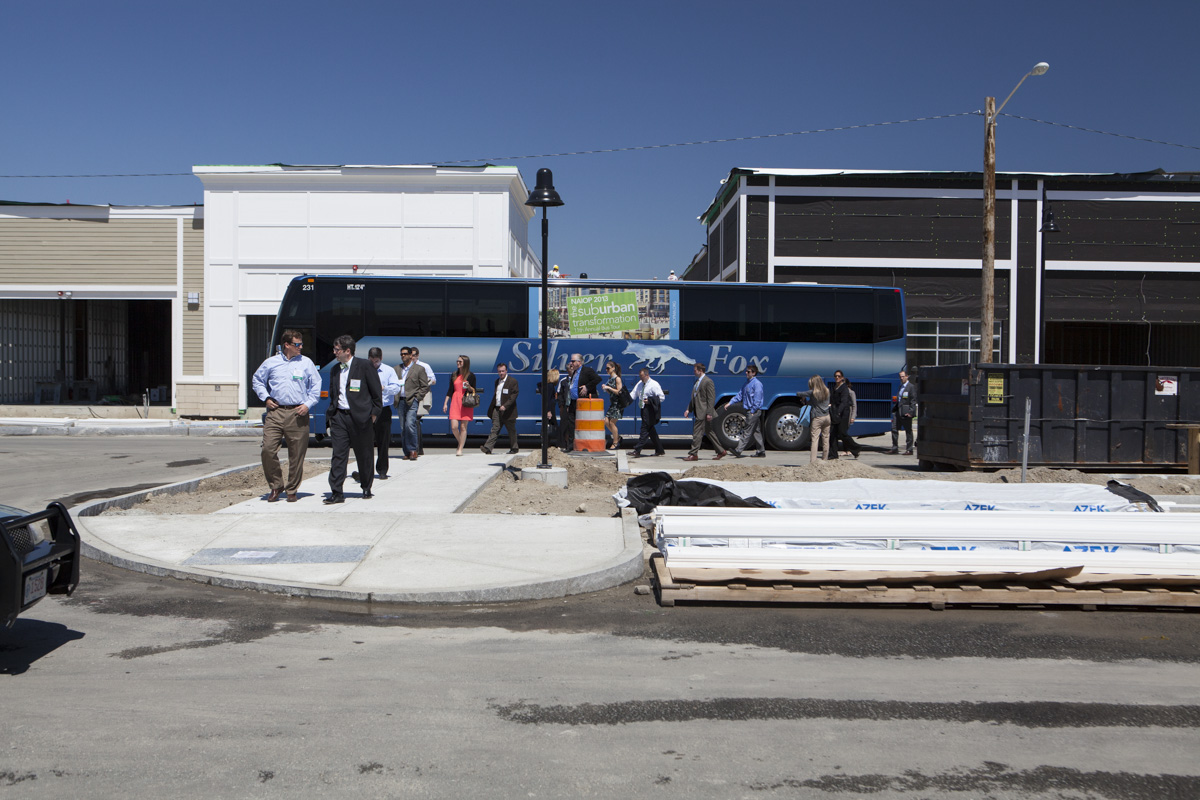
Elisif_20130501_0215Bus Tour Highlights

Six tour buses, escorted by members of the MA State Police, traveled along Route 128 beginning in the Needham/Newton area and ending in Lynnfield. Here are a few highlights:


Elisif_20130501_0268Lunch and Learn at MarketStreet Lynnfield

The tour stopped in Lynnfield for lunch at MarketStreet Lynnfield, a 680,000 square foot mixed-use development currently under construction. Inside a space that will become a Shoe Market store, WS Development’s Tom DeSimone and National Development’s Ted Tye shared details of the joint venture scheduled to open in August 2013.

When complete, MarketStreet Lynnfield will include 395,000 square feet of shops and restaurants, 80,000 square feet of office space, 180 residential apartments known as Arborpoint at MarketStreet, and the 9-hole King Rail Reserve golf course.

Elisif_20130501_0282Voices on Tour

I caught up with a few people on tour. Here’s what they had to say:

  • Tom DeSimone, partner, WS Development: “There’s no better way to understand real estate than to actually be there. The NAIOP Bus Tour gets you closer to the real estate by providing an introduction. Then you can go back and look at whatever may have peaked your interest.”
  • Ted Tye, managing partner, National Development: “It’s great to people out here having a nice day, getting out from behind their desks, and seeing some projects that are being built. And, it’s incredible that in 2013 that we actually have things being built.”
  • David Chilinski, co-founder and president, PCA: “The best part of the NAIOP Bus Tour is that you really get a sense of what’s happening and, importantly, what’s new in the marketplace.  We all know the tried and true properties, but the tour lets you see new projects as well as cases where people are reinventing or adding to projects. That’s the importance of this tour.”
  • Sarah Walker Weatherbee, managing director, Keller Augusta: “You get a sense of history as well as what the future holds for the Boston-area markets like the ones we saw today. And, the networking that the Bus Tour enables is unique to NAIOP—that really makes the day exceptional.”


While here, please read David’s important post below about National Development’s Roseann Sdoia, who was seriously injured in the Boston Marathon bombings. David includes a link to
Roseann’s Recovery Fund for those who wish to donate toward expenses for Roseann’s treatment and recovery.

Support One Fund, Support Boston

OneFund
All of us at NAIOP Massachusetts are saddened by the tragic events that occurred at the Boston Marathon on April 15. Times like these make us realize that Boston is basically a small town – it seems like we are all either connected directly, or by one degree of separation, from someone hurt in Monday’s explosions.

Governor Patrick and Mayor Menino announced the creation of One Fund Boston, which was established to provide assistance to those who were directly impacted by the tragedy. The local business community, including several NAIOP members, immediately stepped up to support the fund. We encourage the commercial real estate industry to show its support. To learn more, or to make a contribution, visit http://onefundboston.org.

In addition, we’ve learned that Roseann Sdoia of National Development, a NAIOP Gavel Firm, was severely injured in the explosions. Her friend set up Roseann’s Recovery Fund, where you can donate towards her treatment and recovery expenses. Our thoughts are with Roseann and the many other victims hurt by this tragedy.

Optimism: the way to start your day

This post was written by Kimberly Sherman, and originally appeared on the Nickerson PR blog, CheersLive!

On Thursday November 29, 2012, over 400 attendees gathered at the Seaport Hotel Boston for the NAIOP/SIOR Annual Market Forecast, one of the industry’s leading market forecasts. Nickerson PR was the sponsor of the much-anticipated event. “Being knowledgeable as a peer in the field, helps Nickerson PR to provide a better service to our clients – we want to be a knowledgeable business partner to every client – not just a vendor. It was very important to sponsor such an event,” said Lisa Nickerson, Principal of Nickerson PR and Board Member SIOR New England.

Barry Bluestone NAIOP.jpgBarry Bluestone, Dean, School of Public Policy &
Urban Affairs at Northeastern University

David Begelfer, CEO for NAIOP Massachusetts moderated the program. The Keynote speaker, Barry Bluestone, Dean, School of Public Policy & Urban Affairs at Northeastern University, offered an optimistic and timely economic snapshot of our local real estate market. Bluestone’s economic overview mostly centered on why we will return to a 0.2% growth rate. He outlined six things we haven’t paid enough attention to.

1. The demographic boon is over
2. The plateau in educational attainment
3. Increase in inequality
4. Globalization and outsourcing
5. Energy and environment
6. Twin deficits

In closing, Bluestone firmly stated that to avoid this path, we would need major innovation and investment for large-scale ideas. He reminded us that the good thing is the US has accomplished this before, so we should have the confidence that we can do it again.

NAIOP Panel.jpg

Some of Greater Boston’s most active real estate professionals presented an analysis of the Massachusetts commercial markets, with a special look at the office, industrial and capital markets. Panelists discussed the drivers and fundamentals behind 2012 statistics, including emerging trends in specific markets, new growth areas and a general outlook for the future. Among these market experts were:

The majority of attendees I spoke to were pleased to leave the event with a feeling of optimism. In the words of market expert panelist Petz, “Boston is hot, we are lucky to both live and work here.”

Some take-aways from NAIOP Forecast attendees:

“It’s always great to hear lots of optimism about the direction of the commercial real estate markets for 2013 and beyond. Absorption rates are increasing significantly throughout the region which bodes well for the CRE market for years to come.” Bud LaRosa, Chief Business Performance Officer, Tocci Building Companies

“It was refreshing to hear Barry Bluestone speak to overcoming the fiscal cliff and offer insight as to why there is plenty of good news ahead for the real estate market.” Merrill H. Diamond, Founding Partner of DIAMOND SINACORI, LLC and IGNITION Residential, LLC

“With 7,500 new multi-family units planned and Boston supporting the effort, it’s nice to be assured that Boston real estate is hot right now.” Markell Blount, Partner, Sparta Consulting Inc.

“I am happily surprised by the level of optimism expressed today. The last few events have been more doom and gloom, so I’ll take this news any day.” Mark Glasser, Principal, Packard Design

Strategies for Today and Predictions for Tomorrow

The following blog post was submitted by Ally Quinby, Account Executive at Solomon McCown.

NAIOP Massachusetts’ Smart Money in Real Estate event, on September 19, gathered together a distinguished panel of Boston’s real estate professionals to discuss the state of today’s market, as well as their predictions for the future.

To set the table for the event, NAIOP MA disseminated a poll to members regarding their current perceptions and future predictions. Doug Poutasse, Executive Vice President, Head of Strategy and Research at Bentall Kennedy, and moderator of the panel, leveraged the results from the poll during the discussion.

In regards to real estate investment, Jeff Furber, CEO of AEW Capital Management, listed the four qualities investors are seeking currently: Safety, Income, Control and Liquidity. Tier 1 core costal markets like Boston have been a major beneficiary of this fact due to the lack of risk associated with investing in stable regions.

Similarly, Jon Davis, CEO of The Davis Companies, believes there are many value-add opportunities in healthier cities, “Here in Boston, we are transforming neighborhoods. Take Kendall Square and the Fort Point Channel; there is so much vibrancy in these areas.”

According to one panelist, what the Boston area is lacking is supply of retail space. Despite the recent buzz around grocery-anchored retail centers, Tom DeSimone, Executive Vice President of WS Development, believes centers like this are “overplayed” and the increase in food sold outside grocery stores across the country, in retail shops like Wal-Mart, will be a problem in the future. In agreement, Mark Weld, Managing Director of Clarion Partners, said, “Distressed debt is aggregating in grocery-anchored retail centers across the country that people thought were on the path to growth.”

Looking forward, all the panelists agreed the looming effects of sequestration raise many questions for real estate professionals across the country. Despite the increased activity seen in markets like Boston, New York, San Francisco and Washington, D.C., uncertainty of this type has its effects. According to Jon Davis, “cleaning up from sequestration is the single biggest risk” we are facing today. There is no indication of whether or not Congress is going to be able to come together.

General sentiment among the panelists regarding the economic future was mild, noting there will not likely be significant improvement or dramatic decline in the state of the market.  Instead, all panelists agreed success today—and in the future—will rely heavily on partnering with the right people for leverage. Especially in times like these, what matters is one’s character and ability to execute.

Boston’s parking freeze needs to be thawed

This Letter to the Editor appeared in the June 14, 2012 edition of Boston Business Journal.

To the editor:
The viewpoint expressed in your recent article titled “Seaport Squeeze” piqued my interest. I find it worrisome that the Seaport area will soon transition from servicing commuter parking for downtown Boston, to an area servicing parking for its new residents and businesses.

We should all be a bit more concerned about the results of this impending transition. The parking freeze was initially proposed in the early 1970s for downtown Boston and Logan Airport. Subsequently, parking freezes were adopted in Cambridge, East Boston and other parts of Boston. With the growth of the office market over the past three decades, many workers have certainly taken advantage of Boston’s mass transit system, but those who commute by car benefit from the low-cost parking in the undeveloped Seaport area.

With a parking inventory freeze in the Seaport, long-term availability of satellite surface parking is at odds with the construction of high-rise apartments and offices. As the amount of commuter parking diminishes, the stress on businesses in the Financial District, to keep their commuting employees, increases. Mass transit cannot absorb all these commuters. At some point, companies that have relied upon employees that commute to work may be forced to look elsewhere for office space.

There are two areas that need attention. Firstly, Boston businesses are highly dependent on the MBTA and the legislature needs to act, not just with a short-term fix, but with a multiyear plan to reduce the T’s burdensome debt, and increase the long-deferred investments to enhance, expand, and improve ridership capacity and satisfaction.

Secondly, a myriad of programs have been implemented nationwide to reduce parking and transportation demand that do not depend on freezes. Even the city of Cambridge has abandoned its parking freeze approach and implemented a Vehicle Trip Reduction programs to address parking, traffic and air-quality issues.

Maybe the time has come to take reevaluate the city’s parking freeze policy, which is one of the very few left in this country.

David Begelfer
CEO of NAIOP Massachusetts

Getting Real in Affordable Housing

The following blog post was submitted by Anne Baker, Account Executive at Solomon McCown.


It’s all about perception versus reality.

That was the takeaway message from NAIOP’s Affordable Housing: Challenges and Initiatives panel on May 23.  The panel included Howard Cohen, Chief Executive Officer at Beacon Communities; Lawrence Curtis, President at WinnDevelopment; Tony Fracasso, Senior Vice President at MassDevelopment; Bart Mitchell, President & CEO at The Community Builders, Inc.; Jeanne Pinado, Chief Executive Officer at Madison Park Development Corporation; and was moderated by Solomon McCown CEO Helene Solomon.

The meeting was kicked off by Aaron Gornstein, the newly appointed undersecretary for the Department of Housing and Community Development (DHCD).   Gornstein outlined his plans for DHCD, emphasizing that the agency is planning ahead for growth in the state.  Streamlining the permitting process, giving support to promising communities, marketing the opportunities available to developers and building needed infrastructure are all essential elements of Gornstein’s affordable housing plans.

But while some may only see affordable housing as a social issue, Gornstein was clear that the high cost of living in Massachusetts has serious long-term ramifications for whether businesses decide to locate here and that the construction of affordable housing creates needed jobs.

False perceptions were also a constant theme throughout the panel discussion. The public is not aware that family homelessness is a relatively recent problem and that it’s easily solved through the construction of affordable housing, Pinado said.  Mitchell and Fracasso both emphasized the creative financing options that are available to affordable housing developers who are looking for them.

Curtis argued passionately that while the construction of affordable housing is important, it alone can solve the housing gap in Massachusetts; we must work together for the preservation of existing low-income and affordable housing.  Cohen also noted that while many upscale communities fight affordable housing developments out of a fear for negative impacts on their school systems, there is little evidence to suggest that is reality. It’s all about overcoming how local communities often approach affordable housing and making the case that inclusion will benefit us all.

View video of Affordable Housing panelists.