CMBS: Too Little, Too Late?

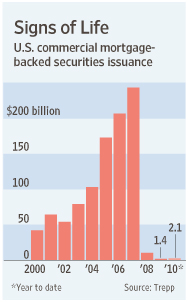
At its peak in 2007, the Commercial Mortgage-Backed Securities (CMBS) loan market funded over $230 billion in the U.S. That market virtually dried up in 2009, with a more modest $11 billion.

However, it appears that the CMBS market may be showing signs of life with an estimated $50 billion expected to be funded by the close of 2011.

At a recent NAIOP program, Banking on Real Estate: Capital Flows and the State of CRE Lending, Stephen Holmes, Executive Director at Morgan Stanley, indicated that more than $1 trillion of CMBS loans will be maturing over the next five years, with $100 million coming due this year alone. Without a serious resurgence in this market, it is hard to know where these refinancing dollars will be found, especially with many of the assets over-leveraged based on today’s market values.

Not surprisingly, there has been a rise in the delinquency rates on CMBS loans, with more than 8% of current outstanding loans at least 60 days past due. Standard & Poor’s is currently expecting that rate to reach as high as 11.5% by year’s end.

The good news is that this important source of Wall Street financing is coming back.  Unfortunately, it might be too little, too late. (Read Banker & Tradesman’s account of the event here)

Millenials and the Alternative Workplace: The Future of the Commercial Real Estate Industry

At a recent NAIOP Massachusetts program, a panel of leading professionals discussed the changing workplace that is being driven, in part, by a new demographic – the Millennials.

As Martha (Marty) O’Mara, PhD, CRE, Managing Director of Corporate Portfolio Analytics, said about this influential category, “they are no longer our kids, but our co-workers.”

This shift is bound to have an impact as they enter the workforce, and Marty’s presentation outlined some surprising facts about this group:

  • Only 15% of Millennials (age 19-29) say having a high-paying career is their top priority.  They place parenthood (52%) and a successful marriage (32%) much higher.
  • 63% have graduated from college, or plan to graduate.
  • Most in the workforce have already experienced bouts of unemployment.
  • Only 61% grew up in a household with both parents.
  • 38% have a tattoo.
  • 8/10 sleep with their cellphone.

They are a powerful market driver and their communication and work style preferences (consuming “experiences” rather than “things”, for example) are already shaping the commercial real estate industry.   

Marty’s bottom line:  “Don’t let a Boomer make a real estate decision.”  More and more companies are recognizing this and designing an “Alternative Workplace” as they plan for the future.

In a short slideshow, Marc Margulies, Margulies Perruzzi Architects shared the key elements of the new Alternative Workplace:

  • Few/no high wall cubicles
  • Multiple workplace environments
  • Density at 165 RSF/person
  • Amenity-rich
  • Dynamic

A panel of experts including Marty and Marc, as well as Bob Richards of Richards Barry Joyce & Partners; Janet Nicholas of Dassault Systèmes; and Greg Lewis of Shire Human Genetic Therapies, then discussed what all of this really means.  

Highlights and things to think about:

  • The Alternative Workplace is designed to support diverse demographics and to be conducive to multiple work styles (mobility being an important element.) 
  • Producing a corporate community that increases productivity through collaboration and interactivity is accomplished through a dramatic change from the historically private spaces (individual worksettings ) to ”neighborhoods” (more collaborative community spaces).
  • The new term is “benching,” providing bench space that can be shared, moved, configured.  The amount of space per employee can change based on the users from a 1.3:1 ratio that efficiently utilizes vacant space due to normal absenteeism, to up to 3:1 for a group that has higher sales and/or consulting staff that travels.
  • Lastly the “town common” area has plenty of amenities.  Picture this as the Kendall Square within the company where different specialties come together as a community in a social, casual area.  These tend to be food oriented, nature focused, bright, and inspirational.

Many of these changes are already being seen in the new designs and renovations of firms throughout the region, but this is just the tip of the iceberg, according to O’Mara and the other speakers.  Big changes are on the horizon for anyone involved in corporate real estate, and those changes will create countless opportunities for the firms who are ready.

Did you attend Wednesday’s program? Share your key takeaways and questions in the comments below!

Massachusetts Needs Regulatory Reform to be Competitive

A MassBenchmarks report from the University of Massachusetts shows the national economy grew by 3.2 percent in the 4th Quarter of last year, while the state’s grew by only 1.8 percent.  This comes after a stellar performance in Massachusetts with the local economy and job growth outpacing the nation since the 4th Quarter of 2009.

The take-away from this is something we already knew: Massachusetts is a unique place, but we are not so special that we can coast our way to recovery ahead of the nation.  Although this may be an economy “pausing to catch its breath,” as the report suggests, the real risk is that just like the recession of 2000, we end up falling short. 

Consider this a wake-up call.  We cannot afford to be complacent; we must go on the attack, doing everything in our power to make this region more competitive, more business friendly, and more efficient. 

If we are to be truly competitive, we must confront the cost of doing business in Massachusetts.  This includes the direct costs of operations (taxes, fees, insurance, utility costs), but also includes indirect costs of time and resources necessary to comply with the complex, multiple layers of regulations, policies, rules and guidance affecting all employers throughout the state.       

With fewer resources available, now is the time for government to do more with less.  We must be more efficient with resources within our regulatory agencies, and we must allow businesses to focus on job growth rather than wasting time managing redundant and often-outdated or ineffective regulations and rules.  For many years, cost-benefit analyses have been required of all agencies for new regulations, but this has never been taken seriously. The attitude seems to be that businesses are “lucky to be here” and can easily afford any regulatory imposition placed on them.  Government has the responsibility to protect the public, but to ignore the costs and the impacts they have on the economy is not protective of a public that is dependent on job revenue to fund its operations.

Things are improving, however.  In Governor Patrick’s second inaugural speech, he specifically mentioned this issue and the importance of job growth.  During the past 18 months, the Governor and his agency heads took a top-down review of new regulations, and we applaud them for that effort.  Now we call upon them to go further by reviewing our existing regulations to ensure that they are doing the job that they were intended to do; that they are consistent with the statutes authorizing them; that they are the most cost effective and efficient means to their goals; and that there are not better ways to accomplish what they do (e.g. privatization or self-certification).

We may never be the lowest-cost state, but let’s develop the reputation of being a state that understands the needs of business and works actively to make interactions with government as smooth and cost effective as anywhere else.

Workforce Housing, Not Zoning Bills, Key to Economic Growth

Earlier this week I testified before the Legislature’s Joint Committee on Municipalities & Regional Government on two “zoning reform” bills, the Land Use Partnership Act (LUPA) and the Comprehensive Land Use Reform Partnership Act (CLURPA).  Supporters of both bills claim that the legislation would encourage real estate development in Massachusetts.  Representatives from the real estate industry, however, disagree.  NAIOP believes that these bills contain many problematic elements which could hinder economic development at a time when it is needed most.

The bills make a number of changes to Chapter 40A; some would apply statewide and other changes would apply only in “opt-in” communities.  The legislation does have some positive aspects: zoning protections to special permits and site plan approvals, and limiting subdivision rules and regulations to subjects not already covered elsewhere by local ordinance or bylaw (e.g., stormwater management, off-site traffic impacts.)  However, other parts of the bill would reduce existing predictability and add financial risks for new business growth.

The most concerning aspect of the legislation would significantly alter the zoning freeze that exists under current subdivision law.  It would limit the zoning freeze to a specific proposed development plan, rather than just the land shown on a plan.  As a result, the freeze would be lost with any change in project use and/or density.  This would be a serious problem for commercial real estate developers who would be unable to respond to a changing market. 

Commercial projects require large initial investments in land, site work, and infrastructure for developments that are generally phased and take many years to complete. Without the protections of a subdivision zoning freeze that allows for flexibility in project uses as the markets change, financing would be very difficult to achieve and fewer projects would move forward. 

To truly encourage economic growth, the focus should instead be on creating workforce housing.  While housing costs have dropped recently, a lack of single family, smaller scale, higher density homes fuels the exodus of 23-40 year olds – a key population demographic for economic growth.  This is an issue of great concern to business leaders who struggle to attract the best talent when competing with other states that provide such housing opportunities.

If the Legislature is intent on addressing the Commonwealth’s competitiveness and its housing, it needs to take a different approach.  We urge the Legislature to work with the Patrick Administration, municipalities, and the business community to create a new program establishing zoning districts that permit the construction of a modest number of affordable, small, single-family homes.  The future of our workforce depends on it.

Commercial Real Estate Icons on the Leading Edge of Philanthropy

Bill and Joyce Cummings

In an age when many Wall Street and other corporate leaders take such pride in reaching even greater heights of personal wealth, it is refreshing to hear about a different type of competition. There is a growing group of the wealthiest individuals in this country who are now competing to see who will become members in a new club of billionaires – those promising to give away half or more of their wealth before they die.

The “Gates/Buffet Giving Pledge” already has nearly 70 members in this prestigious, exclusive club. And now they have two new members – Bill and Joyce Cummings, the founders of Cummings Properties, headquartered in Woburn, Massachusetts.

Not that this should come as a surprise to anyone that knows this couple and their history of giving. Over the past 25 years, the Cummings Foundation has grown to be one of the largest philanthropic foundations in the state.

Bill and Joyce are shining examples of local entrepreneurs who believe in a strong economy that does not forget about those amongst us who are less well off. They have long been leaders, even in an industry that prides itself on its charitable giving and community service, and they certainly have raised the bar with this pledge. (Globe article here)

NAIOP Massachusetts is proud to have Cummings Properties on our Board of Directors, and we offer our heart-felt congratulations to Bill and Joyce for the well-deserved recognition they are receiving.

DEP Funding Essential for Economic Development

Though the real estate development industry may not always be an outspoken advocate for environmental regulation, there is no question every developer agrees that timely and predictable permitting is critical to the success of any project. 

Unfortunately, if the cuts to MassDEP proposed in the House budget are approved, permitting and economic development in Massachusetts could be the unintended victims. DEP’s budget has already been disproportionately reduced by 40% in less than a decade, devastating a staff that has dropped from 1,200 employees in 2002 to about 745 under the proposed FY ’12 House budget recently passed.  Although all of the other agencies under the Energy & Environmental Affairs Secretariat received an average 1% cut from the last fiscal budget, DEP was cut by 10%.  

In development, time is money.  If developers are unable to get environmental permits within a reasonable timeframe, the resulting delays could  kill a project – especially during this fragile economic recovery.

As the Senate develops its budget (expected to be released next week), it must consider the importance of adequately funding DEP.  Under the House budget, DEP may be forced to close one or more regional offices and eliminate another 20% of its permitting staff.  NAIOP strongly suggests that, at the very least, the Senate apply the same percentage cut to DEP used for sister agencies.

Given the current fiscal crisis, budget cuts are an unfortunate reality.  But we must avoid cuts that are so deep they undermine the very economic growth and job creation essential to our recovery.

Demography is Destiny for Multifamily Housing

This was the mantra shared by Dr. Barry Bluestone, founding Dean of Northeastern University’s School of Public Policy & Urban Affairs, at today’s NAIOP program, The Future of MultifamilyHow Demographics Are Driving Development. Barry started off the program with a great presentation on the impact changing demographics are expected to have on Greater Boston’s housing market.  Given the national depression in home prices, it was surprising to see that our local apartment rents continued to rise after 2005 and, even with some adjustment due to the recession, today they are only 2% lower than their 2008 peak.  This is due in large part to vacancy rates that have remained stable at 6%.

Our rental housing market has remained strong for a number of reasons including: foreclosed homeowners reverting to rental housing; young families holding out for further drops in housing prices or being unable to make the necessary down payment due to new lending criteria; and increased student demand.

On the last point, due to the Boston area’s abundance of colleges & universities, the student population has increased by nearly 24,000 undergraduates and 22,000 graduate students since 2000.  And although the schools house over 100,000 undergraduates, nearly 180,000 live off campus. With graduate students, only 8% of them live on campus.

Bluestone was convinced that there are real opportunities for the private sector to provide the needed housing for both undergraduates and graduate students.  New housing alternatives for graduate students could include the creation of Multi-University Graduate Student Villages to help take pressure off the urban rental market and help retain young professionals in the city.

At the opposite end of the spectrum, Massachusetts is aging rapidly, with the Baby Boomers projected to represent higher percentages of the population over the next decade. There will be some great opportunities for multi-family housing during the next decades, with some empty nesters looking for smaller, easier to maintain housing, and others choosing to “age in place” in suburban, smaller units, while still others may look to more urban environments with more amenities provided by city life.

The panel that followed Dr. Bluestone included Larry Curtis, President, WinnDevelopment; Wendy Nowokunski, President, The Northbridge Companies; and Doug Straus, SVP, Director Residential Development, National Development.

Some key take-aways included:

  • For market rate housing, transit-oriented multi-family is highly marketable.
  • Be it subsidized, market, or senior housing, higher quality finishes are now expected as the norm.
  • Senior housing is not your “grandfather’s” housing – it is now varied in service delivery, including independent, assisted living, and memory care residences (diminished cognitive capabilities affects more that 40% of those over 85 living in senior housing.)
  • Even with state and federal subsidies, new construction is very difficult, leading to more interest from investors in repositioning older properties.
  • Green is becoming an expectation, but there is no clear standard as owners market their properties as green.  Some owners are focusing on very visible improvements (solar), while not pursuing the more energy saving upgrades.

It appears that the current strong attraction for rental housing in the investment markets is well founded and the prognosis for the future of this product type is a clearly bullish one.

Boston Federal Reserve President Eric Rosengren Speaks at NAIOP Event

This morning, Dr. Eric Rosengren, President and Chief Executive Officer of the Federal Reserve Bank of Boston, provided the keynote address at NAIOP’s well attended and informative program, “Banking on Real Estate: Capital Flows and the State of CRE Lending.”

David Begelfer & Dr. Eric Rosengren

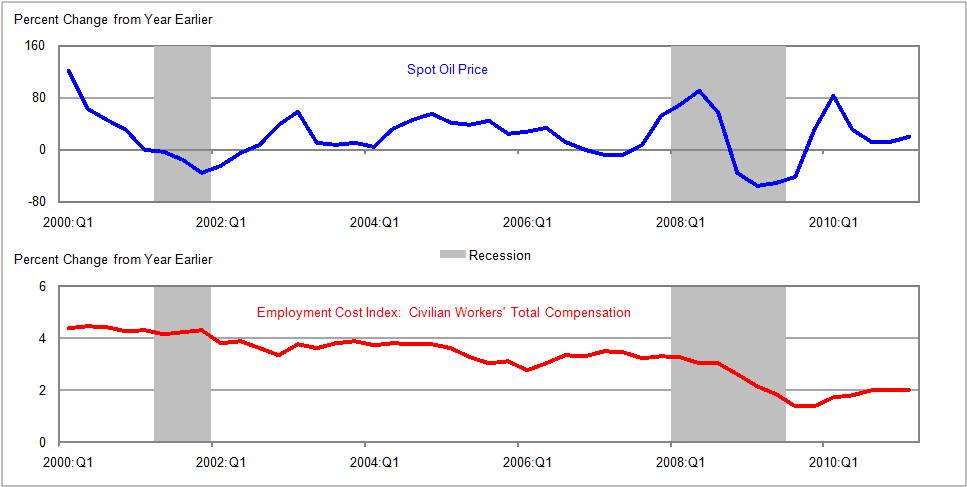
His comments provided insight into how the Fed views world events like Japan’s recent earthquake and political unrest in the Middle East and their potential impact on the United States economy.  He indicated that the fear of inflation resulting from energy and food “supply shocks” seems to be unfounded.  Over the past 25 years, there does not appear to be much evidence of commodity price spikes dramatically affecting the core inflation rate or wages and salaries. These shocks have been transitory, with limited long-term effects on inflation and business/consumer expectations.

As a result, until there is progress on the Fed’s mandates of stable prices and employment, he believes that the current Fed accommodative monetary policy is appropriate. For now, there is no reason to slow the economy down with a tighter monetary policy.

That said, he indicated that the Fed would, most likely, take decisive and forceful action if inflation expectations start to rise.

Based on Dr. Rosengren’s comments, I would say that all indications are that this period of historically low interest rates will continue for the foreseeable future.  This is probably good news for current commercial real estate owners that are worried about the FDIC’s eventual implementation of a “mark to market” policy.  Having to refinance property, with falling rental revenue, would be all the more difficult with rising interest rates.  On the other hand, investors sitting on a lot of cash on the sidelines may still be sitting for a while longer.

OIL PRICES AND WAGES 

                      Source:  WSJ, BLS, NBER / Haver Analytics

It’s a bright time for solar

If there ever was a time to consider investing in solar photovoltaic (PV) projects in Massachusetts, it is now. There are a number of federal and state financial incentives that may not be around for long. 

  1. First, the developer can take advantage of a Federal U.S. Treasury “Cash Grant” based on 30% of the total value within 60 days of the project becoming operational.  This benefit expires on the end of this year. Or, as an alternative, the owner can take a Federal Investment Tax Credit of 30% of the project value. Tax credit can be carried back 1 year and carried forward 20 years.  This incentive expires December 31, 2016.
  2.  Second, the owner can benefit from a 100% bonus depreciation. This is based on the total value in the year that the project is placed into service. This will also expire the end of this year, but will continue for another year with a 50% bonus depreciation.
  3.  Lastly, project developers can benefit from the Massachusetts solar renewable energy certificates (SRECs.)  The market for SRECs is currently trading at more than $500/MWH (there is a $300 floor.) This is value priced annually.

Maybe this is the right thing to do for the environment; but it looks like, for now, it is the smart thing to do for your bottom line.

If You Zone It, They Could Come

In order to spur new development in a place not widely known for its commercial activity, the City Council of Leominster is considering rezoning sections of the city.  The goal is to add flexibility to its land use controls in order to attract new businesses into Leominster while encouraging existing companies to expand.

This is not the first local government to realize that growing its tax base starts with rethinking how it zones and permits development.  Two other recent examples illustrate the importance of this self-appraisal process.

For many years, the town of Westwood had an anti-development reputation.  While virtually all of the land along the 128 Technology Highway bustled with new development activity, countless properties along University Ave in Westwood sat vacant or underutilized. This area, starting at the commuter rail station and continuing throughout a large industrial park – with direct access to the highway, was frozen in the 1960’s.

Recognizing that the town had to make significant changes to attract economic development, Westwood officials invited businesses, developers, consultants, and site selectors to tell them what changes were needed.  As a result of this process, the town’s economic development committee went to Town Meeting and changed Westwood’s zoning by-laws.  Soon after, a massive area of the park was purchased and one of the region’s largest mixed use developments was approved.  Unfortunately, the Grand Recession put the project on hold for the time being.  However, there is no doubt this will be one of the first projects to move forward once the recovery is in full swing.

The other municipality to undertake this self-critique was Lexington.  Its Board of Selectmen started a visioning process that brought in a wide range of experts to see what it would take to encourage further economic development in a town with limited growth areas.  As a result of the town’s new commitment to attracting businesses, Lexington passed a remarkable “up-zoning” at Town Meeting, which more than doubled the commercial density in the Hartwell Avenue area, allowing for a potential 2.9 million square feet of development.

With municipal budgets being slashed, more communities are realizing that they need to compete for new business growth, but they are ill prepared to attract development due to archaic zoning and permitting regulations.  While towns may not be able to guarantee new growth if they follow Lexington and Westwood, if they do not bring predictability, timeliness, and clarity to their permitting, most businesses will be looking elsewhere.