NAIOP Policy and Trends Watch

The Commercial Real Estate Development Association

NAIOP Policy and Trends Watch

Massachusetts Adopts New Energy Code & Stretch Energy Code

The Board of Building Regulations and Standards (BBRS) voted in July to adopt several changes to the energy provisions of the existing building code (8th edition). The BBRS adopted the next edition of the International Energy Conservation Code (IECC 2015) as the base energy code in non-stretch code communities and adopted a new stretch energy code (approximately 15% more energy efficient than the current base energy code), which will automatically take effect in existing stretch code communities without a vote by the city or town.

NAIOP was pleased that the BBRS did not advance the solar rooftop readiness or electric vehicle readiness requirements that had been proposed (and opposed by NAIOP), but disappointed that a new stretch energy code was adopted.

A concurrency period will run from August 12, 2016 – January 1, 2017 which allows persons seeking building permits to submit plans and other required documents that conform to either the energy provisions in effect prior to August 12, 2016, or the amended energy provisions effective August 12, 2016, but not a combination of the two. Beginning January 2, 2017, all building permits and submitted documents must conform to the amended energy provisions only.

Public hearings on the next (9th) edition of the building and energy codes are expected this fall. NAIOP will continue to advocate on behalf of the industry on these important issues.

Federal “Tenant Star” Report Promotes Energy Efficiency in “Next Gen” Commercial Leased Spaces

The U.S. Department of Energy (DOE) just published its Energy Efficiency in Tenant Leased Spaces feasibility study that highlights both opportunities and barriers to implementing energy efficient technologies in multi-tenant commercial spaces.

The study was required by Congress as a part of the Energy Efficiency “Tenant Star” legislation that was passed into law last April. The hope is that this voluntary program will encourage higher energy performance in leased spaces in commercial buildings. Market driven branding incentives have worked well with building owners through the voluntary Energy Star program. Now, this program will attempt to motivate building tenants to increase their energy efficiencies and reduce their energy consumption.

The DOE study finds that “American businesses can occupy more energy-efficient spaces that help improve their bottom line, attract and retain the best workers, and increase their competitiveness.” About half of commercial real estate is occupied by tenants, who could directly benefit from greater energy efficiency. The study further finds that tenant space can be built to save 10-40% energy compared to a typical space.

The study also examined the persistent problem of a lack of energy data. It was determined that a significant increase in sub-metering of tenant spaces would help overcome this barrier. Another persistent problem is the “split-incentive” issue between owners and tenants, with owners paying for the improvements and the tenants benefitting. Accelerated 15-year depreciation of leasehold improvements, can potentially provide real estate owners with greater certainty to undertake property improvements over the typical lease term and economic life of those assets (7-10 years).

Furthermore, the DOE report also encouraged the creation of a federal tenant space recognition system, similar to Energy Star.

The real estate community is supportive of these voluntary, market driven programs that have already shown tremendous results across the country.

My Top Ten Predictions for 2016

2015-6

With one of the best years for the commercial real estate industry almost behind us, what does 2016 look like?  Here are my predictions for the coming year:

1.    Neither casino (Springfield and Everett) will get their final clearances and will certainly not start construction.

2.    The Fed will make another move up in the interest rates.

3.    Foreign investment will dominate investments in commercial properties in the Greater Boston area, but local buyers will still be the major high-end condo buyer.

4.    The Green Line extension will be redesigned at a lower projected cost and will move forward.

5.    Some Boston or Cambridge office leases will hit $90 PSF gross.

6.    The Northern Avenue Bridge will be approved to accommodate vehicular access.

7.    A major office lease will be penned for either of the spec Seaport buildings (Pier 4 or 121 Seaport Boulevard).

8.    A developer will be selected for the Winthrop Square garage site.

9.    Patriots win the Super Bowl!

10.    The Republican presidential convention will not reach consensus on the first 5 ballots.

By the way, here were my predictions for 2015. I think I did pretty well, don’t you (well, other than the hurricane!)?

1.    Foreign buyers will outspend domestic investors for Boston and Cambridge properties and will make a dent in some communities along 128 (e.g. Burlington and Waltham). They will also be a major buyer of Boston condos.

2.    Boston properties will be seeing a record number of office properties changing hands with some of those properties having already transferred ownership within the last 3 years.

3.    No surprise that office rental rates in Boston and the surrounding areas will be increasing. I predict a minimum of 10% over this year. Apartment rents will continue to rise with some resistance in the newest buildings.

4.    The Wynn Casino construction project will not be starting in 2015.

5.    There will be one speculative office building announced in Cambridge, that’s it.

6.    Design firms will have their busiest year renovating spaces and providing greater efficiency for existing tenants.

7.    Construction costs are going to be up substantially, especially in downtown Boston, with greater difficulties getting multiple competitive subcontractor bids.

8.    Boston will experience a major hurricane this coming Fall with substantial flooding due to storm surge.

9.    The Federal Reserve will finally raise rates.

10.    Boston will be selected by the US Olympic Committee to represent the US bid for the Summer Olympics.


NAIOP Files to Intervene in Costly Charles River Watershed Stormwater Court Case

NAIOP Massachusetts recently filed a Motion to Intervene in Conservation Law Foundation, Inc., et al v. United State Environmental Protection Agency, et al. The plaintiffs in that case seek to compel USEPA to impose a new regulatory program that would require owners of commercial, institutional, industrial and high density residential properties in the Charles River watershed with one acre or more of impervious area (parking lots, roofs, sidewalks) to apply for a stormwater discharge permit. NAIOP decided to intervene in the case given the significant impact this duplicative and burdensome regulatory program would have on property owners in a watershed that includes 35 communities and covers 310 square miles.

On April 28, the Conservation Law Foundation and the Charles River Watershed Association filed a complaint in federal court alleging that nutrients, including phosphorus, in runoff from a number of “commercial, industrial, institutional, and high density residential” properties are polluting the Charles River. The goal of the lawsuit is to force EPA into using its rarely used “Residual Designation Authority” (RDA) in the 35 communities that make up the Charles River Watershed to create a new stormwater permitting program. This proposed program would be in addition to the recently issued stormwater permitting program for municipal separate storm sewer systems (MS4s), which collect and manage a substantial portion of the stormwater discharged into the Charles River from developed properties. In this case, CLF is incorrect; EPA does not have a requirement to use the RDA.

This will affect all privately owned commercial and multifamily properties in the Charles River Watershed (communities including Boston, Cambridge, Needham, Newton, Natick, etc.) with more than one acre of impervious area.

In 2010, EPA proposed an RDA pilot stormwater permitting program in the towns of Milford, Franklin and Bellingham. As proposed, this program would require property owners to construct costly, retrofitted stormwater treatment systems. EPA funded a study to determine the potential costs to comply with its proposed permitting program. Though the pilot program targeted sites with two acres or more of impervious area, compared to the one acre threshold now being considered, the total cost in the three communities to comply with the draft permit was astronomical. EPA’s own consultants estimated that the costs would be at least $180 million for the three communities. Expanding such a program to all 35 communities in the Charles River Watershed would easily move that number into the billions. Costly and substantial retrofits of privately owned property would be immediately required if this is implemented. We estimate the costs to be at least $150,000 per acre for compliance. This would apply to existing owners, even if they are not redeveloping or renovating their property.

NAIOP supports the overall objective of improving water quality throughout the Charles River Watershed. However, any regulatory program developed to achieve that objective must be cost-effective, feasible and fairly allocate the regulatory burdens and costs. As we learned through the pilot program, the RDA approach is not the right tool. NAIOP has long championed alternative approaches that focus on public education, source control, and Best Management Practices. We actively supported the recent legislation restricting the use of phosphorous-containing fertilizers. Our intervention in the lawsuit will provide an important stakeholder group with an opportunity to have a seat at the table as these important policy and economic issues are being discussed.

Climate change legislation will cause a flood of regulations

The following Op Ed appeared in the Boston Business Journal on July 31, 2015.

As we saw in New York City with Hurricane Sandy, climate change can have significant impacts affecting the overall economy; directly, by damaging structures, and indirectly, by compromising transportation systems, communications, and utilities. An increasing number of extreme weather events and future sea level rise may lead to more frequent and extensive flooding along the East Coast.

A primary role for city and state governments should be to ensure the continuity and protection of public infrastructure and public safety. The business community, and the community at large, need to have a clear understanding of the government’s responsibilities and its plans for preparing infrastructure and critical services for these potentially cataclysmic events.

NAIOP Massachusetts, The Commercial Real Estate Development Association, has long been one of the leading business groups advocating for a coordinated approach between the public and private sectors with respect to climate change planning.

However, we are very concerned about a bill that was recently passed by the Senate to establish a far reaching planning and regulatory process for addressing climate change. Senate Bill 1979 contains very subjective, vague, and expansive language that could have extremely negative consequences for the Massachusetts economy today and into the future.

We believe the open-ended language the bill contains could lead to widely varying interpretations of how the legislation should be implemented, creating uncertainty and potentially stalling projects for years to come. While we believe that climate change planning is an important issue, this bill is not the solution. Under the legislation, all grants, permits, licenses, approvals, or actions of any kind for any proposed projects, uses or activities issued by any state agency or state authority could be challenged and held hostage to these ambiguous goals. This would open the “regulatory door” to a wide range of proposals, substantially changing and exceeding well established standards and procedures – with few having any direct connection to climate change.

Given how this vague and confusing language could be interpreted, the potential for lengthy and costly legal challenges is quite high.

For these and many other reasons, the bill, as written, cannot and should not be passed into law.

Addressing climate change and sea level rise requires coordination at the highest level of state government and the participation of many state agencies. There needs to be a balance of adequate planning and a risk-based, cost-benefit analysis to ensure that funds are prudently expended by the public and private sectors when considering climate change-related investments. Through such an effort, climate change resiliency will become a more attainable goal.

Thank You Governor Patrick

Deval_PatrickAfter eight years of leadership, later today Governor Patrick will take the Lone Walk and return to the private sector. In addition to the fact that during the past 100 years only one other governor of Massachusetts (Dukakis) has served the Commonwealth for eight uninterrupted years, Governor Patrick leaves behind a long list of accomplishments that have made Massachusetts a better place to live and work.

The Governor was one of the best salesmen/spokesmen for the Commonwealth that we have had in recent history. He traveled across the state and to numerous countries on trade missions. Having joined him on the mission to Israel, I can personally attest to the positive reactions he received from countless encounters with political leaders and business representatives. Many business partnerships have resulted from these missions and we have never seen such a spike in direct flights to and from Boston and many global markets.

The Patrick Administration supported business growth, with a particular focus on the life sciences and renewable energy sectors. This resulted in a substantial surge in employment growth, making Massachusetts a national leader in these emerging fields.

Governor Patrick also oversaw one of the first top-to-bottom regulatory reevaluations for all state agencies. Nearly 2,000 regulations were reviewed to determine which regulations should be rescinded or modified. In addition to this review, a system was put into place requiring that draft regulations go through an extensive vetting process and review by A&F, the Regulatory Ombudsman, and lastly, the Governor. As a result, MassDEP led the way on regulatory reform by establishing a target list of 21 different reforms within the Department. Most of these resulted in regulatory changes that will make a substantial improvement on the cost and time for the regulated community, without diminishing environmental protection.

While Governor Patrick worked to ensure government operated at “the speed of business,” he also never lost sight of the fact that he represented all of the citizens of the Commonwealth. People mattered to him and he learned from their stories. Their experiences shaped his leadership and policy priorities. Today’s column in The Boston Globe by Shirley Leung is a perfect example of this.

So, after eight years, we thank you Governor Patrick for your unwavering commitment to the people of Massachusetts and we wish you all the best in whatever the future may hold.

Next governor needs transportation vision

This article originally appeared in the online CommonWealth Magazine.
The below version includes post-election updated information.

By most accounts, the Patrick transportationadministration and the Legislature have moved the needle forward on the issue of transportation. They know that investing in transportation infrastructure is critical to our state’s economy, quality of life and industrial competitiveness.

However, many aspects of the Commonwealth’s transportation system have already approached capacity constraints with increasing delays on congested highways and transit systems. At the same time, demand has increased and is predicted to continue over the coming years with no major increases in capacity coming soon. Without additional investments in our infrastructure, further declining services, increased travel times, and a degraded environment will be the future of the Massachusetts transportation system.

In 1970, Governor Frank Sargent created the Boston Transportation Planning Review that analyzed and redesigned the entire area-wide transit and highway system. It provided a blueprint for transportation policy and investment that we have been effectively following for the last 40 years.

In 2013, the Massachusetts Department of Transportation outlined the investments needed to stabilize today’s transportation system and proposed designing a system for the 21st century. Working together, the Massachusetts Legislature and the Patrick administration created and provided funding for a transportation plan that responded to years of deferred maintenance, underfunded transit operating costs, and delayed mass transit and regional transportation improvements. The funding focused primarily on bringing the Commonwealth’s existing transportation infrastructure into a state of good repair.

Unfortunately, the funding that was put in place fell short of what is needed to truly meet the existing and future transportation needs of the Commonwealth’s residents and businesses. What has been missing from the conversation of late is visionary thinking and a more expansive understanding of why investments in transportation are so important to the future of our state. With one of the highest housing costs in the nation, a solid transportation network that can expand access to a larger and more affordable housing market is critical to the success of our economic development centers.

Across the country – from the Research Triangle in North Carolina to the Texas Medical Center in Houston – state governments and private industry are investing in systems and incentives designed to replicate the Commonwealth’s innovation economy. Though Massachusetts has strengths in higher education, strong academic medical centers, and a historic commitment to innovative technologies, transit and access are weak links and a potential liability for recruiting and retaining a qualified workforce – and the companies that create those jobs.

As Governor-elect Baker begins to outline the issues that will be critical for the next four years, we assert that a top priority should be the establishment of a new long-range statewide visioning and planning effort for transportation. This will require strong leadership to take the bold steps necessary to establish a vision and make it a reality. To successfully implement such an initiative, we’d propose a few guidelines:

• Connectivity is key: With several strong innovation, life science, and health care clusters that are major economic engines for Massachusetts, creating a reliable network of roads and transit is necessary for improving the flow of ideas and people.

• Out-of-the-box thinking is vital: Aligning transportation programs with energy and environmental goals, focusing on seamless connections between air and rail, bus and subway, and making transportation information an integral part of our hand-held knowledge system are all planning efforts that can begin early in a governor’s term and be implemented over the next decades.

• Embracing multiple modes of transportation and access is essential: A 21st century statewide plan must include not only roads, bridges, and public transit, but also bicycle and pedestrian needs, as well as enhanced information sharing through technology.

• Public private partnerships can extend the reach: Innovative partnerships between the public and private sectors must be part of a long-term plan that addresses the needs of businesses and residents alike.

Long-term planning and continued investments in a modern, integrated, multi-modal network are critical to our global competitiveness. Massachusetts cannot lose out to those states that know that transportation investment equals economic growth.

David Begelfer is CEO of NAIOP, the commercial real estate development association, and Marilyn Swartz-Lloyd is CEO of MASCO.

A Mayor for All

menino_409Today is a sad day for the City of Boston. Mayor Menino cared passionately about his city and his 20 years as Mayor were proof of his determination to make Boston and its residents better. He was known for his involvement in the numerous large developments constructed during his tenure in the Back Bay, Financial District, and, more recently, the Seaport.  He took a “hands-on” approach to the permitting and, many times, the actual design of the high-rises (remember 101 Huntington?). But, he was also knowledgeable about the smallest projects that were proposed in the neighborhoods, from Brighton to Dudley Square. It seemed that no project was too small for him because he viewed development as an integral part of the local economy and community.

However, it was not only the built environment that caught the Mayor’s sharp focus.  He was, after all, the Urban Mechanic. There wasn’t a major business that did not know of his commitment to finding summer jobs for the kids of Boston. Reducing crime, improving education and, above all, making personal connections with so many of the City’s residents are what made him a Mayor we will never forget. We are so lucky to have benefited from his leadership, dedication and love for the City of Boston.

Trends + Technology Marketing Conference: “It’s not the what, it’s the why”

The following blog post was written by Danielle Simbliaris, Marketing Manager at Campanelli.

Elisif_20141022_5979Strap a GoPro to your dog to show perspective apartment tenants what a “day-in-the-life” of your pet is like, test out a virtual space via Oculus Rift, turn flat floor plans into a 3D interactive experience, drive tech-tenants to Fenway by bringing the sausage man to Kendall Square. These ideas and more were discussed during Wednesday’s Trends & Technology Marketing Conference as we dove below the surface level to discuss how marketing is driving transactions nationally and in the Boston market.

Andi Simpson, Director of Marketing & Corporate Communications for Federal Realty Investment Trust as well as Stephanie Williams, Senior Vice President of Planning & Advisory Services of Bozzuto Management Company presented a resonating quote, “It’s not the what, it’s the why”. Whether you are talking about retail, multi-family or office space, tenants are driven to make decisions based on why it will benefit them, not by what is being sold. As commercial real estate sales people, marketing professionals and owners, we are not selling a building of concrete and glass – we are selling a way it makes a tenant feel when they are there, a commute that may be convenient or not, an amenity package that can retain employees and keep apartment renters happy, a dog park that will make pet owners content. Michelle Mastrobattista, Director of Digital Communications at Solomon McCown demonstrated a recent social media campaign launched by her team for 101 Tremont (Paradigm Properties) where the account is written from the perspective of “Boston’s smartest entrepreneur”. She explained, “People use social media to communicate with other people, not buildings.”

So then the question becomes: what new, great, amazing tools do we have to sell that “why” to tenants? Rob MacLeod, Founder & President of Neoscape showed us ways we can bring a building to life via video using a combination of photography, 3D visualization, music and incredible editing that creates a visceral reaction from viewers. Moderator, Krista Bourque, Senior Associate for ADD Inc Branding Iron as well as Deniz Ferendeci, Senior Manager of Building Services at Dyer Brown Architects showed us many ways we can bring our buildings, fit plans, stacking plans and neighborhood to life with 3D, interactive imagery. Barbara Hicks, Senior Associate and Director of Marketing & Media at Margulies Perruzzi Architects as well as Tina Snyder, Director of Marketing at The Bulfinch Companies, Inc. both use video in e-blasts and marketing materials to retain the attention of clients and tenants. A recent video e-blast sent by Hicks helped Margulies Perruzzi land a meeting with a new perspective client that ultimately led to a $40M+ project partner.

Now we have some great new tools, and we are implementing fresh new ideas, but what does the future of real estate marketing hold? Moderator Linda Swain, SVP of Marketing for JLL showed a video of the professional in 2020 filled with Google Glass providing constant data, computers reminiscent of those in Avatar and iPad tours for constant connectivity. During the RE:Tech Demo Day, founder Ash Zandieh discussed the recently huge influx of real estate start-ups and introduced us to companies that will advance the way we access buildings, organize leasing and deal data for analysis, communicate with the community before developments begin and help us to go green.

View event photos

Boston’s Game-Changing CRE Developments on Display at 2014 NAIOP MA Bus Tour

The following blog post was submitted by David Fleming, Principal at PACE Communications Group, a marketing firm that works with CRE companies to promote properties and help lease space.

Elisif_20140514_6876The 2014 NAIOP Massachusetts Bus Tour,“Changing the Game in Boston Real Estate” lived up to its name as attendees got an up close look at game-changing development projects across the city. The tour covered dozens of new and redevelopment projects in Allston, Brighton, the Fenway, Back Bay, the South End, and the Seaport/Innovation District.

Here are just a few highlights:

Game-Changer in Brighton: NB Development’s Boston Landing
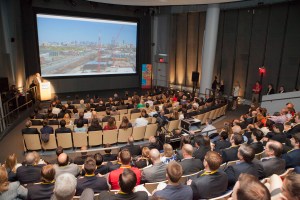
Elisif_20140514_6950The tour kicked off in Brighton as attendees watched a presentation on NB Development’s exciting new Boston Landing project. NB Development Group managing director Jim Halliday, HYM Investment Group founder Tom O’Brien, founding principal of Elkus Manfredi Architects, David Manfredi, and others provided an overview of the spectacular transit-oriented, mixed-use project.

When complete, Boston Landing will feature 650,000 square feet of office, 180 hotel rooms, 65,000 square feet of retail, a world-class indoor track facility, a dedicated MBTA commuter rail station, and significant public space. A game-changer in Brighton, for sure.

Skanska & WS Development Star at Seaport Square
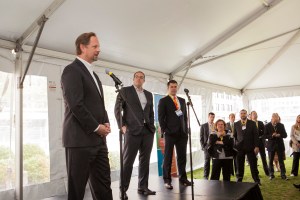
Elisif_20140514_7068At the Boston Innovation/Seaport District, attendees visited another game-changer, Seaport Square. Here, Skanska USA is building three projects totaling close to 1.2 million square feet. Project partner WS Development is responsible for bringing the ground level retail to each building.

Brian Sciera of WS Development explained the company’s mission at Seaport Square is to create energy and excitement where buildings meet the street. To WS Development, energy means retail. And, fashion retail, in particular.

“The backbone of any good retail district is its fashion component,” said Sciera. “Fashion brings that energy to the street by driving interaction between people and buildings.”

Sciera said WS Development is in discussion with several well-known retailers, but was not at liberty to disclose names.

The Skanska USA buildings at Seaport Square are:

  • 101 Seaport: located on Parcel L1 across from the Boston Innovation Center, the office tower will be the new Boston headquarters for PwC
  • 121 Seaport: located onParcel L2,the 17-storybuilding willconsist of 400,000 RSF of office space and ground level retail
  • Watermark Seaport: located on Parcel K, the project will consist of a six-story building and 17-story residential tower, including 346 luxury rental units and 25,000 square feet of retail (Watermark Seaport is a JV with Twining Properties)

Fenway’s Other Big Papi: Samuels & Associates

Elisif_20140514_7119When you’re talking about development in the Fenway Triangle, you’re talking Samuels & Associates. With more than $1 billion invested in the neighborhood, Samuels is Fenway’s other Big Papi.

Just down Boylston Street from The Trilogy and 1330 Boylston, the NAIOP tour buses rolled by Samuels’ latest two projects: The Van Ness and The Verb. The Van Ness is a 22-story, 320-unit apartment building that’s under construction and will be home to downtown Boston’s first Target. And, recently underway, The Verb is a 43,000-square-foot boutique hotel project at the site of the former Howard Johnson’s.

At the Landmark Center, bus tour attendees were treated to lunch by area favorite Tasty Burger. Samuels’ Joel Sklar and Peter Sougarides were onhand to discuss the company’s Landmark Center expansion project, which they described as a complete “rethinking of the former Sears building.” In addition to renovating the interior, updating infrastructure, and removing the above ground parking garage, Samuels plans to create a “world class food market” anchored by Wegman’s.

By adding the Landmark Center expansion to development projects The Van Ness and The Verb, Fenway’s other Big Papi has struck again.

A Game-Changing Tour
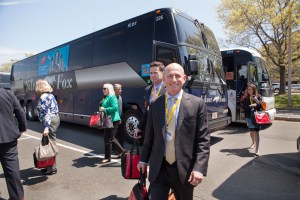
Elisif_20140514_7224Highlighted by Boston Landing, Seaport Square, and the new Fenway Triangle projects, NAIOP Massachusetts’ “Changing the Game in Boston Real Estate” bus tour lived up to its name—and then some.