Remembering Rodger Nordblom

The real estate industry has lost another of its icons with the passing of Rodger Nordblom. Massachusetts has been blessed with a number of pioneers in the commercial real estate business who have had a major role in the sculpting of our cityscapes, creating workplaces for generations of innovative businesses that have grown here. Not only have these individuals been active participants in our economic development, but they have been civic and charitable leaders, giving of their time and resources to so many organizations that have impacted all of our lives.

Whenever you saw Rodger, he had a smile on his face and was always accessible.  We will all miss him.
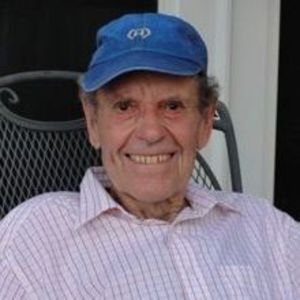
image001

 Rodger Payson Nordblom

  • July 5, 1927 – February 10, 2013
  • Concord, Massachusetts

Rodger Payson Nordblom, 85, died peacefully while in Palm Desert, California on February 10, 2013. Born July 5, 1927, he was the son of Robert C. and Marjorie C. (Payson) Nordblom.

He graduated from Milton Academy, Milton MA in 1945, whereupon he served in the US Navy. Subsequently, he graduated from Harvard University in 1950, where he was captain of the ski team for 2 years. He married Mary Winder Crocker of Fitchburg, MA on September 9, 1949. Together they raised their five children in Concord MA, instilling in them their love of the outdoors, sports, and most importantly, family values. His beloved wife, Mary Winder, passed away on September 7, 2001 after 52 years of marriage. Traveling to California, he met Dawn Chandler whom he married on March 14, 2003. Together they traveled extensively to remote parts of the world and enjoyed 10 years of marriage.

Rodger was the third generation in Nordblom Company where he was President for twenty-five years. He was an outstanding leader in the Boston real estate industry as a pioneer in the development of commercial properties following the construction of Route 128 in the late 1950’s. Throughout the 1960’s and 70’s he developed millions of sq ft of commercial buildings in Greater Boston and was recognized by his peers as president of SIOR in 1977. Rod was always active in the Boston community, including his recent involvement with WGBH, Boys’ and Girls’ Club of Boston and the Museum of Science.

Whether parasailing on his 85th birthday or exploring remote villages in India, he embraced life with enthusiasm and an adventurous spirit. His positive outlook carried him graciously through life’s trials including his own health challenges. Rod was unfailingly fair and always was guided by what he believed to be right both in business as well as his personal life.

He was a mentor to many generously sharing his wisdom and experience therefore empowering those around him. As a result of his deep love for writing and photography, he also authored a number of books. Rod was a gentleman loved and respected by all and he will be best remembered for his kindness and generosity.

Rod is survived by his wife Dawn, her son Danny Chandler of Texas, her daughter Julie Chandler of Raleigh, NC and Rod’s five children, Anne Dodge of Manchester MA, Carolyn Los of Athens Greece, Win Nordblom of Ayer MA, Peter Nordblom of Cambridge MA and Lee Nordblom of Beverly MA and their spouses . He also leaves 19 grandchildren and 14 great-grandchildren as well as his sister June Robinson, her husband Dr. Jack Robinson and many nieces and nephews.

Gifts in his memory may be made to:
The Boys and Girls Club of Boston
115 Warren St.
Roxbury, MA 02119
www.bgcb.org

The Museum of Science
1 Science Park
Boston MA 02114
www.store.mos.org

Grim Optimism for Real Estate and the Economy

Goodwin Procter’s Real Estate Capital Markets Conference was recently held in New York City in partnership with Columbia Business School.  GP-REConferenceAn exceptional group of speakers discussed the real estate markets, investments, and the economy.

The keynote presentation was delivered by Austan Goolsbee, former chairman of President Obama’s Council of Economic Advisers, and now a Professor of Economics at the University of Chicago’s Booth School of Business. Goolsbee spoke with “grim optimism” about the US economy.  The US has the most productive work force in the world and low energy and new-energy sources will benefit our growth.  Relative to the rest of the world, our fiscal imbalance is manageable. All in all, he believes that the next six to twelve months will be a bumpy ride, but prospects in the long-run look good.

The following are a few interesting observations made during the panel discussions:

  • Demographics are playing a key role internationally, especially in the US. Effects of this will be seen in an increased demand for apartments, senior housing, and retail.
  • With accounting standards likely to change in the future, as relating to corporate leasing and ownership, more businesses will likely choose owning large amounts of their space.
  • Retail sales continue to be impacted by online competition, but retail is still a growing market. The future may move towards more hybrids that have both online and storefront locations.
  • Office space needs are dropping in terms of space requirements per new job. However, there is a sense that over time businesses will start to swing back towards a need for greater space.
  • Multifamily housing rents are back to pre-recession highs and it is likely that rents will experience slower growth going forward.
  • Record amounts of capital were raised both in the public and private markets last year. With less growth worldwide, real estate is very attractive to investors.  Investor interest is focused on yields and risk management. Where in the past, “cash is king”, now, “cash flow is king”.
  • Rates should not be rising in the short term, but that is a big risk for all asset classes. The markets could wake up to a starting spike in rates that, in hindsight, will have seemed inevitable.

Will We See More Development Over the Pike?

A recent editorial in The Boston Globe spoke about the successful conclusion of the permitting for Fenway Center, the $450 million mixed-use project over the Mass. Turnpike.   The gist of the piece was that developing air rights is no easy matter.  Besides the very high cost of developing over an eight lane highway, there are the inevitable lawsuits that can stretch an approval process out by 2-3 years.  The Fenway Center case was finally resolved in appeals court.

Columbus Center, another very worthwhile project involving air rights, was not so lucky.  While the financial crisis played a role in its demise, one of the real reasons that it did not move forward was due to the lengthy delays caused by well over 100 public meetings.  No one can deny the appropriateness of having community involvement, but there must be some limit on that process.  Are the city and neighborhood really better off with the scar of an urban highway canyon dividing the Back Bay and the South End than it would have been with a mixed-use project including affordable housing?

The Globe said that “These projects shouldn’t be the last along the Pike.”  However, predictability and transparency are necessary before any developer will be willing to risk capital on a speculative urban development involving air rights.  A few suggestions:

  1. Establish some clear guidelines for developers interested in responding to RFPs for future air rights parcels;
  2. Set a limit on the number of public hearings with the appropriate neighborhood groups within a limited time period;
  3. Allow the developer to opt in to the Permitting Session of the Land Court for any appeals;
  4. Require appellants to post a bond if they choose to appeal the decision of the court;
  5. Allow developers to count some portion of the cost of the infrastructure associated with the air rights project as part of their community betterment payments.

Breaking Ground in Back Bay

The following blog post was submitted by Sheridan Wachtel, Marketing Assistant at Solomon McCown.

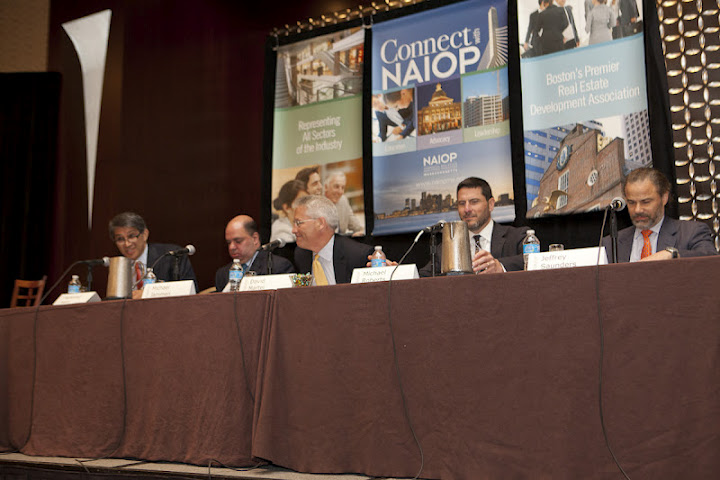
On May 31, experts from all sides of the real estate industry joined us at the Sheraton Hotel to discuss one of Boston’s most iconic and sought-after neighborhoods, the Back Bay. The program, “Breaking Ground in Back Bay,” discussed the future opportunities for retail, residential, office and hotel in the neighborhood that has been the epicenter of the city for decades.

The panel included Peter Meade, Director of the Boston Redevelopment Authority; Michael Jammen, Principal, UrbanMeritage, LLC; David Martel, Executive Director of Cushman & Wakefield of Massachusetts, Inc.; Michael Roberts, Vice President Development of AvalonBay Communities, Inc.; Jeffrey Saunders, President of Saunders Hotel Group, LLC; and was moderated by Leggat McCall Properties LLC Executive Vice President, Mahmood Malihi.
Meade set the table for the discussion citing the pipeline of projects slated for the Back Bay including the redevelopment of the Christian Science Plaza, 888 Boylston, Chanel’s new retail store, and Copley Place residential building—which will be the tallest building in the Back Bay once completed.

Jammen, one of the architects of the Newbury Line Program, discussed the “red hot” retail scene in the Back Bay and more specifically, Newbury Street. “Constrained by being only eight blocks in length, retail real estate on Newbury street is seeing more demand than supply,” said Jammen in light of the fact that the street’s architecture isn’t traditionally window-display friendly. “It doesn’t have the windows like Rodeo Drive and other luxury retail streets of the world…but no one is going to build another Newbury street anytime soon,” said Jammen.

Having represented some of Boston’s most notable office spaces including The Hancock Tower, Martel discussed the increasing value of Back Bay’s office properties. “We have seen a quantum shift in office space demand in the Back Bay since 2008,” said Martel explaining how the coveted 24/7 lifestyle of the neighborhood is an increasingly important factor to office tenants to attract and retain talent—a factor that sets it apart from both contemporary urban areas like the Seaport and traditional office space properties like the Financial District and suburban areas.

With a growing desire to work in the Back Bay, residential real estate in the area has only increased in value. Roberts commented on the demographic shift that has made residential real estate in the Back Bay boom. “Young professionals landing a majority of newly created jobs, along with empty nesters wishing to return to city-livingare the key demographics in residential real estate in this area,” said Roberts.

And, according to Roberts, residents of the Back Bay aren’t planning to move out of the Back Bay anytime soon, citing residential properties in the neighborhood see half the turnover rate than all other neighborhoods in their portfolio.

Rounding out the panel was long-time hotelier Saunders, who discussed the resiliency of hotel occupancy in Boston’s Back Bay despite the influx of new hotels in Boston’s Seaport district. “Back Bay continues to be ground zero for people who want to visit the city,” said Saunders whose hotels operate at 90+ percent occupancy rate in the summer months and projecting 2012 to yield its highest occupancy rates in recent years.

With a full spectrum of real estate development projects underway and even more projected in 2013 and 2014, real estate in the Back Bay will continue to be hot commodity and a place where residents, tenants, tourists and developers want to be.

Watch a video of the panelists, or view photos from the event.

Stretch Code Changes Have Developers Seeing Red, Not Green

This article appeared in the May 28, 2012 edition of Banker & Tradesman.

“Green building” is a term that can be broadly defined. For some, it may mean building a LEED Platinum building. For others, it could be installing water and energy saving measures. There is no question, however, that most developers are more conscious of green building practices. The question is how to encourage this movement? The industry believes the market should be allowed to lead the way when it comes to green building. Mandates imposed by the government requiring specific technologies or energy efficiency measures are not the most effective way to get there. They will only increase costs and slow development of all building types.

The Stretch Energy Code mandate passed in 2009 is one example of government’s attempt to promote energy efficiency. This local option code applies to both residential and commercial buildings. More than 100 communities have adopted it to date. Under the Stretch Energy Code, commercial buildings are required to meet higher energy efficiency standards – approximately 20 percent more than the current statewide energy code.

In 2012, the statewide energy code, as required under the Green Communities Act passed in 2008, will be updated to comply with the more energy efficient International Energy Conservation Code (IECC 2012) – an energy efficiency increase of approximately 20 percent over existing standards. Massachusetts will be leading the way by adopting this new energy code (only two other states have adopted the IECC 2012 to date). Furthermore, the statewide energy code must be updated within one year of any revision to the IECC – contributing to the commonwealth’s current position as the national leader in energy efficiency.

Change Is Coming

However, a change is being proposed to the Stretch Energy Code that will jeopardize our recent, modest economic recovery. In June, the Massachusetts Department of Energy Resources (DOER) is planning to propose a 15 percent increase to the current Stretch Energy Code (to take effect when the IECC 2012 is adopted for the rest of the state). In other words, the new Stretch Code would require buildings to be 35 percent more energy efficient than the current statewide code. Such a change would increase the cost of the construction and maintenance of residential and commercial buildings. Current rents, even in traditionally high rent communities, would be challenged to cover the increased costs associated with such projects. In addition, the change would dramatically alter project design, affecting their marketability to tenants.

Many communities chose to adopt the Stretch Energy Code in order to qualify as a Green Community. By earning this designation, they became eligible for grant money that could be used to make energy efficient upgrades in public buildings. Green Communities are required to minimize the life cycle costs of buildings by utilizing “energy efficiency, water conservation and other renewable or alternative energy technologies,” but this requirement could be achieved by adopting the IECC 2012 rather than the Stretch Energy Code.

Most of these Stretch Code communities believed that once the statewide building code was upgraded to the IECC 2012, the entire state would be on a level playing field. Unfortunately, many cities and towns are now discovering that the changes to the stretch code will take effect automatically in all Stretch Code communities without any vote by City Council or Town Meeting. Furthermore, many Stretch Code communities were not aware that they would continually be subject to an automatic upgrade every three years.

Given the impact this extreme proposal will have on housing production, jobs and a very fragile economic recovery, it is time to recognize its unintended consequences. Maintaining the commonwealth’s lead in energy efficiency should not come with a price tag we cannot afford – the loss of jobs and economic growth.

NAIOP Bus Tour: 10 Facts Learned on the Trial Run

The following blog post was submitted by Duncan Gratton, Senior Managing Director, Principal at Cassidy Turley FHO.

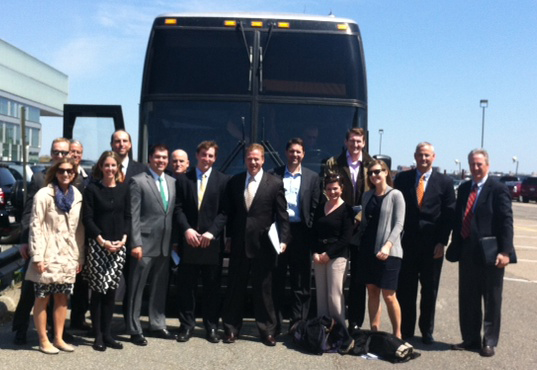
This year marks the 10th Anniversary of NAIOP’s Bus Tour, and as the Vice President of the Bus Tour Committee, I had a hand in planning and designing it. The 2012 Bus Tour, What’s Big and Breaking in Greater Boston, is a fast-paced live market update on some of the most dynamic markets in the area, including Boston’s Seaport, Fenway, Longwood and Cambridge.

The actual date of the Bus Tour is May 2, but this week – along with Bus Tour Captains and NAIOP staff – I went on a dry run of the route. We saw a lot of projects breaking ground and learned several interesting facts from the knowledgeable Bus Tour Captains! Here are the ten I found most interesting:

  1. The largest private construction project in the US is located at Fan Pier. The Vertex buildings are 1,100,000 SF and $900,000,000!
  2. Three of the largest academic/medical clusters in the US are located in Boston. They are:MGH/Partners

    Longwood Medical/Harvard

    Boston Medical Center/Boston University

  3. Kendall Square in Cambridge was supposed to be the original site of NASA. After JFK was assassinated, Lyndon Johnson became President and being from Texas, he chose Houston as the new location.
  4. Boston University is one of the largest landlords in Back Bay/Fenway. They control over 1,000,000 SF of commercial and non-academic real estate.
  5. There are three new life science buildings under construction in Kendall Square (Pfizer, Novartis and Broad Institute) and two new office buildings (Biogen Idec). All are 100% leased.
  6. Rents in Kendall Square and the Seaport District have jumped over 10% in the last 12 months.
  7. New apartment construction is booming – at least six new projects are underway or about to start in Boston!
  8. New Balance has announced plans for four new buildings at Brighton Landing, including a new 250,000 SF world headquarters building. In addition, they are planning a 345,000 SF sports facility that will include a hockey rink and track.
  9. Harvard is constructing an ‘Innovation Lab’ in the former WGBH buildings on Western Avenue in Allston.
  10. Boston University has announced that construction will commence this summer on a new lacrosse stadium on Babcock Street, thanks in part to a $3,000,000 donation from New Balance.

I hope you will join us on May 2 to learn more about What’s Big and Breaking in Greater Boston. Get a sneak peek of what’s in store.

Westwood Station: A New Name, a New Team, and a Different Time

The transformation begins.  Westwood Station at University Avenue on Route 128 will now be known as University Station.  A new team, led by New England Development along with Eastern Real Estate, National Development/Charles River Realty Investors, and Clarion Partners recently purchased the 135- acre prime development site. The first phase of the new University Station is expected to open in 2014.  The project had been on hold since the market crashed and the previous development team of CC&F/ Commonfund sold the property in 2010 after its lender, Anglo Irish Bank, went bankrupt and was acquired by the Irish government.

While this latest announcement is exciting for the region, credit is due to CC&F for amassing such a large tract of land with direct access to Route 128 and a major transit station and permitting a 4 million square foot, mixed-use, transit-oriented, energy efficient master plan.  With an improving economy, the time is right for this landmark project to move forward.

So, what has changed beside the name?

  • The project will remain a mixed-use project comprised of retail, housing, office and hotel uses.  The market, however, has clearly changed and appears ready for multi-family rental housing and a retail center. It will remain to be seen how much of the development will be office and hotel and when that could happen.
  • A supermarket is almost certain to occupy space here.  Again, this is not a change in plans, especially with Wegmans expected to be the designee for this location.  It will not be surprising if other local grocery store chains continue to oppose such a proposal.
  • The state will continue to invest in the highway infrastructure improvements in and around the University Avenue/Route 128 intersection.
  • The project will be a multi-modal transit oriented development, taking advantage of the Amtrak/MBTA Commuter Rail station and Interstate Route 95 and State Route 128.  Before Westwood Station’s plans, the density of development at this location was one of the lowest of any intersection along Route 128, underutilizing the excellent transit opportunities.
  • Although, probably too early to have financing in place, the debt market is sure to be open to investments such as this.  Now is a very different economy from the late 2008 economic disaster that began with sub-prime home loans, led to debt swap defaults, and ended in the near collapse of the financial markets.

With the development team set, a strong financing market in place, a growing demand for retail and residential space, and a prime location for corporate build-to-suit office sites, University Station should be the first mega-project to break ground within the next 12 months. Congratulations and best of luck to all involved!

What Made CC&F an Incubator For So Many Development Companies?

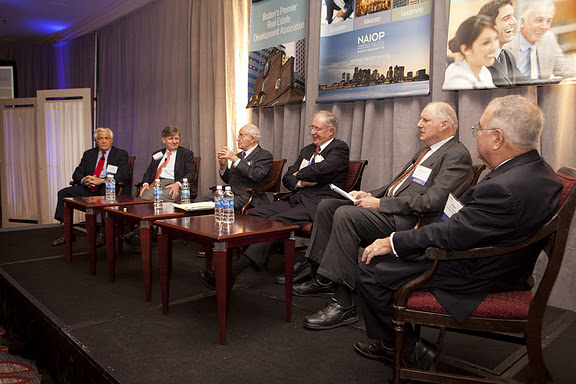
At NAIOP’s recent program, Get Inspired with Gerald Blakeley and the Icons of Boston Real Estate, panelists and CC& F alumni discussed the culture at Cabot, Cabot & Forbes and why it resulted in launching the careers of so many of today’s local and national icons of commercial real estate.
View the video highlights.

Many younger real estate professionals may not realize that CC&F was the national pioneer of over 20 million SF of suburban master planned business parks.  During the program, Gerry Blakely, CC&F’s former CEO, described his start leading the company.  Back then, the land use for industrial properties was either building footprint or paved parking.  Very different from today, there were virtually no setbacks, landscaping, or design covenants.  CC&F’s new model was a commercial business park that established development restrictions and dimensional requirements more strict than the underlying zoning.  Although few banks wanted to risk lending for such a radical and risky venture, CC&F was able to get started and soon proved the profitability of this new concept. In 1948, CC&F opened The New England Industrial Center – the country’s first master-planned business park.  With the preservation of natural site amenities and consistent design standards, this facility quickly became a prototype for business parks that has been emulated worldwide.

CC&F was also responsible for creating millions of square feet of first-class office space across the country.  Their Boston landmark properties include 60 State Street, One Boston Place, 100 Summer Street, and 28 State Street.

As Bill McCall, President of McCall & Almy, pointed out, the people that Gerry attracted to the company were the brightest around who all shared a strong drive to succeed.  These were entrepreneurs taking charge of their own particular divisions within CC&F, whether it was for the industrial, office, or national build-to-suit markets.

The obvious risk was that they were hiring the kind of personalities that would ultimately want to do this work on their own behalf.   Although that proved true for many of the alumni, the company benefitted from that intense, productive energy.

The list of CC&F graduates is impressive and includes: Don Chiofaro, President, The Chiofaro Companies; Ferdinand “Moose” Colloredo-Mansfeld, Senior Advisor, Cabot Properties, Inc.; Terry Considine, CEO, AIMCO; Arturo Gutierrez, Chairman, The Gutierrez Company; Mort Zuckerman, Chairman; and Ed Linde, former CEO, Boston Properties.

The legacy of Blakeley and CC&F lives on with so many of the alumni actively involved as leaders in our industry.  At the conclusion of our program, NAIOP presented the chapter’s first ever Lifetime Achievement Award to Gerry Blakeley for his contribution to the industry and his impact on Greater Boston.

Retainage Legislation Increases Risks and Hinders Development

Yesterday I testified before the Legislature’s Joint Committee on Labor & Workforce Development in opposition to legislation that would make substantial changes to contractor retainage payments. NAIOP believes that the legislation, An Act Relative to Fair Retainage Payments in Private Construction – H. 1401 and S. 956, would hinder economic development at a time when the construction and development sectors are still reeling from the worst recession in a generation.

The bill sets an outside limit of 5% (reduced from the standard practice of 10%) for approved contract payments that can be withheld for retainage.  Retainage is traditionally held until final completion of a project in order to incentivize prompt completion of the project and guarantee that the contract is fulfilled as agreed.  The legislation changes the final payment date to within 30 days after “substantial completion” (a phrase that is unclear and likely to be the source of many legal battles) and it would create enormous uncertainty for developers.

Very few development projects are moving forward.  Financing, especially for larger projects, is extremely difficult to obtain.  Anything that increases uncertainty could make financing a project even more difficult.

Finally, though supported by the Associated Subcontractors of Massachusetts, this legislation could actually have a negative impact on the smaller, less established subcontractors.  Without adequate retainage, developers will not be willing to take a risk with a lesser known subcontractor.  As a result, the legislation would give an advantage to the bigger subcontractors.

Given the current economy, the Commonwealth should be doing all it can to encourage job creation, not find ways to slow or hinder economic development.  Though we do not think the legislation has a high likelihood of passage, we will continue to advocate against it through the remainder of the legislative session.

United Way Real Estate Breakfast Did Well, Does Good

If you are involved in real estate, then, most likely, you were with me last Friday at United Way’s 18th Annual Real Estate and Building Industry Breakfast at the Hynes Convention Center.  The breakfast attracted close to 1,100 people in a challenging economic time.  More importantly, it raised over $3,000,000 in support of the many important community programs funded by the United Way.  This exceeded the 2010 campaign for this industry at a time when so many more families are in need.

The United Way has been a vocal supporter of the Housing First approach, which seeks to change the way homeless families and individuals are served by placing them in housing as a first step. Supportive services such as substance abuse counseling and mental health are then provided once they have obtained housing.  It is based on the premise that individuals and families are more responsive to interventions and support once they are in permanent housing.   The Real Estate breakfast has targeted this program as a priority during the last five years and has exceeded its original fundraising target.

Robert Beal Accepts Award

Honored at this breakfast with the 2011 Norman B. Leventhal /Edwin N. Sidman Real Estate and Building Industry Award was Robert Beal, President of The Beal Companies.  This honor was long overdue to a man who is not only one of the leading philanthropists in Boston, but who has dedicated so much of his time to expand contributions to the United Way’s Tocqueville Society, making our local agency’s society one of the top two in the nation.

In recognition of his commitment to underprivileged youth, the United Way created Fostering Opportunity, A Robert Beal Initiative, which will empower youth aging out of foster care.  More than 1,150 young people in Massachusetts enter a bleak future of unemployment, homelessness, and sometimes, crime when they age out of foster care at 18.  This creative initiative will empower these young people to plan and develop a career path by providing extensive caseworker support, financial literacy training, life planning skills, and mentoring.  In addition, they will be encouraged to save for their tuition and job training with matching funds.

“With Fostering Opportunity, we aim to close the door on homelessness, unemployment, and incarceration-the unfortunate obstacles facing many who age out of foster care,” said Michael K. Durkin, President of United Way of Massachusetts Bay and Merrimack Valley. “Through this program, we hope to open the door to many possibilities for young people who simply want to do better. Live better. Prosper.”

All of us attending the breakfast were very touched by the young man who spoke for the first time in front of an audience about his own life experiences in the foster care system and his drive to find a new life on his own.  It was very clear that the mentoring and support he has been receiving through Adoption and Foster Care Mentoring  has made an enormous difference in his life.

All of us in that function room have our own challenges, both personal and professional, but we are all very lucky to be able to help out those less fortunate than us with our contributions of time and money.  As a result, so many lives are being changed for the better; and where there was no hope, there is now a helping hand.

For more information on these initiatives and the important work of the United Way, please contact Brian Adams at (617) 624-8261.