Boston’s Game-Changing CRE Developments on Display at 2014 NAIOP MA Bus Tour

The following blog post was submitted by David Fleming, Principal at PACE Communications Group, a marketing firm that works with CRE companies to promote properties and help lease space.

Elisif_20140514_6876The 2014 NAIOP Massachusetts Bus Tour,“Changing the Game in Boston Real Estate” lived up to its name as attendees got an up close look at game-changing development projects across the city. The tour covered dozens of new and redevelopment projects in Allston, Brighton, the Fenway, Back Bay, the South End, and the Seaport/Innovation District.

Here are just a few highlights:

Game-Changer in Brighton: NB Development’s Boston Landing
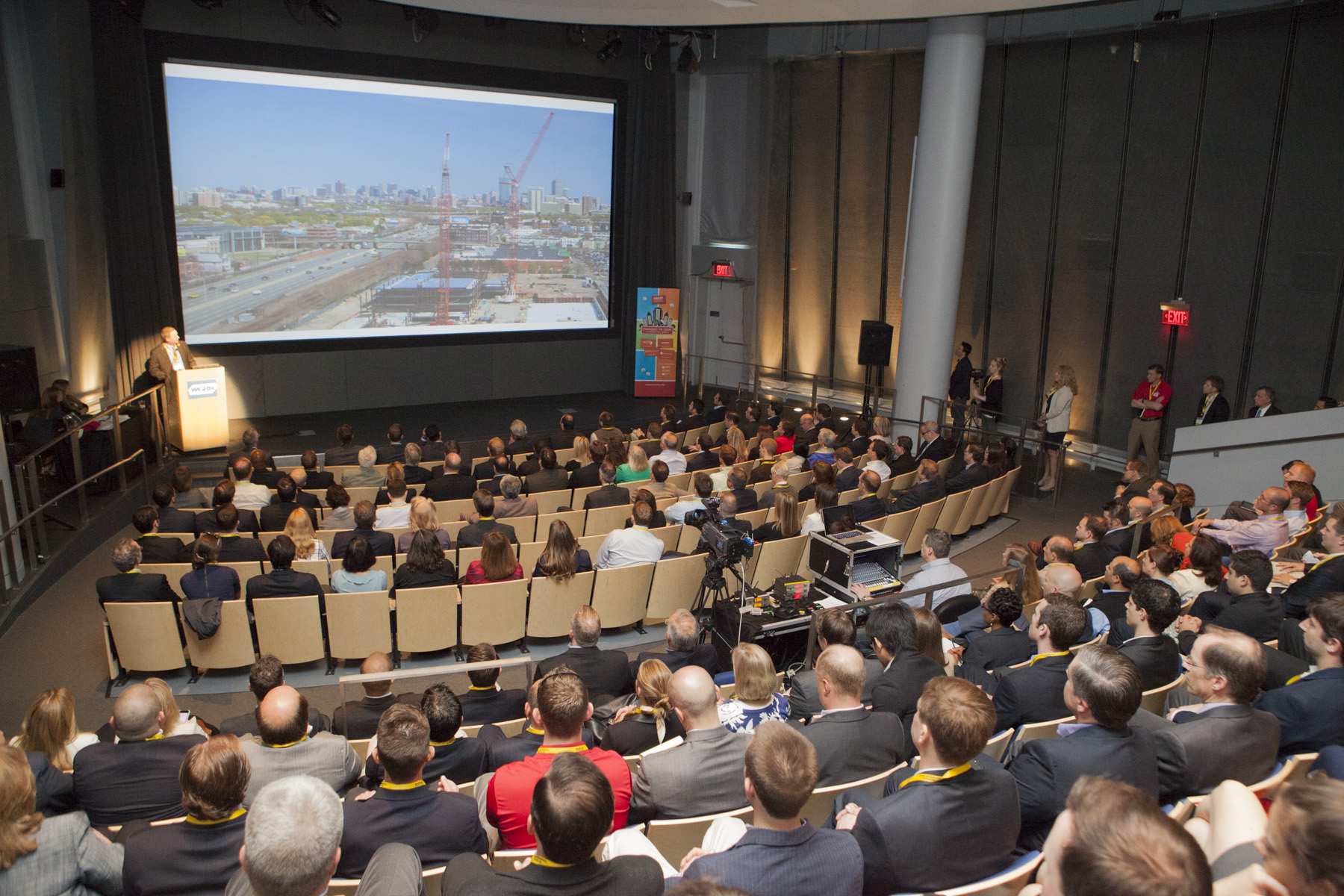
Elisif_20140514_6950The tour kicked off in Brighton as attendees watched a presentation on NB Development’s exciting new Boston Landing project. NB Development Group managing director Jim Halliday, HYM Investment Group founder Tom O’Brien, founding principal of Elkus Manfredi Architects, David Manfredi, and others provided an overview of the spectacular transit-oriented, mixed-use project.

When complete, Boston Landing will feature 650,000 square feet of office, 180 hotel rooms, 65,000 square feet of retail, a world-class indoor track facility, a dedicated MBTA commuter rail station, and significant public space. A game-changer in Brighton, for sure.

Skanska & WS Development Star at Seaport Square

Elisif_20140514_7068At the Boston Innovation/Seaport District, attendees visited another game-changer, Seaport Square. Here, Skanska USA is building three projects totaling close to 1.2 million square feet. Project partner WS Development is responsible for bringing the ground level retail to each building.

Brian Sciera of WS Development explained the company’s mission at Seaport Square is to create energy and excitement where buildings meet the street. To WS Development, energy means retail. And, fashion retail, in particular.

“The backbone of any good retail district is its fashion component,” said Sciera. “Fashion brings that energy to the street by driving interaction between people and buildings.”

Sciera said WS Development is in discussion with several well-known retailers, but was not at liberty to disclose names.

The Skanska USA buildings at Seaport Square are:

  • 101 Seaport: located on Parcel L1 across from the Boston Innovation Center, the office tower will be the new Boston headquarters for PwC
  • 121 Seaport: located onParcel L2,the 17-storybuilding willconsist of 400,000 RSF of office space and ground level retail
  • Watermark Seaport: located on Parcel K, the project will consist of a six-story building and 17-story residential tower, including 346 luxury rental units and 25,000 square feet of retail (Watermark Seaport is a JV with Twining Properties)

Fenway’s Other Big Papi: Samuels & Associates

Elisif_20140514_7119When you’re talking about development in the Fenway Triangle, you’re talking Samuels & Associates. With more than $1 billion invested in the neighborhood, Samuels is Fenway’s other Big Papi.

Just down Boylston Street from The Trilogy and 1330 Boylston, the NAIOP tour buses rolled by Samuels’ latest two projects: The Van Ness and The Verb. The Van Ness is a 22-story, 320-unit apartment building that’s under construction and will be home to downtown Boston’s first Target. And, recently underway, The Verb is a 43,000-square-foot boutique hotel project at the site of the former Howard Johnson’s.

At the Landmark Center, bus tour attendees were treated to lunch by area favorite Tasty Burger. Samuels’ Joel Sklar and Peter Sougarides were onhand to discuss the company’s Landmark Center expansion project, which they described as a complete “rethinking of the former Sears building.” In addition to renovating the interior, updating infrastructure, and removing the above ground parking garage, Samuels plans to create a “world class food market” anchored by Wegman’s.

By adding the Landmark Center expansion to development projects The Van Ness and The Verb, Fenway’s other Big Papi has struck again.

A Game-Changing Tour

Elisif_20140514_7224Highlighted by Boston Landing, Seaport Square, and the new Fenway Triangle projects, NAIOP Massachusetts’ “Changing the Game in Boston Real Estate” bus tour lived up to its name—and then some.

Patience Not Panic Needed with BRA

A recent Globe article stated that three months into Mayor Walsh’s term, “the pipeline of major new (development) proposals has slowed to a trickle.” The implication is that the transition from the Menino Administration has left the Boston Redevelopment Authority rudderless.

I disagree. The final days of 2013 cannot be viewed as the norm for the Menino Administration. Virtually any developer with a project was aggressively pressing for its approval prior to year’s end. The BRA, most likely, set a record for the number of projects permitted.

Given that the Walsh administration has begun an in-depth audit of the BRA, it does not seem unreasonable that city leaders be given time to properly review the current process and propose needed changes in how projects are reviewed and permitted.

Less than 90 days have passed since Mayor Walsh took office. The last mayor had 20 years to shape the BRA’s review process. Before anyone questions the competency of the Walsh Administration, they should allow city leaders to get to know how the city operates and give them adequate time to make changes that could result in a stronger, more vibrant Boston.

We Need Jobs, But Also Skilled Workers

computer_handsThe Boston Globe recently reported that “the state’s tech sector is growing fast, but a shortage of qualified workers is preventing Massachusetts from becoming the capital of the nation’s innovation economy”, according to the 2014 State of Technology Report released by the Mass Technology Leadership Council. “Creating the jobs isn’t the hard part – filling them is the hard part,” said Tom Hopcroft, chief executive of MassTLC. “We can’t find enough people with the skills to fill all of these tech jobs.”

These are not the only types of jobs that remain open according to this Boston Globe graphic, which shows that it is not just the high end tech jobs that are having trouble finding workers.

So, what is worse – not having the jobs, or not being able to provide the workers for those companies that are expanding? It should be the former.  Trying to create new jobs is not only difficult, but there is actually no proven way to do it.  If what we have is a gap in training, or the proper transportation to access trained workers, we should be able to remedy that.

Local and state government should be partnering with local community colleges, vocational schools, and universities to work directly with those businesses that are fortunate enough to be growing and hiring.  If we don’t fix this imbalance expeditiously, we may have bigger problems.  Companies will begin expanding elsewhere and, then not having any local jobs to fill would be a lot worse.

Highlights of NAIOP’s You Can’t Get There from Here

Elisif_20140207_3248This post was submitted by Allyson Quinby, Account Supervisor at Solomon McCown.

View event photos  |  Read Curbed article  |  Watch event video

Real estate professionals gathered at NAIOP’s “You Can’t Get There from Here” event to discuss one of the top priorities in Boston right now: improving transportation. It was exciting to hear about all the projects that are in the works, upgrades to the system already underway, and new technology that will allow commuters to get from point A to point B more efficiently.

The audience was fortunate enough to hear from Secretary of Transportation Richard Davey, who served as the keynote speaker, followed by a panel of experts including Michael Cantalupa of Boston Properties, Donald Cooke of VHB, Marilyn Swartz-Lloyd of MASCO and Yanni Tsipis of Colliers International.

Secretary Davey explained how MassDOT will make numerous improvements to the city’s existing infrastructure with a $12.4 billion Capital Investment Plan that aims to make the lives of commuters easier and spur economic development. The much-needed green line extension to Somerville and Medford as well as the South Coast Rail extension to Fall River and New Bedford will make a huge difference for those who live outside Boston. These new public transit lines will deliver an option that’s much less expensive than driving, which means fewer cars on the road and a significant reduction in traffic congestion and of greenhouse gases (something the Secretary said was a major initiative for MassDOT).

Additionally, a Silver Line Gateway will provide a new route from Logan International Airport to Chelsea to service one of the greatest transit-dependent populations in Greater Boston. Secretary Davey called it a “game changer.” As panelist Michael Cantalupa further noted, transportation plays a vital role in any city’s development. As Boston continues to boom with new office buildings and other high-rise projects, it’s critical these new developments remain accessible through increased transportation options.

Secretary Davey assured the audience that money is being invested in the system’s aging infrastructure, which means the need for new transit cars will finally be addressed. In fact, the state will purchase new Red/Orange Line cars and make upgrades to signal systems in an effort to eliminate the on-going problem of constant breakdowns. Millions will also be poured into the state’s highway system. For example, the alignment of the I-90 Turnpike Allston Interchange will reconfigure ramps and straighten the highway to simplify the roadway, as well as allow more room for development.

Diesel Multiple Unit (DMU) Service is another initiative MassDOT will be implementing. The service will allow more affordable cars to utilize our existing commuter rail line that runs from the South Bay Rail Yard to the South Boston Waterfront. This will open up whole new possibilities for those looking to travel from the Seaport District to Back Bay, a route for which there is currently no efficient method of transportation.

It’s no secret here in Eastern Massachusetts that traffic has a paralyzing effect on local transportation on a daily basis. So it was welcome news to hear that MassDOT is collecting and analyzing years of data to deliver real-time traffic technology. This will not only inform commuters where traffic is, but how bad it will be at what time and why. Secretary Davey announced that by the end of 2014, the real-time traffic message signs that have appeared on major highways will be instituted across the Commonwealth; making Massachusetts the first state in the country to do so.

While the planned investments are exciting, a proposed ballot question could prevent many of these important projects from moving forward. Under the landmark transportation legislation passed last year, the gas tax will be indexed to inflation in the coming years. This will be only a penny or two per gallon at most, but will provide the funding needed to ensure these projects are a reality. The proposed ballot question would repeal the gas tax indexing and would eliminate this crucial source of funding. NAIOP and other business groups are strongly opposed to the ballot question and will be working to fight this initiative in the coming months.

Transportation impacts all of us, and it was fascinating to hear Secretary Davey and the featured panelists give us a sneak peak of what’s in store for the city of Boston and throughout Massachusetts.

A New Day for Boston: NAIOP Welcomes Mayor Walsh

martin_j_walshNAIOP Massachusetts was proud to support yesterday’s inaugural events welcoming Boston’s 54th Mayor, Martin J. Walsh. The day was filled with inspirational speeches, musical performances and hope for the future.

During his inaugural address at Boston College, Mayor Walsh outlined his priorities including creating jobs, improving public safety, ending gun violence, and strengthening Boston’s schools.

NAIOP looks forward to working with Mayor Walsh and his team on the many issues affecting the commercial real estate industry and economic development overall. Among other things, NAIOP will provide input on the proposed changes to the Boston Redevelopment Authority, the need for more affordable and middle-income housing, and improved workforce training programs.

Congratulations Mayor Walsh!

A Scalpel, Not an Axe for the BRA

Ed Glaeser just penned an op-ed in The Boston Globe entitled “Fix BRA; don’t break it.”

With all the campaign talk about the Boston Redevelopment Authority’s problems, it is sometimes easy to forget what it does well, and all that it has accomplished for the benefit of the City, its businesses and residents. Sometimes, a scalpel is preferable to an axe!

Glaeser’s short list of do’s and don’ts are right on target:

  • Above all, don’t make it harder to build.
  • Don’t imitate other cities blindly.
  • Don’t give neighborhoods a veto.
  • Don’t create an agency that has too many objectives.
  • Don’t make a fetish of agency independence.
  • Do increase independent oversight.
  • Do set up clear rules.

Mayor-elect Walsh is very fortunate to be coming into office with a healthy business  environment.  Projects under construction or permitted and ready to go and are at an all-time high.  The key is to maintain predictability and keep this momentum going.  By working with developers and the community leaders that have valid concerns about growth in all of the neighborhoods, reasonable changes can be made to the permitting process.

The goals of that discussion should be to provide permitting rules that are transparent, consistent, timely, and predictable.  We have a great City and we all benefit from thoughtful, well planned growth.

Dueling Visions for Boston’s Future – Mayoral Candidates Q&A

The Boston Mayoral election upon us.  No matter who wins the race, either City Councilor John Connolly or State Representative Marty Walsh, we are all in for a dramatic change after the 20 year term of Tom Menino.

With the city experiencing one of its greatest growth spurts, businesses will want to know what this choice will mean for them starting January 1st.

I sat down with George Donnelly and Jon Chesto, Boston Business Journal’s editors,and Sam Tyler President of the  Boston Municipal Research Bureau‘s Sam Tyler, to interview these two candidates separately, questioning them on their competing visions of what’s best for business, economic growth and Boston’s future.

Q&A with John Connolly

Q&A with Martin Walsh

Don’t forget to vote next Tuesday, November 5th!

The Changing Face of Downtown Boston

The following blog post was submitted by Ally Quinby, Account Executive at Solomon McCown.

Real estate professionals gathered last week to discuss the significant transformation happening in our city’s core. The office, retail and residential sectors are all growing and working together to create a true 24/7, live, work, play environment in downtown Boston.

Even with the boom in the Seaport, Downtown is seeing an influx of new office tenants who want to be in the heart of the city. David Greaney of Synergy Investments told us that of the 70 leases his firm has completed this year, 59 of them were located downtown. And these tenants are looking at more than just the office space. Mark Smith said that Equity includes the amenities of the surrounding area on tours with potential tenants. He also told the room that tenants want comfortable, communicative environments.

All these companies have employees who want to be within walking distance of work. Despite the thousands of apartment units that are planned and currently being constructed, Bill McLaughlin of AvalonBay Communities said that the demand is there because young people aspire to live in the city; we are well-positioned to absorb the deliveries we will see in the next five to six years.

Retail is growing too. Andrea Matteson of CBRE/Grossman Retail Advisors highlighted Walgreens, Equinox, Scholars and the coming Legal Seafoods as game changers who have helped Downtown Crossing look better than ever. She said that first floor tenants are key in providing character for downtown buildings.

Foreign investment and continued development make Boston one of the U.S.’s most dynamic cities, and our panelists agreed that downtown is going to be an integral part of Boston’s growth in the coming years.

Patience for a 1,000 Foot Tower

In a recent BBJ article by Thomas Grillo, there seems to be some interest from the BRA to renew its search for a developer of the city-owned Winthrop Street Garage site on Devonshire Street between Winthrop Square and Federal Street. The previous proposal was to build a 1,000-foot tower with 1.3 million square feet of office space on the approximately one acre parcel.

It’s always exciting for a city to talk about the prospects of having the tallest tower in the city built. However, historically, this city sometimes lacks the patience to allow the marketplace to support the new venture.  It is difficult enough to build an office building a quarter of the size of this dream project without substantial pre-leasing at rents that justify the expense of constructing a tower. A delay in development does not equate with a lack of expertise or, even, capital. It just means that there are economic cycles that affect these decisions. To ignore market demand would be at the owner’s financial peril.

If we want to attract serious interest from developers in this site, the BRA and the new Mayor will have to understand that giving a permit to build a project of this magnitude will require the patience of Job!

The Seaport’s Time Has Come

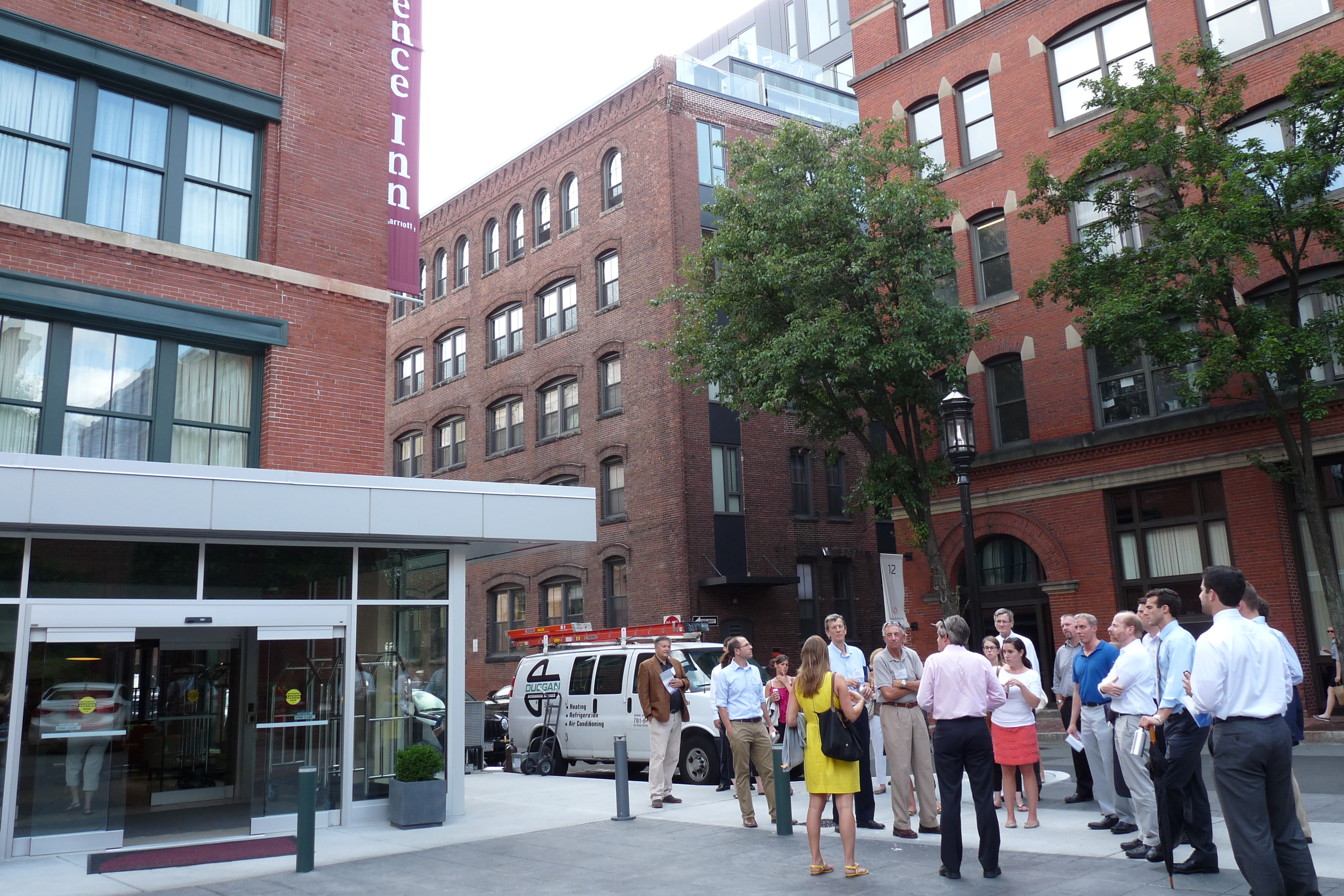
P1090057For many years, the transformation of the Boston Seaport District into a vibrant mixed-use market seemed to always be decades away. For those of us who participated in the NAIOP Seaport Walking Tour, we know that this massive area across Fort Point Channel is finally living up to the hype.

David Manfredi, Principal at Elkus Manfredi, began the program by describing the development over the last 10 years, which includes 2.3 mm sq. ft. of office, 750 new residences, 1,700 hotel rooms, 40 restaurants & cafes, 3 acres of parks, and the ICA and the convention center. This transformation was enabled, in part, by the massive public sector investment in infrastructure and the success of the pioneering development, including the Federal Court House and the Boston Convention and Exhibition Center.

000_0007
Anyone who has been down by the waterfront recently knows there is an enormous amount of construction currently underway, including another 1.8 mm sq. ft. of office, 1,100 apartments, 120 hotel rooms, 30k sq. ft. of retail and many more restaurants, and .5 acre of park space. Highlights include:

• Residences at 399 Congress
• Watermark Seaport apartments
• Boston Wharf Tower apartments
• 411 D Street apartments
• Pier 4 Apartments
• Waterside Place mixed use
• Marriott Residence Inn
• A Loft & Element Hotels
• Tavern Rd, Blue Dragon restaurants
• Bee’s Knees store
• One Channel Center (State Street Bank)
• Block L1 Seaport Sq. (Price Waterhouse)
• 49, 51 and 63 Melcher Street offices
• Vertex at Fan Pier
• Channel Center park
• Q park
• District Hall Innovation Center

Upcoming construction includes yet another 1.1 mm sq. ft. of office, 700 residences, 750 hotel rooms, 300k sq. ft. of retail and many more restaurants, as well as an expansion of the BCEC.

Thousands of new employees will be working in this district, with a likely significant number choosing to live in the area, and all of them spending at least some time in the many restaurants and shops along the waterfront. The need for diversity, options and vitality in this mixed-use area is clear. There is probably more happening in the Seaport District right now than in any other area in Massachusetts (or in any other major metropolitan area across the country, for that matter), and it doesn’t look like it will be slowing down anytime soon.

View photos from the event.