Unknown's avatar

About Tamara Small

Tamara Small is the CEO of NAIOP Massachusetts.

Boston Still Riding the Wave for Growth

Although recent article in The Boston Globe, “Rents soaring in city’s Innovation District”, gives the impression that the Seaport is competing head-on with Back Bay, one needs to look closely at the two markets. The majority of the increases in rents from Class A, high-rise space are from existing properties in the Back Bay, while it is the newly constructed buildings in the Seaport that are contributing to its high rental rates.

Obviously, any tenant committing to newly built office space will be paying a premium to occupy the space, due to the high costs of land and construction.  More telling is the solid rental increases within the existing office building environment occurring in the Back Bay with renewals and new leases.

There is no question that the Innovation District is now on the map and is a credible locational choice for growing businesses.  However, the Back Bay is the established work/play/live neighborhood that will continue to be attractive to a full range of businesses. As time goes on, demand for space (and rents) will be more similar in those districts as well as in the “new” downtown market (formerly referred to as the Financial District).

The good news is that Boston is still riding a wave of growth and construction, setting it apart from most other CBD’s in the country.

New Construction for Greater Boston?

At the recent NAIOP/SIOR Annual Market Forecast, there was talk about the possibilities of speculative commercial development in Boston.  There was a consensus that we will continue to see new construction in the suburbs, Cambridge and Boston due to falling CONSTRUCTION_BLOGvacancies, raising rents, building obsolescence, and limited blocks of space available for large users.

The key stumbling block is whether tenants will pay a premium price over the rents available with existing vacant spaces (especially in areas where rents have not grown as quickly, like Boston’s Financial district.) The new buildings will have the greatest challenges in holding down rents due to the rapid rise in construction costs (with Boston having one the highest union labor wages.)

It is said that “time is money”, so a possible solution is to accelerate the speed of construction. Take a look at the following YouTube video of a 30-story tall hotel built in 360 hours (complete with room furnishings!)

A Scalpel, Not an Axe for the BRA

Ed Glaeser just penned an op-ed in The Boston Globe entitled “Fix BRA; don’t break it.”

With all the campaign talk about the Boston Redevelopment Authority’s problems, it is sometimes easy to forget what it does well, and all that it has accomplished for the benefit of the City, its businesses and residents. Sometimes, a scalpel is preferable to an axe!

Glaeser’s short list of do’s and don’ts are right on target:

  • Above all, don’t make it harder to build.
  • Don’t imitate other cities blindly.
  • Don’t give neighborhoods a veto.
  • Don’t create an agency that has too many objectives.
  • Don’t make a fetish of agency independence.
  • Do increase independent oversight.
  • Do set up clear rules.

Mayor-elect Walsh is very fortunate to be coming into office with a healthy business  environment.  Projects under construction or permitted and ready to go and are at an all-time high.  The key is to maintain predictability and keep this momentum going.  By working with developers and the community leaders that have valid concerns about growth in all of the neighborhoods, reasonable changes can be made to the permitting process.

The goals of that discussion should be to provide permitting rules that are transparent, consistent, timely, and predictable.  We have a great City and we all benefit from thoughtful, well planned growth.

Dueling Visions for Boston’s Future – Mayoral Candidates Q&A

The Boston Mayoral election upon us.  No matter who wins the race, either City Councilor John Connolly or State Representative Marty Walsh, we are all in for a dramatic change after the 20 year term of Tom Menino.

With the city experiencing one of its greatest growth spurts, businesses will want to know what this choice will mean for them starting January 1st.

I sat down with George Donnelly and Jon Chesto, Boston Business Journal’s editors,and Sam Tyler President of the  Boston Municipal Research Bureau‘s Sam Tyler, to interview these two candidates separately, questioning them on their competing visions of what’s best for business, economic growth and Boston’s future.

Q&A with John Connolly

Q&A with Martin Walsh

Don’t forget to vote next Tuesday, November 5th!

Climate Change Preparedness: A Shared Responsibility

Climate change can have significant impacts affecting the overall economy; directly, by damaging structures, and indirectly, by compromising transportation systems, communications, and utilities. An increasing number of extreme weather events and future sea level rise may lead to more frequent and extensive flooding along the coast and inland waterways.  In response, local and state agencies, building owners, lenders, insurance underwriters, and tenants are now considering how to prepare for and respond to such events.

NAIOP has developed guiding principles regarding climate change preparedness and the commercial real estate industry:

  • Preparing for storm related events should be a shared responsibility between the public and private sectors. The primary role for city and state governments should be to ensure the continuity and protection of public infrastructure and public safety. (Having a “climate change proof” building in the middle of a flooded neighborhood, without power or adequate transportation, provides no real public or private benefit.)  Stakeholders should be at the table with state and local decision makers early on in the process to prioritize short-term and long-term public and private responses.
  • Best Management Practices developed in other cities should be shared among public and private sector stakeholders, and their applicability to the Commonwealth should be carefully considered.
  • Not all properties will be affected by climate change in the same way. Owners should have the flexibility to make decisions based on the needs of the individual properties, ownership, tenancy, and product type. Tenants will have varying expectations for building accessibility during and after severe weather events. (e.g., Institutional owners, such as hospitals, may be more likely to make significant investments in order to prevent a shutdown of any kind, while commercial offices may not need the same investments since a safe shutdown and simple return to service would be sufficient).
  • Both costs and risks need to be evaluated by the ownership when considering climate change-related investments or upgrades to buildings, as well as regulatory changes (e.g., if the costs are high and the risks are low, owners cannot be expected to incur unsustainable expenses that result in uncompetitive rents).
  • A combination of incentives and regulatory flexibility may be needed to make the investments in storm preparedness measures viable for the commercial real estate industry (e.g., Zoning changes that would allow for increased building heights, exceptions from gross floor area calculations, or allowing fuel tanks to be stored on a floor above the basement.)
  • The real estate industry, through the actions of owners, investors, lenders, and insurance carriers, will lead to appropriate property preparation and responses to existing and projected weather trends. Regulatory mandates from the government are not the best way to address this issue, because they inappropriately assume industry inaction, and lack the necessary flexibility to accommodate building and site specific variables.

This is an important issue, but the solution should not be aimed solely at commercial building owners.  If we are all affected by the challenges, we should all be doing our part to protect our residents and businesses.

Infrastructure: A Winning Investment for the City

The City of Boston is on a roll with an enormous volume of new construction in many of its neighborhoods. Much of that development was dependent on the ability of the owner to provide funds for local public infrastructure. Unfortunately, that reality can, at times, delay a worthwhile project for many years, missing out on a strong market.

However, a city can be the catalyst for an area, by investing ahead of the market and setting the stage for growth. Through city investments, it can also enhance the efforts for attracting new companies to the area.

A good example is the Seaport/Innovation District. The city can play a very important role by investing in the basic streetscape of this area. Here is a photo of Seaport Boulevard, the main artery running through this district:

seaportblvd

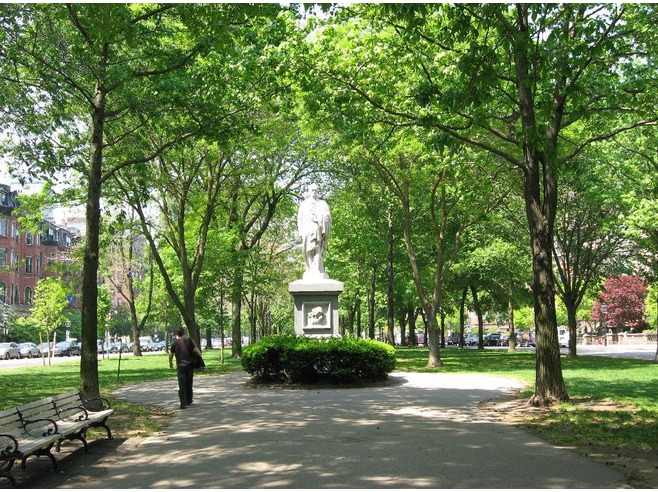
Now, imagine the impact of creating public spaces similar to Commonwealth Avenue or Park Avenue in New York City:

parkave commaveBoston is a world class city and it has the very unique advantage of 100 acres of prime real estate being developed adjacent to its downtown market, allowing it to expand its residences, offices, and shopping. As a result, tens of millions of dollars will make their way into the city’s coffers.

Now is the time for Boston to make a solid investment by making Seaport Boulevard a true boulevard with a wide, tree lined sidewalk with trees, benches and art. Let’s make this area the envy of every other city and a true attraction for families, tourists, and businesses, alike.

Patience for a 1,000 Foot Tower

In a recent BBJ article by Thomas Grillo, there seems to be some interest from the BRA to renew its search for a developer of the city-owned Winthrop Street Garage site on Devonshire Street between Winthrop Square and Federal Street. The previous proposal was to build a 1,000-foot tower with 1.3 million square feet of office space on the approximately one acre parcel.

It’s always exciting for a city to talk about the prospects of having the tallest tower in the city built. However, historically, this city sometimes lacks the patience to allow the marketplace to support the new venture.  It is difficult enough to build an office building a quarter of the size of this dream project without substantial pre-leasing at rents that justify the expense of constructing a tower. A delay in development does not equate with a lack of expertise or, even, capital. It just means that there are economic cycles that affect these decisions. To ignore market demand would be at the owner’s financial peril.

If we want to attract serious interest from developers in this site, the BRA and the new Mayor will have to understand that giving a permit to build a project of this magnitude will require the patience of Job!

The Seaport’s Time Has Come

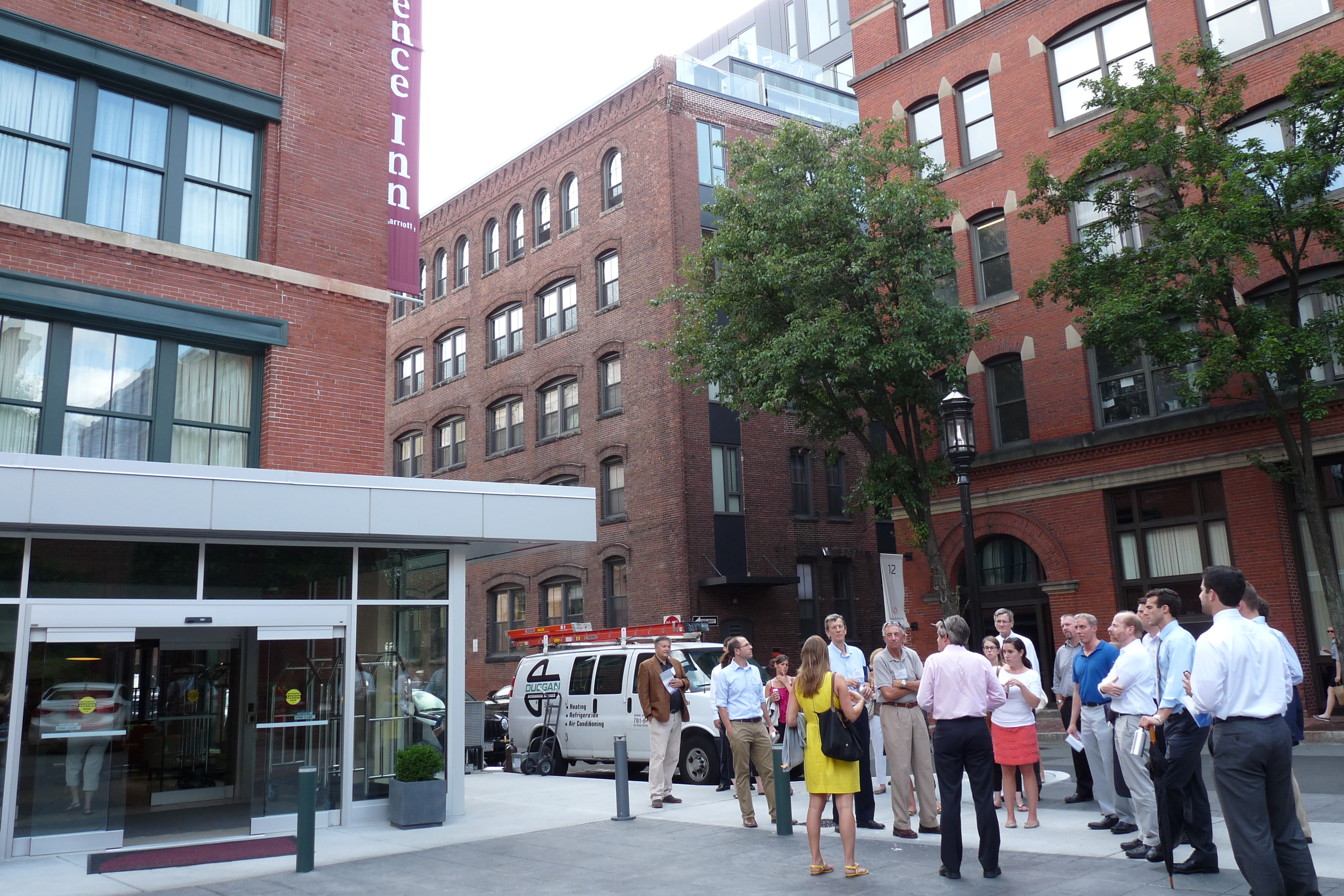
P1090057For many years, the transformation of the Boston Seaport District into a vibrant mixed-use market seemed to always be decades away. For those of us who participated in the NAIOP Seaport Walking Tour, we know that this massive area across Fort Point Channel is finally living up to the hype.

David Manfredi, Principal at Elkus Manfredi, began the program by describing the development over the last 10 years, which includes 2.3 mm sq. ft. of office, 750 new residences, 1,700 hotel rooms, 40 restaurants & cafes, 3 acres of parks, and the ICA and the convention center. This transformation was enabled, in part, by the massive public sector investment in infrastructure and the success of the pioneering development, including the Federal Court House and the Boston Convention and Exhibition Center.

000_0007
Anyone who has been down by the waterfront recently knows there is an enormous amount of construction currently underway, including another 1.8 mm sq. ft. of office, 1,100 apartments, 120 hotel rooms, 30k sq. ft. of retail and many more restaurants, and .5 acre of park space. Highlights include:

• Residences at 399 Congress
• Watermark Seaport apartments
• Boston Wharf Tower apartments
• 411 D Street apartments
• Pier 4 Apartments
• Waterside Place mixed use
• Marriott Residence Inn
• A Loft & Element Hotels
• Tavern Rd, Blue Dragon restaurants
• Bee’s Knees store
• One Channel Center (State Street Bank)
• Block L1 Seaport Sq. (Price Waterhouse)
• 49, 51 and 63 Melcher Street offices
• Vertex at Fan Pier
• Channel Center park
• Q park
• District Hall Innovation Center

Upcoming construction includes yet another 1.1 mm sq. ft. of office, 700 residences, 750 hotel rooms, 300k sq. ft. of retail and many more restaurants, as well as an expansion of the BCEC.

Thousands of new employees will be working in this district, with a likely significant number choosing to live in the area, and all of them spending at least some time in the many restaurants and shops along the waterfront. The need for diversity, options and vitality in this mixed-use area is clear. There is probably more happening in the Seaport District right now than in any other area in Massachusetts (or in any other major metropolitan area across the country, for that matter), and it doesn’t look like it will be slowing down anytime soon.

View photos from the event.

Bullet Trains for Boston?

photo
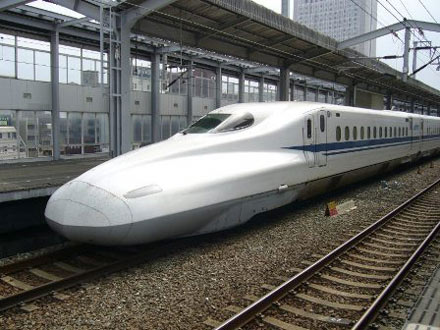
It’s an interesting time to think about investments in infrastructure, as the state legislature’s major transportation bill is now being finalized. As I experience Japan’s modern, expansive train system, I wonder what a bold transit plan for our Commonwealth, and the greater region, could do for our economic future?

For example, imagine a “bullet” train that travels, at least, 150 miles/hour (certainly, a far cry from our aging T fleet.) After years of hunting for an economic solution to our western region, what could a 30 minute commute between Boston and Springfield mean? Talk about an economic development engine that could also open up affordable housing alternatives!

Konnichiwa from Tokyo – Low Vacancy Rates & New Development

TOKYO_2013

I came to Tokyo expecting to find an aging office stock with little new construction and extremely high vacancy rates. I am surprised to report that not only are there magnificently designed, new, mixed-use projects, especially in the Shiodome area, vacancies are at levels that would make us envious. It turns out that vacancy rates in the 7% range (including the older stock) are considered dangerously high. Historically, rates have been under 4% in the Tokyo prime markets, only rising in response to major global impacts like the “dot com bubble” or the recent recession started by the U.S. subprime mortgage crisis. Curiously, real rents have not grown that much. With vacancies like this in Boston, rents would be spiking. Clearly, it’s a different economy!