
Unknown's avatar

About Tamara Small

Tamara Small is the CEO of NAIOP Massachusetts.

Post Election Economic Strategy for Massachusetts

NAIOP congratulates Governor Deval Patrick on his election to a second term!

Ed Glaeser

Ed Glaeser

Under the category “it’s never too early to do good planning,” we would like to recommend that the Governor listen to the advice of Harvard Professor Ed Glaeser as outlined in his recent column in the Fall issue of Commonwealth Magazine

Glaeser very succinctly spells out what the leadership in Massachusetts should focus on in order to position the state for sustained long-term growth including:

  1. Renew the Commonwealth’s commitment to invest in education and show a willingness to innovate.  The state must also do a better job educating disadvantaged children without access to safe, quality schools.  Further support for charter schools is needed.
  2. Create a business environment hospitable to all businesses, large and small, rather than picking winners in only certain sectors
  3. Make Massachusetts  more “small-firm friendly” (e.g., substantially reduce the enforcement of non-compete clauses.)
  4. Establish a “blue-ribbon” panel to review the extensive list of tough regulations and rules that result in Massachusetts frequently being listed as among the least business friendly states.
  5. Tie local allocations of state aid to better, faster local business permitting.
  6. Try to retain more of our local college graduates.  Consider expanding the Adams Scholarship program, waiving in-state tuition charges and fees for high performing in-state high school graduates.
  7. Tie state education aid to good school practices.
  8. Press for housing market reforms that will make the state more affordable and dynamic to be able to attract and keep skilled workers and entrepreneurs.  The state must provide a counter-weight against local regulations discouraging workforce housing.  (e.g. Tie state aid to issuance of building permits, encouraging localities to lower barriers.)

As Glaeser concludes, job creation is a result of the state focusing on its core competencies of providing a decent quality of life to people throughout the state in order to attract entrepreneurs. Then the Commonwealth should step back and allow business to move forward. 

I totally concur.
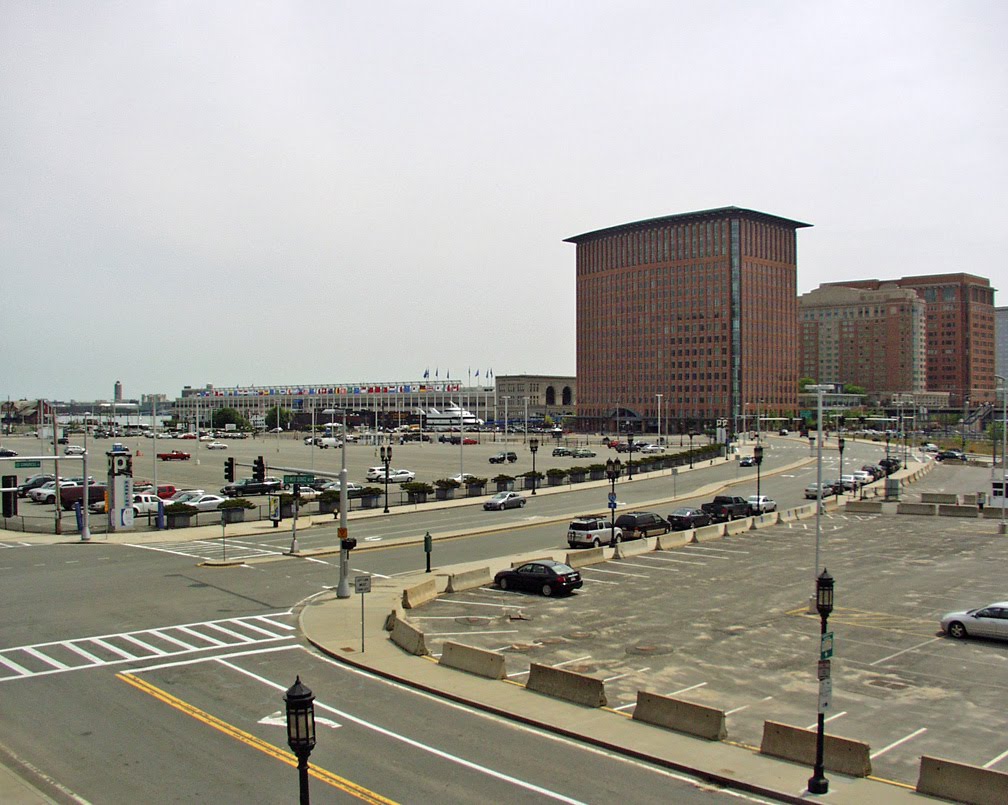
Parking in the Seaport: Here today, gone tomorrow.

Interesting Op-ed piece in the Boston Globe October 23rd by Paul McMorrow talking about the changing requirements for parking in Boston, more specifically in the Seaport District.  Basically, Paul is saying the BRA is moving more to a concept of a maximum allotment for parking for new developments rather than a minimum.  This is supposedly due to the changing commuting dynamics with employees living closer to work (and, therefore, not as dependent on the automobile.)

Parking in the Seaport

More interesting is that as the Seaport is developed, using primarily Joe Fallon’s and John Hynes’ surface parking sites, there will be less and less space available for the drivers currently using these lots.  And who are these people and where do they work?  Well, if you look over to the Financial District what you will see is a densely built office environment without much parking.  There is a parking freeze in that district which the city insists is working very well – a model for the Seaport parking freeze, as a matter of fact.

The problem is that the freeze works in the Financial District because of the availability of so much low cost parking in the Seaport.  So, when that inventory of “cheap” long term parking disappears, the businesses in the Financial District will have a problem on their hands as their employees jockey for the remaining handful of parking spots. That is, unless there is a massive investment in mass transit over the decade.  I leave you to contemplate the chances of that! (Leave your prognostications in a comment, below)

Housing Affordability: Not Yet in Massachusetts

One would think that with the national housing market bust, the issue of affordable housing in Massachusetts is on its way to resolution. Well, maybe not so quickly.

The New England Public Policy Center and the Federal Reserve Bank of Boston recently produced a discussion paper: The Housing Bust and Housing Affordability in New England by Robert Clifford, Research Associate.

The paper looks at affordability in the New England states and the rest of the nation. The results show that although New England’s housing prices have declined and affordability has returned to the pre-housing crisis levels of the early 2000s, owner-occupied housing in Massachusetts is still less affordable than in the rest of the nation. Clifford remarks:

The affordability measures explored here point to lingering sources of concern pertaining to the high cost of homeownership in New England. In four of the six New England states (all but Maine and New Hampshire), recent drops in home prices have not been large enough to make the median-priced home affordable for the median-income household. Or—to present the same results from a different angle—the weak economy has prevented middle-income households from augmenting their incomes enough to allow them to afford the median-housed home in their state. The difference in affordability between New England and the nation is especially acute in Massachusetts.

The study also shows that more of the region’s households are becoming cost-burdened, particularly low- and middle-income homeowners.

Unfortunately, what this means for the Massachusetts economy is that, as the recovery begins nationally, job opportunities in other states will start attracting young families out of the region and into areas that are more affordable, leaving us yet again with a declining skilled workforce.

Once and for all, we need to develop a serious policy that allows for the construction of smaller, denser, affordable, starter homes.

Vote No on Question 3

A referendum on next month’s ballot, Question 3, would not only roll back last year’s Massachusetts sales tax increase, but would bring the sales tax rate all the way down to 3 percent.  The last time we saw a rate that low was in the 60s!  That certainly beats a one-time tax free holiday weekend, and who wouldn’t like a 3% savings on all our purchases year-round?

Unfortunately, as they say, there is no free lunch.  Remember the painful cuts to the state budget these last two years?  Remember the increasing costs of healthcare/Medicare; education; deferred infrastructure investments?  Well, with a declining revenue picture subtract from that another $2.5 billion dollars in state spending. The Massachusetts Taxpayers Foundation’s recently released report, Question 3: Heading Over the Cliff, indicates passage of Q3 would result in across the board cuts of 30% in virtually all state programs!

We’ll all feel it as local aid is dramatically slashed affecting schools, police, firefighters and infrastructure repairs. This is why NAIOP Massachusetts has joined with other leading business groups to form Business Leaders Against Question 3, which has launched a series of radio spots educating voters on the unintended consequences of this proposal.

Yes, we all would like to save money, but not at the expense of hurting ourselves and our neighbors. Join us and vote no on 3!

Filenes Site in Downtown Crossing: “Let’s Get Real”

In a recent Boston Globe OpEd, Paul McMorrow supports the proposal suggested earlier in the year by the developers Vornado and Gale to phase in the redevelopment of the Filenes site in Downtown Crossing.

Their concept was to construct not just the garage and the retail space as originally proposed, but also the foundations necessary to accommodate the future development of the towers. What a great idea!  Not only does this resolve the city’s frustration with the open “hole”, but it gives a shot in the arm for the retail activity in the area.

An earlier rendering of the site

An artists rendering of the site

It is easy to throw verbal rocks at the developer for their failure to honor commitments made before the downturn to move forward with this project. But let’s get real. This is the worst national recession since the Great Depression.  You can look around the whole country and I will challenge you to find a single major speculative office building starting construction.

The city of Boston will be a big winner with this alternative approach. They get the project started, new jobs are created, retail gets a boost, and much needed tax revenues will be maximized once the second phase gets built.

Let’s encourage the start of phase one of this project and allow the market to recover before we make an unreasonable demand to the owners to make a failed investment ahead of its time.

Protect Affordable Housing in Massachusetts: Vote No on Question 2

Question 2 on the Massachusetts ballot this November would rescind Chapter 40B, the state’s affordable housing law.  According to the Citizens’ Housing and Planning Association (CHAPA), 80% of the affordable housing built since 2000 would not have been built without Chapter 40B. Most communities favor large lot, single family subdivisions and, without 40B, would not allow for denser, cluster designs or multi-family housing. 

Housing permitted under Ch. 40B serves a broad range of households that are critical to our workforce.  Many of the market rate units have increased housing opportunities by creating ownership units that are less expensive than the existing large lot homes and by creating quality rental opportunities in high employment areas underserved by the rental market (40B developments represent 53% of all new suburban apartment construction). 

Massachusetts has one of the highest costs of living in the country and the largest single component of that is housing.  It is no wonder that we have led the country in the outmigration of our 25-40 year old skilled workers over the past decade.  If we are to recover our leadership role as an innovation economy, we need to keep these young families and provide them with affordable housing choices. If Chapter 40B is repealed it would immediately halt the creation of needed workforce housing and will jeopardize the future economic prosperity of Massachusetts.  This comes at a time of high unemployment, growing homelessness, and the worst foreclosure crisis on record.

However, if that is not enough to convince you, read the recent study from the University of Massachusetts Donahue Institute that Chapter 40B can spur an economic recovery.  By allowing the 21,000 units of housing already approved to move forward, the Commonwealth would benefit from over $10 billion in spending and nearly 55,000 jobs.  Now that is a stimulus plan!

So, Vote NO on Question 2 because it is the right thing to do for the young families looking to remain and work in Massachusetts.  Or do it because we need to get the recovery going to provide jobs and to help stop the looming cuts to local services.

A Tale of Two Cities: Commercial Real Estate Investment in Boston

The BBJ reports that a PricewaterhouseCoopers national survey confirms what we, here in Boston, have been seeing for this past year, that real estate values are living a double life.  There is a very healthy market here for core assets with low vacancies and long term leases – long enough to get through this downturn and, hopefully hit inflation in rents.

With low interest rates, credit becoming more available for credit worthy borrowers, and a ton of investor money looking for low risk real estate investments, cap rates are falling (and prices are climbing for sellers.)  More owners are considering the sale of their properties, not only due to financial pressures, but because this is a good market to sell class A properties into.  There are already a number of apartment projects that have hit the street with asking prices in the 4-6% cap range – and they will most likely sell at those prices.

Except for the other real estate. You know, the kind of property that the opportunity funds were looking to buy at a deep discount.       

Oh that there were more of that product out there.  But that is the problem.  Generally, banks and/or regulators have not pushed borrowers over the cliff (ala 1990s.) So, with limited core and distressed product and a crush of investor dollars, there is no sign that prices will moderate anytime soon for the quality stuff, or that the problem property will be priced to sell.

At the NAIOP Main Event breakfast: “Investors Unplugged,” this seemed to be the theme.  But there were some concerns voiced even about the core quality product.  The big question seemed to be can you buy at the current low returns and have an exit strategy that justifies the acquisition price.  What if interest rates rise?  Generally, cap rates rise too.  And if you can’t count on cap rates dropping to appreciate your investment, then you must be convinced that vacancies are going to drop sufficiently for rents to go up.  Will that happen in all markets?  Only those with the ability to grow the job market.  (Note, Massachusetts employment has been relatively flat from 1990 to 2010!)

And for those distressed properties counting on leasing up the vacancies, how long an absorption period are you plugging into your underwriting assumptions and how much will those rents need to rise?

Lastly, the answer to the question for each of the NAIOP participants of what can you pay for an asset today, was what is the appropriate rate of return on your capital?  That is going to be very different for the pension fund, opportunity fund, sovereign fund or REIT.

So, get ready for a bumpy ride through 2011.  Some players are rooting for the FDIC to pull the plug on life support, while others are just looking for a little more forebearance.  How that works out will be the key to the pricing of real estate product.

Property Owners May Lose Rights to Appeal

You think that as a property owner you have basic rights and that if there are changes to those rights you must be notified of them.  Not necessarily. If you are a property owner in Milford, Bellingham, or Franklin, you may lose your rights to appeal changes in how you manage stormwater discharges from your property.

Though all affected property owners should have received notice of the comment period for EPA’s Draft General Permit for Residually Designated Discharges, we recently learned that EPA used aerial photos from 2005 to determine what properties hit their two acre threshold. So, any properties that have been developed since that time probably did not receive any notice, but will still be required to comply.

More importantly, only those who participate in this permit process by filing comments on the draft permit or by participating in the public hearing, may appeal a permit decision.  You don’t write a letter, you cannot later appeal!  It does not have to be a technical letter; just go on record that you have concerns about this proposed permit and you want to reserve your rights to appeal.

The deadline to submit comments on is midnight on September 30, 2010.

To view NAIOP’s in-depth comment letter and additional information (links, fact sheets, and presentations) on this regulatory initiative, please visit NAIOP’s new website and click on stormwater (member login required).

No Turkeys Here

Banker & Tradesman’s “Turkey Hunt” column (September 20) unfairly took aim at some of the city’s most innovative real estate projects. The premise was that too many development projects have languished over the years because of “do-nothing” developers whose approvals should be “terminated” by the city to allow other developers a chance to build in Boston.

I think we need to set the record straight about permitting and developing in Boston.

First, permitting is a lengthy process for major projects – from land acquisition, feasibility studies, and discussions with the BRA, to endless meetings with neighborhood groups, and renegotiating the design proposal… all before the formal permitting process can begin. Then there is the city’s Article 80 process and the state’s permitting and MEPA review. 

Many years of negotiation and planning are required before a developer can get to a final approval. Because the process takes so long, a developer cannot know if there will be a market for their project when they finally get the necessary permits. That reality can cause serious delays. The recent credit crisis freezing projects all over the country for the past two years is proof of this. 

These are not “do-nothing” developers.  These investors want to move forward, but they can’t without financing and a ready and willing market.  No developer can avoid market realities.

The good news is that, as a result of the Permit Extension Act, many projects will now be able to maintain their permits so they will be “shovel-ready” when the market improves – avoiding another 5-7 years spent reapplying for permits and missing another market cycle.

As any good hunter knows, before you start hunting for turkeys you better know what you’re looking for.

Permit Me to Glow: The Permit Extension Act Will Help Massachusetts Grow

On August 5, Governor Deval Patrick signed into law an economic development bill (Chapter 240 of the Acts of 2010) that included the Permit Extension Act (Section 173 of the new law).  In response to the credit crisis and market crash of late 2008, NAIOP Massachusetts promoted the Permit Extension Act from the very first day of the legislative session in January 2009.

At that time, none of us could have imagined how or if the country would emerge from one of the worst downturns since the Great Depression.  What was clear was that it would be a long time before any of us would see any new construction from the private or institutional sectors. 

It seemed obvious that if this Commonwealth was to have “shovel-ready” projects set to move forward when the economy turns, those projects could not lose the many permits and licenses already issued by either the local or state authorities.  

It takes years to get a new project approved – starting with numerous local hearings and going through everything from zoning changes, to special permits, to wetlands permits, to traffic mitigation, to environmental reviews at the state MEPA office.  Compound this with numerous appeals, and then you miss your economic cycle! Allowing these permits and approvals to expire would have killed countless projects.

The Permit Extension Act:

  • Extends permits in effect at anytime between 8/15/08 – 8/15/10 for two years (including those that expired during this time).
  • Takes effect immediately for projects that had approvals in place for even a single day of the two year window.
  • Applies to a wide range of permits including wetlands, MEPA, building permits, waterways, and approvals under Chapter 21, 40A, 40R, 43D, as well as variances, and all local bylaws and ordinances. 
  • Goes into effect automatically and no approval is needed by the state or local permitting authority.

Continue reading