
Unknown's avatar

About Tamara Small

Tamara Small is the CEO of NAIOP Massachusetts.

Mass. Officials Make Their Case to Israeli Entrepreneurs

Editor’s Note: NAIOP CEO David Begelfer is traveling with Governor Patrick’s Trade Mission to Israel and is sending daily updates on their progress.On our third day in Israel, Governor Patrick led a Town Hall: “Collaborating as Leaders in the Innovation Economy” at The Technion (Israel’s “MIT”).
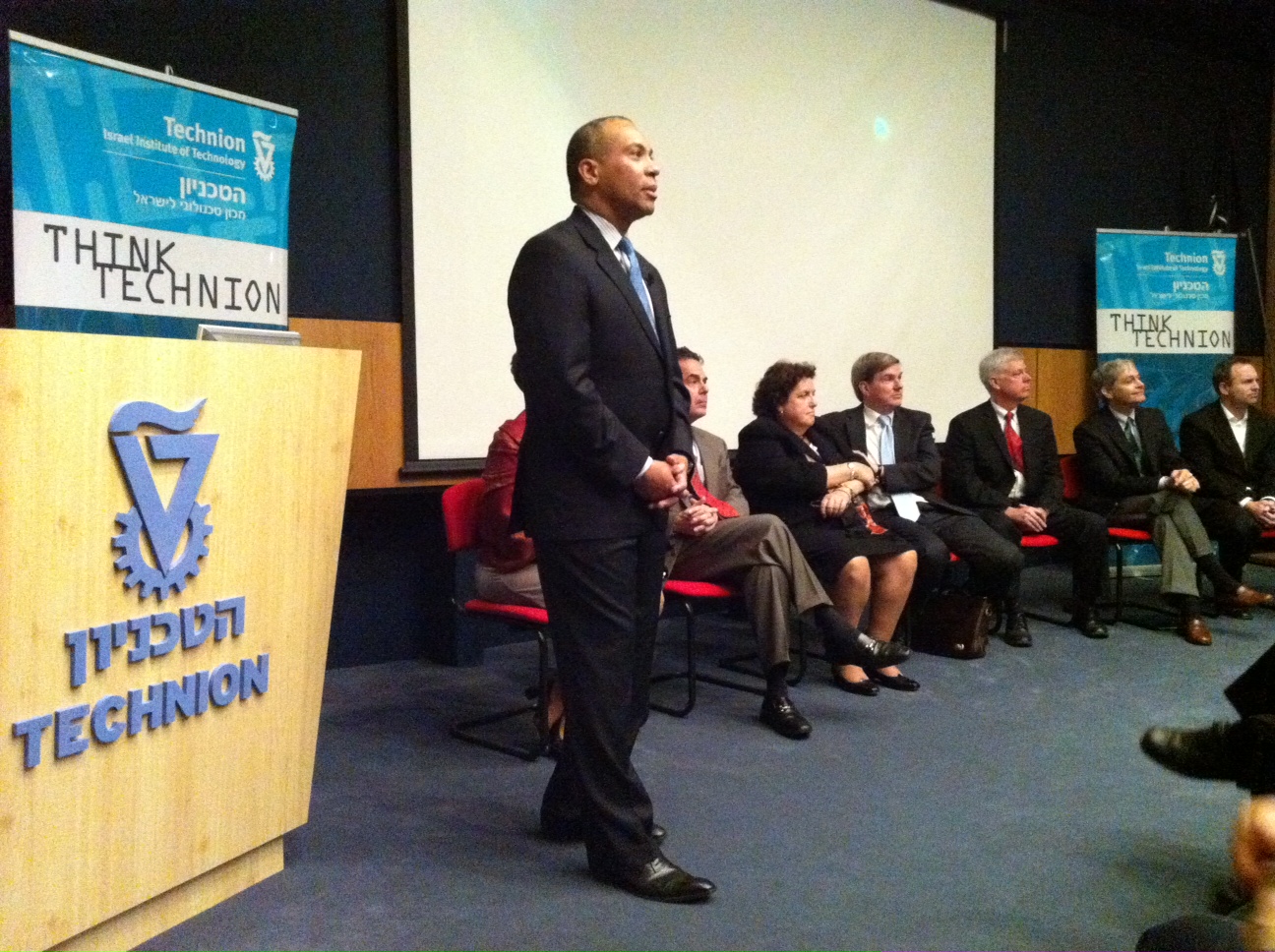
Governor Patrick at The Technion

Questions centered on what early stage resources were available if the Commonwealth wanted to attract start-up businesses? 

Susan Windham-Bannister, President & CEO of the Massachusetts Life Sciences Center, explained that the Center was established to promote and make financial investments to grow life sciences companies. The Center is there to fill the gap in the “Death Valley” of VC funding, the period from when a startup receives initial capital to when it begins generating revenues. Additional financing is usually scarce during this time, so the Center provides 5-year loans to qualified firms.

Patrick Cloney, Director of the Massachusetts Clean Energy Center, said they are promoting the state’s clean energy industry by making direct investments and providing assistance to access capital. In 2009, the state’s ratepayer-funded Renewable Energy Trust Fund was transferred to the Center.

Finally, Pat Larkin spoke about the Massachusetts Technology Collaborative, which encourages the formation, retention, and expansion of technology-related enterprises.  As Director of the MTC’s John Adams Innovation Institute, he makes investments in the knowledge-based economy.

Other notable moments on the trip included a presentation by Haifa Mayor Yona Yahav who spoke to our delegation at the Combined Jewish Philanthropies’ Boston-Haifa Connection’s “Shiluvim” program (an effort to help Ethiopian Jewish immigrant children adjust to a new life in Haifa).

And the BEST falafel stand in Tel Aviv!

Israeli Investors Looking to Buy

Day two on the Massachusetts – Israel Innovation Economy Partnership Mission with Governor Patrick started with an intimate meeting with some of the largest Israeli real estate investment firms and insurance companies. 

These companies have substantial assets in Israel, but, with a relatively small home market, they are diversifying their investments worldwide in Europe, Asia, South America, and the United States. In 2010, Israelis were the second largest investment group in the US.  

These firms are investing in most product types, including office, retail, multi-family, and medical/research. They say that they are finding better returns in the United States than in other countries. 

However, to date their investments have been in major metropolitan areas like New York, Miami, Houston, the Bay Area, and even Las Vegas. They have not had much success in Boston. Some have tried, but few have been able to find the right opportunity. 

Today Governor Patrick made a great case to have these public companies come to Massachusetts. With markets stabilizing and rents moving upwards, now is the time for Israeli companies to look here for direct investment and joint ventures. Industry leaders and government officials look forward to welcoming them to the Bay State!

Direct Boston-Israel Flights Key to Economic Investment

Today, at the start of the Massachusetts – Israel Innovation Economy Partnership Mission with Governor Patrick, our first meeting of the day was with the CEO of El Al Airlines, Major General Eliezer Shkedi. A small group of us met with the General and his staff to pitch having El Al open non-stop direct flights between Boston and Tel Aviv.

General Shkedi, Governor Patrick and Robert Kraft

If there was one single action that could directly affect the growth of new Israeli businesses in the Commonwealth, it would be the convenience of direct flights. Boston is already the second largest origin-destination, business market without nonstop service and Massachusetts ranks 5th among U.S. states for air exports to Israel.

With the ties that we share with Israel in the High Tech, Life Sciences, Finance, and Higher Education sectors, our shared economic future is certain to support this important service.

Companies like EMC, Cubist, and Glasshouse Technologies all indicated their company’s strong interest in supporting direct flights.  Robert Kraft made the obvious statement that non-stop flights are not only good for their business, they would be profitable for El Al, with higher paying business passenger revenue.

Governor Patrick proposed that both “sides” have their staff work on the numbers over the next six months and reach a decision about the feasibility of these flights. General Shkedi agreed to see if it can work.

Right now, El Al is considering non-stops to Miami and Chicago. We might not be able to compete with the large Jewish population in South Florida, but we should hold up well with Chicago, especially with El Al’s partner airline’s (Jet Blue) major expansion in Boston.

Who knows, in a year or two, sitting on the tarmac in New York may not be necessary to get to Tel Aviv.

Off to Israel with Governor Patrick

An important part of NAIOP’s mission is to promote overall economic development, which in turn supports the Commonwealth and its business community.  As such, I am honored to represent the members of NAIOP by joining Governor Deval Patrick, along with a coalition of state officials and business leaders, on next week’s Massachusetts Innovation Economy Partnership Mission to Israel. The coalition will explore growth opportunities within the Commonwealth’s innovation-based industries – technology, life sciences, clean energy and financial services – and areas of common interest between the state’s established and emerging partners in Israel.  The coalition will then continue on to the UK.

During the trip, I will join Governor Patrick and members of the delegation in roundtables, company visits, and meetings with government and business officials in Tel Aviv, Haifa, and Jerusalem.  I believe the mission is an important opportunity for the Commonwealth to explore new growth opportunities and business relationships in the global market, which could lead to increased real estate investment and development throughout the state

There are nearly 100 companies with Israeli founders or Israeli-licensed technologies in Massachusetts today.  In 2009, these companies employed nearly 6,000 people and generated $2.4 billion in direct revenue for the state. Local firms exported over $180 million worth of goods to Israel in 2009 and, at 12.35 percent, the United States is Israel’s largest source of imports.

I plan to blog from Israel and provide regular updates about what we learn. When I return, I and other participants from this trip and last fall’s City to City trip will present a program on The Boston-Israel Connection, presenting our findings and exploring the possibilities for growth that will benefit our industry.

Regulatory Reform – 10 Principles on Guidance

Recently, there has been much talk about the proliferation of regulations, both on a national and statewide basis.  President Obama mentioned it in his State of the Union speech and Governor Patrick referenced it in his Inauguration speech.

There is no doubt that there needs to be a serious review of many regulations at the state and federal levels.  Beyond traditional regulations, however, there is an area of “shadow” regulations that has been expanding through the state’s agencies – regulatory “guidance.”  NAIOP has been concerned for some time about the unlimited growth of guidance.  Guidance is taking on the power of statutes (which can only be enacted by the legislature and the Governor), and/or the authority of regulations (which must be promulgated by the agency under strict controls of the Administrative Procedures Act, including public hearing and provision for judicial review). The purpose of guidance should be to aid in the interpretation of previously existing rules and regulations; not to provide an alternative means to impose new rules without full notice and comment through “rule-making.”

Certainly, there is a place for appropriate guidance, so NAIOP would like to propose ten general principles to be followed when drafting and adopting regulatory guidance:

  1. Guidance should be issued to clarify the interpretation of existing rules and regulations.
  2. A second purpose would be to assist the agency in its review of applications and evaluation of a project’s ability to meet applicable performance standards.
  3. Guidance should be clear and user-friendly.
  4. Guidance documents should state expressly that they are for the purpose of “guidance only,” and that failure to follow guidance does not expose one to the denial of a permit application, penalties, or other sanctions.
  5. Under no circumstance should guidance expand the agency’s jurisdiction (subject matter or geographic) beyond that authorized by statute or regulation. 
  6. Guidance should be drafted with input from stakeholders. 
  7. Following internal and stakeholder review, the agency should submit the document for general public comment, allowing affected individuals to comment on the practical and procedural implications of the guidance.
  8. Agencies should add a three-year sunset clause to all guidance, after which it must either lapse or be reissued following an opportunity for stakeholder and public comment.
  9. All guidance should be clearly indexed and easily accessed on the agency’s web page.
  10. Guidance should be uniformly applied throughout all agency regional offices. Guidance should not be developed and issued by one region without the full support and backing of the entire agency.

In a recent blog, Seth Jaffe, a Partner at Foley Hoag, pointed out that this issue is clearly getting national attention with a recent court decision in National Mining Association v. Jackson.  The judge stated that EPA guidance was being treated as binding and that the guidance constituted “legislative rules because they seemingly have altered the permitting procedures under the Clean Water Act by changing the codified administrative review process.”  The Court found that EPA’s guidance exceeded its authority. 

Bottom line, to reduce the excessive cost of doing business in the Commonwealth, let’s make working on regulatory reform a priority. However, we must also make sure that we don’t offset those gains by piling on unnecessary guidance.

Without “Bricks,” Boston’s Greenway Needs Vision

With the YMCA’s decision to pull the plug on their Boston Greenway site, the dream of non-profit institutional involvement to activate this vast swath of open space finally comes to an end. It all sounded quite optimistic a few years ago, but reality dashed those early hopes.  Although the groups that sought these sites were quite different, they all failed for some similar reasons – some within their control, but others well outside their influence. 

Most of the proponents developed their concepts at a very different time – a bull market economy.  There was a sense that endless funding would be readily available from “flush” donors. Therefore, the plans were grand and the prospects of success seemingly assured.  But even without the financial crash, there were far too many institutional capital campaigns already in the works (universities, hospitals, and cultural/arts) to allow these new projects any realistic hope of being funded, no matter how strong Greater Boston’s philanthropic community. The recession killed off all but those campaigns that were in their last phases (e.g. MFA.), leaving the Greenway projects out in the cold.

Another problem was that the state basically ran out of money on the Big Dig.  That meant that some aspects of the project suffered.  In particular, the ramps now stand out as an orphan in search of a benefactor.  The costs to cover the ramps and fully deliver a seamless parkland were too expensive for the Turnpike, so the costs were transferred to eager non-profits who were looking for downtown sites.  Unfortunately, these groups had no idea as to the ultimate premiums they would be forced to absorb.  At one point, the Turnpike actually hoped they might even be paid for the rights to develop these “challenged” sites. Now the state has to accept that these open sores will most likely remain for the foreseeable future.

Finally, we are all left with a serious problem.  Open space is simply not sufficient to attract the public to activate this long stretch of parkland.  On any given day during the summer, it is rare to see the area stretching from China Town to the Zakim Bridge used anywhere close to the extent of other city parks.  

We may not be able to attract institutional interest to the Greenway any time soon, but we must to work to find a way to make this civic space as usable and attractive as our Emerald Necklace.  Readers – what do you suggest?

Creating Energy Efficient Buildings – the Right Way and the Wrong Way

President Obama recently proposed a new campaign to make commercial building space 20 percent more energy efficient by 2020.  The good news is that this is not an unfunded mandate to the industry, but a plan utilizing incentives such as tax credits.

The “Better Buildings Initiative” has a goal of making commercial buildings more energy efficient over the next decade. A new and more effective tax incentive for building owners seeking to upgrade, by rewarding companies for performance improvements, so the credit amount would be based on the actual energy improvements made in a specific building.

This is a more practical means of encouraging energy efficiency retrofits than forcing owners to make marginal returns on large capital investments or by labeling their buildings to highlight their inefficiencies.  Especially during a recessionary period, making these latter policy choices can only hurt a fragile commercial real estate recovery.

NAIOP will be looking forward to further details on this new initiative. In the meantime, we recently submitted comments in opposition to the proposed Energy Asset Labeling Program for Commercial Buildings in Massachusetts and we will continue to urge the Patrick Administration not to move forward with this program.

Predictions for Real Estate in 2011

This is the fifth recession and subsequent recovery I have worked through.  I have learned that business cycles have been and will always be a part of our industry.  It’s just a question of timing.  

Now that 2011 is underway, here are my predictions for the real estate market this year:

  1. Office rents:  Tower rents will break the $75 per square foot barrier. Suburban rents along 128 will hit $35.
  2. New Construction: Multi-family construction will continue to be a sure thing in Boston and the suburbs.  The only speculative commercial building construction starts in the state will be in Cambridge.
  3. Filenes in Downtown Crossing: Will be approved this year with a construction start in 2012. Besides the obvious garage, there will be at least two floors of retail, an apartment tower, and a phase two office tower.
  4. Financing: Plentiful for the well capitalized owner from multiple sources including CMBS.  Interest rates: steady in the 5-6 percent range.
  5. Cambridge market: Employment and space growth in the Life Sciences (biotech and pharma) will lead to new developments.
  6. Hospitals/Colleges: Improving endowments and lower construction costs will put back on track pre-recession expansion plans (but not Harvard’s massive Allston development.)  
  7. Multi-family construction: Twelve developments (each with over 100 units) will start this year.
  8. Foreclosures: Single family foreclosures will increase and some commercial loans for industrial and suburban office/R&D will be placed on the block.
  9. Investment sales: The number and gross sales volume will be the highest since 2007.
  10. Unemployment rate for the Commonwealth: It will be up slightly (less than 1 percentage point) by the end of the year.

Good News in the Debt Markets

We have come a long way since the “depression” of 2008.  For real estate, lending all but dried up and many loans were being called in (some are still in jeopardy.) But times are changing.  For the right borrower, for the right real estate, money is available from a number of sources and competition for deals is back (with some caveats.)

According to lending guru George Fantini’s Key Trends from the First Quarter 2011 Lender Survey, the recently moribund conduit market (securitized lenders) is back for projects with good cash flows.  According to him, the number of credible originators has doubled to 20 with 10 year loans in the mid to high 5’s (lower with 5 year terms.) However, unlike the other lenders (banks and insurance companies who offer terms up to 30 years for $2-30mm loans), they are only interested in the $10mm plus market.   The trade off is that the conduits are not as conservative when it comes to underwriting, although big banks have been talking about 75% loan-to-value ratios (up to 80% for apartments).

Insurance companies are offering rates from the upper 4’s into the 6’s depending on the loan term (the shorter the term, the lower the rate.)

However, be prepared to sign personally for these loans, unless you are dealing with a high quality product (like apartments) or are willing to lower your loan-to value ration substantially.

But the good news is that debt is back and the world of real estate is starting to normalize.  That won’t completely happen until we see some serious increases in employment and corporate/personal spending.

Get the Most Out of Membership: 5 Tips for You and Your Firm

Everyone knows effective networking is a key to continued business success, personally and for your company.  It is through the cultivation of long-term business relationships that existing business expands and new opportunities open up.

One of the best opportunities to network with peers and potential clients is by being an active member of one or more trade associations.  There is an association for almost every niche, locally and nationally, and beyond networking , they offer many other benefits including seminars, workshops, social events, and issue advocacy.

NAIOP at Night, a popular networking event

But just joining an association is not enough. To get a good return on your investment, follow these five tips to building relationships through associations:

1.  Join the right organizations for you.  There is probably more than one association you should consider. Go beyond the obvious and think about who you want to network with.  If you are an attorney, of course you will benefit from learning and sharing with your fellow lawyers, but you won’t get nearly as many business leads as from a group that represents your target industry (which is why so many top real estate lawyers belong to NAIOP.) Find out from friends and colleagues who the association’s members are, and ask yourself if those are the people you need to be developing relationships with. If so, then join!

2.  Participate.  Just being listed as a member of an organization has limited benefits – you must get involved to reap the full value of your membership.  Get started  by attending  programs and introducing yourself,  especially once you’re seated at a table (and don’t always sit with people you already know!)  Remember, you are there to get to know people and for them to get to know you.  Like any kind of relationship building, don’t race to the “finish line” and don’t use these meetings as selling opportunities.  But do come prepared with business cards and be ready to share a clear, concise, and brief description of what you do.

3.  Join a Committee. The gold mine of networking is within the association’s committee structure.  Organizations are always looking for members to volunteer on their many committees, such as program, membership, government affairs, social, and charitable events. There is no better way to get to know others and develop business contacts than by working with them on a common goal.  It’s enjoyable and you get to contribute your ideas and see their effect. (Learn more about NAIOP’s committees)

Networking at NAIOP's 2010 Bus Tour

4.  Speak up!  Talk to people at programs and events.  If there are coffee breaks, discuss the subject matter of the educational event.  Best kept secret for networking: while listening to the presentation, prepare a relevant question for the speakers if there is a Q&A period.  Often no one is ready to ask the first  question, so stand up, say your name and company and ask away.  It’s a  great way to get noticed.

5.  Get on the leadership track.  Once you have a better knowledge of the association and have sampled some of their committees, consider becoming a part of the volunteer leadership.  Choose a committee you have a strong interest in and where you feel you can contribute.  Make a commitment to attend regularly and to consistently contribute to the group in some way, whether it be suggesting program ideas, finding speakers, hosting meetings, recruiting new members, etc. Organizations promote from within and generally choose those members that show leadership qualities.

Bottom line: Join, participate, and enjoy; the benefits will come your way.