
Legislative Wrap-Up: NAIOP Fights for Industry Through Final Hours of Session

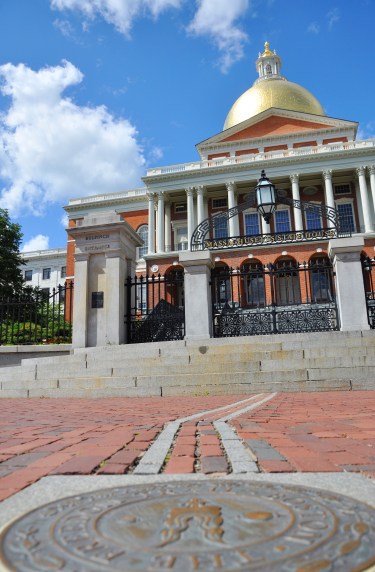
MAStateHouse_GrayIn the early hours of August 1, Massachusetts legislators adjourned a busy two-year legislative session in which lawmakers introduced 4,861 bills in the House and 3,128 bills in the Senate. NAIOP Massachusetts and its Government Affairs Committee members worked tirelessly to represent the interests of the commercial real estate development industry. NAIOP applauds the leadership of the “big three” – Governor Charlie Baker, House Speaker Robert DeLeo, former Senate President Harriette Chandler, newly elected Senate President Karen Spilka, as well as committee chairs and legislators who pursued a wide-ranging agenda. For the remainder of 2018, the legislature will meet in informal session, but during those sessions bills need the unanimous approval of the limited number of members attending to be approved. Any member of the legislature can prevent a bill from advancing simply by objecting.

While NAIOP advocates on hundreds of bills, here are the must-know highlights of the 2017-2018 legislative session and what they mean for CRE:

Railroad Right of Way Reform Passes in Economic Development Bill
In a win for NAIOP Massachusetts’ advocacy, the economic development bill approved by the House and Senate reforms the current railroad right of way statute (MGL 40/54a) that has created uncertainty and delays for projects on former railroad rights of way. The language in Section 10 of H. 4868 removes the confusing “land appurtenant to” language from the review process; directs MassDOT to establish guidelines, timeframes, and a determination of inapplicability option for unimpacted land; and brings certainty to landowners and lenders while protecting properties of importance to the Commonwealth’s future transportation needs. The final language was based on a stand-alone bill filed at the request of NAIOP by Rep. Joe Wagner and was the result of years of discussions between NAIOP, MassDOT and the legislature. The economic development bill also includes $250 million for the MassWorks program and $75 million for workforce skills capital grants, as well as many other bond reauthorizations designed to spur economic development.

VERY special thanks to Secretary Pollack, Rep. Wagner, Rep. Strauss, Sen. Boncore, Sen. Lesser, legislative leadership, and NAIOP members for their work on this issue. The bill is now before Governor Baker and is expected to be signed very soon.

Flawed Zoning Bill Defeated
NAIOP and all real estate groups in the state, as well as the Mass Municipal Association, opposed H. 4397.  The bill was a top priority for planners and environmental groups and contained anti-growth concepts including eliminating the Approval Not Required (ANR) process, reducing the scope of zoning “freeze” protection under current law only to the particular subdivision plan that is submitted rather than to the “land shown on the plan,” authorizing the use of impact fees without limitation, and mandating inclusionary zoning without incentives. NAIOP educated lawmakers on the numerous provisions of the bill, which would have hindered housing production in Massachusetts.  We are very pleased this very flawed bill did not advance.

Housing Production Bill Left on the Table
NAIOP strongly supported H. 4290, which was filed by Governor Baker and given a favorable report by the Joint Committee on Housing.  That bill allowed cities and towns to adopt zoning best practices by a simple majority vote, rather than the current two-thirds supermajority.  This would have been allowed in situations where the zoning change encouraged more concentrated development including the adoption of 40R “Smart Growth” districts or starter homes, reduced parking requirements, allowing accessory dwelling units, and reducing minimum lot sizes.  The bill was supported by a broad coalition of business groups, the Massachusetts Municipal Association, and the real estate industry.  We are disappointed that the bill did not receive a vote.  Governor Baker has encouraged the legislature to move the policy during informal session (now through December).  NAIOP will continue to work with the Administration and the legislature to promote policies that encourage the production of housing.

Vicarious Liability Bill (Wage Theft) Does Not Pass
NAIOP was part of an 18-member coalition of business groups opposing flawed wage theft legislation containing vicarious liability for businesses that employ entities that commit wage theft (S. 2546). It would have targeted innocent, law-abiding businesses and held them responsible for the actions of other businesses. This would have applied stop work orders and penalties to the lead company who would have had no way of knowing about such a violation.  The Senate passed the bill, but it was not taken up in the House.  NAIOP, which served on a working group with legislators and the proponents of the bill (labor interests), will continue to advocate for fair and balanced solutions to wage theft that go after those who are breaking the law, while opposing proposals that target law abiding businesses.

Balanced and Effective Approach to Climate Change Passes
NAIOP supported the environmental bond bill and climate change resiliency legislation (H. 4835), which passed both chambers and is now before Governor Baker for his signature. It directs state agencies to draft a comprehensive climate adaptation plan and evaluate the Commonwealth’s adaptive capacity to respond to climate change. The Plan will be updated every five years, ensuring a focus on climate change resiliency beyond the current Administration. NAIOP was strongly opposed to other climate change legislation (CAMP – S. 2196)  that would have required “all certificates, licenses, permits, authorizations, grants, financial obligations, projects, actions and approvals issued by a state agency or state authority” to be consistent to the maximum extent practicable (MEP) with a plan.  NAIOP opposed the language because “consistency” would have been open to interpretation and the term “maximum extent practicable” was not defined and therefore set the stage for legal challenges against projects.  We are pleased that the final environmental bond bill does not include this language and NAIOP looks forward to working with the Administration to develop this important plan.

Housing Bond Bill – Brownfields Tax Credit Extended
Earlier in the session, Governor Baker signed the Housing Bond Bill (H. 4536), which included one of NAIOP’s top legislative priorities – a 5-year extension of the Brownfields Tax Credit. The bill authorized $1.8 million in new capital spending for the production and preservation of affordable housing with an extension of the Low-Income Housing Tax Credit and an increase in the annual allocation to $25 million. For more information, read our blog post, Brownfields Tax Credit Extension Signed into Law.

NAIOP is grateful to Senator Rodrigues for his leadership on this issue and applauds the housing bond bill conference committee members (Reps. Honan, McGonagle, Hill and Sens. Boncore, Keenan, O’Connor) for championing the Brownfields Tax Credit, which increases housing, creates new employment, and enhances local and state tax revenues by restoring blighted properties to productive use.

Community Benefit District Legislation Falls Short of Approval
Legislation (H.4546) that would have authorized Community Benefit Districts did not receive final procedural support in the legislature after initial approval in the House and Senate. Community Benefit Districts (CBD) impose assessments on property owners, in addition to property taxes, to fund supplemental services. A CBD may be established only if the property owners in the district who sign the petition to create the CBD will pay more than 50 percent of the yearly assessment. Like last session, NAIOP opposed the CBD framework based on the issue that it would impose additional fees on property owners who may not have supported the creation of the district in the first place. Many other advocacy groups and legislators recognized the potential problems with the CBD framework and stopped the bill from becoming law.

Water Banking Fees Defeated
NAIOP strongly opposed Act Providing for the Establishment of Sustainable Water Resource Funds. House Bill 2116 would have provided communities with the authority to create water banks – essentially an impact fee that unfairly targeted new development and focused on environmental mitigation and water conservation measures rather than water infrastructure upgrades or capacity issues.

Job Site Roster Bill Defeated
Senate Bill 1019, An Act relative to transparency in employee benefits reporting in private construction, would have affected projects with 10 or more residential units or commercial projects of 5000 square feet or more by requiring that a roster of employees and independent contractors on a jobsite be publicly posted.  The legislation required a certificate of compliance with no mechanism for applications and issuance, and no timeframes.  Given the extremely fluid nature of a job site, combined with the project delays and costs associated with this legislation, compliance with such a requirement would have been nearly impossible.

Special thanks to all NAIOP members who provided input and expertise on the wide range of issues NAIOP pursued this session. NAIOP will now begin drafting its legislative agenda for the 2019 – 2020 session by meeting with members to determine how to best advance the goals of the industry.

NAIOP South End Walking Tour Highlights

This post originally appeared on BLDUP.

IMG_0322Site of Harrison Albany Block in Boston’s South End – NAIOP Summer Walking Tour

Boston’s South End is booming and a large group of comfy shoe clad CRE professionals saw the progress first hand as they trekked the area on the NAIOP walking tour this past Wednesday (July 18th). The tour brought together the top minds who have shaped the South End’s progress and expanded Boston’s center of gravity. Beginning at the brand new, highly stylish, 345 Harrison & wrapping with drinks at the Ink Block pool, our partners at NAIOP have once again provided members with an informative and entertaining program.

Tour Highlights included:

345 Harrison:

This new 585 mixed-use project spans a 2-acre site across from the Ink Block.  Elizabeth Likovich, Director, UDR, explained that 345 Harrison was thoughtfully designed to feature several different facade types so the project would appear to be 5 or 6 different buildings instead of a “superblock”.  The development has also embraced the artistic side of the South End with over $1 million of art on display throughout the common areas, most by local artists. 345 Harrison includes a variety of unit types from micro studios (all of which are already leased) to three bedrooms designed for families.

321 Harrison:

With permits in hand, Todd Fremont-Smith, Senior VP, at Nordblom Company told the crowd they hope to break ground on this project on August 1st.  321 Harrison, to be built on top of the existing garage, will include over 230K of office space. The glass facade, facing downtown Boston, will include the Roman numerals, 3,2,1 a nod to the building’s address.  Construction is expected to be complete by summer 2020.

Exchange South End:

The Abbey Group acquired the 5.6-acre parcel, home to the Boston Flower Exchange in September 2016 and has been working with the community and city on planning since. Their vision is to create a new urban campus of 4 new mixed-use buildings of lab, office, and innovation/tech space. Audrey Epstein Reny, Managing Partner of The Abbey Group mentioned that the firm decided to move toward office and lab space to complement the existing housing in the neighborhood and they hope to bring 4,000 to 7,000 jobs to the area.  The new Exchange South End will also feature ample green space in the form of a 1-acre park to be called Albany Green.

Harrison Albany Block:

Construction has begun on this upcoming 600,000 square-foot mixed-use project being developed by Leggat McCall Properties.  The underground parking garage, shared between the residential components is being completed first, followed by the first residential tower expected to open in December 2020.  In total Harrison Albany block will add around 600 residences to the area with 8600 square feet of ground-floor retail. Existing buildings at 600 Harrison & 575 Albany will stay in place with improvements to house additional office space along with 50 additional units.

Ink Block:

The Ink Block was the first domino to fall in the South End redevelopment boom and there are now 6 buildings complete within this project. The 7th, 7INK by Ollie, was just approved by the city and will be Boston’s first major co-living development.  This project will offer 250 units of all-inclusive living with amenities ranging from laundry service to a full calendar of social events. Ted Tye, Partner and Director of Acquisitions at National Development, said he hopes to break ground this spring on the final piece of this game-changing development.  Another major piece of this project has been the clean up of the once neglected area under the highway.  This new “Underground” is now home to neighborhood events and has energized this area that connects the South End to South Boston.

Mass Municipal Association and Real Estate Community Join Together to Support Housing Choice Legislation to Create Much-Needed Housing Across the Commonwealth

Today the following statement was issued in support of An Act to Promote Housing Choices (H.4290):

The Greater Boston Real Estate Board, the Home Builders and Remodelers Association of Massachusetts, the Massachusetts Association of Realtors, NAIOP—The Commercial Real Estate Development Association, and the Massachusetts Municipal Association, join together to express our strong support for H. 4290, An Act to promote housing choices. In its current form, this important bill is a unique opportunity to increase the much-needed supply of housing in Massachusetts.

As reported favorably by the Joint Committee on Housing, H. 4290 represents an unprecedented consensus by the major stakeholders to advance housing development. This narrowly tailored bill addresses the state’s need for housing while respecting the important role municipalities play in determining whether new housing is built. It does so by eliminating one barrier to housing production – the need for a supermajority vote of Town Meeting or a city council to approve zoning changes for housing and smart growth planning.

To encourage cities and towns to adopt zoning that supports sustainable housing production, the Department of Housing and Community Development created the Housing Choice Initiative. That program rewards communities that produce new housing and adopt best practices to promote smart growth with grants and technical assistance. Passage of H. 4290 will make it easier for communities to achieve Housing Choice designation.

Unlike another legislative proposal now before House Committee on Ways & Means (H. 4397), which would rewrite the Zoning Act in ways that are complicated, controversial, and would hinder the production of housing, H. 4290 contains no mandates or other provisions that are opposed by all of our organizations.

According to the UMass Donahue Institute, “the challenge for Massachusetts going forward will be to address the housing, transportation, and infrastructure constraints that make it more difficult for the workers who will be needed to fill these positions to relocate to the state and meet the needs of growing employers. While this challenge is not new, the price of inaction is high and rising.” Massachusetts is one of the most expensive states in the country in terms of housing affordability. It is critical that we do not complicate or increase housing costs by enacting legislation that would further worsen the existing problem.

Together with the recently enacted Housing Bond Bill, H. 4290 can make a significant impact on the Commonwealth’s historic shortage of housing. We respectfully urge the legislature to pass this important bill before the end of the formal session.


NAIOP 30th Annual Charitable Golf Tournament Brings Total Raised for Heading Home to Over $3 Million

Elisif_20180614_6535

On June 14, NAIOP held its 30th Anniversary Charitable Golf Tournament to benefit Heading Home, an organization that provides hundreds of Greater Boston families with housing and services to thrive in the long run. After a fun-filled day of golf, refreshments, and networking at The International in Bolton, MA we are thrilled to report that we have surpassed $3,000,000 in donations to Heading Home. This year’s proceeds will benefit the Heading Home Economic Mobility Center.

Thank you volunteers, sponsors and golfers for your support!

Special thanks to:

2018 NAIOP Golf Committee Co-Chairs: Shawn Hurley of Marcus Partners and Phil Dorman of Oxford Properties

Golf Steering Committee: Vicki Keenan and Matthew Siciliano of CBRE/New England, and John Myers of Redgate

&

Platinum Sponsors: Marcus Partners, Oxford Properties

Gold Sponsors: CBRE New England, National Development, Charles River Realty Investors, New England Development, Newmark Knight Frank, Redgate

Pin Flag Sponsors: Callahan Construction Managers and Walker & Dunlop

Silver Sponsors: Boston Properties and Turner

Hat Sponsor: NB Development Group

Entertainment Sponsor: Keller Augusta

Additional Sponsors:

Aerotek
AHA Consulting Engineers
Alexandria Real Estate Equities
Allen & Major Associates
Atlantic Management Corp.
Avison Young
Bank of America Merrill Lynch
Bard, Rao + Athanas
Consulting Engineers
BioMed Realty
Boston Financial Management
Boston Global Investors
Boston Realty Advisors
Bowdoin Construction Corp.
Chapman Construction/Design
Citizens Commercial Banking
Clarion Partners
Colliers International
Columbia Construction Co.
Commodore Builders
CUBE 3 Studio
DivcoWest
Dyer Brown Architects
Eastdil Secured
Eastern Bank
First American Title
Fort Point Project Management
Gensler
Gilbane Building Company
Haley & Aldrich
Hines
J.C. Cannistraro
J. Calnan & Associates
JLL
Jumbo Capital Management
Margulies Perruzzi Architects
Maugel Architects
McCall & Almy
McNamara Salvia
MIT Investment Management
Company
M&T Bank
NOREL Service Company
Office Resources Inc.
Perkins + Will
PES Associates
Red Thread
Related Beal
R.J. Kelly Co., Inc.
Rockland Trust Company
R.W. Holmes Realty Company
Samuels & Associates
Sanborn, Head & Associates
Sasaki
Skanska
SourceOne, Incorporated
Stewart Title Guaranty Co.
Synergy Investments
Taurus Investment Holdings
TD Bank
Timberline Construction Corp.
Tsoi Kobus Design
Unispace
View Dynamic Glass
VPNE Parking Solutions
Walker Consultants
WS Development

We will be back hope to see you again in 2019 for the 31st Annual Golf Tournament on June 20! For information, contact Debbie Osheroff at 781-453-6900 x3.


Exploring Greater Boston with NAIOP

This post originally appeared on the Solomon McCown & Company blog. It was authored by Michelle Cassidy.

Elisif_20180606_5622You can see NAIOP’s bus tour photos online.

We recently had the pleasure of attending NAIOP’s annual, highly anticipated event: The Bus Tour. This year’s theme – “Then, Now, Next” – offered a glimpse into some of Boston’s most transformative developments in the city’s evolving and historically booming neighborhoods.

We journeyed from the Financial / Central Business District to the Seaport to South Boston / Dorchester. Then, we drove through the Back Bay / South End, before reaching the Fenway followed by our final stop in Allston / Brighton.

Each neighborhood provided a look into Boston’s past while highlighting its promising future. Many buildings that were originally constructed for industrial uses are being repositioned for today’s needs. Here’s a rundown of key takeaways:

Financial / CBD – While highlighting the beautiful renovation of One Post Office Square’s lobby, speakers emphasized that tenants are now moving to better brand themselves and attract / retain talent, whereas historically they were driven by cost. The lobby renovation enables substantial natural light to enter the building and complements the streetscape. Anchor Lines Partners / JLL are renovating the building’s other interiors – we love their flexible fitness floor concept which will provide tenants with a healthy lifestyle at their fingertips.

Eastern Seaport – Given Kendall Square’s limited space, there is a lot of potential for new lab and R & D space in the Seaport, particularly the Drydock area and Raymond L. Flynn Marine Park. Many industrial buildings such as the Innovation and Design Building and 451 D St. are being repositioned for innovative tech or life science companies. The successful mixed-use development along Seaport Boulevard is continuing into this area too. Parcel K, developed by Lincoln Property Co. and designed by Arrowstreet, will bring additional residences, a Hyatt Place hotel and 20,000 square feet of retail and restaurant space. The new Omni hotel, developed by Davis Companies, will also bring more keys, collaborative workspaces and luxury spaces such as a pool deck with views of the Harbor.

South Boston – Redgate and HILCO’s development of The Edison Power Plant is improving the connectivity between the Seaport and South Boston. The 2.1 million-square-foot development includes seven new buildings that consists of more than 1,000 apartments and condos, a 150-room hotel, 339,000 square feet of office space and 68,000 square feet of retail. Investors are taking note of visionary projects such as this and pursuing unique opportunities here; for example, Akelius, the largest listed company in Sweden, recently purchased the Carson Tower Apartments near Carson Beach.

Dorchester – Nordblom is repositioning the former Boston Globe headquarters into ‘The Beat’ (The Boston Exchange for Accelerated Technology). The team is transforming the space into a modern gem with high ceilings, two roof decks, a food hall and a possible brew pub. The space will have the ability to suit various tenants including flex tech, autonomous vehicles and robotics.

The Fenway – Given the booming Longwood Medical area, there is high demand for housing in this area, and Skanska’s recently delivered The Harlo, a luxury residential building with fabulous amenities and ground-floor retail speaks to that demand. There’s also commercial office development – the tour stopped at 401 Park, commonly known as Landmark Center. The building, which was originally a Sears’ manufacturing plant, is being repositioned by Samuels & Associates into an impressive mixed-use development with a million square feet of lab and office space, a coveted ‘Time Out’ food hall, and a 1.1-acre public park with retail and activities.

Allston/Brighton – Our last stop was at Boston Landing, a 1.9 million square foot mixed-use development by HYM and NB Development Group. We toured the luxury apartment building, Lantera, which includes impressive amenity spaces including a pool and roof deck. The interiors, designed and decorated by Elkus Manfredi Architects, are full of beautiful, vibrant colors and are definitely worth checking out. The development is also proximate to public transit. Now that the Boston Landing train station is completed, it’s easy to get to and from the heart of Boston to this area. The station, constructed by Skanska, is built to Envision® Silver verification. To date, this is the highest level awarded in Greater Boston and the first transit project in New England to achieve Envision.

Connectivity continues to improve throughout Greater Boston thanks to the transformative developments and renovations we visited on the Bus Tour. We’re excited for all these projects to deliver and to bring additional vitality to the neighborhoods in which they are located.

Brownfields Tax Credit Extension Signed into Law

On May 31, Governor Baker signed the Housing Bond Bill, An Act Financing the Production and Preservation of Housing for Low and Moderate Income Residents (H. 4536), which authorizes $1.8 million in new capital spending for the production and preservation of affordable housing. The bill included one of NAIOP’s top legislative priorities – a 5-year extension of the Brownfields Tax Credit.

TWEETCaptureThe Brownfields Tax Credit, which was set to expire in August without this important extension,  encourages new “innocent” owners to clean up contamination.  Any party that contaminated a property or owned the property at the time of contamination is not eligible for the tax credit.
Depending on the extent of the completed cleanup, the taxpayer may apply to the Department of Revenue for a credit equal to either 25% or 50% of the cleanup cost. If the site has an Activity and Use Limitation (AUL), then 25% would apply; if no AUL, then eligibility increases to 50%. Without this tax credit, first created in 1998, contaminated properties would remain a public health risk and there would be no incentive to clean up and redevelop these sites.

In addition to the Brownfields Tax Credit Extension, the bill does the following, among other things:

  • State Low-Income Housing Tax Credit Extension. Extends the state’s ability to commit $20 million per year in tax credits to affordable housing projects until 2025 and authorizes an additional $5 million per year in tax credits specifically to support the preservation of existing affordable housing.
  • Housing Development Incentive Program Tax Credit. Extends the states ability to commit $10 million per year in tax credits to market-rate housing projects in Gateway Cities until 2024.

The brownfields tax credit extension provisions (Sections 5, 6 and 7 of the Housing Bond Bill) were first filed at the start of the 2017-18 legislative session, at NAIOP’s request, as Senate Bill 1610 by Senator Michael Rodrigues.

NAIOP is grateful to Senator Rodrigues for his leadership on this issue and applauds the housing bond bill conference committee members (Reps. Kevin Honan, Joseph McGonagle, Bradford Hill and Sens. Joseph Boncore, John Keenan, Patrick O’Connor) for championing the brownfields tax credit, which increases housing, creates new employment, and enhances local and state tax revenues by restoring blighted properties to productive use.

While another NAIOP-supported provision that increased the tax credit to 50% for  projects with an Activity & Use Limitation and twenty percent of the housing set aside for those making 120% or less of Area Median Income had been included in the Senate version of the bill, that provision was not included in the final bill.

Thank you to NAIOP members that advocated on behalf of this key policy priority for the commercial real estate industry and the Commonwealth.

Do Climate Resiliency the Right Way

NAIOP Massachusetts authored the following op-ed on key climate change resiliency legislation. Commonwealth Magazine ran the op-ed on April 1, 2018. 

Do Climate Resiliency the Right Way

Extreme weather is a threat to overall economy

Promoting climate change resiliency is top of mind for Massachusetts residents and businesses. The 2018 nor’easters have placed considerable stress on our infrastructure and communities, as well as the public’s consciousness.  Sixty-five percent of voters now say that climate change is affecting storms, according to a recent WBUR poll, conducted by the MassINC Polling Group.

In addition to the public health and environmental risks associated with climate change, NAIOP Massachusetts, The Commercial Real Estate Development Association, views climate change as a threat to the overall economy.  As we have seen with increasing frequency, transportation systems, communications, utilities, and businesses of all sizes are affected by extreme weather events.  Preparing for a changing climate needs to be a shared responsibility between the public and private sectors.

Currently, developers are tailoring plans to local site needs, particularly flooding risks in Cambridge and Boston, and, as an example, utilizing technology such as aquafences. They are bringing working knowledge to Climate Ready Boston and similar initiatives, seeking best practices from developers and governments in other states, and partnering with the public sector on key climate initiatives.

On March 15, NAIOP was proud to join Gov. Charlie Baker, public officials, and members of the environmental advocacy community to support new climate change resiliency and environmental bond legislation.  The governor’s bill (House 4318 – An Act Promoting Climate Change Adaptation, Environmental and Natural Resource Protection and Investment in Recreational Assets and Opportunity) directs the state, led by the secretary of energy and environmental affairs and the secretary of public safety and security, to draft a comprehensive plan, known as the Integrated State Hazard Mitigation and Climate Adaptation Plan.

Under the legislation, the plan would need to be updated every five years, ensuring a focus on climate change resiliency beyond the current administration. The plan would include the following components: observed and projected climate trends, risk analysis and vulnerability assessments, and evaluation of the Commonwealth’s adaptive capacity to respond to climate change.  It further requires the state to carry out the plan and to offer guidance and strategies for municipalities to navigate the state plan, alongside local bylaws and regulations.

The legislation authorizes $1.4 billion in capital allocations for investments in safeguarding residents, communities, and businesses from the impacts of climate change.  As an example, it expands the Municipal Vulnerability Preparedness grant program, which 20 percent of Massachusetts municipalities currently participate in, with a $50 million commitment.  It also commits another $170 million to coastal resiliency measures, such as critical seawalls and dams that protect our environmental assets.

This comprehensive approach sets the Commonwealth on a path towards improved resiliency without unreasonably hampering economic development and new housing.  Other climate change legislation, such as Senate bill 2196 – known as the Comprehensive Management Adaptation Plan, or CAMP, bill, is the wrong approach.  The bill, [crafted initially by Sen. Marc Pacheco of Taunton], goes far beyond regulating the reasonable impacts of climate change and would create tremendous uncertainty for the real estate industry, the business community, and regulatory agencies.

Under CAMP, “all certificates, licenses, permits, authorizations, grants, financial obligations, projects, actions, and approvals issued thereafter by a state agency or state authority” would need to be consistent to the maximum extent practicable with the yet to be determined adaptation plan.  Consistency with this plan would be open to interpretation and the term “maximum extent practicable” is not defined.  It is disconcerting that a cost-benefit analysis is not part of this approach. It is unclear how such a broad requirement could even be implemented and the legal challenges around such a concept could be significant.  Tying up every grant, permit, approval, certificate, and authorization in court would do nothing to better prepare the Commonwealth for climate change.

Unlike CAMP, the governor’s climate change legislation builds on the significant work done to date by the Baker-Polito Administration on this issue.  It codifies key portions of Executive Order No. 569, which established an integrated climate change strategy for the Commonwealth.

The governor’s climate change resiliency legislation prepares the Commonwealth to adapt and mitigate climate change on a long-term basis, working hand in hand with local policymakers and regulators.  It provides communities with the tools they need to build up resiliency efforts through new grants and programs aimed at protecting critical environmental resources.

In short, House bill 4318 is the right approach at the right time.  Its passage will ensure that climate change adaptation and resiliency continue to be a top priority for the public and private sectors.

The legislation now goes to a legislative committee for its consideration. NAIOP strongly urges legislative leaders to approve the necessary investment in planning for extreme storms and rising sea levels.

Tamara Small is the senior vice president of government affairs for NAIOP Massachusetts – The Commercial Real Estate Development Association.


Legislative Update: Issues Affecting CRE on Beacon Hill

STATEHOUSEIMAGE

Coasting past a February 7th deadline to advance, retract, or postpone action on the 7,300 bills filed this session, Massachusetts legislators are now meeting through July 31, at which point they will break for the summer and the fall campaign cycle.

As NAIOP expected, several opportunities and threats made it through the deadline set for legislative committees to report out bills to the legislature, including the following:

Housing Choice Initiative

Having unveiled the Housing Choice Initiative with broad-based support in December, Governor Baker used his January State of the Commonwealth speech to highlight the Administration’s plan to spur housing production. The Governor’s legislative package, supported by NAIOP, received a favorable report from the Joint Committee on Housing in February. H.4075 is expected to now move to the House Committee on Ways & Means. Under the legislation, numerous local zoning changes, including the adoption of a 40R district, reduced parking ratios or mixed-use zoning, among others, would require only a majority vote of the local legislative body instead of a supermajority. NAIOP believes this bill, combined with the Housing Choice Designation for municipalities that prioritize housing production, and the Housing Bond Bill (referenced below) are important tools for addressing the Commonwealth’s housing crisis. NAIOP will continue to work to advance this much-needed legislation.

Problematic Zoning Legislation

Smart growth advocates and environmental groups remain committed to Senate Bill 81 and House Bill 2420, the zoning bills that are strongly opposed by the real estate industry. Both of the bills were granted an extension order to March 7. NAIOP, working with a broad real estate coalition, continues to educate lawmakers about the problematic provisions of the bills – particularly language that would hinder the production of housing in Massachusetts. Now that new Senate President Harriette Chandler has indicated that affordable housing is a top priority, NAIOP is advocating that the Governor’s approach is the best path forward for the Commonwealth and will continue to oppose any efforts to combine the Governor’s bill and the zoning bills.

Wage Theft

Wage theft is a serious matter and those who intentionally violate wage theft laws should be held accountable. Unfortunately, two wage theft bills (Senate Bill 999 and House Bill 1033), while well-intended, go after employers who are following the rules and doing the right thing. The bills penalize those who inadvertently do business with a firm that has committed a wage violation, through the imposition of vicarious liability (something that no other state imposes). The legislation would affect anyone involved in construction and development, but it would also have a huge impact on all businesses. It would apply equally to hospitals, universities, and businesses, large and small, that outsource aspects of their operations to other companies or “contractors.”  The financial impact could be severe. Both of the bills were given an extension order until March 7.

NAIOP is part of a large business coalition that is deeply concerned with the impact these bills could have on the Massachusetts economy. Senator Jason Lewis and Representative Paul Brodeur created a wage theft working group, which includes representatives from both sides of the issue. The group has met several times and we will continue to offer up alternative solutions to addressing the issue of wage theft and we will continue to oppose any wage theft bill that would include vicarious liability.

Housing Bond Bill & Brownfields Tax Credit

In January, the House passed a $1.7 billion housing bond bill, which contains numerous provisions supported by NAIOP.  It includes an extension of the soon-to-expire Brownfields Tax Credit and extends the authorization of other tax credits including the state’s Low-Income Housing Tax Credit and the Community Investment Tax Credit.  The bill is now before the Senate Committee on Bonding, which held a hearing on it last week. NAIOP will continue to advocate for quick passage of this important legislation.

A potential economic development bill, an omnibus energy bill, and countless other bills are also on NAIOP’s radar. In the next five months, NAIOP will continue to fight for legislation that encourages economic development and supports the commercial real estate industry.  If there are issues of interest to you or your firm, please contact NAIOP’s Government Affairs Team.

NAIOP Supports Baker-Polito Housing Legislation

housingpressconference
On Monday, NAIOP was pleased to join Governor Baker, Lieutenant Governor Polito, and Undersecretary Chrystal Kornegay to support a new initiative to increase housing production in the Commonwealth. The Administration’s Housing Choice Initiative creates a new system of incentives and rewards for municipalities that deliver sustainable housing growth. It also creates a new technical assistance toolbox to empower cities and towns to plan for new housing production and proposes legislative changes, through An Act to Promote Housing Choices, to deliver smart, effective zoning at the local level. (A section by section summary of the bill is also available.)

NAIOP believes the production of workforce housing is critical for the continued growth of the Massachusetts economy and we are pleased to support this initiative. Unlike the extremely problematic zoning legislation that is supported by planners and environmental groups and opposed by the real estate industry and municipalities, this bill does not include language that would hinder the production of housing. Instead, it rewards communities that are producing new housing units and have adopted certain best practices with a new Housing Choice Designation.

Cities and towns that receive the Housing Choice Designation will be eligible for new financial resources, including exclusive access to new Housing Choice Capital Grants, and preferential treatment for many state grant and capital funding programs, including MassWorks, Complete Streets, MassDOT capital projects and PARC and LAND grants.

Under the legislation, the following local zoning changes would require only a majority vote of the local legislative body:

  • Reducing dimensional requirements, such as minimum lot sizes, to allow homes to be built closer together.
  • Reducing required parking ratios, which can lower the cost of building new housing and accommodate development on a smaller footprint.
  • Creating mixed-use zoning in town centers, and creating multi-family and starter home zoning in town centers, near transit, and in other smart locations.
  • Adopting “Natural Resource Protection Zoning” and “Open Space Residential Development.” These zoning techniques allow the clustering of new development while protecting open space or conservation land.
  • Adopting provisions for Transfer of Development Rights (TDR), which protects open space while creating more density in suitable locations.
  • Adopting 40R “Smart Growth” zoning, which provides incentives for dense, mixed-use development in town centers, near transit, and in other “smart” locations.
  • Allowing accessory dwelling units or “in-law” apartments – small apartments in the same building or on the same lot as an existing home.
  • Allowing for increased density through a Special Permit process promoting more flexible development.

While it does not mandate that any town adopt these zoning best practices, it does remove the barrier of having to convince a supermajority of the legislative body to adopt them.  

Unlike the zoning bills referenced above, this bill has the support of all of the key players – municipalities, business groups, housing advocates, environmental groups, and real estate. NAIOP looks forward to working with the Baker Administration and the legislature to advance this important legislation, which will be an important step in truly addressing the housing crisis facing Massachusetts.

NAIOP/SIOR Annual Market Forecast Remains Positive

This guest blog post was written by Mike Hoban of Hoban Communications.

Elisif_20171129_1972Fueled by one of the strongest economies in the nation, the Boston commercial real estate market should continue to thrive for the foreseeable future. That was the conclusion of the enthusiastic panel at the 2017 NAIOP/SIOR Annual Market Forecast held last week at the Westin Waterfront Hotel before a crowd of 450 CRE professionals.
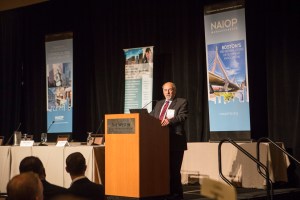
Moderated by David Begelfer, CEO of NAIOP Massachusetts, the panel included Molly Heath, Executive VP, JLL (Cambridge); Ben Sayles, Director, HFF (Capital Markets); John Carroll, Executive VP, Colliers International (Suburbs); Ron Perry, Principal, Avison Young (Downtown); and JR McDonald, Executive Managing Director, Newmark Knight Frank (Industrial). Barry Bluestone, Professor of Public Policy at Northeastern University and Senior Fellow at The Boston Foundation, set the table for the program with an economic forecast that – with one major caveat – bodes well for the long-term health of Greater Boston CRE.

Bolstered by the highly educated workforce provided by the educational and medical institutions located in Greater Boston, the Massachusetts economy has outperformed the U.S. economy nearly every year since 2009. GDP growth for the Commonwealth has generally been in the 2.5 to 3.0 percent range since 2010, a figure that is significantly above the national average of 2.0 during that period. The Bay State has added 355,600 jobs since the recession (including 62,500 last year), an 11.2 percent increase since 2009. The 4.2 percent unemployment rate has led to virtual full employment, and with the tight labor markets, average wages are beginning to increase, albeit slowly. And none of the factors that typically contribute to a slowdown are in evidence.

Elisif_20171129_1971But despite the positive outlook, there is a looming threat to the overall health of Greater Boston economy, he cautioned. “The housing stock is limited and growing too slowly to meet the demand, and as a result, home prices and rents continue to rise,” said Bluestone, who is one of the co-authors of the Boston Foundation’s 2017 Greater Boston Housing Report Card. The price of housing is pushing workers farther away from the urban core, causing housing prices in traditionally affordable communities to escalate, as well as putting a strain on an overburdened public transit system. The Housing Report Card estimates that the region will need an additional 160,000 housing units by 2030 to accommodate its expanding population (an additional 342,000), “and that is going to be a challenge,” Bluestone concluded.

Elisif_20171129_1988JLL’s Heath led off the program with an overview of the Cambridge office and lab markets. “The Cambridge market is one of the strongest markets that we track globally at JLL, and it continues to be driven by this incredible demand from the tech and life science clusters,” she stated, adding that the demand is coming not only from organically grown companies, but outside firms seeking to establish an R&D presence in close proximity to MIT, Harvard, and the educated workforce. With a vacancy rate below 3.0 percent, there continues to be upward pressure on rental rates, with office (by 13 percent) and lab (23 percent) soaring well above previous highs. Achieved rents for office space in E. Cambridge are now in the low $90’s (gross), with lab space in the low $80s (NNN). And due to the lack of supply in the market, “we really do believe that there is room (for rents) to run,” said Heath.

Elisif_20171129_1992Colliers’ Carroll reported that “the suburbs are alive and well”, as the market has added over five million SF of positive absorption since the downturn. There has also been a steady increase in rent growth in the Class A office market, approximately 10 percent since 2009, with new construction in Waltham achieving rents in the low $50s. The Class B market is not faring as well (although there is some rent growth occurring in select markets), with some of the older building stock being slated for repositioning or demolition to make way for senior living, hotel and other non-office uses (including 450,000 SF of properties in Chelmsford). One particularly bright spot is the emergence of biotech in the suburbs. The Gutierrez Company is currently constructing a five-story, 350,000 SF building for EMD Millipore (2018 Q3 completion) in Burlington, Alkermes is “close to signing” a lease for a 250,000 SF build-to-suit in Waltham, and Waltham-based Tesaro is in the market for a 300,000-500,000 SF suburban campus.
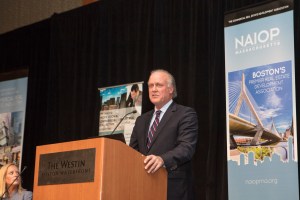
Elisif_20171129_2005Citing the enormous amount of commercial, residential, retail and restaurant development underway in the Seaport and other Boston locations, Avison Young’s Perry observed that “Boston is clearly a different city today than it was even five years ago.” The in-migration to the city by firms seeking talent continues, he said, citing the recent relocations by Reebok, PTC and Alexion to the Seaport, as well as Amazon’s establishment of a Boston presence with the 150,000 SF lease at 253 Summer St. and Rapid7’s relocation to North Station. Demand remains strong Downtown, with over 4.5 million SF of requirements in the market, including nine companies seeking 100,000-500,000 SF. CBD Class A rents range from the mid $40s to the mid $80s (Back Bay high-rise), and vacancy rates in the top floors of the towers (10 percent) are nearly in equilibrium with the lower floors (9.4 percent), as tech companies continue to absorb space on the lower tiers.
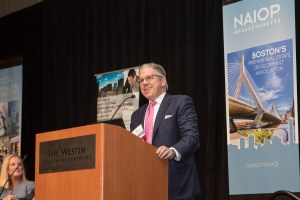
Elisif_20171129_2006NKF’s McDonald reported on the industrial market – the newfound darling of investors and developers – noting the transformational effect that Amazon and e-commerce has had on the product type. With 12.8 percent average annual returns to investors over the last five years, industrial has outperformed both retail (12.1) and multifamily (9.9), driven by feverish demand for “last mile” properties located in urban and infill submarkets. That demand has driven rents “way beyond the norms” of what had traditionally been $5 to $6 psf to the “high single digits and low teens” for buildings such as 480 Sprague St. in Dedham, a 234,000 SF warehouse that straddles the Boston line. And warehouse space located within the urban market, such as 202 Southampton St. in the South End (which lacks basics such as air-conditioning), is fetching $20 psf, based solely on location.

Elisif_20171129_2017HFF’s Sayles addressed the ‘When will the cycle end?’ question early on his presentation. “End of cycle concerns have largely abated,” he reassured the gathering. “Nobody is really talking about that right now, instead, what people’s biggest concern is, ‘If I sell, what am I going to do with that capital?” He expects pricing for assets to remain flat in the near term with cap rates trending downward. Financing for assets is up by 17 percent from Q3 2016 to Q3 2017, but investment sales for that period declined by approximately 8.0 percent as buyers are choosing longer term holds. Sales volume for Boston is expected to be approximately $13 billion for 2017, with foreign capital again accounting for a significant portion of those transactions.

Begelfer was in full agreement with Sayles’ assessment of the cycle concerns. “Boston is pretty unique. There are only a handful of cities around the country that are experiencing this kind of strong growth,” he observed. “Any slowdown that we see is probably not going to come from the economy, it will be from the cost of construction and land costs, or the pricing of assets. It won’t be caused by a recession, but by our own success,”