Seaport: The Hottest Neighborhood in Boston

If attendance is any indicator, the record-breaking 700 registrants at NAIOP’s “Windows on the Waterfront” event confirmed that the newly-rebranded Innovation District in the Boston Seaport district is indeed hot.  This is the year when the long-awaited neighborhood became a reality, spurred in large part by two key events – Vertex’s initial commitment to lease two buildings ( 1.1 million sq. ft.)  on Fan Pier, and Cresset’s opening of Liberty Wharf to the wild acclaim of restaurant and bar aficionados.

Windows on the Waterfront

An aerial shot from David Manfredi's presentation

However, as the NAIOP audience learned, that is just the beginning for development in this area. In an outstanding overview of the neighborhood, David Manfredi described the “promise” of this new district as:

  • A vibrant, new mixed use neighborhood
  • A neighborhood driven by innovation
  • A place to live, work, play, shop, dine, learn and visit

Helping developers fulfill that promise are several massive infrastructure improvements over the past decade, including: access to a redeveloped highway system that includes the Big Dig; an upgraded Logan Airport; expanded water transit; and the construction of the Silver Line.  Add to that the Boston Convention and Exhibition Center (BCEC), the Federal Court House, the beginning of a local park system and Harborwalk, the ICA relocation, and the city’s energetic branding of the Innovation District, and it’s hard to imagine why anyone wouldn’t want to be there!

At the event, Mayor Menino indicated that the city did not want the development of this area to be rushed, avoiding a cold, uninviting commercial zone.  He wanted, and now sees forming, a 24-hour, mixed use area that will attract both families and entrepreneurs.

Despite the large amount of available, buildable land adjacent to downtown (rare for most cities), the redevelopment of this enormous land mass has taken quite a while to get moving.  Early in the last decade, Seaport Place developed 1 million sq. ft. of office space and a full service hotel.  Another 600,000 sq. ft. came along with Manulife’s headquarters.  The next few years were fairly quiet for commercial development, until Joe Fallon built the first office building on Fan Pier, a speculative 526,000 sq. ft. tower at One Marina Park Drive.  Fallon had previously developed the 465 unit Park Lane apartments and partnered on the convention center’s Westin Waterfront hotel.  Soon after, the 470 room Renaissance Hotel was built.

Read more about the city’s hottest neighborhood in Part Two tomorrow – use the buttons at right to subscribe by email or RSS.  Among the topics: residential and retail uses, Liberty Wharf, and what’s next for the Seaport/Innovation District.
The Risks and Rewards of Waterfront Development

On August 17th, NAIOP had its first “Boston by Sea” Harbor Cruise along the waterfront, featuring commentary by Barry Hynes of FHO Partners, Lowell Richards of MassPort, and Kairos Shen of the BRA.

Besides the unique view of the many waterfront development projects, what stood out for me was the extreme difficulty of permitting and building projects on the water, as exemplified by the many projects that have failed financially, in some cases bankrupting the developers.

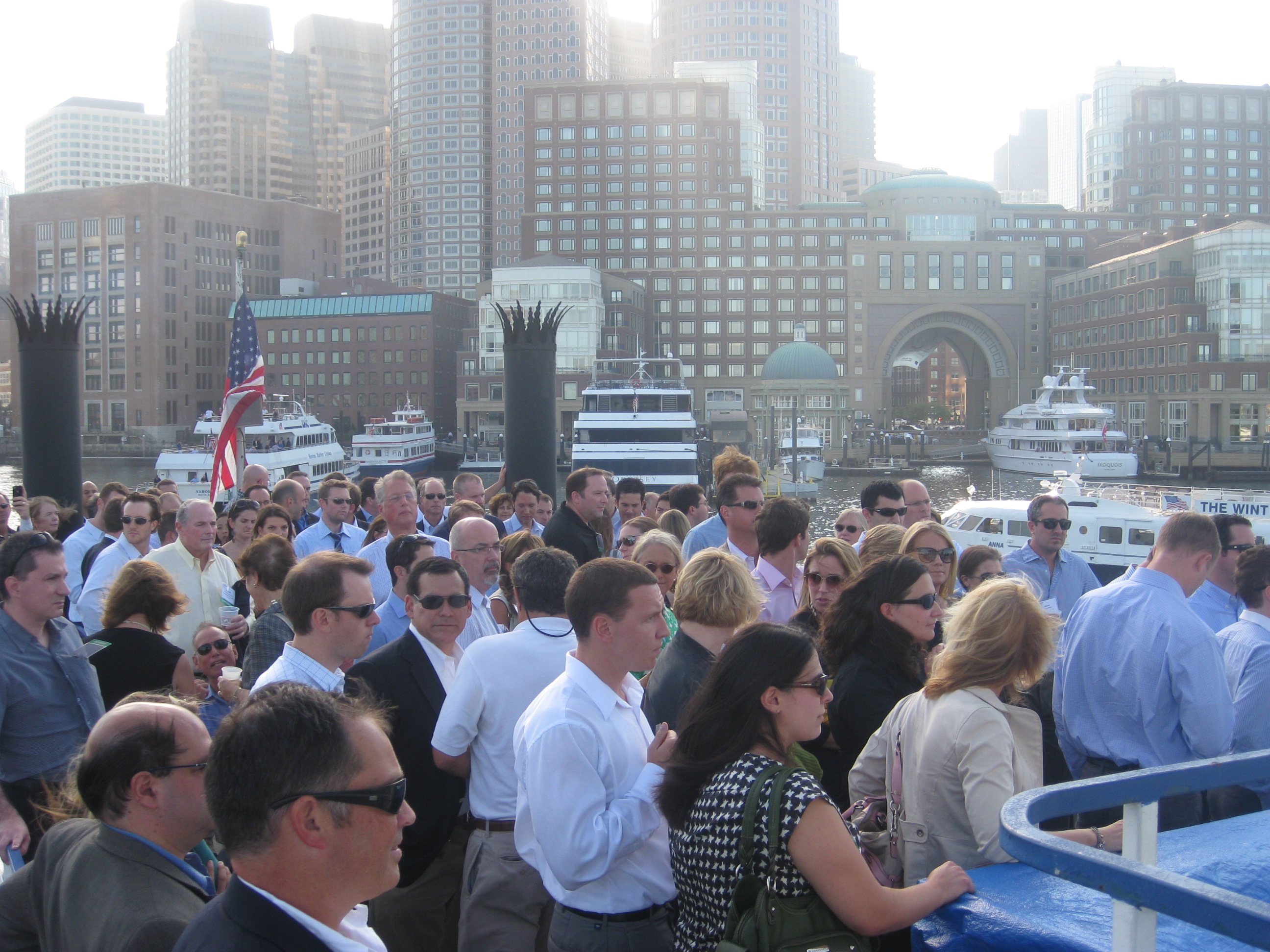
Attendees get the scoop on the Boston waterfront of the past, present and future

For all its benefits (views, access, etc.), waterfront development has plenty of obstacles and costly surprises for those who want to build.  There is the Chapter 91 law that regulates most of the city’s coastal areas, the Municipal Harbor Planning process, Boston’s Article 80 permitting process, input and review from neighborhood Impact Advisory Groups, pier piling replacement, and, frequently, costly hazardous waste issues.  To top that off, there is the developer’s dilemma of timing the project to match market demand.  With all of the uncertainty associated with getting a project financed and approved in a timely manner, it is difficult to know in advance if there will be the necessary demand for the completed product at a price that will justify the costs.

That can result in prime development locations lying fallow.  During our waterfront tour, we saw a number of development sites in East Boston that have still not started, even though they were planned for construction 5-10 years ago.  Portside at Pier One, New Street, Clippership Wharf, and Hodge Boiler Works have languished for years.  Most were fully permitted.  However, there is talk that Portside at Pier One, proposed by Roseland Property Company, may begin a first phase.

Many properties have changed hands numerous times before being developed.  Prime examples are Fan Pier and the former McCourt assemblage, both having remained primarily parking lots for three decades until the current owners purchased the land.

Clearly there have also been several successful projects.  Without question, Rowes Wharf stands out as one of the premier mixed use development projects in all of Boston.  It also looks like the “tide has turned” for Boston’s Seaport/Innovation Zone, which has many development projects underway.  With one office building up, Joe Fallon and Cornerstone are now starting construction on two more buildings for Vertex.  A hotel is in the works for Pier 4 with New England Development, and an adjacent apartment project is being proposed by Hanover.

Liberty Wharf has transformed the neighborhood with its restaurants – making it the new place to be any night of the week.  In addition, The Drew Company’s project is getting closer with a key residential component and Seaport Square is expected to move forward with a major retail development handled by John Hynes and WS Development (developers of the enormously successful Legacy Place in Dedham.)

Despite the uncertainties in the financial markets, the Seaport area seems to have found the necessary momentum to attract businesses, residents, shoppers, and tourists.  If the developers and the city can keep up the pace, soon the Seaport will no longer evoke memories of failed developments and abandoned plans.  Instead, it can stand as an example of what can be achieved with vision and persistence.

(Editor’s Note: Hear more about the Seaport at NAIOP’s “Windows on the Waterfront”, Sept. 21, featuring Seaport developers John Drew, John Hynes III, Stephen Karp, along with David Manfredi, John P. Fowler, and special guest Mayor Thomas Menino.)

NAIOP Brings the Heat to End Homelessness

Records were certainly broken at NAIOP’s Annual Golf Tournament benefitting Heading Home, held Wednesday.  Not just the 90+ degree temperatures or the countless number of water bottles consumed on the course, but a record that matters – money raised. This was the year that NAIOP passed $1,600,000 in total donations to Heading Home, raised over the tournament’s 23-year history.   

It was a proud moment when I presented Tom Lorello, Heading Home’s Executive Director, a super-sized check in the amount of $122,000, an amount I know represents their largest corporate donation, and which they have come to count on each year. 

David Begelfer (far right) and Tom Lorello (third from right), joined by volunteers and staff.

This money will help Heading Home fulfill its mission to end homelessness in Greater Boston by providing housing in conjunction with effective support services to help change the conditions that create homelessness. Tom and his staff have been pioneers in the Housing First movement, and they are seeing great results despite the continuing housing crisis that grips our state.

At the tournament, we shared a few facts about Heading Home and their clients that help tell the story about why we support their work:

Did You Know?

  • Average age of a Heading Home client is 8 years old
  • In Massachusetts each night there are 3,000 families without a home

In 2010, Heading Home:

  • Served 2,134 at-risk and homeless people
  • Placed 112 families and  58 individuals into permanent housing

The Heading Home Formula:

  • Housing + Job Training + Matched Savings Plans = Self Sufficiency
  • It works: 90% of Heading Home clients have remained permanently housed

Heading Home was the day’s big winner, of course, but tell that to the winners of NAIOP’s new Super Raffle, which offered over 30 prizes donated by local firms. Congratulations to John Bryer of DiMella Shaffer Associates, Inc. who won the grand prize of a Mini Cooper lease, Dante Angelucci of Leggat McCall Properties who won an entertainment center, and Steve Daley of AEW Capital Management who won a vacation cruise package!  (See photos, press release, and other resources)

None of this could have happened without the hard work of the Charitable Events Committee, led by Bob Hayes at KeyPoint Partners and Steve Brodsky at Synergy Investment & Development, along with the dedicated staff at Heading Home, NAIOP’s Board and staff, and of course, our many generous donors and sponsors.  Thank you to all who helped make this day truly one for the record books!

Commercial Real Estate Icons on the Leading Edge of Philanthropy

Bill and Joyce Cummings

In an age when many Wall Street and other corporate leaders take such pride in reaching even greater heights of personal wealth, it is refreshing to hear about a different type of competition. There is a growing group of the wealthiest individuals in this country who are now competing to see who will become members in a new club of billionaires – those promising to give away half or more of their wealth before they die.

The “Gates/Buffet Giving Pledge” already has nearly 70 members in this prestigious, exclusive club. And now they have two new members – Bill and Joyce Cummings, the founders of Cummings Properties, headquartered in Woburn, Massachusetts.

Not that this should come as a surprise to anyone that knows this couple and their history of giving. Over the past 25 years, the Cummings Foundation has grown to be one of the largest philanthropic foundations in the state.

Bill and Joyce are shining examples of local entrepreneurs who believe in a strong economy that does not forget about those amongst us who are less well off. They have long been leaders, even in an industry that prides itself on its charitable giving and community service, and they certainly have raised the bar with this pledge. (Globe article here)

NAIOP Massachusetts is proud to have Cummings Properties on our Board of Directors, and we offer our heart-felt congratulations to Bill and Joyce for the well-deserved recognition they are receiving.

“It’s Getting Better all the Time”, The Beatles

At the well-attended NAIOP Developing Leaders breakfast this morning, a panel presented “Booming In Beantown: Why Boston Remains One of CRE’s Hottest Markets.”

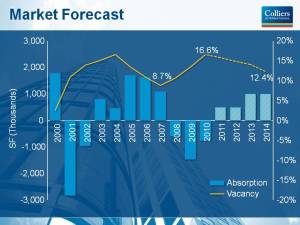
I was particularly interested in three slides that certainly left me and the other attendees sighing with relief about our future.  The first two slides were from Yanni Tsipis, Senior Vice President of Development & Consulting Services, at Colliers International.  The Market Forecast shows the historic run-up of the vacancy in Boston to a 10 year high of 16.6%.  However, they are forecasting positive absorption over the next four years, dropping the vacancy rate to 12.4%.  That might not be the low single digits, but it is in the range to start pushing up the rental rates.

The next slide should not come as a great surprise regarding the relative health of the commercial real estate investment market.  It does, though, show how bad off are the other regions of the country.  The delinquent or special service loans are under 5% for the Boston market.  However, take a look at some of the other metro markets like Phoenix, Riverside-Ontario, and Seattle.  New York and Washington, the other “stars” are a bit worse off than Boston.  It has been many a recession ago since we were not the poster child for being the worst affected region.

Finally, Peter Merrigan, President & CEO of Taurus Investment Holdings provided a chart showing Boston’s advantage in terms of employment gains.  This may be the first time Boston has ever been in any top grouping regarding employment (other than loss of.)  Not only is Boston ranked third with over 1.3% twelve month gains, but the Commonwealth is ranked fourth in actual raw employment numbers!

Bring out your old records and enjoy the refrain: “It’s getting better all the time.”  And hopefully for the foreseeable future too.

Four New Tools for Real Estate Marketers

Monday’s program on Jumpstart Your Marketing included a wealth of ideas and examples of how to navigate the modern marketing mix, including new approaches to websites, how to select the right social media platform for the job, and knowing when to let the product speak for itself. Among the case studies and client examples, the speakers shared a handful of resources guaranteed to help marketers make better use of their time, get a new perspective on their work, and reach their target audience.

Here are four new tools CRE marketers should know about:

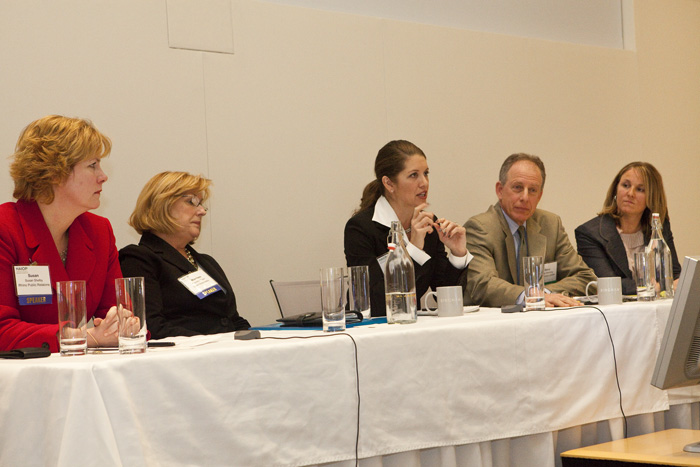
Speakers at NAIOP's Jumpstart Your Marketing program (l-r): Susan Shelby, Mo Doerr, Diane Danielson, Steve Steinberg, Tina Snyder

  • HootSuite – One of the best tools to automate and organize social media, HootSuite allows you to post once on multiple channels (Twitter, LinkedIn, Facebook, and others), as well as scheduling tweets, retweeting, and tracking. As Diane Danielson said “This allows me to write once and publish twice!” We use the service as well, and have found it invaluable for managing NAIOP’s social media efforts.
  • Texting To SellTina Snyder, speaking with colleague Steve Steinberg, shared this cost-effective way to generate leads from property signage. A call to action is displayed asking passers-by to text a unique Mobile ID, after which they instantly receive two text messages back: The first shows pictures and listing details for that property, the second provides contact info with an option to receive an immediate call back. Each time a property’s unique Mobile ID is texted, you receive an alert with your prospect’s contact information. It’s a simple, effective and low cost option to generate leads!
  • Guts: Advertising from the Inside Out, by John Lyons: A classic how-to book recommended by Mo Doerr, who raved about the author’s provocative approach to strategy.  One of her favorite quotes: “Have teeth, will bite. A strategy is a carefully designed plot to murder the competition. Any idea that makes your competition hate you, cry foul, or quietly invoke Chapter 11 qualifies.” (currently out of print, but still available online)
  • Facebook –Facebook isn’t new, but what many don’t realize is that it has greater customization options than may be obvious. Diane used the landing page for SouthField as an example, showing how, through careful use of custom tabs and graphics, they were able to fully brand their Facebook Page, keeping it tightly integrated with the rest of the SouthField marketing materials.

These are just a few of the tools available to today’s marketing professional – what are your favorites? Is there a tool you can’t live without, or one you wish you’d never wasted your time on? Let us know – comment today!

Get the Most Out of Membership: 5 Tips for You and Your Firm

Everyone knows effective networking is a key to continued business success, personally and for your company.  It is through the cultivation of long-term business relationships that existing business expands and new opportunities open up.

One of the best opportunities to network with peers and potential clients is by being an active member of one or more trade associations.  There is an association for almost every niche, locally and nationally, and beyond networking , they offer many other benefits including seminars, workshops, social events, and issue advocacy.

NAIOP at Night, a popular networking event

But just joining an association is not enough. To get a good return on your investment, follow these five tips to building relationships through associations:

1.  Join the right organizations for you.  There is probably more than one association you should consider. Go beyond the obvious and think about who you want to network with.  If you are an attorney, of course you will benefit from learning and sharing with your fellow lawyers, but you won’t get nearly as many business leads as from a group that represents your target industry (which is why so many top real estate lawyers belong to NAIOP.) Find out from friends and colleagues who the association’s members are, and ask yourself if those are the people you need to be developing relationships with. If so, then join!

2.  Participate.  Just being listed as a member of an organization has limited benefits – you must get involved to reap the full value of your membership.  Get started  by attending  programs and introducing yourself,  especially once you’re seated at a table (and don’t always sit with people you already know!)  Remember, you are there to get to know people and for them to get to know you.  Like any kind of relationship building, don’t race to the “finish line” and don’t use these meetings as selling opportunities.  But do come prepared with business cards and be ready to share a clear, concise, and brief description of what you do.

3.  Join a Committee. The gold mine of networking is within the association’s committee structure.  Organizations are always looking for members to volunteer on their many committees, such as program, membership, government affairs, social, and charitable events. There is no better way to get to know others and develop business contacts than by working with them on a common goal.  It’s enjoyable and you get to contribute your ideas and see their effect. (Learn more about NAIOP’s committees)

Networking at NAIOP's 2010 Bus Tour

4.  Speak up!  Talk to people at programs and events.  If there are coffee breaks, discuss the subject matter of the educational event.  Best kept secret for networking: while listening to the presentation, prepare a relevant question for the speakers if there is a Q&A period.  Often no one is ready to ask the first  question, so stand up, say your name and company and ask away.  It’s a  great way to get noticed.

5.  Get on the leadership track.  Once you have a better knowledge of the association and have sampled some of their committees, consider becoming a part of the volunteer leadership.  Choose a committee you have a strong interest in and where you feel you can contribute.  Make a commitment to attend regularly and to consistently contribute to the group in some way, whether it be suggesting program ideas, finding speakers, hosting meetings, recruiting new members, etc. Organizations promote from within and generally choose those members that show leadership qualities.

Bottom line: Join, participate, and enjoy; the benefits will come your way.

Boston’s Investment Market in 2011 – What Would Leventhal Say?

News of the recent sale by The Fallon Co. and Cornerstone Real Estate Advisers of the 465-unit Park Lane Seaport apartment towers to a group of institutional investors comes as no surprise. Neither was the price tag at over $195 million.

Well located and leased commercial properties as well as multifamily rental properties are being bid-up by pension funds, foreign investors and investment funds.  There is plenty of money, but a limited supply of this quality product.

Alan Leventhal

With a limited supply and increasingly restive investors, Boston’s investment market looks ready for a comeback, and expert investors are already showing signs that 2011 could be the year.  I’ll be listening closely at our Annual Meeting next Wednesday, when investing guru Alan Leventhal speaks with NAIOP Chairman Kevin McCall about his company’s plans and predictions.

As reported in the BBJ, Fitch Ratings provided outlooks for 2011 and concluded that Boston is “one of five markets with economic vitality and tenant demand to remain a viable option for investors in real estate debt.”

Alan’s company, Beacon Capital Partners’ investment strategy focuses primarily on office properties in a select number of target markets, including Boston, Washington, D.C., New York, Los Angeles, San Francisco, Seattle, Chicago, London, and Paris.  They believe that these markets are more resilient to the peaks and valleys of the real estate cycle and offer greater and more consistent strength over the long term.

Beacon has had a great track record in evaluating prospective investments in constrained markets that offer them opportunities to capitalize on the market inefficiencies and to add value through operating expertise.    Let’s see what he has to say about this market and what we can expect to see in 2011. Register to hear A Conversation with Alan Leventhal, part of the NAIOP Annual Meeting, from 8-9:30 on Wednesday, Dec. 15 at the Seaport Hotel.

MIT Professor William Wheaton to Speak at NAIOP/SIOR Forecast

MIT Professor William Wheaton – who is speaking at our Dec. 2 NAIOP/SIOR Annual Market Forecast – has been generating national media coverage lately with his calls for lenders to “split the difference” on mortgages facing foreclosure. From an email sent out by the MIT Center for Real Estate, where Wheaton teaches a popular course on the economics of real estate markets: 

“With the release of MIT/CRE Professor William Wheaton’s recent proposal for fixing the housing mess, three of the nation’s premier media outlets (Fortune MagazineNational Public Radio, and CNBC) have sought him out for further comment and forecasting. Professor Wheaton proposes that the 2-sides of the equation “split the difference”.  Lenders write down the mortgage to current value, and then take a significant (but not complete) share of any equity appreciation that does occur. This gives the borrower a deal good enough to prevent “walking”, and also provides the lender with an asset (the contingent claim on appreciation at sale) that is much better than taking the write down alone. It’s a win-win, although the devil is always in the details.” 

Professor Wheaton will turn his attention to the commercial side of things at our always-popular Forecast, where his economic overview will look at current conditions, their impact on the market, and what to expect in the coming year.  Don’t miss this opportunity to hear the latest economic news from a local expert! Click here for more info on the Forecast.

How to Become a Woman of Influence in Boston Real Estate

This post was written by NAIOP member Diane K. Danielson, a consultant who works with clients to incorporate social media into their traditional marketing and business development plans.

On Nov. 2nd, over 100 women packed into Goulston & Storrs to hear from several of Boston real estate’s “Women of Influence.” The panelists and moderator (see photo) shared stories, tips and thoughts about what it takes to rise to the top in commercial real estate.

(l-r) Amanda Strong, Marty Jones, Lisa Brothers, Marilyn Sticklor, and Sarah Abrams (bios below)

I’ve been working outside of the real estate industry for a little over five years and this was the first opportunity I had to gauge if anything had changed in my absence. Based on what I heard at the panel, it was clear that commercial real estate in Boston remains male-dominated, but discussions about gender in the workplace have, in fact, progressed. Here are a few observations I made – if you have your own, please share them in the comments.

  1. The panel consisted of four women who were presidents of major companies and/or national industry organizations. Finding this many women in these positions would have been a bit harder 5-10 years ago.
  2. When asked about life balance, no one shied away from the question or denied it was an issue. Their response: It’s hard. You’ll feel like you’re neglecting your family and your job. However, it’s up to you to decide how open you are about your non-work life in the office. It’s also up to the women and men in top management to set the example if they want a friendly work/life environment.
  3. Avoid carrying around a career killing chip on your shoulder. Yes, sexism does still happen, but it’s like any other obstacle in your career path, you have the power to either overcome it or succumb to it.
  4. Do the math. There is no part of commercial real estate that doesn’t involve finance. Learn the numbers even if you are in marketing or human resources. If you need to boost your understanding in this area, there are great educational institutions out there that can help you and your career.
  5. Stop sitting around waiting to get noticed. This was by far the most troubling part of the panel for me because I had assumed this would be a non-issue by now. Yet it seems that women still play the “good girl,” work hard, and don’t adequately self-promote. As a result, they are less likely to have “sponsors” in the office, i.e. individuals who will go out on a limb on their behalf. (Sponsors are more crucial than mentors for making it to the top, but that’s fodder for a whole other post.)

Perhaps my favorite highlight was when Sarah Abrams shared an anecdote about whenever she invited men to attend a NEWIRE event, they always asked “will other men be there?” If the shoe was on the other foot, i.e. if she made her decisions to attend real estate events based on whether other women would be in attendance, she certainly wouldn’t be sitting where she is right now.

Speakers

  • Sarah Abrams, former President of Fidelity Real Estate Company, President of the New England Chapter of CoreNet and of NAIOP Massachusetts (note: link is to a recent profile of Sarah at MIT CRE site)

    At NAIOP's Women of Influence Event

  • Lisa Brothers, Vice President, COO, and Co-Owner, Nitsch Engineering (president/CEO as of 2011), president of the American Council of Engineering Companies/Massachusetts, and recipient of many civic and professional awards
  • Marty Jones, President of the Corcoran Jennison Companies, recipient of the Affordable Housing Vision Award by National Housing & Rehabilitation Association
  • Amanda Strong, Asset Manager for Colony Realty Partners, Founder of AAREP New England and newly-elected President of AAREP-National

Moderator

  • Marilyn Sticklor, Director at Goulston & Storrs, twice-named a Massachusetts Super Lawyer, with expertise in all aspects of commercial real estate development.