Planning for a Changing Climate is a Shared Responsibility: Private, Public and Philanthropic Sectors Must Work Together

The following column was published in the July 7 edition of Banker & Tradesman.

NYC CLIMATE TRIP JUNE 2019In June, a group of business leaders, philanthropists and environmental advocates joined Boston Mayor Marty Walsh and his environmental team on a “City to City” trip to New York hosted by the Environmental League of Massachusetts and the Greater Boston Chamber of Commerce. As the CEO of an organization that has made climate change resiliency one of its top policy priorities, I was honored to be part of this distinguished group.
The trip was designed to provide attendees with an inside look at how Lower Manhattan responded to Hurricane Sandy and how the public and private sectors are planning for the future. During the walking tour, it quickly became clear that building owners and developers were the “first responders” post-Sandy. Whether through the installation of flood protection measures, nature-based solutions, the elevation of mechanical systems or innovative design measures, the commercial real estate industry is spending millions of dollars on climate change resiliency.

While these types of investments are critical, having a “climate–proof” building in the middle of a neighborhood without power or transportation provides no real public or private benefit.

During Hurricane Sandy, a 9.5-foot storm surge flooded the Hugh L. Carey Tunnel, which connects Brooklyn and Manhattan, with 60 million gallons of contaminated salt water, causing extensive damage. After the storm, the city installed 50,000-pound steel flood gates to protect against a 500-year flood event. Watertight flood walls were installed around the tunnel’s ventilation shafts. Hundreds of millions of dollars in FEMA funds were spent on the project.

If that was the cost for just one project, then one thing is very clear – addressing climate change through mitigation and adaptation will require massive amounts of funding and collaboration between federal, state, local, private and philanthropic entities.

What Does This Mean Locally? 
Boston is taking this issue very seriously.

In October, Walsh released the Resilient Boston Harbor Plan, which is designed to protect the city against the impacts of rising sea level and climate change. The plan includes elevated landscapes, enhanced waterfront parks, flood–resilient buildings and increased access to the waterfront. The city of Boston also became one of the first cities to set a target of carbon neutrality by 2050. Flood overlay zones are being developed, which will affect new construction and existing buildings.

At the state level, aggressive goals for reducing greenhouse gas emissions have been set, new energy efficiency codes have been adopted and comprehensive adaptation and mitigation plans are now being implemented. Nearly all of these policies and plans will affect the real estate industry.

For commercial real estate developers in the Boston area, climate change resiliency is a top priority. Extreme weather events, eroding shorelines and sea level rise have the potential to impact properties and tenants. As a result, new development projects are the most climate resilient. They are designed to take on the storms of the future and often include measures that will protect surrounding neighborhoods from the impacts of climate change.

Recognizing that while climate change cannot be ignored, economic realities still apply. If one sector of the market is overly burdened with new regulations and costs, resiliency measures will fail.

What’s the Solution? 
As the state and cities move forward with their climate resiliency efforts, flexibility is required so that the real estate industry can effectively address climate change without restricting future housing and economic development, which produce crucial property tax revenue. Regulations should provide owners and developers with the ability to make decisions based on the needs of the individual properties, tenancy and product type. Both costs and risks must be evaluated when considering climate change-related investments or regulatory changes.

Given the impact of climate change on all residents of the commonwealth, the burden for addressing this issue should be shared equitably. While an increase in the transfer tax has been proposed as a solution, it’s not the right approach. It only targets a subset of the population and may have the unintended consequence of driving up the cost of housing.

Lowell’s Rep. Thomas Golden, with the support of House Speaker Robert DeLeo, recently filed H3846, An Act Relative to GreenWorks. This proposal is a $1.3 billion energy and resiliency bill designed to offset climate change, creating a new grant program for cities and towns throughout Massachusetts to fund projects focused on climate resiliency. It is modeled after the successful MassWorks infrastructure program and builds on the Environmental Bond Bill passed in 2018.

Given the magnitude of this issue, no one piece of legislation can fully address climate change, but the GreenWorks legislation will set the commonwealth on a path towards improved resiliency. Its passage, combined with public-private partnerships and innovative solutions, will ensure continued economic growth and quality of life in Massachusetts as we tackle one of the greatest challenges threatening the future of the planet.

NAIOP Testifies in Support of Umbrella Liquor Licenses for Large Real Estate Development Projects

Earlier this month, NAIOP’s Government Affairs Associate, Anastasia Nicolaou, testified before the Joint Committee on Consumer Protection and Professional Licensure in support of H. 208, An Act Relative to Large Project Based Licenses. If passed, the bill would allow owners of large real estate development projects to apply for an “umbrella liquor license” with the local licensing authority, overseen by the State Alcoholic Beverages Control Commission. Under the “umbrella license” the local licensing authority would be able to issue restricted project-based liquor licenses for restaurants. These licenses would not be subject to the quota established in the Massachusetts General Laws. They would be tied to the property, not available for resale, and non-transferable.

Currently, liquor license quotas in a city or town in Massachusetts create a barrier for including restaurants in real estate development projects, weakening the project’s overall feasibility. In her testimony, Nicolaou underscored the importance of shop/work/live to the future of retail. Restaurants are critical components to the success of mixed use developments, which create jobs, tax revenue, and community centers for their residents and municipalities.

Nicolaou also focused on the important role of local government in the proposed process.

“This legislation allows the local government to participate in the decision-making process by requiring the adoption of a local ordinance or bylaw to allow this process within their jurisdiction,” said Nicolaou. “This encourages a partnership between the developers and local government as they work together for the future economic prosperity of the community.” NAIOP was pleased to testify in support of this legislation along with representatives from ICSC and will continue to advocate for passage of the bill so that future real estate development projects could benefit from the proposed change

NAIOP Joins Mass. Municipal Association, Housing Advocates and Business Leaders in Support of Housing Choice Legislation

Image

On May 14, NAIOP’s CEO Tamara Small testified before the Joint Committee on Housing in support of H.3507, An Act to Promote Housing Choices. If passed, the bill would enable cities and towns to adopt certain zoning best practices related to housing development by a simple majority vote, rather than the current two-thirds supermajority.

Small testified on a panel with representatives from a coalition of groups responsible for permitting and building housing throughout the Commonwealth including Jon Robertson, Legislative Director at the Mass Municipal Association; Benjamin Fierro III, Counsel to the Home Builders and Remodelers Association of MA; Greg Vasil, CEO of the Greater Boston Real Estate Board; Robert Brennan, President of CapeBuilt Development; and Kathleen Franco, CEO of Trinity Management. The group expressed their strong support for the bill, which would make it easier for communities to enact local zoning changes that encourage housing development.

In her testimony, Small underscored the importance of partnerships between developers and the communities. “Any successful housing development requires a partnership between the developer and the community to ensure that the project addresses local needs,” said Small. “The legislation preserves that partnership by requiring a majority vote, while making it easier for communities to rezone property to encourage more housing production.”

Throughout the hearing, mayors, housing advocates, and business leaders, including Mayor Kim Driscoll of Salem, Mayor Joseph Curtatone of Somerville, the Metropolitan Area Planning Council, the Smart Growth Alliance, CHAPA, and the Massachusetts Business Roundtable testified in support of the bill and called on the Joint Committee to report H. 3507 out favorably.  

NAIOP will continue to advocate for passage of the bill as soon as possible. Because communities enact zoning changes at annual Town Meetings, quick passage of this bill is needed to ensure that implementation of these important reforms is not delayed another cycle.

NAIOP Files Amicus Brief in Marchese v. BRA: Brief Urges SJC to Uphold Superior Court’s Decision in Favor of BPDA

Law firm WilmerHale recently filed an amicus brief on behalf of NAIOP Massachusetts, The Commercial Real Estate Development Association, in the case of Joseph Marchese vs. BRA.  The amicus brief urged the Supreme Judicial Court to affirm the Superior Court’s decision in favor of the Boston Planning and Development Agency (BPDA), formerly known as the Boston Redevelopment Authority (BRA).

NAIOP chose to pursue this opportunity because the case addresses the “demonstrations clause” of the urban renewal statute, a critical economic development tool, which is often used for artistic, cultural and historical preservation in the City of Boston.  NAIOP believes that if the BPDA and similar agencies cannot use their statutorily granted powers of eminent domain to carry out demonstration projects and plans, it could chill development throughout the Commonwealth.

“We are grateful to the incredible team at WilmerHale for their work,” said Tamara Small, CEO of NAIOP Massachusetts. “Joseph Marchese vs. BRA has wide reaching implications for our industry and all of Boston. The BPDA’s success in this matter will benefit Boston’s continued economic development, as well as positively impact the City’s communities and public spaces alike.”

The WilmerHale team involved in the matter was led by Partners Keith Barnett and Michael Bongiorno and included Senior Associate Arjun Jaikumar and Associates Matthew Costello and Julia Harvey.

Oral arguments began on Thursday, May 9.

BPDA Director Brian Golden Speaks on Boston’s Development Climate at NAIOP’s Government Affairs Luncheon

This guest blog post was written by Meghan Doherty of BLDUP.

At a recent NAIOP Government Affairs program, hosted at the office of Nutter McClennen & Fish, Boston Planning and Development Authority (BPDA) Director Brian Golden discussed Boston’s current development climate and the upcoming planning initiatives his office is pursuing.

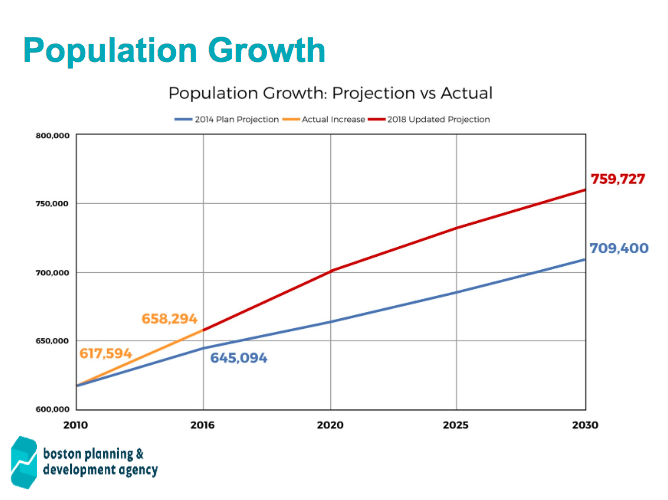
Director Golden opened with a brief history of the BPDA crediting Mayor John B. Hynes for starting the office in the late 1950s. During that time, as the middle class was moving away from cities into the suburbs, Boston saw its population drastically declining, which led to the creation of the Boston Redevelopment Authority. The newly created entity was tasked with promoting development in order to attract economic investment in Boston. It worked. Between 1980 and 2010, Boston’s population grew at a rate of around 1,500 people each year. Since 2010, Boston’s population growth has skyrocketed gaining around 8,000 additional residents each year.

BPDA-Blog1

In fact, Boston’s rapid growth in the past 10 years has led to the BPDA adjusting its population projections. In 2014, just over 709,000 citizens were projected in the City of Boston by 2030. Revised projections have increased that number to 759,000. This population growth is driving development and planning throughout the city. Since Mayor Walsh has taken office, around $50M new square feet of development have been approved. Mayor Walsh’s administration has also increased the city’s housing goals from 53,000 to 69,000 new units of housing. Currently, Boston is ahead of pace for this goal since much of the development in the past few years has been residential.

BPDA-Blog2

Director Golden also discussed the importance of the IDP requirements currently in place to bring middle income and affordable housing to the city. Since the IDP program began in 2000, nearly 2,600 income-restricted housing units have been built and over $137M has been raised in the Inclusionary Housing Fund. When asked about the possibility of increasing the IDP requirement from the existing 13%, Director Golden cited two examples from recent trips to Seattle and San Francisco. In San Francisco, IDP requirements are high, around 20%, and this burden has halted many projects. This policy, Director Golden believes, is an overreach. As he said, “20% of nothing is nothing.”  In Seattle, however, the IDP requirement is 11% and working well. His goal for Boston is to ensure that projects can move forward while also providing for the maximum amount of housing the market will allow.

BPDA-Blog3

Other highlights from Director Golden’s presentation included:

  • New projects are increasing property tax revenue for the city at a record pace, and these are benefits that flow to all Bostonians. For 2019, the BPDA estimates an additional $77M in tax revenue from new projects alone. These funds are crucial to the city budget to maintain the high quality of life Boston residents expect.
  • Diversity is top of mind for the BPDA’s actions in the city. All RFPs for public land will include criteria to promote diversity and inclusion. The BPDA expects to see a robust plan for diversity and inclusion through all phases of the development including the development/design team through the workforce building the project.
  • The BDPA’s  Resilient Boston Harbor initiative, which will kick off public engagement this month, will focus on how all different types of existing and new projects can deal with rising sea levels. The BPDA’s goal is to use this opportunity to elevate the public realm. Golden cited Moakley Park as an example. Plans here will rework Columbia Road and Day Boulevard to build a natural barrier to deal with the predicted sea level rise while also creating a world-class park. 10% of the city’s capital budget will be devoted to building out pieces of elevated public infrastructure like this project.
  • The BPDA currently is working on 16 major planning initiatives across the city. A full list can be found here http://www.bostonplans.org/planning/planning-initiatives

During the Q+A, when asked what the biggest hurdles are for Boson to reach its 2030 goals, Director Golden cited transportation and affordability. Currently, his office is working on the Go Boston mobility study and stressed that ensuring quality public transit will be key to ensuring continued growth.

Director Golden’s presentation was a thorough overview of the state of development in Boston. It gave a positive view of the future of Boston’s economic and community-oriented future, and his comments gave attendees important insight into the goals of the BPDA over the next few years. It is clear that Director Golden has a holistic understanding of the landscape in Boston, and will continue to work with NAIOP members and other key stakeholders to plan for Boston’s future, while respecting its past.

The Time to Act on the Housing Crisis is Now

This post was originally published as an op-ed in Banker & Tradesman on 3/17/19.

Apartment-InteriorSometimes data can simplify even the most emotionally charged and complicated policy debates. Housing policy is no exception to this rule. Recent data may provide some clarity on how we got to where we are today, as well as how we can begin to address the current housing crisis 

Today there are more people working in Massachusetts than at any other time in the commonwealth’s history. According to the University of Massachusetts’ Donahue Instituteby the year 2040 the Massachusetts population is projected to increase by 600,000, with the fastest increase projected in Greater Boston’s inner core. Boston’s population is growing more quickly than previously expected, with 759,000 residents expected to live in Boston by 2030.  

As a result, the Metropolitan Area Planning Council (MAPC) projects Eastern Massachusetts will need 435,000 new units of housing by 2040However, according to the Massachusetts Housing Partnership’s Center for Housing Data, annual housing production is only about half of what it was in the 1960s, 70s and 80s. Massachusetts permitting is 36 percent less housing than the national average (based on new housing per capita), ranking us 38th in the nation 

Words Not Enough to Address Crisis 

At the current pace of housing construction, the commonwealth will be more than 90,000 units short of demand by 2030  

At the same time, permitting requirements have become more onerous with local rules and special bylaws, making the development process longer and more unpredictable. Appeals frequently delay the start of a project by one to two years or often kill the project altogether. To complicate matters, construction inflation is at 6.5 percent in the Boston market – higher than the rest of the nation.  

The lack of housing is now approaching crisis level. The number of communities with median prices above $1 million has doubled in the past decade. As a result, the shortage of workforce housing is now significant threat to our economic growth. Business leaders frequently struggle to attract the best talent when competing with other states that provide more affordable housing opportunities.   

While tackling this issue will require a multi-pronged approach, the data show that this is, in large part, a supply and demand issue. Without more housing production it is becoming very clear that the state’s potential to grow its skilled workforce will be at risk.  

Many Massachusetts communities are now recognizing, some for the first time, they need to do more to encourage growth. The 15 members of the Metro Mayors Coalition late last year announced a target to create 185,000 new housing units across the region by the year 2030. It is a laudable goal and these communities should be applauded for their leadership. However, simply saying you want housing does not create itActionable steps are needed to achieve this goal.   

Fortunately, An Act to Promote Housing Choices (House Bill 3507), recently filed by Gov. Charlie Baker, provides a clear framework for cities and town to encourage new housing production.   

 Bill Helps Communities That Want to Change 

The legislation, which is supported by a broad coalition including the Massachusetts Municipal Association, NAIOP – The Commercial Real Estate Development Association and the Smart Growth Alliance, among others, makes it easier for communities to work with developers to encourage sustainable growth.   

The legislation allows cities and towns to adopt certain zoning best practices by a simple majority vote, rather than the current two-thirds supermajority. This would be allowed in situations where the zoning change will encourage more concentrated development including the adoption of 40R “Smart Growth” districts or starter homes, reduced parking requirements, accessory dwelling units and/or reduced minimum lot sizes.  

This legislation also includes a provision, added during the last legislative session by the Joint Committee on Housing, that would reduce the voting threshold for a local special permit to a simple majority. This would apply to multifamily or mixed-use projects with at least 10 percent affordable units that are near transit or in commercial centers.  

While there is no one silver bullet to solving the housing crisis, the supermajority threshold has long been a barrier for needed housing developments throughout the commonwealthThis legislation would make it easier for communities to rezone property to encourage more housing production  

During the legislative session that concluded in July 2018, the bill came close, but did not pass.  Since then, housing advocates, planners, developers and municipal officials have come together to support the passage of this legislation. On behalf of this remarkable coalition, we urge the legislature to pass this bill as quickly as possible. The time for action is now.  

NAIOP Weighs In On Focus40: The 2040 Investment Plan for the MBTA

focus40

Today NAIOP submitted comments in support of Focus40, the 2040 Investment Plan for the MBTA. NAIOP applauds Secretary Pollack and the Baker-Polito Administration for the significant time and thought that went into Focus40.  A reliable public transit system is critical for sustained economic growth and NAIOP believes that Focus40, combined with the Administration’s Commission on the Future of Transportation in the Commonwealth, and ongoing initiatives such as Rail Vision, as well as the significant work done by the Fiscal and Management Control Board, create a framework for the future.

By focusing on the three tiers of Doing, Planning and Imagining, Focus40 identifies investments that will make the MBTA a more reliable, robust and resilient public transportation system. Focus40 identifies 12 key programs: Blue Line 2040, Orange Line 2040, Green Line 2040, Silver Line 2040, Red Line 2040, Resiliency, Customer Experience, Paratransit, Commuter Rail 2040, Water Transportation 2040, Bus 2040 and Place Based Service Additions.

NAIOP’s comment letter is very supportive and encourages additional focus in the following areas:

– Water Transportation: In the current draft, an identified program objective for 2040 is “supporting a robust, multi-operator Boston Harbor water transportation system, serving more passengers and destinations and excellent connections to landside MBTA service.”  NAIOP believes that water transit has significant potential and that Focus40 provides a unique opportunity to further investigate how waterfront communities, including Boston, could benefit from an expanded system.  NAIOP looks forward to serving as a resource on this issue.

– Ride Sharing and Technology: While references to ridesharing are made under the Customer Experience program recommendations, NAIOP suggests that detailed analysis about the current and future impact of ride sharing services, e.g. Uber, Lyft as well as other technologies be included.  In addition to offering an alternative or complement to MBTA service, these companies are changing the composition of our streets and the level of congestion in many areas.  New and “disruptive” technologies are already impacting transportation and should be considered, making enhanced transportation information sharing through technology an integral part of the Commonwealth’s transportation plan.

– Regional Needs: Considering how the program objectives and recommendations might affect access to other parts of the Commonwealth should be further investigated in Focus40.  While we acknowledge that the MBTA is first and foremost the public transportation system for Boston and surrounding communities, we think that it’s necessary to zoom out and look at outside factors that may interact with the MBTA lines.

– Non-Capital Priorities and Human Resources Planning:  While it is important to have goals and big ideas to guide large investments, the essentials of good MBTA administration are absolutely critical.  The transformational work of the Fiscal and Management Control Board over the past three years illustrates this very clearly.  It is imperative that the big ideas in Focus40 do not overshadow the vital day to day needs and expectations of the region.  We recommend that Focus40 consider how human resources planning and operational strategies will allow this to continue.

Finally, it’s worth noting that in 2015, at the start of the Baker-Polito Administration, NAIOP issued the report, From Good to Great: Recommendations for the Baker-Polito Administration.  The report was based on member feedback and included recommendations on a wide range of policy areas, including transportation.  Specifically, NAIOP urged the Administration to develop a “Vision 2040 Transportation Plan,” which “should address tomorrow’s opportunities, focusing on the issues which may arise over the next 25 years, including long term demographic, economic, environmental, technological, cultural and governmental transformations, the potential effects of global climate change on infrastructure, and the development of new modal choices.”  It’s great to see that when NAIOP members weigh in, policymakers listen! We look forward to continuing to engage members and working with the MassDOT team on this and other transportation initiatives.

Luxury Residence Report Misses the Mark

A report was recently issued from the Institute for Policy Studies that has attracted significant media coverage and editorials from virtually all of the local print and broadcast outlets.

Elisif_20161213_5514.jpgCredit: Elisif Brandon

It’s a great story: the ultra-rich, international money launderers have descended on the Boston real estate scene, crowding out poor and middle-class residents.

However, when you go beyond the buzz and dig into the content of the report, there is much to question. The report implies that owning condos through a trust or LLC is done to hide the owner’s identity. This form of ownership is actually a very common practice for tax, estate, and transactional reasons. Furthermore, while some buyers may choose to remain anonymous, it’s rather uncommon and to imply that anyone who does this is somehow laundering money is factually incorrect.

If these higher priced apartments or condos were not built, middle income apartments would not be replacing them — the economics just do not work with the current high construction costs. Furthermore, these buildings are already paying a tax devoted to the production of affordable housing, with a requirement to provide for at least 15 percent of the units built on site as affordable or a fee to produce those units off site. In addition, the city’s office buildings must also pay a “linkage fee” for affordable housing and workforce training.

Virtually all of these new developments are built on vacant land or in commercial areas where there had not been any housing, so they have not displaced existing residents. In fact, many of these developments have been the catalyst to creating new 24/7 neighborhoods.

If these condo owners are not here full-time to justify a residential tax break, so what? Do we want to discourage retirees living in Florida from living here for six months? Do we want to tell the penthouse owner, Michael Dell, to take a hike and take his jobs with him? I don’t think so.

The real issue is that it will take federal and state resources, communities working with developers, and overcoming NIMBY-ism and fear of affordable housing at the local level to truly address this housing crisis. Rather than drawing false conclusions and creating easy scapegoats, it’s time we all come together to find economically feasible solutions.

This letter to the editor originally appeared in the Boston Business Journal on September 20, 2018, as written by NAIOP Massachusetts CEO David Begelfer.


20 years later, Brownfields Act remains a pioneering policy

This op-ed originally appeared in Viewpoint on bizjournals.com on September 13, 2018. The joint op-ed was authored by Ned Abelson, attorney at Goulston & Storrs and co-chair of the NAIOP Brownfields Committee, and by David Begelfer, NAIOP Massachusetts CEO and an active participant in the passage of the Brownfields Act. 

Twenty years ago this summer, Gov. Paul Cellucci signed into law the “Brownfields Act,” establishing new incentives and protections to encourage parties to clean up and redevelop contaminated property in Massachusetts. This law provides comprehensive liability relief and financial incentives to attract new investment in these properties while ensuring a safe and effective cleanup. Simply put, without the passage of the Brownfields Act, many communities that are now thriving would be filled with vacant and contaminated properties.

Suburban Office Park

A Brownfield site is blocked from productive use because of potentially hazardous contaminants. Prior to the passage of this law, developers considering cleaning up and then redeveloping such a property often concluded the effort was simply too risky, too expensive and too time-consuming to offset future profits from leasing the property to retailers, businesses and residents.

A model for states across the country, the Brownfields Act allows innocent Massachusetts real estate owners and operators to apply to the Department of Revenue for a state income tax credit to offset the net cost of the cleanup. Any party that contaminated a property or owned the property at the time of contamination is not eligible for the tax credit. Depending on the extent of the completed cleanup, the taxpayer may apply for a credit equal to either 25 percent or 50 percent of the cleanup cost. If the site has an Activity and Use Limitation, or AUL — typically a use restriction placed on title as part of the cleanup process — then a 25 percent credit would apply; if no AUL, then eligibility increases to 50 percent. Without this tax credit, many contaminated properties would remain a public health risk and there would be no incentive to clean up and return these sites to productive use.

The credits have provided critical additional funding for community development corporations, or CDCs, and other community-based organizations. And a change to the law in 2006 has helped nonprofit organizations, which were previously not able to use all of their credits, to sell or transfer the credits to others. In recent years, the state Department of Revenue has distributed between $28 million and $61 million annually in Brownfields tax credits, benefitting between 40 and 80 development projects each year.

The Brownfields Act was created through a unique collaboration of Massachusetts policymakers and a truly diverse set of stakeholders. Developers, town officials, environmentalists, business association representatives, scientists and many others spent hundreds of hours negotiating the details of this landmark legislation.

For Massachusetts residents and businesses, the benefits have been significant. By cleaning up these sites, public health conditions improved, local communities were revitalized, housing was built in vacant areas, new jobs were created, and municipal real estate tax revenue grew. For developers and their partners in engineering, construction and architecture, redeveloping a former industrial site no longer posed a financial or legal death sentence.

For a very modest investment by the commonwealth, billions of dollars of investments have been made throughout the state, benefitting its citizens and municipalities. We commend the Legislature’s work this session to provide for a five-year extension of the Brownfields tax credit in the Housing Bond bill, signed by Gov. Baker on May 31. Twenty years later, the Brownfields Act’s approach to economic development and public health policy continues to be bipartisan, beneficial, bold and, most important, very successful.


BLDUP Spotlight and Q&A – David Begelfer, Reesa Fischer and Tamara Small of NAIOP Massachusetts

This post comes from BLDUP.com: BLDUP Spotlight – David Begelfer, Reesa Fischer and Tamara Small of NAIOP Massachusetts

Bldup_Spotlight_NAIOP_MA

Last week NAIOP announced that David Begelfer would be retiring after more than 27 years leading the organization. NAIOP’s Board of Directors voted Reesa Fischer, currently Chief Operating Officer, and Tamara Small, currently Senior Vice President of Government Affairs, to co-lead the association. Fischer will serve as Executive Director with operational, financial, programming and membership/marketing oversight. Small will serve as Chief Executive Officer with oversight of the organization’s government affairs and lobbying activities, public relations, and research. BLDUP sat down with the three industry leaders to discuss the transition and NAIOP’s goals for the future.

BLDUP: For our readers that are not familiar, what is NAIOP?

Tamara Small: Officially NAIOP is The Commercial Real Estate Development Association. Long ago NAIOP stood for National Association of Industrial and Office Parks. It was then changed to National Association of Industrial and Office Properties.  In 2009, the national organization recognized we represented so much more than industrial and office properties.  They did not want to lose the brand recognition that NAIOP had so they kept the acronym, but changed what it stood for.  We now represent office, retail, mixed-use, multifamily, lab and institutional space here in Massachusetts. We are the largest of all the NAIOP chapters at nearly 1,700 members.

Reesa Fischer: Our membership is made up of a variety of industry leaders.  While we are primarily (60%), owners, developers, and operators, the other 40% is made up of attorneys, brokers, and everyone else who supports the commercial real estate industry.  This variety of folks involved in the organization is also a big differentiator for NAIOP.  We operate based on a 3 legs of the stool principle, government affairs advocacy, events/education & networking.

BLDUP:  What is NAIOP forecasting for the Boston market?  Are there any trends you are seeing?

David Begelfer: What I see as our greatest risk going forward is probably not a recession, at least locally.  The Boston market is quite strong and we do not see a lot of oversupply or speculative projects.

A serious downturn does not look like it’s in the cards for the next 2-3 years but we do anticipate somewhat of a slow down because of our success. There are two major components exceeding inflation, land cost and construction costs (the biggest part being labor costs) and these two issues affect development.  We have a very tight market with regards to the construction industry and the number of people and subcontractors.  We also have barriers for entry for companies and individuals to move in from out of state because of the high cost of living.  We are seeing inflation in costs of land/construction because of our dynamic economy. Because of this, we are already starting to price out residential rent projects, pushing them toward condos.

Another aspect of this looming problem is the limited capacity of skilled unemployed workers that can fuel the market going forward.  We have relied upon immigration from out of the country for the last 25 years of growth.  Immigration is starting to have some cracks for various reasons (policy, political, practical economic).  We have concerns that the constant flow is drying up and Massachusetts has always had a problem with net migration out of the state.  The bottom line, as I see it, is that we are at a greater risk from our success than from a possible recession.

BLDUP:  David, What is your proudest achievement as outgoing CEO of NAIOP?

David Begelfer:  It is very hard to choose one particular moment, but if I had to take an overview of the past 27+ years, I’m very proud of the “secret sauce” of NAIOP.  From the start, the secret sauce was to integrate the top professionals and engage in our organization primarily in government affairs and advocacy.  It’s very difficult to handle the wide range of issues that we deal with, regulatory, legislative, judicial, policy and then within each of those baskets another array of issues from environmental, transportation, economic, building codes, all across the map.  The only way we have been able to handle this and provide expert feedback is the unbelievably involved professionals who work with us. This has allowed us to expand the breadth and depth of issues that we deal with and we have done it in a way that we can give something back. We can’t pay for this counsel but instead, we offer networking, connections, and leadership opportunities to add value to our relationships and provide a win/win for everyone involved.  The involvement and growth of volunteerism within the organization is the greatest success I could imagine.

Additionally, we have been able to bring some of the top people in the industry onto our staff.  One of the reasons this is a seamless transition is that others have developed expertise within our organization. It was very easy to choose Reesa & Tamara to move forward into the leadership of the organization.

Reesa Fischer: I feel it is important to mention David’s ability to embrace change.  Most trade associations are very stagnant and very conservative.  They do what they do and as long as it’s not broken they don’t fix it is. One thing we value at NAIOP (and it’s why I love working here) is that embracing change is what it’s going to take to stay competitive.  We like to think of our organization as a disruptor and we are always trying new things that people wouldn’t necessarily expect from a trade association.

David Begelfer: We are always looking to see what can be changed and done differently.  There is no complacency in this organization. People talk about having periodic strategic plans; we strategically think about our organization throughout the year.  That may cause more work, but it keeps us relevant. You can’t fight change you have to embrace it!

BLDUP: Government affairs and advocacy is a big part of what you do. How do you work to accomplish your advocacy goals?

Tamara Small: We have our eyes and ears on anything that would have an impact on the industry and we weigh in wherever appropriate – whether it’s legislative, regulatory or judicial advocacy.  The process is a very collaborative one.  We have over 200 people on our Government Affairs committee and a very active board of directors who provide input. This expertise allows us to provide real-world examples that illustrate the impact of any proposed changes.

As an example, we just wrapped up the legislative session which ran from January 2017 through July 31, 2018.  There were about 8,000 bills filed this session and we tracked hundreds of them, provided testimony, served on legislative task forces and met with legislators.  Clearly, no legislator can be an expert on every single issue. So, for those issues that are of interest to us, we provide substantive, factual information on how the bill would affect the commercial real estate industry – and often the greater overall economy. Through this approach, we have built strong relationships with legislators and regulators.

A good example of how NAIOP handles advocacy would be a provision of the economic development bill that was signed into law by Governor Baker on August 10. The bill includes language that will bring clarity to the development process for properties along railroad rights of way. The process had been a source of frustration to the development community for many years. So, through our government affairs committee, we drafted a legislative fix and worked for 8 years to educate lawmakers on the need for the change. Through the leadership of key legislators and MassDOT Secretary Stephanie Pollack, we were able to work together on language that was signed into law. It will bring transparency and predictability to the development process – two things that are critical for any real estate project.   Talking about railroad rights of way may not be the most exciting topic, but it is one of those things that will affect important transit-oriented projects throughout the Commonwealth.

BLDUP:  What is the next legislative issue you will be focusing on?

Looking ahead, our three areas of focus will be: Housing, Transportation, and Climate Resiliency

We believe that climate resiliency is a top priority for the industry. It’s an economic development issue.  We were very supportive of the climate change legislation that passed this session. The bill that was passed requires the Commonwealth to develop a climate adaptation plan, complete vulnerability assessments at the state and local levels, and identify how the public and private sectors can work together to really think through what climate change means for the real estate industry and for the greater economy.

Another broader economic development issue that we are passionate about is the need for more workforce housing.  We were very supportive of Governor Baker’s housing bill.  We worked with all of the business groups as well as the Mass Municipal Association to try and get that passed in the final hours of the legislative session, but unfortunately, it didn’t make it. In my mind, it would have been the most significant housing bill in years.  We also thought it was very significant that we had such a broad coalition of support for the first time in 30 years of discussion around this issue. We are going to continue to push for this in the next session, which kicks off in January.

Our third big area is transportation. We will continue to advocate for an efficient, world-class transportation system in MA.  We need the type of system that allows people to get in and out of the city and to expanding areas with ease.  We are going to be looking at that in the next legislative session to ensure we can expand on existing capacity.

BLDUP:  Reesa & Tamara what are your goals for the NAIOP in next 5-10 years and David what would you like to see continue after you retire?

David Begelfer: I do think that NAIOP is going to continue to sit on the same 3 legs of the stool, advocacy, education, programming/networking.  Every member gets something from one or all of these areas.  We need to take a look at new technology, be proactive, be entrepreneurial, be thoughtful, and stay in touch with members and their needs.  We also want to offer new platforms for information.

One thing that is NOT going to be happening, is people are NOT going to be totally virtual. They want to meet face to face. That’s never going to change.  You will always need networking.

We have also taken a look at online learning and have seen a much greater demand for face to face learning but in a tighter timeline.  We are moving into podcasts.  That seems to be a very popular way for people to get information while driving, walking, or spinning. It’s hard to plan for the future when technology is changing so quickly.  Right now we have a partnership with the MIT Center for Real Estate that enables us to see what is on the cutting edge of the industry.  We just need to continue to keep an open mind.

Reesa Fischer: It’s about expanding the information and knowledge the we can provide the members and providing them with different options of delivery. People are just so busy and not everyone can come to a site event.  Some people prefer podcasts or live webinars.  We need to expand our information and methods of delivery to stay relevant.

We have also seen a huge demand for professional development skills that are outside of the industry.  The membership is looking to be able to provide skills for their talent.  Talent is a big issue right now, retaining and obtaining.  Learning professional skills while networking and engaging with people in the industry is a unique opportunity we can provide our members.

Tamara Small:  We are nothing without members. We look forward to working with our many member-driven committees and continually seeking feedback directly from the industry.  As Reesa and I transition to our new roles, we will be sitting down with our leadership and members to do our own focus groups in order to understand what they need. We look forward to growing and expanding with them.

Reesa Fischer:  Yes, we are very externally focused!

BLDUP:  What is the last book you read that you would recommend and why?

Reesa Fischer: The Road to Recognition by Seth Price.  Seth is a local guy who runs Placester and did a keynote at one of our marketing conferences.  The book is about building your personal brand which plays into a corporate brand: being authentic, setting up expectations, meeting expectations.  Detailing ways to keep you competitive either personally or professionally. It’s how I look at our organization so that we can continue to be important in the industry.

Tamara Small: Starting Small and Making It Big: An Entrepreneur’s Journey to Billion-Dollar Philanthropist by Bill Cummings.  It is interesting to hear his rags to riches story and his unbelievable drive and entrepreneurial spirit that have helped create his company.  The book provides history about the CRE industry but also an inside look at one of the most entrepreneurial people I’ve encountered.  He is also someone who has really devoted a good part of his career now to charitable endeavors and that is very admirable.

David Begelfer: Leonardo da Vinci by Walter Isaacson.  It’s astounding the genius that was there but not just genius: the genius was combined with unbelievable curiosity.  Almost anything he saw he wanted to look further into it. It’s frightening that a lot of what he discovered was never published and lost for hundreds of years. People would rediscover these things hundreds of years later.  He discovered something about how the heart works but it was not actually verified until 1970. He was way ahead of his time. It is a very fascinating read and again it was not just intelligence but a need to be entrepreneurial and also a great observer and creative.

BLDUP:  It is important to note that despite the CRE industry being primarily male, NAIOP’s new leadership team is female.  Tamara and Reesa what are your thoughts on this.

Reesa Fischer:  Just a little history, when I started here 8 years ago, the percentage of women in the industry and in NAIOP was significantly lower.  It is really exciting to see that women have very quickly been getting involved.  Our female membership rates have gone from around 10% up to 28-30%.

About 7 years ago we started an annual event, the Women of Influence luncheon. It sells out 200+ tickets every year with wait lists of people.  I think the pipeline is filling up as young women are starting to come into the industry and seeing there are a variety of ways to get involved, not just brokerage but in the development world as well.

Women are very organized and project management focused and very collaborative and that is what this industry is.  It’s about time women recognize they can actually play an important role. We are also more women in senior roles and running companies.

Our Distinguished Real Estate Award recipient this year is Related Beal, run by Kimberly Sherman Stamler.  Our President-elect for next year is also a woman so the top 3 levels of our organization will be female.  We are very excited to feel like we are following the trend and blazing new trails for women in the industry.

Tamara Small:  Going forward we will operate under a collaborative leadership structure which we found is much more common with women.  Reesa and I have worked together for so many years and we both have our own unique strengths so we are excited to continue this and take NAIOP to the next level.

David Begelfer: We have not said we want to have women run the organization, we have put into place the best people we have for the position and they happen to be women.  They are stepping up and being chosen to lead because of their skills.

BLDUP:  David, to conclude on more of a personal note, what are your plans for your new free time?

David Begelfer:  I have a lot of interests to stay active and involved in the industry.  I love to travel, play golf, those are wonderful things, but I don’t see that as sufficient to keep me alive and well and excited about my future. I’m looking into opportunities that will allow me to keep active and participate in this active industry. I am mostly looking forward to being a member of NAIOP and getting all the value that a member gets from being involved.