What the Future Holds for Cambridge, MA – The Innovation Capital of the World

This blog post was submitted by Allyson Quinby, Account Executive at Solomon McCown & Company.

NAIOP Massachusetts’ “Cambridge: Ready, Set, Go!” breakfast event on February 15 featured a well-versed panel of real estate executives who spoke on “What’s new and what’s next for this hot market.”  Mary Lentz, McCall & Almy, moderated the expert panel that included Tom Andrews, Alexandria Real Estate Equities; Michael Cantalupa, Boston Properties; Shawn Hurley, Skanska USA Commercial Development; Steven Marsh, MIT Investment Management Company; and Thomas O’Brien, The HYM Investment Group.

View photos and event presentation slides.

Marsh noted how the world is changing every day, and that the U.S. along with many other superpowers such as China and India, continues to look for new ways to compete. For example, the U.S. aggressively leads the way when it comes to innovation, and as Marsh discussed, Cambridge has long been the epicenter of innovation productivity.

Due to Vertex’s move to Boston’s Seaport district, many in the real estate industry worry that the Cambridge market no longer holds the same stature it once did. However, NAIOP’s expert panelists assured us that we are in a natural state in Cambridge, and as stated by Cantalupa, “If you can afford to be next to MIT, you will be.” The lab market is steady, and many developers like Skanska USA Commercial Development are currently taking time to re-evaluate outdated space to create real estate opportunities that will fit all types of tenant needs in the future.

Home to two of the finest institutions of higher education in the world, Harvard and MIT, the panelists argued that Cambridge has gained and will maintain a prominent reputation. Companies in the life-sciences, technology, bio-pharmacology, education and innovation sectors, along with many startups, have found their homes in Cambridge. Due to the competitive advantage that comes with a Cambridge address, real estate firms have experienced a tremendous amount of success leasing space in this market. As the panelists noted, there is still an active demand and we continue to see new development activity in this market today.

Marsh and Andrews also spoke about the importance of proximity for lab space to MIT and other academic buildings. It is crucial that all facilities continue to collaborate, creating an environment that fosters innovation. Hurley also noted how mixed-use space needs to continue to be developed; it is important that we connect lab to retail and public spaces.

O’Brien discussed the next generation workforce and the need to build corporate and residential spaces that attract young professionals. His firm is developing the NorthPoint neighborhood, a mixed-use campus with flexibility – one that allows people to live and work in the same place.

Cantalupa and Hurley spoke on how real estate developers need to build flexible buildings that can adjust to market demands. Hurley noted how Skanska’s plan behind 150 Second Street was to deliver a Class-A, highly flexible property with a sustainable design that had features all tenants could enjoy. The building was also designed to accommodate either one or multiple tenants.

As stated by Marsh (and I agree), “Cambridge is special – it goes well beyond real estate” – and it is here that we want to continue the innovation story.

Note from NAIOP: Learn more about the dynamic Cambridge market by attending our 10th Anniversary Bus Tour, Big & Breaking in Greater Boston. Cambridge, along with Fenway, Longwood, Boston’s Seaport and Allston will be featured during this fast-paced and informative live market update bus tour.

If You Build It, They Will Come: Demand Exists for More Multifamily Housing in Greater Boston

A recent article in The Boston Globe talked of the recent surge in apartment construction, identifying 11 developments either under construction or about to receive final approvals. Although not as many, there are also large multifamily projects underway in the suburbs, including John M. Corcoran’s development in SouthField (the former Weymouth Naval Air Base) that Rick High described at NAIOP’s recent lunch program.

Some skeptics believe that the weak economy and high supply will result in an oversupply of multifamily housing. I disagree. There is no doubt we have room in the market for quite a few more projects, both in Boston and the surrounding communities.

Since the recession began in 2009, the vacancy rates for rental housing have plummeted and, not surprisingly,  the rents have pushed upwards.  Boston now has one of the lowest vacancy rates in the country. With higher rents and interest rates remaining historically low, new multifamily developments are finally viable.  Though the costs of housing production in Massachusetts are still among the highest in the nation, due in part to labor costs, these projects are profitable (by some rather thin margins, though.)

If you believe the increased demand is only due to the burst of the single family housing bubble and the resulting foreclosures, you need only look at the other drivers in this area. The research firm REIS has reported that the net absorption in this market is the highest on record since it started tracking the data in 1980!

As reported by Cushman & Wakefield, there are a number of factors contributing to the growth of the rental housing market in the Boston area:

  •  Job Growth: With a conservative 35,000 jobs a year projected to be created, there will be an additional 35,000 households over the next 5 years;
  • Change of Ownership: 87,000 rental households are needed to fulfill the demand created by the shift in ownership from single family to rental;
  • Increase of Echo Boomers (ages 21-34): 27,000 rental units are needed to satisfy the demand created by this generation. Approximately 75% of this population are renters and this demographic is expected to grow by 2.2% over 5 years.

Bottom line – that’s a lot of demand!  And even with all of the construction planned, the vacancy rate is still projected to drop.  Certainly good news for developers and the Massachusetts economy!

Commercial Real Estate Bubble?

Is the investment market for core commercial properties cooling a bit? If so, what does this mean for Boston?

According to Pensions and Investments newsletter, the California Public Employees’ Retirement System (CalPERS) is considering dropping its real estate allocation to 8% from 10% by year end.

The buying pressure for core “trophy” properties from pension funds, foreign investors, REITs, and private investment pools are pushing acquisition pricing back to the pre-recession highs.  Locally, 33 Arch Street traded at a sub 5 cap rate ($530/sf.)  Earlier, Boston Properties acquired the Hancock Tower at an initial 4.6 cap ($475/sf.) Most recently, Landmark Center was purchased by Samuels for $530.5 million ($558/sf.)

The Blackstone Group told investors it had raised another $4 billion for its latest real estate fund with a target of $10 billion.  It has already invested/committed $4.4 billion to real estate deals during the first six months of this year.  Blackstone believes that the opportunities lie with the relatively low prices and the sluggish global economy.

At some point, investors will need to ask whether these investments have been worth the high prices paid for them.  Will they achieve the projected rental increases and vacancy decreases that the investments were based on, if the economy continues to remain sluggish with nominal job growth?

According to Colliers’ Boston office , although the vacancy rate in Boston only dropped from 16.6% to 16.3% during the second quarter, the Back Bay submarket showed an overall 8.0% vacancy, with class A space at a very low 5.8%.  Rents have improved with Class A asking rents averaging slightly above where they were before the rental spike that occurred in mid-2007. However, Boston Class B space and the suburban markets are another story. Vacancy rates are still high with the Route 128 submarket at 19.3% and Route 495 at 25.6%. With Boston class B space discounted 30% off class A space and suburban rents having dropped 20%, properties in these markets are clearly going to be challenged for some time.

The good news is that Massachusetts is actually doing better than the rest of the nation, but even here there may be fears of another bubble – especially in light of recent market events.  Could we have a “double-dip” downturn in commercial real estate?  If the world economy does not show some initial stabilization followed by real growth, we may see some of these recent property acquisitions reselling at a loss. Only time will tell.

What’s the Impact of the US Debt Downgrade on CRE?

Everyone is trying to determine the impact that the recent S&P downgrade will have on the economy, their businesses, and their  personal investments.  I personally do not think it will have a substantial impact beyond the stock market’s roller coaster ride over the next few weeks.  That does not mean I believe the economy is in good shape, far from it.  I think this particular event is a distraction from the anemic job recovery across the country (granted that Massachusetts is finally outpacing the rest of the country after being the poor performer in the last few recessionary recoveries.)  Add to that the financial disasters within the European Union states, and the political unrest from London to Damascus, and you do not come away with much optimism for the next few years.

As for commercial real estate, we are in the “people business” in that the only way we can fill our buildings is to have businesses employ workers and expand that base.  With the uncertainty in the marketplace, we are not seeing any great surge in employment.  Some of the recent drop in the unemployment rate was unfortunately due to unemployed workers who gave up looking for a job.  The question is how do the businesses in the Commonwealth feel about their prospects?  Prior to the S&P announcement, AIM’s business confidence index for Massachusetts remained neutral at around 50 points out of 100 (not very encouraging.)

However, in our industry there may be some winners.  Investment funds have purchased commercial properties at a discount these past couple of years and more properties may come up for sale (either willingly or forced by their bankers.)  There will be exceptions to the dismal economic forecast in all real estate market categories with build-to-suits leading the way (e.g. Vertex, Novartis, Liberty Mutual) and a number of multi-family apartment projects benefitting from a robust rental market
locally.  The Seaport District will be an important bellwether.  After years of waiting for its “turn” there is some real momentum with Fan Pier, Liberty Wharf, and talk of multi-family housing, a hotel, and long-awaited retail. (Save the Date – NAIOP will be hosting a conference on the Seaport’s development plans on September 21st.)

Today’s Boston Globe had a good overview of the industries in Massachusetts and their reaction to the downgrade.  As I indicated in that article, as the industry that houses these businesses, we are “holding our breath” for the time being and hoping that what modest momentum we have had in Massachusetts does not get slowed any further.

The Return of an Owner’s Market?

It might be a sign that the commercial real estate industry’s recovery is beginning.  A recent article in Banker & Tradesman,  entitled High Rise Office Space Expected to Soar, describes a significant improvement in the industry bellwether of tower leasing. With vacancy rates around six percent in the “upper floor” market in Boston high rises, rents are beginning to push upwards.

This is obviously the premium space in Boston, but in the past it has been a good indicator of market recoveries.  There needs to be more business expansion with substantial job creation for this to spread to other Class A space in downtown and the Route 128 suburbs, but it is a start.

Brokers are now advising their clients to lock in their leases at the current rates.  It appears that the indecision that was evident in 2009 and 2010 is being replaced with timely transactions.  Whether these lease renewals are for current space needs or include expansion for future growth is the most important question.

The good news is that Massachusetts is one of the few states showing any job growth.  Let’s hope that this is the start of a more sustained recovery.

Millenials and the Alternative Workplace: The Future of the Commercial Real Estate Industry

At a recent NAIOP Massachusetts program, a panel of leading professionals discussed the changing workplace that is being driven, in part, by a new demographic – the Millennials.

As Martha (Marty) O’Mara, PhD, CRE, Managing Director of Corporate Portfolio Analytics, said about this influential category, “they are no longer our kids, but our co-workers.”

This shift is bound to have an impact as they enter the workforce, and Marty’s presentation outlined some surprising facts about this group:

  • Only 15% of Millennials (age 19-29) say having a high-paying career is their top priority.  They place parenthood (52%) and a successful marriage (32%) much higher.
  • 63% have graduated from college, or plan to graduate.
  • Most in the workforce have already experienced bouts of unemployment.
  • Only 61% grew up in a household with both parents.
  • 38% have a tattoo.
  • 8/10 sleep with their cellphone.

They are a powerful market driver and their communication and work style preferences (consuming “experiences” rather than “things”, for example) are already shaping the commercial real estate industry.   

Marty’s bottom line:  “Don’t let a Boomer make a real estate decision.”  More and more companies are recognizing this and designing an “Alternative Workplace” as they plan for the future.

In a short slideshow, Marc Margulies, Margulies Perruzzi Architects shared the key elements of the new Alternative Workplace:

  • Few/no high wall cubicles
  • Multiple workplace environments
  • Density at 165 RSF/person
  • Amenity-rich
  • Dynamic

A panel of experts including Marty and Marc, as well as Bob Richards of Richards Barry Joyce & Partners; Janet Nicholas of Dassault Systèmes; and Greg Lewis of Shire Human Genetic Therapies, then discussed what all of this really means.  

Highlights and things to think about:

  • The Alternative Workplace is designed to support diverse demographics and to be conducive to multiple work styles (mobility being an important element.) 
  • Producing a corporate community that increases productivity through collaboration and interactivity is accomplished through a dramatic change from the historically private spaces (individual worksettings ) to ”neighborhoods” (more collaborative community spaces).
  • The new term is “benching,” providing bench space that can be shared, moved, configured.  The amount of space per employee can change based on the users from a 1.3:1 ratio that efficiently utilizes vacant space due to normal absenteeism, to up to 3:1 for a group that has higher sales and/or consulting staff that travels.
  • Lastly the “town common” area has plenty of amenities.  Picture this as the Kendall Square within the company where different specialties come together as a community in a social, casual area.  These tend to be food oriented, nature focused, bright, and inspirational.

Many of these changes are already being seen in the new designs and renovations of firms throughout the region, but this is just the tip of the iceberg, according to O’Mara and the other speakers.  Big changes are on the horizon for anyone involved in corporate real estate, and those changes will create countless opportunities for the firms who are ready.

Did you attend Wednesday’s program? Share your key takeaways and questions in the comments below!

The Changing Face of Retail

Yesterday’s NAIOP Main Event, New Rules for Retail: The Post-Recession Reality, had a standing room only crowd, and for a good reason. (See event photos here.)  The retail landscape is changing more quickly than ever before due, in part, from the influence of the internet and the changing demands of the consumer.  ICSC and NAIOP members heard from a panel of industry experts: David Smookler, Principal, The Dartmouth Company; Tom DeSimone, Executive Vice President, WS Development; Jeff Gellerman, Director Real Estate, Lowes Home Improvement, and Bill Moscarelli, Vice President Real Estate, National Amusements

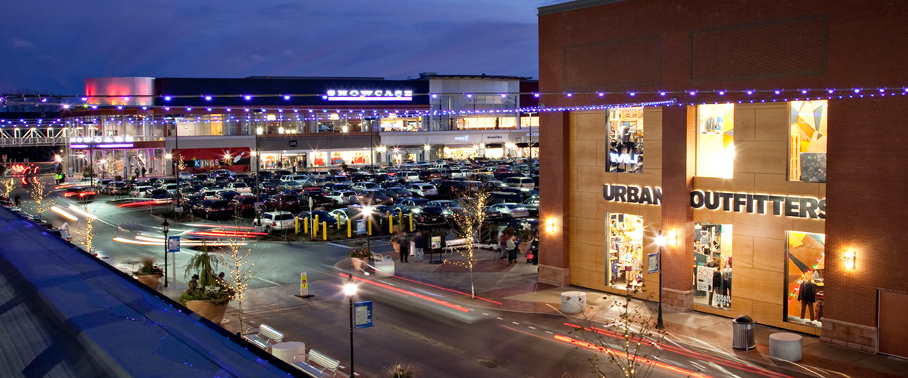
Legacy Place (photo by Michael Blanchard)

Based on the presentations, it’s clear that the cookie-cutter approach to retail development is history.  To succeed, new retail development must be customized to the community, the site, and the market.  The design of the successful Legacy Place is not going to be replicated in Lynnfield’s mixed use partnership with WS Development and National Development – it will be its own unique blend of uses and public spaces.  The stand-alone Cineplex developed by National Amusements has changed dramatically in just 15 years.  Stadium seating, 3-D movies and restaurant-style dining have made going to the movies a totally different experience. And there seems to be no doubt that even with hundreds of channels on TV and endless options for shopping and entertainment online, people will still continue to go out to have fun.  

That said, the influence of the internet continues to expand and cannot be ignored.  Shoppers are doing much of their “homework” online and shopping experiences (good, but mostly bad) are shared through social media channels and can quickly go viral. Lowes discussed the importance of staying ahead of the curve by offering customers tutorials on home improvement projects with links to purchase the supplies needed to complete the job.  

When it comes to retail, what seems to be the rule now, as before, is that change will continue to be a critical part of this industry.

“It’s Getting Better all the Time”, The Beatles

At the well-attended NAIOP Developing Leaders breakfast this morning, a panel presented “Booming In Beantown: Why Boston Remains One of CRE’s Hottest Markets.”

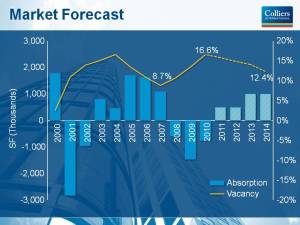
I was particularly interested in three slides that certainly left me and the other attendees sighing with relief about our future.  The first two slides were from Yanni Tsipis, Senior Vice President of Development & Consulting Services, at Colliers International.  The Market Forecast shows the historic run-up of the vacancy in Boston to a 10 year high of 16.6%.  However, they are forecasting positive absorption over the next four years, dropping the vacancy rate to 12.4%.  That might not be the low single digits, but it is in the range to start pushing up the rental rates.

The next slide should not come as a great surprise regarding the relative health of the commercial real estate investment market.  It does, though, show how bad off are the other regions of the country.  The delinquent or special service loans are under 5% for the Boston market.  However, take a look at some of the other metro markets like Phoenix, Riverside-Ontario, and Seattle.  New York and Washington, the other “stars” are a bit worse off than Boston.  It has been many a recession ago since we were not the poster child for being the worst affected region.

Finally, Peter Merrigan, President & CEO of Taurus Investment Holdings provided a chart showing Boston’s advantage in terms of employment gains.  This may be the first time Boston has ever been in any top grouping regarding employment (other than loss of.)  Not only is Boston ranked third with over 1.3% twelve month gains, but the Commonwealth is ranked fourth in actual raw employment numbers!

Bring out your old records and enjoy the refrain: “It’s getting better all the time.”  And hopefully for the foreseeable future too.

Predictions for Real Estate in 2011

This is the fifth recession and subsequent recovery I have worked through.  I have learned that business cycles have been and will always be a part of our industry.  It’s just a question of timing.  

Now that 2011 is underway, here are my predictions for the real estate market this year:

  1. Office rents:  Tower rents will break the $75 per square foot barrier. Suburban rents along 128 will hit $35.
  2. New Construction: Multi-family construction will continue to be a sure thing in Boston and the suburbs.  The only speculative commercial building construction starts in the state will be in Cambridge.
  3. Filenes in Downtown Crossing: Will be approved this year with a construction start in 2012. Besides the obvious garage, there will be at least two floors of retail, an apartment tower, and a phase two office tower.
  4. Financing: Plentiful for the well capitalized owner from multiple sources including CMBS.  Interest rates: steady in the 5-6 percent range.
  5. Cambridge market: Employment and space growth in the Life Sciences (biotech and pharma) will lead to new developments.
  6. Hospitals/Colleges: Improving endowments and lower construction costs will put back on track pre-recession expansion plans (but not Harvard’s massive Allston development.)  
  7. Multi-family construction: Twelve developments (each with over 100 units) will start this year.
  8. Foreclosures: Single family foreclosures will increase and some commercial loans for industrial and suburban office/R&D will be placed on the block.
  9. Investment sales: The number and gross sales volume will be the highest since 2007.
  10. Unemployment rate for the Commonwealth: It will be up slightly (less than 1 percentage point) by the end of the year.

Boston’s Investment Market in 2011 – What Would Leventhal Say?

News of the recent sale by The Fallon Co. and Cornerstone Real Estate Advisers of the 465-unit Park Lane Seaport apartment towers to a group of institutional investors comes as no surprise. Neither was the price tag at over $195 million.

Well located and leased commercial properties as well as multifamily rental properties are being bid-up by pension funds, foreign investors and investment funds.  There is plenty of money, but a limited supply of this quality product.

Alan Leventhal

With a limited supply and increasingly restive investors, Boston’s investment market looks ready for a comeback, and expert investors are already showing signs that 2011 could be the year.  I’ll be listening closely at our Annual Meeting next Wednesday, when investing guru Alan Leventhal speaks with NAIOP Chairman Kevin McCall about his company’s plans and predictions.

As reported in the BBJ, Fitch Ratings provided outlooks for 2011 and concluded that Boston is “one of five markets with economic vitality and tenant demand to remain a viable option for investors in real estate debt.”

Alan’s company, Beacon Capital Partners’ investment strategy focuses primarily on office properties in a select number of target markets, including Boston, Washington, D.C., New York, Los Angeles, San Francisco, Seattle, Chicago, London, and Paris.  They believe that these markets are more resilient to the peaks and valleys of the real estate cycle and offer greater and more consistent strength over the long term.

Beacon has had a great track record in evaluating prospective investments in constrained markets that offer them opportunities to capitalize on the market inefficiencies and to add value through operating expertise.    Let’s see what he has to say about this market and what we can expect to see in 2011. Register to hear A Conversation with Alan Leventhal, part of the NAIOP Annual Meeting, from 8-9:30 on Wednesday, Dec. 15 at the Seaport Hotel.