Boston May Be Hurt By Its Development Successes

construction-tools

Construction costs have been increasing steadily over the last four years, up 8% from 2011 to 2013 and they are on track for, at least, another 4% this year. That is good news for labor, but it may not be so good for future development. Material costs are also climbing with structural steel and reinforcing bars up double digits over the last 12 months. There are substantial increases projected for other building materials like gypsum, cement and lumber.

The explosion of construction has left some developers finding it more difficult to even attract bids from some subcontractors. After being burnt in the last downturn, many subcontracting companies scaled back and have chosen not to take the risks of accelerated expansions of their companies.

With new developments projected to start this year and next, and additional large scale projects on the drawing boards or in permitting, the demand for labor and materials will only increase, pushing costs up even higher.

What many developers are nervous about down the road is the start of the mega projects. The convention center expansion and the Winn casino in Everett are sure to “suck the oxygen” out of the construction environment.

Unfortunately, at some point the construction costs are going to make a number of commercial and/or multi-family developments infeasible. In a free market, one would expect labor to move into the area when demand is strong and supply limited. Unfortunately, our high cost of living (especially housing) will severely limit that correction in the market. The last recession brought down construction costs. Let’s hope we can find a different solution this time around.

Developers take steps to reinvent suburban office parks

The following article was written by Jay Fitzgerald and appeared in the July 27, 2014 edition of The Boston Globe:

When the exodus to the suburbs got underway more than a half-century ago, employers followed, and the office park was born. But today, as younger workers return to the city, and employers again follow the labor, these isolated campuses of low-slung buildings, parking lots, and company cafeterias face challenges, from new competitors to aging facilities to high vacancy rates.

As a result, owners and developers across Eastern Massachusetts are seeking to reinvent the suburban office park, taking a page from urban revitalization that transformed old mill and factory buildings into mixed-use developments of housing, retail, and office spaces. In communities such as Burlington and Marlborough, developers are adding restaurants, hotels, and other amenities, as well as housing, to compete with the “live, work, play” attraction of the city.

In Marlborough, for example, Atlantic Management Inc. of Framingham purchased the former Hewlett-Packard campus three years ago to launch a more than $200 million rehab of the 110-acre site, which dates back to the 1960s. The project is well underway, with Atlantic refurbishing the two office buildings, while AvalonBay Communities of Virginia, which purchased 26 acres at the site, builds 350 luxury apartments.

Atlantic Management also plans to develop a 153-room hotel and 50,000 square feet of retail and restaurant space that may one day include a farmers market. Already, this redevelopment of the Marlborough Hills office park has attracted a major corporate tenant, Quest Diagnostics of New Jersey, which plans to locate more than 1,000 lab workers there later this year.w

“The number-one challenge for many companies is how to attract talent,” said Joseph Zink, chief executive of Atlantic Management.“Companies need to attract talent and this is one way to do it. I think we’re going to see more of this in Massachusetts.”

Suburban office parks across the nation are trying to respond to tenants insisting on more amenities, said David Begelfer, chief executive of NAIOP Massachusetts, a real estate trade group. In Massachusetts, there’s no precise figure on how many office parks are undertaking renovations large and small, Begelfer said, but “it’s dozens of them and they’re easily spending billions of dollars.”

“The market is demanding it,” he said.

Commercial real estate specialists say the trend in office park redevelopment is driven by two forces. First, property owners need to renovate aging, outdated buildings, some of which are a half-century old. Second, they must meet increasing competition from Boston, Cambridge, and other nearby urban communities.

Along Interstate 495, the vacancy rate for Class A offices is hovering at nearly 18 percent, compared with 11.5 percent in Boston and less than 6 percent in Cambridge. Commercial rents are depressed. Offices lease for only $20 per square foot in the region, less than half of what similar space fetches in Boston and Cambridge, according to Jones Lang LaSalle, a commercial real estate firm.

The site of the former headquarters of data storage giant EMC Corp. in Hopkinton is an extreme case of a struggling suburban property. The 160,000-square-foot building, just off I-495, has sat empty for 13 years, ever since EMC moved to newer offices elsewhere in town, said Steven Zieff, a partner with Hopkinton’s Crossroads Redevelopment LLC.

Crossroads has an option to buy the 38-acre property, which also includes four one-story buildings, and hopes to redevelop the site into a mixed-use complex of housing, retail stores, restaurants, and office space.

“People are looking for something different,” said Zieff. “It’s the entire ‘live, work, play’ environment that people want. They don’t want to go to just an office park with a cafeteria and parking lots.”

Along Route 128, the situation is not nearly as dire, with the office vacancy rate between Woburn and Needham running at 6.4 percent, below Boston’s. Rents near that stretch of the highway are rising as the economy continues to improve, averaging about $34 per square foot, about $20 less than office space in Boston and Cambridge.

But office park owners still feel pressure from intensifying competition with cities. In recent years, a number of suburban companies have moved to Boston or Cambridge, including ad firm Allen & Gerritsen, which moved to the Seaport District from Watertown. Biogen Idec soon will move from a Weston office campus to a new headquarters under construction in Kendall Square.

At the 13-building New England Executive Park in Burlington, the vacancy rate is 10 percent, with tenants that include tech firms BAE Systems, Charles River Systems, and Black Duck Software. Still, National Development, the park’s owner, is convinced it needs improvements to stay competitive.

Later this year the firm plans to start a major overhaul that includes demolishing an office building — all 13 buildings were built between 1969 and 1986 — and constructing 300,000 square feet of new development. The new additions will include a 170-room hotel, three full-service restaurants, and new retail and office space.

“We’re seeing this great rush to the city [by tenants],” said Ted Tye, managing partner at the Newton-based National Development. “What that’s doing is forcing suburban properties to stay on their toes. And we’re responding to that.”

National Development, however, won’t add housing to its New England Executive Park mix. Tye said he’s not convinced that housing within office parks is a smart idea. Some towns might end up getting financially hurt because commercial and industrial properties are usually taxed at higher levels than residential properties, he said.

He added that it’s also hard to duplicate urban settings within suburban parks if they’re not near public transit and don’t have easy pedestrian access to offices. “This is a source of some disagreement within the industry,” he said of housing’s role in office park redevelopment.

In contrast, Nordblom Co., owner of Northwest Park in Burlington, is a firm believer in “live, work, play.” Three years ago, it launched a massive $500 million project to redevelop about half the 285-acre office park to include 600,000 square feet of retail space, 300 new apartments, a 225-room hotel, and 3.5 million square feet of new or refurbished offices.

Todd Fremont-Smith, senior vice president of Nordblom, said the redevelopment, which could take another 10 years to complete, has already attracted new office tenants, a steakhouse restaurant called The Bancroft, and a new Wegman’s supermarket, which opens in October.

“By mixing the uses, you have a more dynamic environment — and it’s more rentable,” Fremont-Smith said. “People are seeking urban-like amenities where they work. I think we’re going to see more of this at both office and industrial parks. People want it.”

View the original article here.

Zoning Legislation Will Hinder Housing Production In Massachusetts

In response to the June 2, 2014 Boston Globe editorial, “Sprawl takes a fall?,” NAIOP Massachusetts submitted the following Letter to the Editor: 

A recent Boston Globe editorial titled “Sprawl takes a fall?” urges the Legislature to pass zoning legislation with the incorrect assumption that the bill will result in the production of more reasonably priced housing. Unfortunately, the legislation would actually hinder, not encourage, the production of this much needed housing.

The bill makes a number of changes to the zoning law, Chapter 40A, which would apply statewide. However, many of the other changes would apply only in “opt-in” communities.  Key parts of the bill would limit predictability and add financial risks for expanding businesses in the Commonwealth. For these reasons, all of the industry trade groups in the state representing builders and developers strongly oppose this legislation.

The lack of workforce housing is a barrier to economic growth, limiting the ability of business leaders to attract the best talent when competing with other states with lower costs of living. Instead of passing this very problematic bill, we urge the Legislature to work with the Administration, municipalities and the business community to create a new program that truly encourages the production of denser and more affordable housing.

David I. Begelfer
CEO
NAIOP Massachusetts, The Commercial Real Estate Development Association


Patience Not Panic Needed with BRA

A recent Globe article stated that three months into Mayor Walsh’s term, “the pipeline of major new (development) proposals has slowed to a trickle.” The implication is that the transition from the Menino Administration has left the Boston Redevelopment Authority rudderless.

I disagree. The final days of 2013 cannot be viewed as the norm for the Menino Administration. Virtually any developer with a project was aggressively pressing for its approval prior to year’s end. The BRA, most likely, set a record for the number of projects permitted.

Given that the Walsh administration has begun an in-depth audit of the BRA, it does not seem unreasonable that city leaders be given time to properly review the current process and propose needed changes in how projects are reviewed and permitted.

Less than 90 days have passed since Mayor Walsh took office. The last mayor had 20 years to shape the BRA’s review process. Before anyone questions the competency of the Walsh Administration, they should allow city leaders to get to know how the city operates and give them adequate time to make changes that could result in a stronger, more vibrant Boston.

NAIOP Responds to Boston Globe Article

A February 23 article in The Boston Globe gives the impression that the development community encouraged the Massachusetts Department of Environmental Protection (MassDEP) to reduce standards for site cleanups to allow for faster approvals for developers. On the contrary, no part of the commercial real estate community either initiated or encouraged a review of the lengthy list of cleanup standards. The regulatory changes that are about to be released are a part of an agency-wide review, made all the more important by the need for this agency to be more efficient, given its limited resources.

In 1983, the legislature established an oil and hazardous waste cleanup program, Chapter 21E, formalizing the process for MassDEP to manage disposal sites. But with too few cleanups, unclear rules, delays in Department approvals, and insufficient resources, the cleanup process for contaminated sites quickly bogged down.  In response to this situation, the legislature overhauled Chapter 21E and the promulgation of regulations under the Massachusetts Contingency Plan (MCP) in 1993 created a new privatized, risk-based program. It eliminated the MassDEP backlog and allowed the Department to focus on the most complex sites.  Within the first two years of the program’s implementation, there were more than 3,200 permanent site cleanups. The success of this program made it a national model.

The MCP requires contamination to be cleaned up to a level that protects people and the environment, taking into account both the present and future use of the site. MassDEP developed conservative, detailed, contaminant-specific lists of both reportable concentrations and cleanup standards, based on the toxicity and mobility of the contaminants involved. Risk characterizations are used to determine whether detected contaminants pose a threat to human health or the environment and whether further comprehensive response actions are required.

The recent changes to these standards include some values that were increased, but also others that were decreased.  Each change was based on the latest scientific literature.  If MassDEP establishes a value based on science, does it not have the responsibility to adjust it either up or down, as the availability of new data dictates?

Massachusetts residents and businesses can and should continue to rely on a proven and protective program based on legitimate technical considerations. Emotional criticisms of every change in these standards are not conducive to the objective, science-based decision-making that has allowed Massachusetts to achieve a stellar track record in the successful transformation of blighted, contaminated sites into safe and productive community assets.

Boston Still Riding the Wave for Growth

Although recent article in The Boston Globe, “Rents soaring in city’s Innovation District”, gives the impression that the Seaport is competing head-on with Back Bay, one needs to look closely at the two markets. The majority of the increases in rents from Class A, high-rise space are from existing properties in the Back Bay, while it is the newly constructed buildings in the Seaport that are contributing to its high rental rates.

Obviously, any tenant committing to newly built office space will be paying a premium to occupy the space, due to the high costs of land and construction.  More telling is the solid rental increases within the existing office building environment occurring in the Back Bay with renewals and new leases.

There is no question that the Innovation District is now on the map and is a credible locational choice for growing businesses.  However, the Back Bay is the established work/play/live neighborhood that will continue to be attractive to a full range of businesses. As time goes on, demand for space (and rents) will be more similar in those districts as well as in the “new” downtown market (formerly referred to as the Financial District).

The good news is that Boston is still riding a wave of growth and construction, setting it apart from most other CBD’s in the country.

New Construction for Greater Boston?

At the recent NAIOP/SIOR Annual Market Forecast, there was talk about the possibilities of speculative commercial development in Boston.  There was a consensus that we will continue to see new construction in the suburbs, Cambridge and Boston due to falling CONSTRUCTION_BLOGvacancies, raising rents, building obsolescence, and limited blocks of space available for large users.

The key stumbling block is whether tenants will pay a premium price over the rents available with existing vacant spaces (especially in areas where rents have not grown as quickly, like Boston’s Financial district.) The new buildings will have the greatest challenges in holding down rents due to the rapid rise in construction costs (with Boston having one the highest union labor wages.)

It is said that “time is money”, so a possible solution is to accelerate the speed of construction. Take a look at the following YouTube video of a 30-story tall hotel built in 360 hours (complete with room furnishings!)

A Scalpel, Not an Axe for the BRA

Ed Glaeser just penned an op-ed in The Boston Globe entitled “Fix BRA; don’t break it.”

With all the campaign talk about the Boston Redevelopment Authority’s problems, it is sometimes easy to forget what it does well, and all that it has accomplished for the benefit of the City, its businesses and residents. Sometimes, a scalpel is preferable to an axe!

Glaeser’s short list of do’s and don’ts are right on target:

  • Above all, don’t make it harder to build.
  • Don’t imitate other cities blindly.
  • Don’t give neighborhoods a veto.
  • Don’t create an agency that has too many objectives.
  • Don’t make a fetish of agency independence.
  • Do increase independent oversight.
  • Do set up clear rules.

Mayor-elect Walsh is very fortunate to be coming into office with a healthy business  environment.  Projects under construction or permitted and ready to go and are at an all-time high.  The key is to maintain predictability and keep this momentum going.  By working with developers and the community leaders that have valid concerns about growth in all of the neighborhoods, reasonable changes can be made to the permitting process.

The goals of that discussion should be to provide permitting rules that are transparent, consistent, timely, and predictable.  We have a great City and we all benefit from thoughtful, well planned growth.

Infrastructure: A Winning Investment for the City

The City of Boston is on a roll with an enormous volume of new construction in many of its neighborhoods. Much of that development was dependent on the ability of the owner to provide funds for local public infrastructure. Unfortunately, that reality can, at times, delay a worthwhile project for many years, missing out on a strong market.

However, a city can be the catalyst for an area, by investing ahead of the market and setting the stage for growth. Through city investments, it can also enhance the efforts for attracting new companies to the area.

A good example is the Seaport/Innovation District. The city can play a very important role by investing in the basic streetscape of this area. Here is a photo of Seaport Boulevard, the main artery running through this district:

seaportblvd

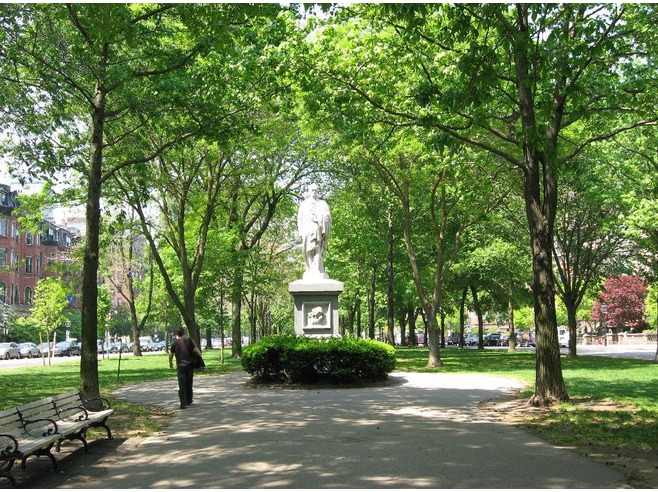
Now, imagine the impact of creating public spaces similar to Commonwealth Avenue or Park Avenue in New York City:

parkave commaveBoston is a world class city and it has the very unique advantage of 100 acres of prime real estate being developed adjacent to its downtown market, allowing it to expand its residences, offices, and shopping. As a result, tens of millions of dollars will make their way into the city’s coffers.

Now is the time for Boston to make a solid investment by making Seaport Boulevard a true boulevard with a wide, tree lined sidewalk with trees, benches and art. Let’s make this area the envy of every other city and a true attraction for families, tourists, and businesses, alike.

Patience for a 1,000 Foot Tower

In a recent BBJ article by Thomas Grillo, there seems to be some interest from the BRA to renew its search for a developer of the city-owned Winthrop Street Garage site on Devonshire Street between Winthrop Square and Federal Street. The previous proposal was to build a 1,000-foot tower with 1.3 million square feet of office space on the approximately one acre parcel.

It’s always exciting for a city to talk about the prospects of having the tallest tower in the city built. However, historically, this city sometimes lacks the patience to allow the marketplace to support the new venture.  It is difficult enough to build an office building a quarter of the size of this dream project without substantial pre-leasing at rents that justify the expense of constructing a tower. A delay in development does not equate with a lack of expertise or, even, capital. It just means that there are economic cycles that affect these decisions. To ignore market demand would be at the owner’s financial peril.

If we want to attract serious interest from developers in this site, the BRA and the new Mayor will have to understand that giving a permit to build a project of this magnitude will require the patience of Job!