Direct Flights to Israel – Help Make the Case

As loyal readers may be aware, NAIOP Massachusetts has been involved in efforts to strengthen economic ties with Israel.  A critical component is attaining nonstop air service from Boston to Tel Aviv. To make this happen, we need your help.   

Given how many opportunities El Al has to expand its service in the United States, we are eager to demonstrate that New England should be next on the list. We are working with the Governor’s office, Massport, and key organizations that generate large amounts of travel to Israel. We plan to make our case to El Al in the fall.

A local survey firm, Strategic Partners, has been retained by Massport to conduct a survey of businesses, organizations and individuals about their current and expected travel to Israel. If you and/or your company travels or might travel to Israel, we would like you to participate in this survey.

To opt-in to the survey, please click here. Once you have opted-in, the actual survey will follow in the coming weeks. With your help, we can make the strategic and business case to El Al about nonstop Boston-Tel Aviv service. 

Thank you for your support,
David

Massachusetts Needs Regulatory Reform to be Competitive

A MassBenchmarks report from the University of Massachusetts shows the national economy grew by 3.2 percent in the 4th Quarter of last year, while the state’s grew by only 1.8 percent.  This comes after a stellar performance in Massachusetts with the local economy and job growth outpacing the nation since the 4th Quarter of 2009.

The take-away from this is something we already knew: Massachusetts is a unique place, but we are not so special that we can coast our way to recovery ahead of the nation.  Although this may be an economy “pausing to catch its breath,” as the report suggests, the real risk is that just like the recession of 2000, we end up falling short. 

Consider this a wake-up call.  We cannot afford to be complacent; we must go on the attack, doing everything in our power to make this region more competitive, more business friendly, and more efficient. 

If we are to be truly competitive, we must confront the cost of doing business in Massachusetts.  This includes the direct costs of operations (taxes, fees, insurance, utility costs), but also includes indirect costs of time and resources necessary to comply with the complex, multiple layers of regulations, policies, rules and guidance affecting all employers throughout the state.       

With fewer resources available, now is the time for government to do more with less.  We must be more efficient with resources within our regulatory agencies, and we must allow businesses to focus on job growth rather than wasting time managing redundant and often-outdated or ineffective regulations and rules.  For many years, cost-benefit analyses have been required of all agencies for new regulations, but this has never been taken seriously. The attitude seems to be that businesses are “lucky to be here” and can easily afford any regulatory imposition placed on them.  Government has the responsibility to protect the public, but to ignore the costs and the impacts they have on the economy is not protective of a public that is dependent on job revenue to fund its operations.

Things are improving, however.  In Governor Patrick’s second inaugural speech, he specifically mentioned this issue and the importance of job growth.  During the past 18 months, the Governor and his agency heads took a top-down review of new regulations, and we applaud them for that effort.  Now we call upon them to go further by reviewing our existing regulations to ensure that they are doing the job that they were intended to do; that they are consistent with the statutes authorizing them; that they are the most cost effective and efficient means to their goals; and that there are not better ways to accomplish what they do (e.g. privatization or self-certification).

We may never be the lowest-cost state, but let’s develop the reputation of being a state that understands the needs of business and works actively to make interactions with government as smooth and cost effective as anywhere else.


Workforce Housing, Not Zoning Bills, Key to Economic Growth

Earlier this week I testified before the Legislature’s Joint Committee on Municipalities & Regional Government on two “zoning reform” bills, the Land Use Partnership Act (LUPA) and the Comprehensive Land Use Reform Partnership Act (CLURPA).  Supporters of both bills claim that the legislation would encourage real estate development in Massachusetts.  Representatives from the real estate industry, however, disagree.  NAIOP believes that these bills contain many problematic elements which could hinder economic development at a time when it is needed most.

The bills make a number of changes to Chapter 40A; some would apply statewide and other changes would apply only in “opt-in” communities.  The legislation does have some positive aspects: zoning protections to special permits and site plan approvals, and limiting subdivision rules and regulations to subjects not already covered elsewhere by local ordinance or bylaw (e.g., stormwater management, off-site traffic impacts.)  However, other parts of the bill would reduce existing predictability and add financial risks for new business growth.

The most concerning aspect of the legislation would significantly alter the zoning freeze that exists under current subdivision law.  It would limit the zoning freeze to a specific proposed development plan, rather than just the land shown on a plan.  As a result, the freeze would be lost with any change in project use and/or density.  This would be a serious problem for commercial real estate developers who would be unable to respond to a changing market. 

Commercial projects require large initial investments in land, site work, and infrastructure for developments that are generally phased and take many years to complete. Without the protections of a subdivision zoning freeze that allows for flexibility in project uses as the markets change, financing would be very difficult to achieve and fewer projects would move forward. 

To truly encourage economic growth, the focus should instead be on creating workforce housing.  While housing costs have dropped recently, a lack of single family, smaller scale, higher density homes fuels the exodus of 23-40 year olds – a key population demographic for economic growth.  This is an issue of great concern to business leaders who struggle to attract the best talent when competing with other states that provide such housing opportunities.

If the Legislature is intent on addressing the Commonwealth’s competitiveness and its housing, it needs to take a different approach.  We urge the Legislature to work with the Patrick Administration, municipalities, and the business community to create a new program establishing zoning districts that permit the construction of a modest number of affordable, small, single-family homes.  The future of our workforce depends on it.

DEP Funding Essential for Economic Development

Though the real estate development industry may not always be an outspoken advocate for environmental regulation, there is no question every developer agrees that timely and predictable permitting is critical to the success of any project. 

Unfortunately, if the cuts to MassDEP proposed in the House budget are approved, permitting and economic development in Massachusetts could be the unintended victims. DEP’s budget has already been disproportionately reduced by 40% in less than a decade, devastating a staff that has dropped from 1,200 employees in 2002 to about 745 under the proposed FY ’12 House budget recently passed.  Although all of the other agencies under the Energy & Environmental Affairs Secretariat received an average 1% cut from the last fiscal budget, DEP was cut by 10%.  

In development, time is money.  If developers are unable to get environmental permits within a reasonable timeframe, the resulting delays could  kill a project – especially during this fragile economic recovery.

As the Senate develops its budget (expected to be released next week), it must consider the importance of adequately funding DEP.  Under the House budget, DEP may be forced to close one or more regional offices and eliminate another 20% of its permitting staff.  NAIOP strongly suggests that, at the very least, the Senate apply the same percentage cut to DEP used for sister agencies.

Given the current fiscal crisis, budget cuts are an unfortunate reality.  But we must avoid cuts that are so deep they undermine the very economic growth and job creation essential to our recovery.

If You Zone It, They Could Come

In order to spur new development in a place not widely known for its commercial activity, the City Council of Leominster is considering rezoning sections of the city.  The goal is to add flexibility to its land use controls in order to attract new businesses into Leominster while encouraging existing companies to expand.

This is not the first local government to realize that growing its tax base starts with rethinking how it zones and permits development.  Two other recent examples illustrate the importance of this self-appraisal process.

For many years, the town of Westwood had an anti-development reputation.  While virtually all of the land along the 128 Technology Highway bustled with new development activity, countless properties along University Ave in Westwood sat vacant or underutilized. This area, starting at the commuter rail station and continuing throughout a large industrial park – with direct access to the highway, was frozen in the 1960’s.

Recognizing that the town had to make significant changes to attract economic development, Westwood officials invited businesses, developers, consultants, and site selectors to tell them what changes were needed.  As a result of this process, the town’s economic development committee went to Town Meeting and changed Westwood’s zoning by-laws.  Soon after, a massive area of the park was purchased and one of the region’s largest mixed use developments was approved.  Unfortunately, the Grand Recession put the project on hold for the time being.  However, there is no doubt this will be one of the first projects to move forward once the recovery is in full swing.

The other municipality to undertake this self-critique was Lexington.  Its Board of Selectmen started a visioning process that brought in a wide range of experts to see what it would take to encourage further economic development in a town with limited growth areas.  As a result of the town’s new commitment to attracting businesses, Lexington passed a remarkable “up-zoning” at Town Meeting, which more than doubled the commercial density in the Hartwell Avenue area, allowing for a potential 2.9 million square feet of development.

With municipal budgets being slashed, more communities are realizing that they need to compete for new business growth, but they are ill prepared to attract development due to archaic zoning and permitting regulations.  While towns may not be able to guarantee new growth if they follow Lexington and Westwood, if they do not bring predictability, timeliness, and clarity to their permitting, most businesses will be looking elsewhere.

NAIOP Welcomes New MassDevelopment CEO

We are very excited that Marty Jones will be the new President and CEO of MassDevelopment 

The MassDevelopment Board made a great strategic move by attracting such an experienced real estate professional to this position. There is no question she will be a tremendous asset to the organization. 

Many of us know Marty through her longstanding role as President of the Boston-based Corcoran Jennison Companies where she oversaw development and management operations.  Recently, Marty was elected to the NAIOP Massachusetts Board of Directors.

With its substantial financial and human resources, MassDevelopment will play an integral role in the Administration’s recently restructured Economic Development operations. MassDevelopment will be critical to stimulating growth across the Commonwealth. 

We look forward to working with Marty in her new position and continuing our collaborative working relationship with MassDevelopment.

Trade Missions Should be Viewed Over Long Term

I just had an op ed published in Mass High Tech on Governor Deval Patrick’s recent 10-day Innovation Economy Partnership Mission to Israel and the U.K.

Too often, the sole criteria used to judge whether a trade mission is a success is jobs.  Unfortunately, this is short-sighted. Economic development strategies must be designed for the long-term.

The Commonwealth’s economic plan needs to have at its core a focus on growing its local, existing business base, while still looking beyond its borders for strategic global opportunities. The right missions, such as this one, are key to our future success.

“It’s Getting Better all the Time”, The Beatles

At the well-attended NAIOP Developing Leaders breakfast this morning, a panel presented “Booming In Beantown: Why Boston Remains One of CRE’s Hottest Markets.”

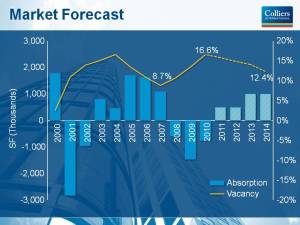
I was particularly interested in three slides that certainly left me and the other attendees sighing with relief about our future.  The first two slides were from Yanni Tsipis, Senior Vice President of Development & Consulting Services, at Colliers International.  The Market Forecast shows the historic run-up of the vacancy in Boston to a 10 year high of 16.6%.  However, they are forecasting positive absorption over the next four years, dropping the vacancy rate to 12.4%.  That might not be the low single digits, but it is in the range to start pushing up the rental rates.

The next slide should not come as a great surprise regarding the relative health of the commercial real estate investment market.  It does, though, show how bad off are the other regions of the country.  The delinquent or special service loans are under 5% for the Boston market.  However, take a look at some of the other metro markets like Phoenix, Riverside-Ontario, and Seattle.  New York and Washington, the other “stars” are a bit worse off than Boston.  It has been many a recession ago since we were not the poster child for being the worst affected region.

Finally, Peter Merrigan, President & CEO of Taurus Investment Holdings provided a chart showing Boston’s advantage in terms of employment gains.  This may be the first time Boston has ever been in any top grouping regarding employment (other than loss of.)  Not only is Boston ranked third with over 1.3% twelve month gains, but the Commonwealth is ranked fourth in actual raw employment numbers!

Bring out your old records and enjoy the refrain: “It’s getting better all the time.”  And hopefully for the foreseeable future too.

Fidelity’s Marlborough Closure in Perspective

Fidelity recently announced it will be closing its Marlborough location over the next 2 years and relocating 1,100 employees to the remaining 3 regional locations in downtown Boston, Smithfield, RI and Merrimac, NH.  The company’s staff has been reduced significantly over the past few years and this decision was made as part of the company’s worldwide reductions during the recent global economic crisis.

What is interesting to me has been the immediate reaction in the press. For the most part, the story has been about Fidelity’s “ingratitude” and the need for the state to punish the company for making such a decision. 

Fidelity still remains one of the largest employers in the Commonwealth with thousands of workers. They, unlike many Fortune 500 firms, maintain their headquarters here. 

What we have is a global company that makes a business decision to relocate some of its employees and to close a regional office. Shouldn’t we be asking what we can do to make us more competitive?  

Beating up on an employer and an industry is probably not the best way to keep them here over the long term. Let’s do a better job at listening to our employers and understanding their problems, before they become ours.

Direct Boston-Israel Flights Key to Economic Investment

Today, at the start of the Massachusetts – Israel Innovation Economy Partnership Mission with Governor Patrick, our first meeting of the day was with the CEO of El Al Airlines, Major General Eliezer Shkedi. A small group of us met with the General and his staff to pitch having El Al open non-stop direct flights between Boston and Tel Aviv.

General Shkedi, Governor Patrick and Robert Kraft

If there was one single action that could directly affect the growth of new Israeli businesses in the Commonwealth, it would be the convenience of direct flights. Boston is already the second largest origin-destination, business market without nonstop service and Massachusetts ranks 5th among U.S. states for air exports to Israel.

With the ties that we share with Israel in the High Tech, Life Sciences, Finance, and Higher Education sectors, our shared economic future is certain to support this important service.

Companies like EMC, Cubist, and Glasshouse Technologies all indicated their company’s strong interest in supporting direct flights.  Robert Kraft made the obvious statement that non-stop flights are not only good for their business, they would be profitable for El Al, with higher paying business passenger revenue.

Governor Patrick proposed that both “sides” have their staff work on the numbers over the next six months and reach a decision about the feasibility of these flights. General Shkedi agreed to see if it can work.

Right now, El Al is considering non-stops to Miami and Chicago. We might not be able to compete with the large Jewish population in South Florida, but we should hold up well with Chicago, especially with El Al’s partner airline’s (Jet Blue) major expansion in Boston.

Who knows, in a year or two, sitting on the tarmac in New York may not be necessary to get to Tel Aviv.