Unknown's avatar

About Tamara Small

Tamara serves as the CEO for NAIOP Massachusetts.

Update from Beacon Hill

Formal sessions for the 2015-2016 legislature will end on Sunday, July 31. Since many legislators attended the Republican National Convention last week or the Democratic National Convention this week, a lot of action and major votes are expected this weekend as formal sessions will be held on Saturday and Sunday. NAIOP has been actively lobbying on a number of important bills and will continue to do so through the final moments of the session on Sunday night.

Much of NAIOP’s advocacy has been devoted to fighting bills that would do harm to the industry and discourage economic development. Among those bills are the zoning and wage theft bills, which were both passed by the Senate. NAIOP has been working to educate members of the House on the serious consequences these bills would have on economic development if passed.

This weekend the Legislature is expected to pass a number of bills that are now in conference committee and are priorities for both the House and Senate including: the ride-hailing industry bill; a municipal government reform bill; the non-compete legislation; an omnibus energy bill; and an economic development bill.  NAIOP has weighed in on the energy bill by supporting the positions of organizations like AIM on the procurement issues, while also supporting PACE language, and opposing the climate adaptation management plan (CAMP) language, as well as mandatory energy scoring and energy audit requirements. A letter to conference committee members was sent last week highlighting our concerns with the most problematic sections of the bill.

NAIOP is also advocating for the inclusion of language in the economic development bill that was included in the House version. Specifically, NAIOP supports important changes to I-cubed, increased funding for MassWorks and the creation of a new starter home program.

In short, there is one thing that is certain about the final hours of the legislative session – absolutely nothing is certain. Stay tuned for future updates from Beacon Hill.

Senate Energy Bill to Require Home Energy Audits & Labeling

Tomorrow the Senate will be voting on its version of an energy bill that passed the House in early June. The bill includes a new requirement that single family homes, multifamily properties with less than 5 units, and condominiums must undergo an energy audit prior to the property being listed for sale. The results of the audit would need to be disclosed when the property is listed. The bill also requires the Department of Energy Resources (DOER) to establish a home energy rating and labeling system, which would be based on, but not limited to, a property’s energy consumption, energy costs, and greenhouse gas emissions. The property’s energy rating and label would also need to be disclosed. In addition, DOER would track and publicly report the number of home energy audits conducted and energy ratings and labels issued.

NAIOP has serious concerns with the impact this could have on the housing market, particularly in low-income communities where homeowners may not have the means to make upgrades and properties would be potentially devalued with a low score/label. NAIOP supports the Mass Save program and believes that incentives, not penalties, will do more to address energy efficiency in the Commonwealth.

A number of concerning amendments to the bill have also been filed. Amendment #8 is the climate change legislation that was passed by the Senate earlier this year. NAIOP is strongly opposed to this language due to the confusing and vague language it contains and the substantial adverse impact it would have on development. It would require all “commonwealth certificates, licenses, permits, authorizations, grants, financial obligations, projects, plans, actions, and approvals for any proposed projects, uses, or activities in and by the commonwealth” to be consistent “to the maximum extent practicable “with a yet to be developed climate plan. Clearly, this language could delay and potentially halt countless public and private projects.

Amendment #68 would mandate electric vehicle charging stations. NAIOP does not believe the building code is the right place to advance the growth of specific technologies or sectors of the economy.

Following the Senate’s vote, the bill will go to conference committee where members will have to agree to compromise language. That version of the bill would then need to go back to the House and Senate for a vote before the end of the session on July 31.

Plaintiffs Drop Stormwater Lawsuit Against EPA: NAIOP Applauds Decision & Remains Opposed to RDA as Regulatory Tool

Yesterday, the Conservation Law Foundation and Charles River Watershed Association, plaintiffs in Conservation Law Foundation, Inc., et al v. United States Environmental Protection Agency, et al., voluntarily dismissed the lawsuit without prejudice. NAIOP Massachusetts filed a Motion to Intervene in the case.

The plaintiffs in that case sought to compel EPA to impose a new regulatory program that would have required owners of commercial, institutional, industrial and high density residential properties in the Charles River watershed with one acre or more of impervious area (parking lots, roofs, sidewalks) to apply for a stormwater discharge permit through the use of EPA’s rarely used “Residual Designation Authority” (RDA). NAIOP decided to intervene in the case given the significant impact this duplicative and burdensome regulatory program would have had on property owners in a watershed that includes 35 communities and covers 310 square miles.

“NAIOP has long supported the overall objective of improving water quality throughout the Charles River Watershed, but with compliance costs estimated to be in excess of $1 billion, the RDA approach is simply not the right tool,” said David Begelfer, CEO of NAIOP Massachusetts. “We are pleased the plaintiffs dropped the suit. Such important policy decisions should not be negotiated behind closed doors. NAIOP urges EPA to carefully think through this issue, seek feedback from affected stakeholders, and ensure any potential programs are cost-effective, feasible and fairly allocate the regulatory burdens and costs.”

NAIOP will continue to monitor this issue closely and keep members informed of any new developments.

NAIOP Applauds Legislature for Budget with Important T Reforms

Last night a $38.1 billion state budget (H. 3650) was released from conference committee. NAIOP applauds the conference committee members (House Ways and Means Chairman Brian Dempsey, Senate Ways and Means Chairwoman Karen Spilka, Sens. Sal DiDomenico and Vinny deMacedo and Reps. Stephen Kulik and Todd Smola), Senate President Stan Rosenberg, and Speaker of the House Robert DeLeo for their leadership in passing a bill that includes important reforms for the MBTA.

One of the most important aspects of the bill (and something NAIOP has championed) is the creation of a MBTA Fiscal and Management Control Board chaired by the Secretary of MassDOT. The budget states that the Fiscal and Management Control Board shall “initiate and assure the implementation of appropriate measures to secure the fiscal, operational and managerial stability of the authority and shall continue in existence until June 30, 2018.” A two year extension beyond 2018 could be granted if needed. The Board shall formulate and recommend a plan to the secretary of transportation to stabilize and strengthen the finances, management, operations and asset condition of the authority. The Fiscal and Management Control Board will also develop performance metrics and measure items included in the plan. NAIOP believes the creation of the Control Board will provide greater accountability and transparency for the T’s governance and management practices and is critical to ensure a safe, reliable, fiscally stable, modern transit system for Massachusetts.

The budget also suspends the Pacheco Law for three years. The Pacheco Law requires a vetting process before privatization of services at the MBTA and, according to a report released today by the Pioneer Institute, it has cost the MBTA at least $450 million since 1997. NAIOP strongly supports this important reform.

The House and Senate are expected to approve the budget today and then it goes to Governor Baker for his review. He then has 10 days to review it review it before signing it and announcing amendments and vetoes.

NAIOP will continue to actively advocate for transportation reforms that support roads, bridges, public transit – and economic growth.

Transportation Transformation: Event Recap & Support for MBTA Reforms

On Thursday, April 9, NAIOP hosted the Transportation Transformation Conference, which featured federal and state transportation officials as well as national experts who discussed the role of transportation in a growing Massachusetts economy; new technology and other innovative solutions to transportation challenges; and what the future holds for the nation and Massachusetts.

The event was held the day after Governor Baker’s Special Panel to Review the MBTA released its detailed report on a plan of action to reform and improve the MBTA. MassDOT Secretary Stephanie Pollack discussed the report’s findings at the event. NAIOP supports the recommendations outlined in the report and looks forward to working with the Baker Administration, Legislature and the business community to create a reliable and safe public transit system.

The following is a guest blog and event recap by Fred Wagner, Principal at Beveridge & Diamond, former Chief Counsel of the Federal Highway Administration (FHWA), and moderator at the Transportation Transformation Conference. The post originally appeared on Enviro Structure.
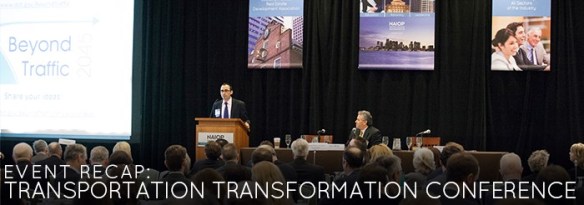
TRANSPORTATION TRANSFORMATION RECAPThe NAIOP Massachusetts Transportation Transformation conference held on April 9 was one of those rare trade association meetings where you didn’t want the sessions to end.  Ideas flowed from the podium and from the audience faster than the New England melting snow flowed into the Charles River.

Perhaps unwittingly, transportation thought leaders from local, state and federal agencies echoed the philosophy of legendary architect Daniel Burnham (D.C.’s Union Station, NYC’s Flatiron Building):  “Make no little plans; they have no magic to stir men’s blood and probably themselves will not be realized.  Make big plans, aim high in hope and work, remembering that a noble, logical diagram once recorded will not die, but long after we are gone be a living thing, asserting itself with ever-growing insistence.”

Over 300 attendees heard Vinn White, Senior Policy Advisor to the U.S. Department of Transportation Secretary Anthony Foxx, describe the draft “Beyond Traffic” report  and how the challenges of demographic and technological trends will shape our transportation network looking 30 years into the future.  After showing this well-viewed YouTube video showing traffic flow in Ethiopia’s Meskel Square, he asked what these images of chaos had in common with what you’d see in Davis Square in Somerville, Massachusetts.  The answer?  People.  People living their lives, trying get to work, bringing kids to school, or visiting friends and family.  In short, Mr. White suggested, even if our major intersections thankfully don’t resemble the bedlam from Meskel Square, we may have more in common than we think.

Newly confirmed MassDOT Secretary Stephanie Pollack described how in her view, there was no such thing as a transportation plan that existed in isolation.  Rather, she wanted to know from communities what they thought their biggest challenges were, and then look to transportation infrastructure to help solve those challenges.  “Don’t just pull projects off the shelf that have been there for 30 years,” she has instructed her new staff.  “There’s probably a reason they’ve been up on that shelf for so long.”

Secretary Pollock’s views were supported by Jay Ash, the new Secretary of Housing and Economic Development in Massachusetts Governor Baker’s Administration.  He commented to the receptive audience how unusual it must be for them to hear a Transportation Secretary and an economic development executive being so much on the same page.  Secretary Ash reiterated how he had, over the course of his career in public service and in his new role, visited communities all over the Commonwealth with visionary plans.  All of them demanded to some extent an improved transportation network to convey people to new centers of commerce, education, or recreation.

Finally, Gabe Klein, the former head of Washington, D.C.’s and Chicago’s Departments of Transportation, and Harriet Tregoning, the Director of the U.S. Housing and Urban Development Office of Economic Resilience, both provided a glimpse into the future of urban/suburban transportation.  Pedestrians, bicyclists, streetcars, and yes, even automobiles, living in harmony, operating on re-engineered streets that provide safe and reliable means of mobility.

“Change is coming faster than we believe,” Mr. Klein predicted.  Autonomous vehicles could be a reality in less than 5 years, given the current pace of technological advances and investment by huge companies like Google and Amazon.  Parking downtown could be a thing of the past, as people share solar-powered, self-driving cars, moving seamlessly between work and errands, never really needing a place to leave an empty, under-utilized vehicle.  Imagine planning a new mixed-used development without the burden of complying with a parking ratio?  Not quite worthy of a John Lennon lyric, perhaps, but even so…

Gatherings like this serve as a reminder why all of us in the development sector love our work.  We get to “make big plans” and, with any luck, see them come to life.

View event photos
Beyond Traffic: Imagining a Brighter Infrastructure Future

The following is a guest blog by Fred Wagner, Principal at Beveridge & Diamond, former Chief Counsel of the Federal Highway Administration (FHWA), and moderator at the upcoming NAIOP Transportation Transformation Conference in Boston on April 9.The post originally appeared on Enviro Structure. The Beyond Traffic report will be one of many topics discussed at the upcoming event. We hope to see you there!

U.S. Department of Transportation Secretary Anthony Foxx has a favorite saying that he attributes to one of his public school teachers:  “Having no plan is a plan.”  Well, now the USDOT has a plan, or, as it calls it, a “framework,” to create the foundation for transportation infrastructure improvement for the next 30 years.  It’s called “Beyond Traffic,” a remarkably comprehensive analysis of existing data, expected trends, and policy suggestions for the entire spectrum of future transportation choices.

On April 9, NAIOP Massachusetts, The Commercial Real Estate Development Association, will host a forward-thinking conference  -“Transportation Transformation” – examining the role of transportation in a growing Massachusetts economy and its impact on real estate development.  A representative of the USDOT’s Office of Policy will kick off the NAIOP event by describing the Beyond Traffic framework and offering ideas on how the concepts reflected in Beyond Traffic could be applied to regional and local transportation planning efforts. Beveridge & Diamond is proud to sponsor this important event.

While it’s difficult to summarize a 300+ page document in one blog post, I’ll give it a go.  The over-arching theme could be this:  “Let’s make infrastructure investment decisions based on the reality of what is and what is likely to be, rather than simply based on short-term fixes to maddening congestion challenges.”

What are some of those realities?

  • We face an aging transportation system that desperately needs attention.
  • More and more Americans will be settling in “mega-regions” around the country, potentially exacerbating congestion in our already most populated cities.
  • Younger people will likely continue to drive less, and look to alternative means of mobility.
  • At the same time, the proportion of older Americans will continue to grow, placing greater demands on travel for work and leisure in that segment of our population.
  • Innovation will alter the way we think about commuting, from ride-sharing options, to increased telecommuting, to autonomous vehicles.
  • Our changing climate will demand that we stress adaptation for some of our most crucial transportation infrastructure.

Some of the data revealed in Beyond Traffic is no doubt sobering.  The U.S. population is expected to increase by 70 million by 2045.  Transportation costs will continue to be the second largest expense for U.S. households (besides shelter) and, at the same time, will likely remain the second highest source of GHG emissions.  We face a huge investment gap at the same time a political solution to long-term funding at the federal level remains a daunting challenge.

Yet, for every significant challenge, great opportunities exist.  Technological advances have resulted in a doubling of vehicle fuel efficiency standards.  Americans have much greater flexibility in how and where they work.  GPS technology tells us where we need to go, but can also be used to help us find parking spaces downtown or in garages more efficiently.  Autonomous vehicles can potentially allow even more vehicles to use our highways and streets, but do so more safely and efficiently.  (Never mind getting additional work done while your car drives you to your destination.)  Freight shipments will also become more efficient as automation connects ports to rails to trucks.

Beyond Traffic challenges all of us to confront how future policy choices could either complement or conflict with these trends.  While the USDOT stresses that this framework is not an action plan, it cries out for all of us to consider how to create such a plan.  Anyone interested in this topic should go to www.dot.gov/beyondtraffic to offer comments before a final version of the report is published later this year.

Good to Great: Creating a Long-term Vision for the Commonwealth’s Transportation Needs

On April 9, NAIOP will host Transportation Transformation, a thought provoking conference addressing the challenges and opportunities facing Massachusetts as we plan for the transportation system of the future. MassDOT Secretary Stephanie Pollack and Secretary of Housing & Economic Development Jay Ash will discuss the role of transportation in a growing Massachusetts economy. Vinn White, Senior Policy Advisor, Office of the Secretary, US Department of Transportation will discuss how demographic shifts will affect transportation, and nationally recognized transportation experts will discuss lessons learned from other regions, new technologies to consider, and what all of this means for real estate development. If you fought to get to work this winter, then this conference is for you!

Building off of these same themes, we thought this week was a good week to share our Good to Great recommendations to MassDOT. Special thanks to Marilyn Swartz-Lloyd, President and Chief Executive Officer, of the Medical, Academic, Scientific Community Organization (MASCO) for her input on this. Comments, as always, are encouraged!

Good to Great: Creating a Long-term Vision for the Commonwealth’s Transportation Needs
The Commonwealth’s transportation infrastructure is critical to our state’s economy, quality of life and industrial competitiveness. However, many of its elements have already exceeded capacity constraints with increasing delays on congested highways and transit systems. At the same time, demand has increased and is predicted to continue over the coming years with no major increases in capacity coming soon. Without a serious long-term plan, further declining services, increased travel times, and a degraded environment will be the future of the Massachusetts transportation system.

In 1970, Governor Frank Sargent created the Boston Transportation Planning Review that analyzed and redesigned the entire area-wide transit and highway system. It provided a blueprint for transportation policy and investment that we have been effectively following for the last 40 years. Massachusetts needs a similar long-range visionary thinking that will result in a comprehensive transportation plan for 2040.

A Vision 2040 Transportation plan, endorsed by the Baker Administration, should address tomorrow’s opportunities, focusing on the issues which may arise over the next 25 years, including long term demographic, economic, environmental, technological, cultural and governmental transformations, the potential effects of global climate change on infrastructure, and the development of new modal choices.

To successfully implement such an initiative, NAIOP supports the following guidelines:

  • Connectivity is key: Creating a seamless, reliable connection between air and rail, bus and subway, and the network of roads and transit is necessary for improving the flow of ideas and people.
  • Out-of-the-box thinking is vital: New and “disruptive” technologies are already impacting other parts of society and should be considered, making enhanced transportation information sharing through technology an integral part of the Commonwealth’s hand-held knowledge system.
  • Public Private Partnerships needed: Innovative public private partnerships can leverage the limited state resources to increase capacity to actualize a long-term plan that can be implemented over the next decades.

Good to Great: Developing a Public Private Partnership on Climate Change Resiliency

Yesterday, NAIOP was proud to participate in a Climate Change Resiliency Forum at the State House. NAIOP’s CEO, David Begelfer, joined legislators, climatologists, environmental advocates, a representative from the insurance industry and EEA Secretary Matthew Beaton to discuss this important economic development issue. NAIOP advocated for a public private partnership and echoed the comments we presented to the Baker Administration in the Good to Great report. The following is our weekly excerpt from that report. Comments are encouraged!

Climate change can have significant impacts affecting the overall economy; directly, by damaging structures, and indirectly, by compromising transportation systems, communications, and utilities. An increasing number of extreme weather events and future sea level rise may lead to more frequent and extensive flooding along the coast and inland waterways.

The varying interpretations and projected economic and environmental impacts from climate change and sea level rise demand that the private and public sectors coordinate their common objectives. Unfortunately, to date, there has been a serious lack of coordination or collaboration on this issue. Individual cities and towns are taking their own steps to regulate and respond to climate change and sea level rise. Within MassDEP alone, multiple climate change policies and regulations are being drafted using different climate change projections. All of these regulatory and policy initiatives are focusing on how private development projects should address this issue, and very few have addressed the public sector’s role. For example, capital expenditures will be necessary for equipping existing public infrastructure to meet storm surges. Clearly, having a “climate change proof” building in the middle of a flooded neighborhood, without power or adequate transportation, provides no real public or private benefit.

There is no question this issue will be a significant challenge for the Baker Polito Administration. Addressing climate change and sea level rise requires coordination at the highest level of state government, and the participation of many state agencies. Therefore, NAIOP urges the Administration to consider the following steps to better coordinate how this issue is addressed in order to avoid the calamities that have been suffered by other coastal states:

Create a high level point of contact (Climate Change Chief) for local, state, and federal agencies, as well as the private sector. This position should be located in the Governor’s office or within the Executive Office of Administration & Finance. Given the need for coordination across many facets of state government, and the impact of this issue on the state’s resources, it should not be located in EOEEA. Planning for responses to rising sea levels is an operational and infrastructure challenge, not an environmental policy issue. To ensure consistency across the Administration, the Climate Change Chief should have input on all policies or regulations dealing with climate change. All agency findings and regulations regarding the extent of sea level rise or climate change must not be cost prohibitive to the private sector and should include public funding and participation.

Working closely with the Governor’s office, the Climate Change Chief would pursue the following action items:

  • Establish a structure/partnership with academic and research institutions to identify, develop, test, and incorporate reliable climate change and sea level rise forecasts and climate change preparedness programs.
  • Conduct an inventory of state agency regulations adopted or now under review/proposed dealing with how existing and new public and private development should respond to climate change and sea level rise.
  • Undertake an inventory of state and regional authorities, their threatened assets, and their infrastructure preparedness needs, and identify state monies committed to study climate change and sea level rise. Identify capital funds that should be dedicated to infrastructure upgrades for vital state and regional properties, with a priority toward vulnerable infrastructure.
  • Coordinate the agenda of the state agencies responsible for establishing a target range for sea level rise, determining its effect upon existing infrastructure and future development and developing guidelines for climate preparedness and mitigation planning and review (e.g., MEPA, MassDOT, MBTA, BBRS, MWRA, MassDEP, DPU, Mass Housing, MEMA and CZM).
  • Identify state agency personnel responsible for the review of policies, procedures, and regulations regarding climate change and sea level rise.
  • Ensure that cost-benefit analysis guides policy making. Policymakers should look at programs in terms of maximizing preparedness and resiliency benefits while minimizing burdens on fiscal and other resources.
  • Encourage consistent local efforts to address climate change preparedness including identifying susceptible infrastructure (e.g., mass transit, highways, stormwater systems, energy, fuel, communications, etc.), adopting reliable climate change projections, and establishing guidelines and regulations to incorporate climate change into future planning decisions and outreach programs.

We urge the Governor to coordinate this critical effort to ensure focus and consistency on this economic development issue.

Good to Great: Realigning Resources at Environmental Agencies

The following is our weekly excerpt from NAIOP’s report, Good to Great: Recommendations for the Baker Polito Administration. Comments are encouraged!

When considering a long-term vision for the Commonwealth’s environmental agencies, NAIOP encourages the Executive Office of Energy & Environmental Affairs (EEA) to start by realigning resources to ensure 1) environmental protection and 2) that resources are appropriately allocated to ensure timely and predictable permitting. In recent years, the regulated community has observed that a larger percentage of staff at the environmental agencies is focused on the development of new policies and regulations instead of the expedient implementation of existing regulations (i.e., permit approvals, compliance assistance, etc.). Prompt and predictable permitting is critical for economic development projects and ensures increased tax revenue for the Commonwealth. Compliance assistance programs provide a preventive and cost effective approach to ensuring environmental protection.

Therefore, NAIOP proposes the following recommendations:

  • Tie Permit Fees to Results: Permit streamlining was brought to MassDEP’s doorstep in the late 1980’s. Facing considerable time delays for the issuance of permits with no timetables, NAIOP was a founding member of the MassDEP Fees and Program Advisory Committee that established a fee program for all permits and a retained revenue account in return for the MassDEP’s agreement to set enforceable timetables for administrative review, technical review, and issuance of permits. General results were positive and fees have been adjusted gradually over the years to reflect cost of living increases. Permitting fees went into a dedicated revenue account, which was intended to supplement the MassDEP budget so that it could continue to provide its other non-permitting services. The original committee included NAIOP, AIM, Mass Municipal Association, MASSPIRG, Environmental League of Massachusetts, and other private and public sector representatives. The enacting statute establishing the agreement and authorizing MassDEP to establish the fee program is M.G.L., c. 21A, §18 and the regulations are at 310 CMR 4.00.As the architects of the Program left state government and Massachusetts faced revenue shortfalls, the original agreement was sacrificed for revenues. Gradually the Legislature began to apply permit monies to the MassDEP operating budget. Rather than decreasing the time for permit issuance based upon the lesser number of permits due to a slow economy, the General Fund percentage decreased for the MassDEP budget. As recently as 2013, the Fees Committee wrote to the Governor and to the Ways and Means Committees requesting that the agreement be honored. Business was hesitant to support the Department’s request for additional funding based upon the legislative track record applying fees for operations. NAIOP urges the Baker Polito Administration to reinstate the original agreement and ensure permitting fees are directed to the dedicated revenue account to ensure adequate resources for permit issuance.
  • Increase Use of General Permits: NAIOP encourages all environmental agencies to consider increasing the use of general permits. General permits are more cost effective and achieve the same goal as individualized permits, but do so faster and more cost-effectively and provide a higher level of certainty in outcome (including reducing the risk of permit appeals). In order for this to work, however, it is critical that agencies be committed to making these general permits effective and not so limited in scope or so overly burdened by contingent conditions that they are no longer useful. EEA should conduct an internal review of all programs to identify those that could move, in whole or in part, from individualized permits to general permits.
  • Move to Permit-by-Rule (aka self-certification): Self-certification needs limited staff resources to administer and oversee and uses enforceable third-party certifications to ensure that rules are met and standards are achieved. MassDEP is already using self-certification for some programs, but there are numerous opportunities for expanding the use of this cost-effective and proven regulatory approach.
  • Increase Permitting Staffing for Waterways Program: Waterways is responsible for issuing Chapter 91 licenses for docks, piers, and other water-dependent structures as well as non-water dependent uses and structures on tidelands and filled tidelands. It is involved in almost every major coastal project, including transportation, energy, infrastructure, commercial buildings and housing. Staff has recently been increased to five persons, still woefully inadequate to ensure timely processing of project permitting demands. The lack of staff is holding back the development of many major public and private projects. Additional resources must be committed and dedicated to new employees that focus solely on Waterways permitting and not policy development.
  • Continue Regulatory Reform Implementation: The Regulatory Reform initiative was originally motivated by a reduced budget affecting staff permitting and oversight, but the effort has also resulted in important regulatory and policy changes. Continually reviewing existing regulations to determine if they are needed or if changes are required, and closely examining the costs and benefits associated with new regulations before they are drafted, should be a top priority for the Baker Polito Administration (and is required under Chapter 238 of the Acts of 2012).
  • Provide MassDEP with Delegated Authority over National Pollutant Discharge Elimination System (NPDES) Programs and the Funding Needed to Adequately Administer the Program: As of June 2013, 46 states had been authorized to administer the federal NPDES permit program. Massachusetts is just one of four states in the nation where the federal government is in charge of the permit issuance, compliance and enforcement for the 2,990 NPDES permit holders in Massachusetts. MassDEP jointly issues NPDES permits with EPA. Having MassDEP as the sole permitting authority with EPA limited to an oversight role could result in a more efficient permitting process. In addition, as the NPDES program continues to evolve in response to increased concerns over issues like nutrient loading and stormwater impacts, MassDEP would have greater control over policy decisions. However, appropriate resources would be needed (estimated at approximately $9.5 million per year) to ensure a carefully coordinated approach to watershed management.
  • Concentrate on Implementing & Enforcing Existing Rules and Regulations: Agencies should concentrate on implementing and enforcing existing rules and regulations before expending resources on new program and policy development. This builds on the Regulatory Reform Initiative and is critical for the proper allocation of resources.

Good to Great: Expanding & Implementing Statewide Regulatory Reform

The following is our weekly excerpt from NAIOP’s report, Good to Great: Recommendations for the Baker Polito Administration. Comments are encouraged!

In 2012, the Patrick Administration launched a top-to-bottom regulatory reevaluation for all state agencies. The initiative resulted in a review of 1,791 regulations for efficiency and effectiveness. In addition, 255 regulations were amended or eliminated. The goal was to determine which regulations should be rescinded, modified, or made more consistent with a national model or standard.

The Baker Polito Administration should expand upon and strengthen the Regulatory Reform Initiative through the following initiatives:

– Appoint a proactive Regulatory Ombudsman with significant authority operating out of the Governor’s office. This person and a support team will be responsible for implementing the Regulatory Reform initiative by overseeing the following:

  • Seek out and motivate agencies to respond to feedback from the regulated community on problematic policies or regulations.
  • Maintain and reinvigorate the Business Advisory Committee to help the Ombudsman and team identify problematic regulations and alternative processes.
  • Consider initially freezing and reviewing any policies or regulations approved in the final 60 days of 2014, until there is a thorough review by the agency and the Ombudsman. (NAIOP strongly supports the “Regulatory Pause” put in place by the Baker Administration.)
  • Ensure that any newly proposed regulation go through an extensive vetting process that begins first with identifying the need for the regulation and ensuring the benefits of the regulation outweigh the impacts and burdens on business and the public. Any agency proposing a new regulation must complete a “small business impact statement” documenting the potential financial and time costs. This impact statement must include feedback from the regulated community. The Ombudsman and team will be responsible for ensuring the small business impact statement meets certain established standards.
  • Provide authorization on the public comment period for draft regulations.
  • Ensure the implementation of the ongoing periodic review of existing regulations required under the economic development bill passed in 2012 to identify those that should be amended or repealed.

– When regulations are approved for public comment, draft regulations must be posted online and emailed to a list of affected stakeholders (via voluntary sign-up as now done with DEP, DOR, and a few other agencies).

– While guidance can be helpful, it should be clarified by the Baker Polito Administration that guidance is just that, guidance, and does not take the place of regulations in any way.

– The Baker Polito Administration should seriously consider amending or eliminating current state regulations that exceed federal standards or duplicate federal processes.