NAIOP Massachusetts Installs 2020 Leadership Team: Leslie Cohen to Serve as 2020 Chapter President, Sara Cassidy Moves to Board Chair; Special Awards Given

At its Annual Meeting on November 20, NAIOP Massachusetts, The Commercial Real Estate Development Association, elected a new President and Board members, along with a new Leadership Council. The Board includes the principals of many of the region’s leading commercial real estate firms.

Leslie Cohen, Chief Operating Officer and Head of Asset Management at Samuels & Associates, was elected President of NAIOP Massachusetts for 2020.  In this capacity, she will work closely with NAIOP staff and Chapter leadership to guide the organization. Sara Cassidy of AEW, who served as the 2019 President, will serve as Board Chair; Tom Andrews of Alexandria Real Estate Equites becomes President-Elect; Jessica Hughes of Tishman Speyer will serve as Treasurer; and Patrick McMahon of Federal Realty Investment Trust becomes Secretary.

“NAIOP is the voice for an industry that plays a critical role in the region’s economy and competitiveness. Our members are innovative, engaged in their communities and focused on ensuring that Massachusetts is a great place to work and live,” said Cohen.  “At the same time, we have a great opportunity to foster diversity across the field.  I look forward to collaborating with other senior NAIOP leaders to implement new initiatives that will cultivate a broader pipeline of talent interested in all aspects of the commercial real estate industry.”

Cohen has been part of the Samuels team for more than 17 years. She previously served as the President of CREW Boston (formerly NEWiRE) and has served on the Board of Trustees and the Building Committee at the West End House in Allston, on the Building and Grounds Committee at Tufts University, and, for the second time, will co-chair Heading Home’s Housewarming event. In 2013, Cohen was selected as a Boston Business Journal’s 40 under 40 honoree. In 2014 and 2018 she was honored as one of Bisnow’s Power Women in Commercial Real Estate.

“NAIOP’s volunteer leaders represent the best of this industry. NAIOP’s Executive Director Reesa Fischer and I are honored to work with professionals like Leslie in our efforts to advance and grow the industry,” said Tamara Small, CEO of NAIOP. “Their creativity and energy will allow our organization to address the needs of commercial real estate professionals while focusing on advocacy, education and professional development.”

The 2020 Leadership Council members include:

Chapter Affairs Chair: Michael Wilcox, The Bulfinch Companies, Inc.

Developing Leaders Chair: Alex Schultz, Davis Companies

Developing Leaders Vice Chair: Sam Campbell, JLL

Diversity Equity & Inclusion Chair: Taidgh McClory, TH McClory, LLP

Diversity Equity & Inclusion Vice Chair: Amanda Strong, MITIMCo

Government Affairs Chair: Carolyn Desmond, Skanska Commercial Development

Government Affairs Vice Chair: Matthew Snell, Nutter McClennen & Fish

Membership& Marketing Chair: Tina Snyder, DivcoWest

Membership& Marketing Vice Chair: Katherine Shoss, The Bulfinch Companies, Inc.

Program & Education Chair: Robert Borden, CBRE

Program& Education Vice Chair: Michael Buckley, Avison Young

Awards Chair: Allen Breed, MITIMCo

Golf Tournament Co-Chairs: Andrew Gallinaro, National Development and Sarah Lagosh, Eastdil Secured

Developing Leaders Board Liaison: Abby Mondani, Oxford Properties

Communications Chair: Wendy Pierce, Goldstein Pierce PR

Strategic Development Co-Chairs: Kerry Hawkins, JLL; Derrick Goodwin, Lee Kennedy Company; Dan McGrath, Berkeley Investments; Kathy McMahon, National Development and Adam Weisenberg, Sullivan & Worcester LLP

In addition, the following industry leaders joined the NAIOP Board for three-year terms:

Katharine Bachman, Gravestar

Marcella Barriere, Google

Kevin Benedix, Boston Global Investors

Lawrence Curtis, WinnDevelopment
Russell DiMartino, Skanska Commercial Development

Todd Fremont-Smith, Nordblom Company

Richard Galvin, CV Properties

David Goodhue, Colliers International

Taran Grigsby, Fidelity Real Estate

Timothy Guy, Clarion Partners

Andrew Hoar, CBRE

Shawn Hurley, Marcus Partners

Gary Kerr, Greystar

Sarah Lagosh, Eastdil

Charles Leatherbee, Trammel Crow Company

Douglas Manz, HYM Investments

Steve Marsh, MITIMCo

John Myers, Redgate

Tinchuck Ng, Cottonwood Management

Alex Schultz, The Davis Companies

Kirk Sykes, Accordia Partners

Joseph Zink, Atlantic Management

NAIOP Massachusetts also presented several special awards to select members who have made significant contributions to benefit the industry.  Sara Cassidy presented the 2020 President’s Award to Rob Borden of JLL in recognition of his exceptional leadership, strategic direction and vision as Vice-Chair of NAIOP’s Program Committee.  Larry Feldman of GZA was presented with the 2020 NAIOP Government Affairs Champion Award in recognition of his years of work on NAIOP’s Brownfields Redevelopment Committee.  His advocacy has resulted in countless laws and policies that encourage the cleanup and redevelopment of contaminated sites in Massachusetts.

The Annual Meeting was held prior to the start of the NAIOP/SIOR Annual Market Forecast, which included an economic overview by Kelly Whitman, Vice President of Investment Research at PGIM Real Estate, and market updates from Kristin Blount (Downtown), Executive Vice President, Colliers International; Robert Byrne (Suburbs), Managing Director, Cushman & Wakefield; Ben Coffin (Cambridge), Managing Director, JLL; Rick Schuhwerk (Industrial), Executive Managing Director, Newmark Knight Frank; and Chris Skeffington (Capital Markets), Senior Vice President, CBRE.

About NAIOP

NAIOP Massachusetts, which represents 1,650 members, is the leading organization for developers, owners, and investors of office, research & development, industrial, mixed use, multifamily, retail and institutional real estate in the Commonwealth.  NAIOP advocates for policies that advance commercial real estate while providing outstanding education and networking opportunities.

NAIOP Coastal Resiliency Legislation Heard Before Joint Committee on Environment: NAIOP CEO Joined by Climate Resiliency Expert

Last week, NAIOP CEO Tamara Small and NAIOP Climate Change Resiliency Committee Co-Chair, Stephanie Kruel of VHB, testified in support of NAIOP’s coastal resiliency legislation, S. 430, An Act Relative to Coastal Resiliency Projects.

NAIOP CEO Tamara Small and NAIOP Climate Change Resiliency Committee Co-Chair, Stephanie Kruel of VHB testifying before the Joint Committee on Environment, Natural Resources and Agriculture.

As climate change continues to threaten homes, businesses, and infrastructure, Massachusetts’ coastal communities will need flexibility to properly implement their coastal resiliency plans. Many of these plans, including the Climate Ready Boston initiative, will require the use of fill to protect the City against the impacts of rising sea levels and climate change. Such projects could include berms, waterfront parks, and seawalls. S.430 provides a framework for these critically important projects to be reviewed and approved.

“Many laws and regulations, including the Wetlands Protection Act, were written decades ago and did not anticipate the potential impacts of sea level rise, nor the range of solutions that might be required to reduce flood risk,” testified Kruel. “As noted in the October 2018 Coastal Resilience Solutions for South Boston report, to be able to implement proposed resiliency measures, some existing regulations and permitting requirements may need modification to consider the impacts of sea level rise and flood protection projects. In the same vein, Bill S.430 is intended to prevent provisions of the WPA and 310 CMR 10 from inhibiting the construction of coastal resiliency projects.”

“Coastal municipalities in the Commonwealth must be given the tools and resources they need to implement their coastal resiliency plans,” said Small. “We believe that the flexibility this bill provides allows for the public and private sectors to work together to protect communities from the impacts of climate change.”

NAIOP believes that S. 430 is a critical component to the Commonwealth’s climate resiliency efforts and will continue to advocate for the passage of this legislation.

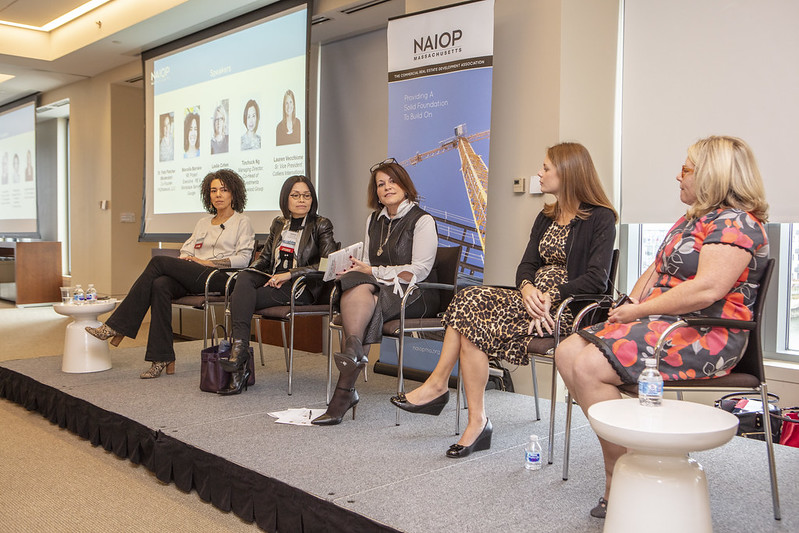
Changing the Game for Women in Commercial Real Estate

This post was written by Mike Hoban of Hoban Communications.

Ten years ago, when NAIOP Massachusetts launched its first ‘Women of Influence Luncheon’, the commercial real estate industry in Boston  (and NAIOP) looked pretty much like the floor of the U.S. Senate – approximately 10 percent women with few people of color. Today, the Boston CRE industry still very much resembles the Senate, but given that the number of women in that chamber has grown to 25 percent and people of color now constitute 10 percent of Senators, it is clearly a step in the right direction for both constituencies. For NAIOP (whose membership is now 27 percent women), that change has been reflected in leadership as well, with 20 of the 49 (40 percent) members on the board of directors for the 1,650 member organization are either women or people of color.

Last week, NAIOP again held its annual Women of Influence luncheon, hosted at the home office of Nutter McClennen & Fish, LLP in the Seaport. The sold out event attracted nearly 200 (mostly women) participants, and its theme, “Changing the Game for Women in Commercial Real Estate,” reflected just how much the conversation around women in the industry has changed in the last decade. “This is our tenth anniversary and we wanted to change things up,” said Reesa Fischer, executive director of NAIOP Massachusetts. “This is no longer about seeing what your career path is and how you get there. It’s about women providing opportunities for other women and strategies for achieving equitable workplaces.”

The panel discussion was moderated by Dr. Patti Fletcher, CEO of PSD Network LLC (which advises corporations and female executives), and author of “Disrupters: Success Strategies from Women Who Break the Mold”. The panel included Marcella Barrière, LEED AP, project executive for real estate & workplace services for Google; Leslie Cohen, COO and head of asset management for Samuels & Associates; Tinchuck Ng, managing director and co-head of investments at the Cottonwood Group; and Lauren Vecchione, senior VP for Colliers International.

Fletcher told the gathering that changing the workplace dynamic is not about just working harder or “leaning in more” – which has long been the go-to strategy for professional women in the workplace. Instead, she says, “We have to get real about what we’re facing, and we also have get real that blaming and shaming of men and trying to ‘fix’ them does not work. What does work is understanding where that systemic bias is and creating a new, more efficient and equitable status quo where everyone can thrive.”

Cohen emphasized the importance of mentorship and sponsorship for women, particularly those just entering the field. She joined CREW Boston (then NEWiRE) nearly two decades ago, and participated in a program that paired her with a female mentor in Dallas. The two worked together for a year on a development plan that was practical and “intentional about where I was going to go and how I was going to get there,” said Cohen. The mentor also stressed the importance of overcoming fears around networking, a skill which eventually led to her assuming the role of president of both CREW and NAIOP at different points in her career. And she still talks to her mentor on a monthly basis. “It’s been hugely beneficial to get advice and an outside opinion to help me not only to navigate, but to keep me challenging myself to keep growing,” said Cohen.

In addition to mentors, panelists discussed the importance of having advocates within the industry – both male and female – to support and champion them as difference makers. Barrière, who is African-American, said that due to the lack of black women in senior leadership positions in commercial real estate, there is a shortage of available mentors for her, so she seeks out advocates instead. “And the difference for me is, ‘Who is going to walk into the room when I’m not there and talk about what great work I did?’ A mentor is going to talk to me about how to overcome situations, and that’s a private conversation. That is coaching and that is guidance. An advocate is going to walk into the room when I’m not there and say, ‘This person has earned a shot. Their work is great and they need to be promoted or they need to be put on this project’.”

Vecchione added that women can become advocates for other women by practicing “echoing” during meetings. “One thing I was taught by Kristin (Blount, Collier executive VP/partner) was that we need to echo for one another,” she said. “When you’re not the only woman in the room, and you do have a good idea, it’s not always acknowledged, unfortunately. So what is helpful to your other female colleagues is just echoing what they’ve said if you do think it’s a good idea. And the more that we can do that, the more we have each other’s backs, and it can go a long way towards helping all of us.”

One of the difficulties for many professional women in the workplace, said Fletcher, is overcoming “imposter syndrome” – the belief that one is inadequate despite ample evidence to the contrary. Often fueled by perfectionism, Fletcher’s research indicates that imposter syndrome is three times more likely to be experienced by women than men, and seven times more likely by women of color. Multiple panelists shared that despite their track records of success (including being included on the prestigious NAIOP panel) they can still experience those feelings of inadequacy in the workplace.

Barrière suggested that the best way to overcome imposter syndrome is by “silencing it, calling it out, and just saying to (oneself), ‘If I was invited into this room, then I belong here,’ and leave it at that. Move forward from there without questioning that fact. On a level playing field, mindset and tenacity will win the day.”

Ng said the key to succeeding in the environment from an external standpoint is focusing on what really matters to the task at hand – and always bringing the conversation back to the deal. “You’ll get looked at differently. Trust me,” said Ng. “As someone who’s trained as an architect, is a woman and Chinese, I bring diversity to that room no matter what, and that’s my value-add. Call it out. Humor helps enormously, at least in my case, but at the end of the day, what’s going to get you the level of respect is going back to the point of, ‘this is a better solution because it generates ‘X’ return’.”

Vecchione and Ng both emphasized that while there are disadvantages to being a women or person of color in the industry, there are also a number of positives. Vecchione said that she focuses a lot more on the advantages because it’s what she can control, and reminded the audience that “we all have the ability to stand out in a crowd and create a brand for ourselves.” Ng suggested that one way to distinguish yourself from the pack was to carve out a niche. In her case, it was to become expert in cross-border tax implications for real estate acquisitions and dispositions. She told the audience that it was easier for her establish a level of confidence regarding expertise about cross border transactions, “because I look different, even though I’ve lived here for 25 years,” she joked, and encouraged the audience to “take what is sometime perceived as differences – I wouldn’t call them disadvantages – and ask yourself if that can become your niche.”

While the CRE industry and society as a whole has a long way to go in terms of equity along race and gender lines, Cohen sees a good deal of “forward progress” in commercial real estate. When she began her career with Samuels 17 years ago, she was often the only women in the room. Currently she is working on a development project with Harvard University where nearly all of the people in leadership positions are women. “If I can think of the future work that we have in front of us, it’s getting more women in the room, into that very close circle, who are making decisions, particularly hiring decisions – and I think that’s the important one that still needs to happen – but I think there’s been a lot of progress,” said Cohen.