Trade Missions Should be Viewed Over Long Term

I just had an op ed published in Mass High Tech on Governor Deval Patrick’s recent 10-day Innovation Economy Partnership Mission to Israel and the U.K.

Too often, the sole criteria used to judge whether a trade mission is a success is jobs.  Unfortunately, this is short-sighted. Economic development strategies must be designed for the long-term.

The Commonwealth’s economic plan needs to have at its core a focus on growing its local, existing business base, while still looking beyond its borders for strategic global opportunities. The right missions, such as this one, are key to our future success.

Yes, In Your Back Yard

Paul McMorrow’s recent op ed in The Boston Globe discussed the impacts of the recent decision issued by the Massachusetts Supreme Judicial Court on a zoning dispute in Chatham (Kenner v. Zoning Board of Appeals of Chatham).  This case brought to light an issue developers in Massachusetts have known for years – a few dissatisfied residents have the power to stall development projects in the court system for years, many times without proper standing.

In most cases, the project opponents have not sustained actual harm (the primary qualification for challenging a local zoning decision), but they still have the ability to slow and potentially kill a new development.  At least, that is, until now.    

With its decision in this case, the SJC raised the bar for NIMBY (Not In My Back Yard) lawsuits.  The typical NIMBY suit is based on the litigant’s perception that a proposed development will impact them.  With this ruling, the SJC clearly stated that for a suit to move forward there must be true and measurable harm to the aggrieved party.

The SJC gave more authority to the Land Court to make decisions regarding the proper standing of a party to bring a law suit in opposition to a project.  In so doing, they basically took away the ability of the state appeals court to question the Land Court’s judgment on standing.

This decision is not going do away with all project appeals, nor will it screen out all frivolous appeals.  However, this is one of the clearest messages we have seen in years from the courts.  It recognizes that it is unfair to allow a local minority to use litigation for the sole purpose of preventing approval of development projects that were fully vetted through a legitimate public permitting process.  NAIOP applauds the decision!

“It’s Getting Better all the Time”, The Beatles

At the well-attended NAIOP Developing Leaders breakfast this morning, a panel presented “Booming In Beantown: Why Boston Remains One of CRE’s Hottest Markets.”

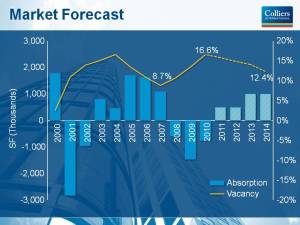
I was particularly interested in three slides that certainly left me and the other attendees sighing with relief about our future.  The first two slides were from Yanni Tsipis, Senior Vice President of Development & Consulting Services, at Colliers International.  The Market Forecast shows the historic run-up of the vacancy in Boston to a 10 year high of 16.6%.  However, they are forecasting positive absorption over the next four years, dropping the vacancy rate to 12.4%.  That might not be the low single digits, but it is in the range to start pushing up the rental rates.

The next slide should not come as a great surprise regarding the relative health of the commercial real estate investment market.  It does, though, show how bad off are the other regions of the country.  The delinquent or special service loans are under 5% for the Boston market.  However, take a look at some of the other metro markets like Phoenix, Riverside-Ontario, and Seattle.  New York and Washington, the other “stars” are a bit worse off than Boston.  It has been many a recession ago since we were not the poster child for being the worst affected region.

Finally, Peter Merrigan, President & CEO of Taurus Investment Holdings provided a chart showing Boston’s advantage in terms of employment gains.  This may be the first time Boston has ever been in any top grouping regarding employment (other than loss of.)  Not only is Boston ranked third with over 1.3% twelve month gains, but the Commonwealth is ranked fourth in actual raw employment numbers!

Bring out your old records and enjoy the refrain: “It’s getting better all the time.”  And hopefully for the foreseeable future too.

Fidelity’s Marlborough Closure in Perspective

Fidelity recently announced it will be closing its Marlborough location over the next 2 years and relocating 1,100 employees to the remaining 3 regional locations in downtown Boston, Smithfield, RI and Merrimac, NH.  The company’s staff has been reduced significantly over the past few years and this decision was made as part of the company’s worldwide reductions during the recent global economic crisis.

What is interesting to me has been the immediate reaction in the press. For the most part, the story has been about Fidelity’s “ingratitude” and the need for the state to punish the company for making such a decision. 

Fidelity still remains one of the largest employers in the Commonwealth with thousands of workers. They, unlike many Fortune 500 firms, maintain their headquarters here. 

What we have is a global company that makes a business decision to relocate some of its employees and to close a regional office. Shouldn’t we be asking what we can do to make us more competitive?  

Beating up on an employer and an industry is probably not the best way to keep them here over the long term. Let’s do a better job at listening to our employers and understanding their problems, before they become ours.

Political Notes from Israel

Editor’s Note: NAIOP CEO David Begelfer traveled with Governor Patrick’s Trade Mission to Israel; this is his update from day 4 of the trip.

The following are a few notes from my final day with the Trade Mission – there is truly too much going on to report it here, but I hope this gives some insights into the progress Governor Patrick and the delegation made in building relationships that could translate into real economic development opportunities for the Commonwealth.

Meeting Prime Minister Dan Meridor

1) Deputy Prime Minister Dan Meridor
After a very candid presentation of the political environment, the Minister (who oversees intelligence) answered a question about the effect of political uncertainty and previous conflicts on Israeli investments. According to him, there are no problems, with strong investments continuing due to strengths in innovation economy, $8 billion in trade surpluses, and a strengthening currency. 

2) U.S. Consul General Daniel Rubinstein
West Bank GDP is 8%. (higher in Gaza, but off an extremely low base,) Foreign donations and foreign Palestinian investments total$900 million annually. Social media expanding in both Gaza and West Bank. 90% literacy throughout Palestinian Territories. Housing costs are growing very fast with an increase of more than 40% over last few years. However, there is less concern over “bubble” due to underwriting with 35% down and limitations on multiple home ownership. Most young families require parental assistance. 

3) Jerusalem Mayor Nir Barkat
Coming from the private sector as a successful founder & CEO of a computer software company and a venture capital firm, he retired 8 years ago at age 40. In 2008 he was elected mayor – a truly visionary and dynamic leader. He enlisted Michael Porter to help strategize based on Jerusalem being the best location, best known brand. Leveraging Jerusalem’s competitive advantages, Mayor Barkat is developing the business cluster and tourism together. His goal is 10 million tourists (3 now,) health & sciences cluster expansion, and looking to the future with patient-centric vs. hospital-centric care.

Governor Patrick Meets with President Shimon Peres

4) President Shimon Peres
At 87 years old, and personally representing the whole history of the State of Israel, President Peres spoke and answered questions on his view of the past, present, and future here and relations with the U.S. Answering a question about what contributed to the phenomenal growth of the economy from the start, he said it began in earnest with defense. Without planes, Israel was forced to build their own, requiring research, precision manufacturing, and the need to produce a superior product in order to survive.

5) Industry, Trade and Labor Minister Shalom Simhon
Governor Patrick and the Minister signed a Memorandum of Understanding for collaboration in research and development between the Commonwealth’s and Israeli companies. The Minister’s office and the office of Chief Scientist will identify existing programs that can be scaled up to an international level. There is hope that the Kinesset will pass legislation allowing the Chief Scientist to invest in a foreign program or academic program, which could benefit Massachusetts schools and businesses.

You can hear more about these opportunities at NAIOP’s upcoming program, The Boston-Israel Connection, featuring fellow trip participants David Abromowitz and Thomas O’Brien, as well as participants from the 2010 City to City trip to Haifa, Thomas Palmer and Robert Buckley. Learn more about that program, held Tuesday, March 29th, at the offices of the Combined Jewish Philanthropies.

A few other photos from the trip:

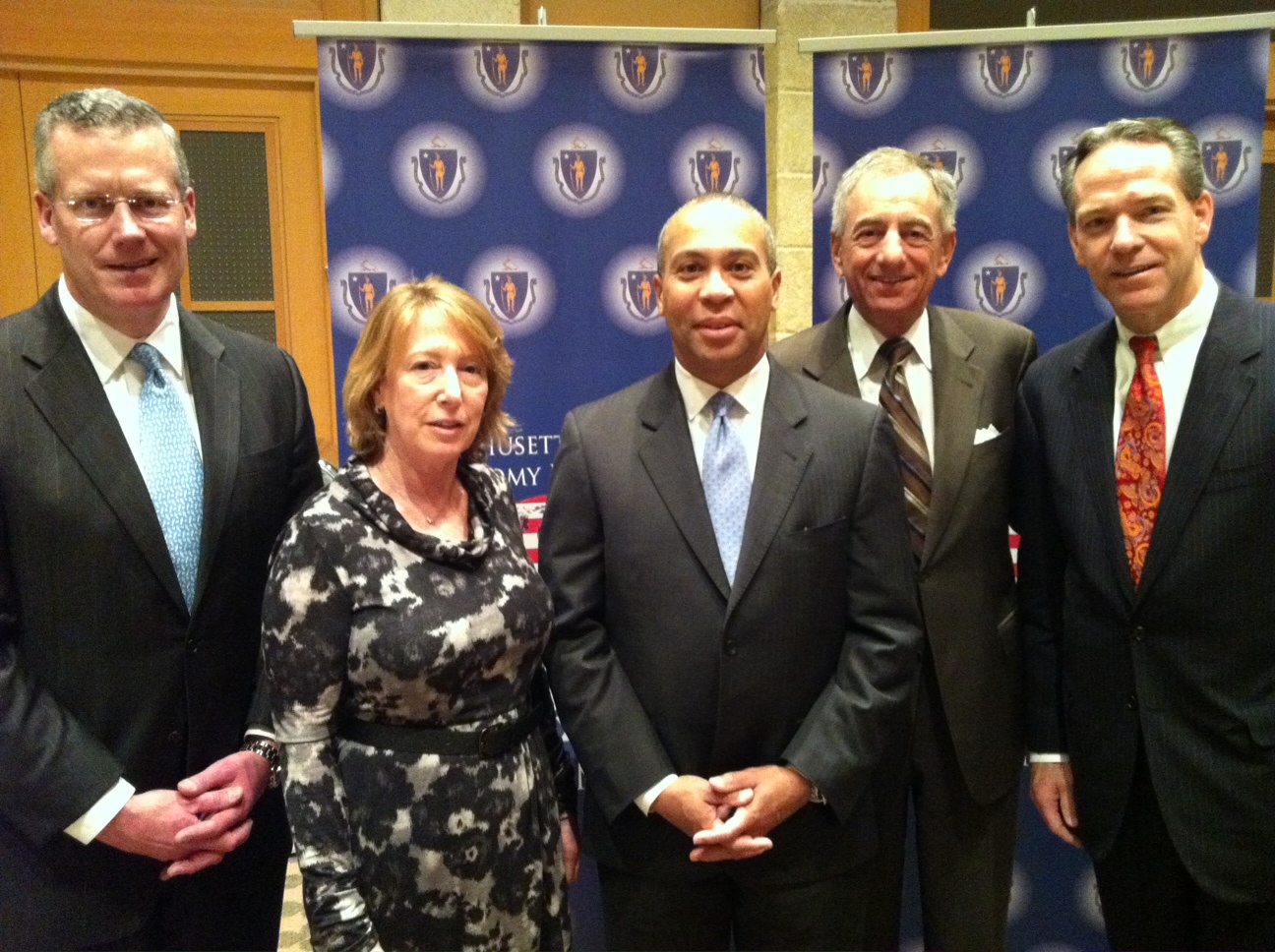
Governor with NAIOP CEO David Begelfer, and NAIOP members John Fish, Tom O'Brien & Helene Solomon

    David Begelfer with cabinet Secretaries Greg Bialecki & Rick Sullivan

Mass. Officials Make Their Case to Israeli Entrepreneurs

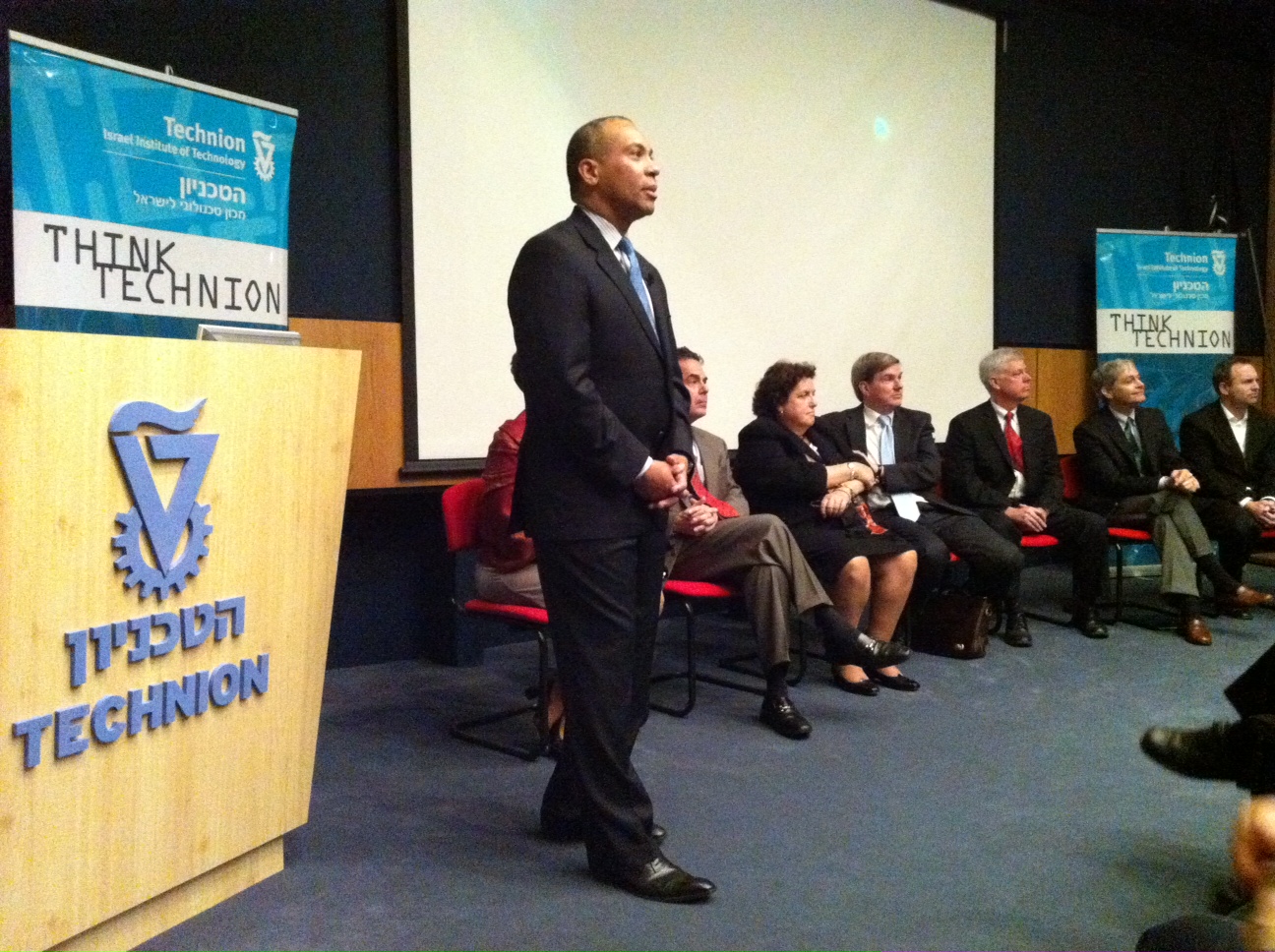
Editor’s Note: NAIOP CEO David Begelfer is traveling with Governor Patrick’s Trade Mission to Israel and is sending daily updates on their progress.On our third day in Israel, Governor Patrick led a Town Hall: “Collaborating as Leaders in the Innovation Economy” at The Technion (Israel’s “MIT”).

Governor Patrick at The Technion

Questions centered on what early stage resources were available if the Commonwealth wanted to attract start-up businesses? 

Susan Windham-Bannister, President & CEO of the Massachusetts Life Sciences Center, explained that the Center was established to promote and make financial investments to grow life sciences companies. The Center is there to fill the gap in the “Death Valley” of VC funding, the period from when a startup receives initial capital to when it begins generating revenues. Additional financing is usually scarce during this time, so the Center provides 5-year loans to qualified firms.

Patrick Cloney, Director of the Massachusetts Clean Energy Center, said they are promoting the state’s clean energy industry by making direct investments and providing assistance to access capital. In 2009, the state’s ratepayer-funded Renewable Energy Trust Fund was transferred to the Center.

Finally, Pat Larkin spoke about the Massachusetts Technology Collaborative, which encourages the formation, retention, and expansion of technology-related enterprises.  As Director of the MTC’s John Adams Innovation Institute, he makes investments in the knowledge-based economy.

Other notable moments on the trip included a presentation by Haifa Mayor Yona Yahav who spoke to our delegation at the Combined Jewish Philanthropies’ Boston-Haifa Connection’s “Shiluvim” program (an effort to help Ethiopian Jewish immigrant children adjust to a new life in Haifa).

And the BEST falafel stand in Tel Aviv!

Israeli Investors Looking to Buy

Day two on the Massachusetts – Israel Innovation Economy Partnership Mission with Governor Patrick started with an intimate meeting with some of the largest Israeli real estate investment firms and insurance companies. 

These companies have substantial assets in Israel, but, with a relatively small home market, they are diversifying their investments worldwide in Europe, Asia, South America, and the United States. In 2010, Israelis were the second largest investment group in the US.  

These firms are investing in most product types, including office, retail, multi-family, and medical/research. They say that they are finding better returns in the United States than in other countries. 

However, to date their investments have been in major metropolitan areas like New York, Miami, Houston, the Bay Area, and even Las Vegas. They have not had much success in Boston. Some have tried, but few have been able to find the right opportunity. 

Today Governor Patrick made a great case to have these public companies come to Massachusetts. With markets stabilizing and rents moving upwards, now is the time for Israeli companies to look here for direct investment and joint ventures. Industry leaders and government officials look forward to welcoming them to the Bay State!

Direct Boston-Israel Flights Key to Economic Investment

Today, at the start of the Massachusetts – Israel Innovation Economy Partnership Mission with Governor Patrick, our first meeting of the day was with the CEO of El Al Airlines, Major General Eliezer Shkedi. A small group of us met with the General and his staff to pitch having El Al open non-stop direct flights between Boston and Tel Aviv.

General Shkedi, Governor Patrick and Robert Kraft

If there was one single action that could directly affect the growth of new Israeli businesses in the Commonwealth, it would be the convenience of direct flights. Boston is already the second largest origin-destination, business market without nonstop service and Massachusetts ranks 5th among U.S. states for air exports to Israel.

With the ties that we share with Israel in the High Tech, Life Sciences, Finance, and Higher Education sectors, our shared economic future is certain to support this important service.

Companies like EMC, Cubist, and Glasshouse Technologies all indicated their company’s strong interest in supporting direct flights.  Robert Kraft made the obvious statement that non-stop flights are not only good for their business, they would be profitable for El Al, with higher paying business passenger revenue.

Governor Patrick proposed that both “sides” have their staff work on the numbers over the next six months and reach a decision about the feasibility of these flights. General Shkedi agreed to see if it can work.

Right now, El Al is considering non-stops to Miami and Chicago. We might not be able to compete with the large Jewish population in South Florida, but we should hold up well with Chicago, especially with El Al’s partner airline’s (Jet Blue) major expansion in Boston.

Who knows, in a year or two, sitting on the tarmac in New York may not be necessary to get to Tel Aviv.

Off to Israel with Governor Patrick

An important part of NAIOP’s mission is to promote overall economic development, which in turn supports the Commonwealth and its business community.  As such, I am honored to represent the members of NAIOP by joining Governor Deval Patrick, along with a coalition of state officials and business leaders, on next week’s Massachusetts Innovation Economy Partnership Mission to Israel. The coalition will explore growth opportunities within the Commonwealth’s innovation-based industries – technology, life sciences, clean energy and financial services – and areas of common interest between the state’s established and emerging partners in Israel.  The coalition will then continue on to the UK.

During the trip, I will join Governor Patrick and members of the delegation in roundtables, company visits, and meetings with government and business officials in Tel Aviv, Haifa, and Jerusalem.  I believe the mission is an important opportunity for the Commonwealth to explore new growth opportunities and business relationships in the global market, which could lead to increased real estate investment and development throughout the state

There are nearly 100 companies with Israeli founders or Israeli-licensed technologies in Massachusetts today.  In 2009, these companies employed nearly 6,000 people and generated $2.4 billion in direct revenue for the state. Local firms exported over $180 million worth of goods to Israel in 2009 and, at 12.35 percent, the United States is Israel’s largest source of imports.

I plan to blog from Israel and provide regular updates about what we learn. When I return, I and other participants from this trip and last fall’s City to City trip will present a program on The Boston-Israel Connection, presenting our findings and exploring the possibilities for growth that will benefit our industry.

NAIOP Comments on Proposed Brownfields Policy

Today NAIOP submitted an extensive comment letter to DEP on its proposed Vapor Intrusion Guidance. NAIOP has significant concerns with the guidance document and the negative impact it would have on the redevelopment of the Commonwealth’s Gateway Cities and brownfield sites. In addition to providing a thorough analysis and review of the document, the comment letter also asks DEP for a detailed response to our comments and concerns.

Brownfields can only be successfully redeveloped when the health of site occupants is protected, the regulatory path is clear, required response actions can be performed in a timely and cost effective manner, and regulatory closure means just that.  In other words, potential developers must be comfortable that these issues can be addressed with a reasonable degree of predictability.  In many places, the draft Guidance does not accomplish these objectives.  As a result, there is a very real risk that a significant portion of the sites that will be subject to the Guidance will not be redeveloped. 

All of NAIOP’s comments are provided with the objective of improving the Guidance in a manner that is consistent with the goals referenced in recent public comments made by DEP Commissioner Kimmell.  We share the Commissioner’s interest in building upon the past success of the Commonwealth’s risk-based, Licensed Site Professional implemented, cleanup program to protect public health while encouraging the redevelopment of contaminated sites.  Unfortunately, we believe the current draft of the Guidance does not achieve these goals.  However, we very much look forward to working with the Commissioner and the Department to develop a final Guidance document that does.

Very special thanks to the members of NAIOP’s 21E Committee, especially committee co-chair Ned Abelson of Goulston & Storrs, who contributed an enormous amount of time to this issue over the past several years.