The Future of Multifamily

This blog post was submitted by Allyson Quinby, Account Executive at Solomon McCown & Company.

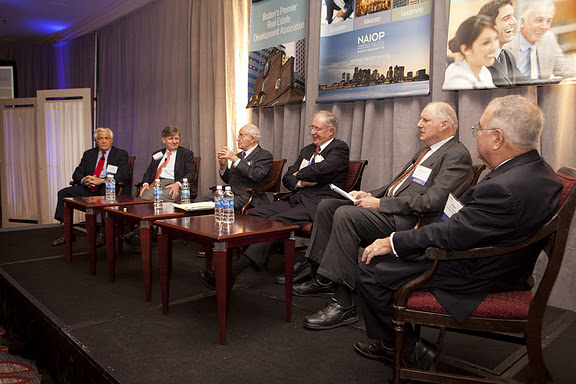
On Wednesday, April 4, industry experts gathered at Boston’s Seaport Hotel to discuss the future of Boston’s apartment market at NAIOP’s Future of Multifamily breakfast program. The panel featured experts in the industry including, Raymond Torto, Chief Global Economist at CBRE; Kent Larson, Principal Research Scientist at MIT Media Lab; Julie Smith, President of The Bozzuto Group; Simon Butler, Executive Vice President at CBRE New England; and James Gray, Principal at ADD Inc,  as moderator. View panelist video.

Torto kicked off the panel and set the table for the discussion by explaining that from 2007 to 2012, there was an influx of graduating students in Boston. That, compounded with the fact that more individuals chose renting over homeownership skyrocketed Boston to the 7th largest multifamily market in the country—and counting.

Butler expanded on the supply side of the multifamily trend. According to Butler, Greater Boston’s supply of multifamily housing will continue to increase over the next three years.  Currently, there are only a handful of residential construction projects underway in Boston and Cambridge metro areas. However, by 2014 these projects will be completed and almost double that number will be in the pipeline.

Smith addressed the demographic of individuals influencing the multifamily boom. Similar to Baltimore, New York and DC, Boston’s market is made up of single people, divorcees, and those in the 25-40 age group moving into the urban area and opting to rent over buying. Additionally, there is a demographic of individuals between the ages of 50 and 60—frequently empty-nesters—who are moving into luxury apartments. While varying in age, these demographics both expect hotel-like lobbies, energy-efficient appliances, common spaces and fitness centers all within a 30-minute commute to work.

Larson rounded out the panel by wowing the audience with his answer to the growing demand for personalized, high-quality and affordable units. Through the use of robotic walls, smaller apartments can now have multiple functions turning a full dining room into a bedroom with a touch of a button. MIT is providing the technology for these transformable environments that meet the popular need for spaces that can serve as the home and the workplace.

The factors that sustain the multifamily boom are just as interesting as the factors that led to this real estate trend. Rooted in job growth and urbanization, and perpetuated by the growing number of individuals opting to rent over homeownership, the emerging multifamily trend requires architects, developers and marketers to develop new strategies for building and filling these units.

What the Future Holds for Cambridge, MA – The Innovation Capital of the World

This blog post was submitted by Allyson Quinby, Account Executive at Solomon McCown & Company.

NAIOP Massachusetts’ “Cambridge: Ready, Set, Go!” breakfast event on February 15 featured a well-versed panel of real estate executives who spoke on “What’s new and what’s next for this hot market.”  Mary Lentz, McCall & Almy, moderated the expert panel that included Tom Andrews, Alexandria Real Estate Equities; Michael Cantalupa, Boston Properties; Shawn Hurley, Skanska USA Commercial Development; Steven Marsh, MIT Investment Management Company; and Thomas O’Brien, The HYM Investment Group.

View photos and event presentation slides.

Marsh noted how the world is changing every day, and that the U.S. along with many other superpowers such as China and India, continues to look for new ways to compete. For example, the U.S. aggressively leads the way when it comes to innovation, and as Marsh discussed, Cambridge has long been the epicenter of innovation productivity.

Due to Vertex’s move to Boston’s Seaport district, many in the real estate industry worry that the Cambridge market no longer holds the same stature it once did. However, NAIOP’s expert panelists assured us that we are in a natural state in Cambridge, and as stated by Cantalupa, “If you can afford to be next to MIT, you will be.” The lab market is steady, and many developers like Skanska USA Commercial Development are currently taking time to re-evaluate outdated space to create real estate opportunities that will fit all types of tenant needs in the future.

Home to two of the finest institutions of higher education in the world, Harvard and MIT, the panelists argued that Cambridge has gained and will maintain a prominent reputation. Companies in the life-sciences, technology, bio-pharmacology, education and innovation sectors, along with many startups, have found their homes in Cambridge. Due to the competitive advantage that comes with a Cambridge address, real estate firms have experienced a tremendous amount of success leasing space in this market. As the panelists noted, there is still an active demand and we continue to see new development activity in this market today.

Marsh and Andrews also spoke about the importance of proximity for lab space to MIT and other academic buildings. It is crucial that all facilities continue to collaborate, creating an environment that fosters innovation. Hurley also noted how mixed-use space needs to continue to be developed; it is important that we connect lab to retail and public spaces.

O’Brien discussed the next generation workforce and the need to build corporate and residential spaces that attract young professionals. His firm is developing the NorthPoint neighborhood, a mixed-use campus with flexibility – one that allows people to live and work in the same place.

Cantalupa and Hurley spoke on how real estate developers need to build flexible buildings that can adjust to market demands. Hurley noted how Skanska’s plan behind 150 Second Street was to deliver a Class-A, highly flexible property with a sustainable design that had features all tenants could enjoy. The building was also designed to accommodate either one or multiple tenants.

As stated by Marsh (and I agree), “Cambridge is special – it goes well beyond real estate” – and it is here that we want to continue the innovation story.

Note from NAIOP: Learn more about the dynamic Cambridge market by attending our 10th Anniversary Bus Tour, Big & Breaking in Greater Boston. Cambridge, along with Fenway, Longwood, Boston’s Seaport and Allston will be featured during this fast-paced and informative live market update bus tour.

The Uptick in Tech – part two

This blog post was submitted by Ben Breslau, Managing Director, Americas Research at Jones Lang LaSalle.

The third impact of technology on our markets is through the workplace. Here the confluence of demographics and improving technology is enabling and inspiring progressive companies to redesign how we think of space. Employees are clearly more mobile, as technology allows the flexibility to work from anywhere and on any device. But even within the space, tenants are harnessing more open, collaborative, flexible, efficient, and sustainable workplaces.

The driving force for tenants in the past was typically cost, but now in addition to driving efficiency the space itself is being looked at as a way to enable productivity as well as recruit top talent. These trends likely mean lower demand for commodity office space, and a redefinition of the characteristics driving space demand. Office space is not going away, but the target is moving.

One question that I always get is whether the tech boom is just the tech bubble 2.0. Is it sustainable? We recently did an analysis of technology P/E ratios as compared to the dot com bubble and found that valuations remain near the lows of the last 15 years. Today’s tech companies are cash rich and startups have been funded more conservatively. I won’t pretend to know what they all do, but many are making products that enhance and improve the lives of people and the productivity of businesses.

We think this tech wave is still in its early to mid stage with plenty of room to run.

Casinos Coming to Massachusetts – An Inside Look at What the Future May Bring

NAIOP just had its gaming program: Casinos Coming to Massachusetts: Spinning the Wheel – What this New Industry Means for the Commonwealth. The event attracted a large crowd and generated significant media coverage. It was the first program of its kind since the casino legislation was signed into law and it was the first public speaking opportunity for Steve Crosby, the Chairman-Designate of the newly established Massachusetts Gaming Commission.

During his presentation, Steve indicated that there were eight guiding principles that came out of the legislation:

  1. The public must have confidence in the selection and oversight process.
  2. There will not be a local referendum until there is a signed agreement with the casino operator/developer and the municipal leadership.
  3. Financial stability of the development must be proven.
  4. Lottery revenues need to be maintained.
  5. Job growth and economic development should be maximized.
  6. Small businesses and local tourism in the surrounding areas need to be protected.
  7. Revenues must be generated for the Commonwealth.
  8. Any potential negative consequences should be mitigated.

Steve sees this as a great opportunity to leverage what might be a $2-4 billion private investment into the Commonwealth for the public good. He also hopes that the individual project designs will enhance the culture, social values, and history of the local areas.

Finally, he pointed out that the Commission was just created. Four other members still need to be selected and an executive director needs to be hired before they can even begin establishing regulations and rules, or issue requests for proposals. He guessed that it would take 12-18 months to accomplish all of that with another 6-9 months, at the earliest, before an initial decision on a specific project could be made. The exception to that might be the one slot parlor, which could be on a faster track.

So, casinos are coming, but just not this year!

View event photos.

What Made CC&F an Incubator For So Many Development Companies?

At NAIOP’s recent program, Get Inspired with Gerald Blakeley and the Icons of Boston Real Estate, panelists and CC& F alumni discussed the culture at Cabot, Cabot & Forbes and why it resulted in launching the careers of so many of today’s local and national icons of commercial real estate.
View the video highlights.

Many younger real estate professionals may not realize that CC&F was the national pioneer of over 20 million SF of suburban master planned business parks.  During the program, Gerry Blakely, CC&F’s former CEO, described his start leading the company.  Back then, the land use for industrial properties was either building footprint or paved parking.  Very different from today, there were virtually no setbacks, landscaping, or design covenants.  CC&F’s new model was a commercial business park that established development restrictions and dimensional requirements more strict than the underlying zoning.  Although few banks wanted to risk lending for such a radical and risky venture, CC&F was able to get started and soon proved the profitability of this new concept. In 1948, CC&F opened The New England Industrial Center – the country’s first master-planned business park.  With the preservation of natural site amenities and consistent design standards, this facility quickly became a prototype for business parks that has been emulated worldwide.

CC&F was also responsible for creating millions of square feet of first-class office space across the country.  Their Boston landmark properties include 60 State Street, One Boston Place, 100 Summer Street, and 28 State Street.

As Bill McCall, President of McCall & Almy, pointed out, the people that Gerry attracted to the company were the brightest around who all shared a strong drive to succeed.  These were entrepreneurs taking charge of their own particular divisions within CC&F, whether it was for the industrial, office, or national build-to-suit markets.

The obvious risk was that they were hiring the kind of personalities that would ultimately want to do this work on their own behalf.   Although that proved true for many of the alumni, the company benefitted from that intense, productive energy.

The list of CC&F graduates is impressive and includes: Don Chiofaro, President, The Chiofaro Companies; Ferdinand “Moose” Colloredo-Mansfeld, Senior Advisor, Cabot Properties, Inc.; Terry Considine, CEO, AIMCO; Arturo Gutierrez, Chairman, The Gutierrez Company; Mort Zuckerman, Chairman; and Ed Linde, former CEO, Boston Properties.

The legacy of Blakeley and CC&F lives on with so many of the alumni actively involved as leaders in our industry.  At the conclusion of our program, NAIOP presented the chapter’s first ever Lifetime Achievement Award to Gerry Blakeley for his contribution to the industry and his impact on Greater Boston.