How to Become a Woman of Influence in Boston Real Estate

This post was written by NAIOP member Diane K. Danielson, a consultant who works with clients to incorporate social media into their traditional marketing and business development plans.

On Nov. 2nd, over 100 women packed into Goulston & Storrs to hear from several of Boston real estate’s “Women of Influence.” The panelists and moderator (see photo) shared stories, tips and thoughts about what it takes to rise to the top in commercial real estate.

(l-r) Amanda Strong, Marty Jones, Lisa Brothers, Marilyn Sticklor, and Sarah Abrams (bios below)

I’ve been working outside of the real estate industry for a little over five years and this was the first opportunity I had to gauge if anything had changed in my absence. Based on what I heard at the panel, it was clear that commercial real estate in Boston remains male-dominated, but discussions about gender in the workplace have, in fact, progressed. Here are a few observations I made – if you have your own, please share them in the comments.

  1. The panel consisted of four women who were presidents of major companies and/or national industry organizations. Finding this many women in these positions would have been a bit harder 5-10 years ago.
  2. When asked about life balance, no one shied away from the question or denied it was an issue. Their response: It’s hard. You’ll feel like you’re neglecting your family and your job. However, it’s up to you to decide how open you are about your non-work life in the office. It’s also up to the women and men in top management to set the example if they want a friendly work/life environment.
  3. Avoid carrying around a career killing chip on your shoulder. Yes, sexism does still happen, but it’s like any other obstacle in your career path, you have the power to either overcome it or succumb to it.
  4. Do the math. There is no part of commercial real estate that doesn’t involve finance. Learn the numbers even if you are in marketing or human resources. If you need to boost your understanding in this area, there are great educational institutions out there that can help you and your career.
  5. Stop sitting around waiting to get noticed. This was by far the most troubling part of the panel for me because I had assumed this would be a non-issue by now. Yet it seems that women still play the “good girl,” work hard, and don’t adequately self-promote. As a result, they are less likely to have “sponsors” in the office, i.e. individuals who will go out on a limb on their behalf. (Sponsors are more crucial than mentors for making it to the top, but that’s fodder for a whole other post.)

Perhaps my favorite highlight was when Sarah Abrams shared an anecdote about whenever she invited men to attend a NEWIRE event, they always asked “will other men be there?” If the shoe was on the other foot, i.e. if she made her decisions to attend real estate events based on whether other women would be in attendance, she certainly wouldn’t be sitting where she is right now.

Speakers

  • Sarah Abrams, former President of Fidelity Real Estate Company, President of the New England Chapter of CoreNet and of NAIOP Massachusetts (note: link is to a recent profile of Sarah at MIT CRE site)

    At NAIOP's Women of Influence Event

  • Lisa Brothers, Vice President, COO, and Co-Owner, Nitsch Engineering (president/CEO as of 2011), president of the American Council of Engineering Companies/Massachusetts, and recipient of many civic and professional awards
  • Marty Jones, President of the Corcoran Jennison Companies, recipient of the Affordable Housing Vision Award by National Housing & Rehabilitation Association
  • Amanda Strong, Asset Manager for Colony Realty Partners, Founder of AAREP New England and newly-elected President of AAREP-National

Moderator

  • Marilyn Sticklor, Director at Goulston & Storrs, twice-named a Massachusetts Super Lawyer, with expertise in all aspects of commercial real estate development.
Boston-Haifa Innovation Zones

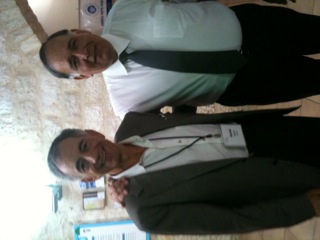
I’m on a Boston-Haifa “City to City” tour to help Boston get insights for the creation of an Innovation Zone in its Seaport District.

A group of 27 members of the Boston business and civic community are meeting with municipal, technology, and university leaders in Haifa and Tel Aviv, Israel through the City to City program run by Northeastern University and Mayor Menino.

Israel is one of the world leaders in producing a high quality skilled workforce that has attracted many of the leading global technology companies including Intel, who has here its largest R&D/production facility outside the US. (A great read: the new book: “Start-up Nation.”)

The first day we spent time with Haifa’s Mayor Yonah Yakov and the city’s Haifa Economic Corp. (HEC). To get companies to invest in their tech park, the City offers a 20% discount on municipal taxes. In their incubator building, start-ups get 3 years income tax free and 1:1 investment match with the government up to $200,000.

The Mayor was very generous with his time. He is a visionary, willing to risk political & infrastructure capital to get major projects started. Need a permit in 3 weeks? He can deliver. He took an abandoned area of the downtown, put in public areas and walkways, brought a new college into the district with classrooms and dorms and 2,500 students in only 3 years. Now they have restaurants, shops and galleries moving in.

Haifa is on the move!

Tribute to Ed Linde

NAIOP Massachusetts just held its awards dinner honoring Boston Properties with its 2010 Distinguished Real Estate Award and the late Ed Linde with its Public Service Award.

Edward H. Linde

When I started out in this business in the 70s, it was hard not to notice this dynamic duo of Ed and Mort.  They were a prime example of the new developer: thoughtful, analytic, creative, methodical, and visionary.  I had a number of opportunities to talk with Ed over the years.  For me and for so many others, he was always accessible and provided sage counsel.     

For Ed, the time and charitable investments he made in the community were an integral part of his life.  When he was on a volunteer board, he was there to be an active participant, regardless of the  time commitment required. 

So, a lesson from Ed to all of us; yes, it is important to do well, but equally important to do good!

NAIOP chose to honor the memory of Ed Linde in recognition of the impact he had on countless charitable and civic causes throughout the city. Known as a tireless supporter of the arts and other philanthropic causes, Ed was co-founder and Chief Executive Officer of Boston Properties until his death this January.

Throughout his career, he led by example in business as well as in philanthropy, serving as a mentor to many in the business and non-profit communities. Together with his family foundation, he was a major supporter of many of Boston’s most respected organizations, including the Massachusetts Institute of Technology, Museum of Fine Arts, Boston, Boston Symphony Orchestra and the Dana-Farber Cancer Institute.  But his support of these organizations was just the tip of the iceberg, as his civic and charitable commitments ran deep through the city, including: The Beth Israel Deaconess Medical Center, Boston World Partnerships, Jobs for Massachusetts, and WGBH, among many others.

In honor of his lasting contributions to our city and our industry, NAIOP Massachusetts has decided to rename this award the Edward H. Linde Public Service Award, so that his legacy may live on to inspire future generations of philanthropists.

Reduce the Regulatory Burden in Massachusetts

At a recent John LaWare Leadership Forum at the Federal Reserve Bank of Boston, I joined a panel of business leaders to discuss “What Keeps Us Up At Night.”

My comments were as follows:

  • Massachusetts was once known as Taxachusetts. Unfortunately, we are now becoming known for our cumbersome local and state regulatory system.
  • This problem has grown over the last two decades to the point that it is an inhibitor of job growth.
  • The problem on the local stage is a lengthy, unclear, and unpredictable permitting process with specialized regulatory bylaws that further raise the conservative thresholds established by the state.
  • On the state level, regulatory agencies have operated in an economic vacuum for too many years, unconcerned with the impacts of their rules on business growth and competitiveness. Rarely, if ever, are cost/benefit analyses performed on proposed regulations to determine, in advance, their impacts on businesses.

Market risks are enough to make new innovative businesses think long and hard before starting up.  Massachusetts should not be adding unreasonable delays and uncertainty to this important economic engine.

Post Election Economic Strategy for Massachusetts

NAIOP congratulates Governor Deval Patrick on his election to a second term!

Ed Glaeser

Ed Glaeser

Under the category “it’s never too early to do good planning,” we would like to recommend that the Governor listen to the advice of Harvard Professor Ed Glaeser as outlined in his recent column in the Fall issue of Commonwealth Magazine

Glaeser very succinctly spells out what the leadership in Massachusetts should focus on in order to position the state for sustained long-term growth including:

  1. Renew the Commonwealth’s commitment to invest in education and show a willingness to innovate.  The state must also do a better job educating disadvantaged children without access to safe, quality schools.  Further support for charter schools is needed.
  2. Create a business environment hospitable to all businesses, large and small, rather than picking winners in only certain sectors
  3. Make Massachusetts  more “small-firm friendly” (e.g., substantially reduce the enforcement of non-compete clauses.)
  4. Establish a “blue-ribbon” panel to review the extensive list of tough regulations and rules that result in Massachusetts frequently being listed as among the least business friendly states.
  5. Tie local allocations of state aid to better, faster local business permitting.
  6. Try to retain more of our local college graduates.  Consider expanding the Adams Scholarship program, waiving in-state tuition charges and fees for high performing in-state high school graduates.
  7. Tie state education aid to good school practices.
  8. Press for housing market reforms that will make the state more affordable and dynamic to be able to attract and keep skilled workers and entrepreneurs.  The state must provide a counter-weight against local regulations discouraging workforce housing.  (e.g. Tie state aid to issuance of building permits, encouraging localities to lower barriers.)

As Glaeser concludes, job creation is a result of the state focusing on its core competencies of providing a decent quality of life to people throughout the state in order to attract entrepreneurs. Then the Commonwealth should step back and allow business to move forward. 

I totally concur.

VOTE! Every Vote Counts!

Today is Election Day. As we have seen in recent years, a single vote can change an election. If you haven’t voted already, polling places will be open today from 7:00AM – 8:00PM statewide. Need more information? Click here for a full list of candidates.VOTE! In addition, there are three ballot initiatives for you to consider. NAIOP is part of a coalition working to defeat Question 2 and Question 3 on the ballot (the organization has not taken a formal position on Question 1). 

And, in case you missed the most recent edition of the Boston Business Journal, NAIOP, Associated Industries of Massachusetts (AIM) and the BBJ, invited the candidates for governor to discuss issues of primary importance to the state’s business community. The organizations began this tradition in 2006. David Begelfer and Tamara Small of NAIOP interviewed Republican Charles Baker and Independent Timothy Cahill in separate sessions a week before the election. Unfortunately, Governor Deval Patrick’s campaign could not schedule an interview.

We wish the candidates the best!

Parking in the Seaport: Here today, gone tomorrow.

Interesting Op-ed piece in the Boston Globe October 23rd by Paul McMorrow talking about the changing requirements for parking in Boston, more specifically in the Seaport District.  Basically, Paul is saying the BRA is moving more to a concept of a maximum allotment for parking for new developments rather than a minimum.  This is supposedly due to the changing commuting dynamics with employees living closer to work (and, therefore, not as dependent on the automobile.)

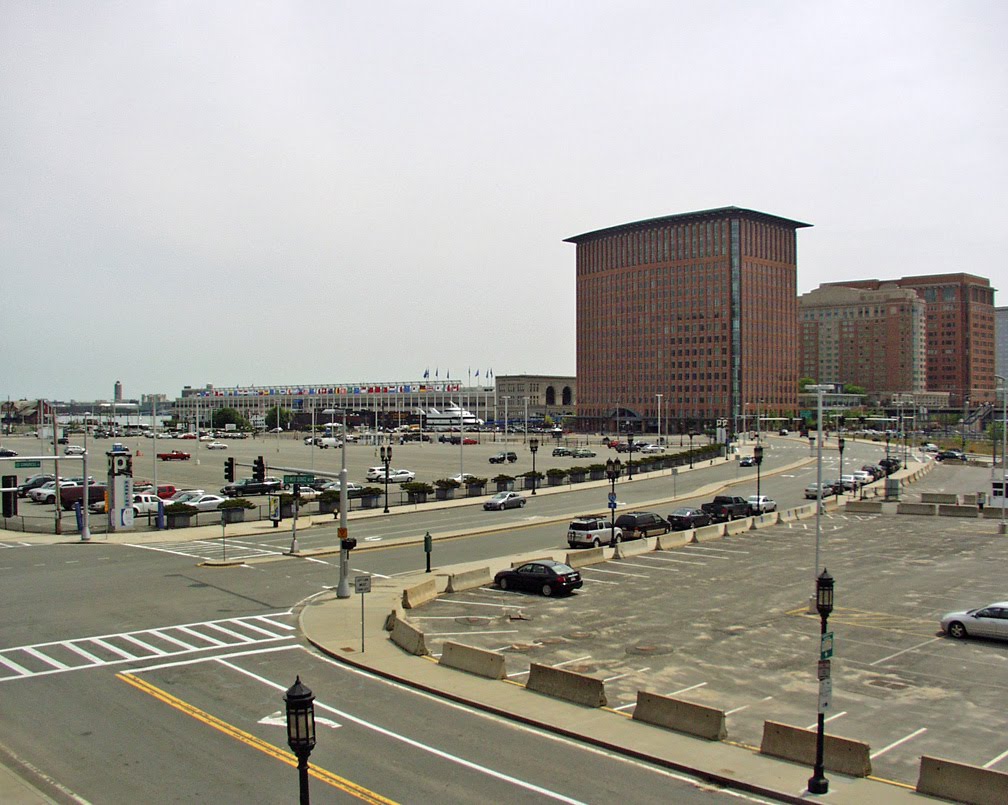
Parking in the Seaport

More interesting is that as the Seaport is developed, using primarily Joe Fallon’s and John Hynes’ surface parking sites, there will be less and less space available for the drivers currently using these lots.  And who are these people and where do they work?  Well, if you look over to the Financial District what you will see is a densely built office environment without much parking.  There is a parking freeze in that district which the city insists is working very well – a model for the Seaport parking freeze, as a matter of fact.

The problem is that the freeze works in the Financial District because of the availability of so much low cost parking in the Seaport.  So, when that inventory of “cheap” long term parking disappears, the businesses in the Financial District will have a problem on their hands as their employees jockey for the remaining handful of parking spots. That is, unless there is a massive investment in mass transit over the decade.  I leave you to contemplate the chances of that! (Leave your prognostications in a comment, below)

Housing Affordability: Not Yet in Massachusetts

One would think that with the national housing market bust, the issue of affordable housing in Massachusetts is on its way to resolution. Well, maybe not so quickly.

The New England Public Policy Center and the Federal Reserve Bank of Boston recently produced a discussion paper: The Housing Bust and Housing Affordability in New England by Robert Clifford, Research Associate.

The paper looks at affordability in the New England states and the rest of the nation. The results show that although New England’s housing prices have declined and affordability has returned to the pre-housing crisis levels of the early 2000s, owner-occupied housing in Massachusetts is still less affordable than in the rest of the nation. Clifford remarks:

The affordability measures explored here point to lingering sources of concern pertaining to the high cost of homeownership in New England. In four of the six New England states (all but Maine and New Hampshire), recent drops in home prices have not been large enough to make the median-priced home affordable for the median-income household. Or—to present the same results from a different angle—the weak economy has prevented middle-income households from augmenting their incomes enough to allow them to afford the median-housed home in their state. The difference in affordability between New England and the nation is especially acute in Massachusetts.

The study also shows that more of the region’s households are becoming cost-burdened, particularly low- and middle-income homeowners.

Unfortunately, what this means for the Massachusetts economy is that, as the recovery begins nationally, job opportunities in other states will start attracting young families out of the region and into areas that are more affordable, leaving us yet again with a declining skilled workforce.

Once and for all, we need to develop a serious policy that allows for the construction of smaller, denser, affordable, starter homes.

Vote No on Question 3

A referendum on next month’s ballot, Question 3, would not only roll back last year’s Massachusetts sales tax increase, but would bring the sales tax rate all the way down to 3 percent.  The last time we saw a rate that low was in the 60s!  That certainly beats a one-time tax free holiday weekend, and who wouldn’t like a 3% savings on all our purchases year-round?

Unfortunately, as they say, there is no free lunch.  Remember the painful cuts to the state budget these last two years?  Remember the increasing costs of healthcare/Medicare; education; deferred infrastructure investments?  Well, with a declining revenue picture subtract from that another $2.5 billion dollars in state spending. The Massachusetts Taxpayers Foundation’s recently released report, Question 3: Heading Over the Cliff, indicates passage of Q3 would result in across the board cuts of 30% in virtually all state programs!

We’ll all feel it as local aid is dramatically slashed affecting schools, police, firefighters and infrastructure repairs. This is why NAIOP Massachusetts has joined with other leading business groups to form Business Leaders Against Question 3, which has launched a series of radio spots educating voters on the unintended consequences of this proposal.

Yes, we all would like to save money, but not at the expense of hurting ourselves and our neighbors. Join us and vote no on 3!

40B Update at NAIOP MultiFamily Event 10/20

Following up on David Begelfer’s recent post on protecting 40B, I want to note that NAIOP’s Director of Policy and Public Affairs, Tamara Small, will offer a brief update on 40B and related public affairs topics at next week’s Main Event program on multifamily housing: MultiFamily – The Bright Star.

Following Tamara’s update, the program will feature leading housing developers discussing the outlook for affordable housing, as well as market-rate and senior housing. Speakers include: Howard Cohen, Chief Executive Officer, Beacon Communities, LLC, Thomas Grape, Chairman and Chief Executive Officer, Benchmark Senior Living, and David Hall, Development Partner, The Hanover Company, with George Fantini, Chairman, Fantini & Gorga, as moderator. Click here for more info – hope to see you there!