NAIOP Remembers George Slye

ImageGeorge Slye, one of Boston’s greatest icons in real estate, passed away last month. The Boston Globe published an article about his life and his career, especially focusing on his partnership with Hank Spaulding to form the full service commercial real estate development firm, Spaulding & Slye.

There have been a handful of companies that have truly impacted the cityscape and the way our business has evolved.  Spaulding & Slye was one of those, through their suburban and downtown developments and the innovative approaches they took from design, through construction, and then, property management and tenant services.

The real estate industry will long remember George, his vision, and his leadership.

Out front on climate change

This article appeared in the Summer 2012 issue of Commonwealth Magazine.

Massinc’s recent research report, Rising to the Challenge: Assessing the Massachusetts Response to Climate Change, was billed as “the first independent assessment of state action on climate change.” We, at NAIOP Massachusetts, believe that it missed an opportunity to provide a more complete, non-partisan account. Although it is acceptable to inquire into the progress that the state is making to reduce greenhouse gas emissions as required by statute, this report is by no means a sufficient analysis of the issue.

The Massachusetts Global Warming Solutions Act, passed in 2008, required the state’s secretary of energy and environmental affairs to set a greenhouse gas reduction goal of between 18 and 25 percent for the year 2020 (one of the most ambitious in the nation). Ian Bowles, who was the secretary at the time, chose to set that target at 25 percent. The secretary was required to submit an action plan to the Legislature that could assist in meeting this goal; however, there was no requirement that the plan be followed or that other means could not be used to achieve this target.

We have no argument with the statute’s basic premise that climate change is a serious global problem and there need to be international and national plans in place to reduce greenhouse gas emissions in a timely manner. But we feel that questions need to be raised regarding the practical challenges of emissions reductions—where and how they can best be achieved, at what cost, and over what period of time?

Climate change is not a local issue. One state’s reduction in greenhouse gas emissions will have little impact on how that state will be affected by global climate change. Any other expectation is un­realistic. However, pursuing policies that could unintentionally hinder growth will most definitely put the Commonwealth at a competitive disadvantage when it comes to attracting or retaining jobs.

MassINC’s stated goal was to uncover the facts and reach independent conclusions based on evidence. Its approach was developed from the perspective that the state has committed to achieving ambitious greenhouse gas reduction goals, and that there should be a dialogue about the best way to do so. Unfortunately, the report comes up somewhat short. Rather than offering a dialogue, the report simply checks off which measures in the plan have or have not been completed to date. It accepts these recommended measures as the only path to achieving the required reductions and lacks any qualitative critique of these mitigation methods.

A comprehensive assessment of this issue would include a serious discussion of the economic and financial impacts that will result from recommendations of the state plan. This includes a cost/benefit analysis of any presumed impacts on businesses and residents. However, the only mention of cost impact in MassINC’s report is general statements from environmental advocacy groups indicating that these measures are fully balanced by the savings they will produce. The groups also imply that the costs would be less detrimental as valued against the cost of building a new power plant, which is a very unsuitable standard by which to judge individual policies. In addition, many of the policies outlined in the plan would have dramatic impacts on the economic development goals of the Commonwealth and should be questioned accordingly

The report is also lacking more substantive examination of the controversial decision to fund many of the alternative energy and efficiency programs with increased electricity costs for ratepayers. What are the impacts of the plan’s recommendations? What are the associated costs to those existing businesses that are dependent on high energy consumption? Are these investments the right ones for the Commonwealth? Does the growth of new jobs created by the grants and incentives justify the jobs lost due to high energy costs?  Besides the anecdotal evidence, what are the firm data regarding these investments and the return in terms of jobs, tax revenue, and economic development?

Also overlooked is the question of whether the aggressive greenhouse gas target for Massachusetts will significantly alter the projected impacts of climate change in the Commonwealth. The report describes projected climate change threats that include a rise in sea level, more frequent severe storms, and temperature spikes in the summers. If the Commonwealth is successful in meeting (and even exceeding) its greenhouse gas reductions at a substantial cost to the public, does anyone credibly believe such reductions would meaningfully reduce potential climate change impacts?

The Massachusetts Department of Energy Resources needs to be more open and transparent with its decisions to pursue mitigation plans. These should be grounded in sound economic cost-benefit analyses using data from its regulated industry stakeholders. Advancing policies without reliable data and analysis of their impact could cause the state to make decisions that have unintended negative consequences on our future economic growth.

Critical first steps would be to educate the marketplace, provide additional support to make these methods financially attractive, and recognize that the state of the economy is an important determinant of when to require greater efficiency measures. We should be researching whether there are more cost effective ways to get to the appropriate goals before we accept and mandate the most expensive solutions.

Increased energy efficiency in new development and existing buildings is a prime target for achieving the 2020 target goals. But it is important to keep in mind that not all markets around the Common­wealth are created equal. Statewide energy mandates for all building types will create a disincentive to develop new properties in areas where the markets cannot absorb the increased costs. Unfortunately, many of the “one-size-fits-all” government proposals do not account for varied building types or tenant energy requirements, and they rarely take into account actual investment/payback ratios.

The more stringent energy efficiency requirements disregard the mismatches between who pays the cost of an option (owner) and who gains the benefit (tenant), making it difficult to justify economically the investment in the first place. There is also too much emphasis being put on regulating the energy efficiency of the building shell. Much of a building’s energy use actually falls within the tenant spaces and therefore is not directly influenced by mandates for increased energy code efficiency. However, with appropriately scaled tax incentives, owners could receive financial benefits for the upfront investment and tenants could see reductions in their operating costs.

On a national basis, rather than using regulatory mandates, President Obama has announced the Better Buildings Initiative, an innovative economic development program using tax incentives to make existing buildings more energy efficient through retrofit projects. The amount of the incentive would grow with increased energy savings, encouraging ambitious projects and also rewarding more moderate retrofits that achieve meaningful levels of energy savings.

Since Massachusetts has among the highest energy costs in the nation, it makes good business sense to reduce a property’s controllable operating costs, especially if it can help to also reduce greenhouse gas emissions. Becoming more energy efficient is an important consideration in today’s commercial real estate industry. Many developers, owners, and tenants understand that it makes economic sense to find ways to increase initial capital investments for energy efficient technology and design elements that will result in a reasonable payback of energy savings.

As a result, the market is becoming more responsive to the need for energy efficiency, especially with volatility in energy costs, and a more educated and demanding tenant base. We have already seen that, without regulatory requirements, more buildings are now built as LEED-certified “green buildings.” Before the state moves toward aggressive mandates, policy makers should consider incentive-based solutions. Doing so could leverage and support private investments in order to help businesses reach higher levels of energy efficiency. MassINC should follow-up its report with a more critical look at the existing, proposed mitigation measures, as well as other alternatives, which could lead the Commonwealth down the right path to our greenhouse gas reduction goals.

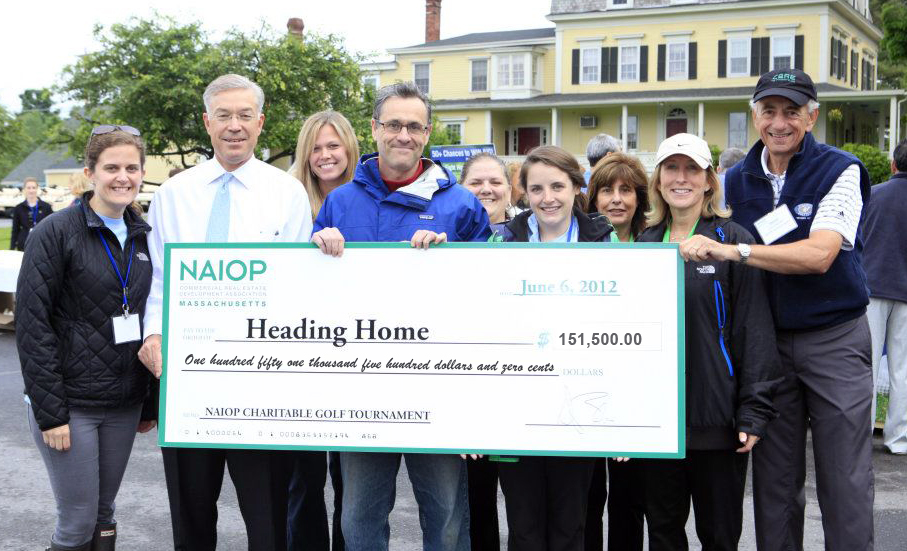
NAIOP Raises $151,500 for Heading Home

This post was submitted by Marc Margulies, principal at Margulies Perruzzi Architects and president of Heading Home’s Board of Directors

On June 6th, NAIOP Massachusetts held its 24th Annual Charitable Golf Tournament to benefit Heading Home, raising $151,500 to support programs to end homelessness in Greater Boston. This record-breaking sum is the largest in the tournament’s history, bringing the total donated to Heading Home to more than $1.85 million. The commercial real estate community should be proud
that its steadfast commitment to Heading Home reaps real rewards for homeless families.

In 2011, Heading Home helped more than 2,000 homeless people in Greater Boston by providing them a place to call home and opportunities for self-sufficiency. Two-hundred and fifty units of housing have been created since 2006, with 61 new units created in the past year alone.  More than 400 volunteers annually commit their time and energy to Heading Home, and the commercial real estate community provides a large number of those volunteers. The monies raised by NAIOP will continue to support Heading Home’s programs to end homelessness locally.

Andrew Hoar, president of CB Richard Ellis/New England and chair of the 2012 NAIOP Massachusetts Charitable Events Committee, led the effort to make this record-breaking donation possible. Andy has been on the Heading Home Board of Directors since 2007, and he, his wife, and his firm are longtime contributors to the organization. Andy’s efforts this year hit the fundraising goals out of the park!

Another ardent Heading Home supporter who deserves special recognition is NAIOP Massachusetts CEO, David Begelfer. David has been actively involved in the struggle to end homelessness for more than 24 years, and started the annual NAIOP golf tournament to support Heading Home. In 2010, David received the Bob Ray Partnership Award from the Massachusetts Housing and Shelter Alliance for his commitment to ending homelessness. His support of Heading Home, including serving on the organization’s Advisory Council, has been unwavering through the years.

Since the first NAIOP Golf Tournament that raised $5,000 for Heading Home, the commercial real estate industry has continued to come together to show support for homeless families and individuals. Thank you to NAIOP’s member volunteers, staff, and generous donors who helped to raise this record-breaking donation for Heading Home. It is only through their support that the tournament is able to raise funds needed to help Heading Home accomplish its goal of ending family homelessness.

View pictures from the event.

Boston’s parking freeze needs to be thawed

This Letter to the Editor appeared in the June 14, 2012 edition of Boston Business Journal.

To the editor:
The viewpoint expressed in your recent article titled “Seaport Squeeze” piqued my interest. I find it worrisome that the Seaport area will soon transition from servicing commuter parking for downtown Boston, to an area servicing parking for its new residents and businesses.

We should all be a bit more concerned about the results of this impending transition. The parking freeze was initially proposed in the early 1970s for downtown Boston and Logan Airport. Subsequently, parking freezes were adopted in Cambridge, East Boston and other parts of Boston. With the growth of the office market over the past three decades, many workers have certainly taken advantage of Boston’s mass transit system, but those who commute by car benefit from the low-cost parking in the undeveloped Seaport area.

With a parking inventory freeze in the Seaport, long-term availability of satellite surface parking is at odds with the construction of high-rise apartments and offices. As the amount of commuter parking diminishes, the stress on businesses in the Financial District, to keep their commuting employees, increases. Mass transit cannot absorb all these commuters. At some point, companies that have relied upon employees that commute to work may be forced to look elsewhere for office space.

There are two areas that need attention. Firstly, Boston businesses are highly dependent on the MBTA and the legislature needs to act, not just with a short-term fix, but with a multiyear plan to reduce the T’s burdensome debt, and increase the long-deferred investments to enhance, expand, and improve ridership capacity and satisfaction.

Secondly, a myriad of programs have been implemented nationwide to reduce parking and transportation demand that do not depend on freezes. Even the city of Cambridge has abandoned its parking freeze approach and implemented a Vehicle Trip Reduction programs to address parking, traffic and air-quality issues.

Maybe the time has come to take reevaluate the city’s parking freeze policy, which is one of the very few left in this country.

David Begelfer
CEO of NAIOP Massachusetts

Breaking Ground in Back Bay

The following blog post was submitted by Sheridan Wachtel, Marketing Assistant at Solomon McCown.

On May 31, experts from all sides of the real estate industry joined us at the Sheraton Hotel to discuss one of Boston’s most iconic and sought-after neighborhoods, the Back Bay. The program, “Breaking Ground in Back Bay,” discussed the future opportunities for retail, residential, office and hotel in the neighborhood that has been the epicenter of the city for decades.

The panel included Peter Meade, Director of the Boston Redevelopment Authority; Michael Jammen, Principal, UrbanMeritage, LLC; David Martel, Executive Director of Cushman & Wakefield of Massachusetts, Inc.; Michael Roberts, Vice President Development of AvalonBay Communities, Inc.; Jeffrey Saunders, President of Saunders Hotel Group, LLC; and was moderated by Leggat McCall Properties LLC Executive Vice President, Mahmood Malihi.
Meade set the table for the discussion citing the pipeline of projects slated for the Back Bay including the redevelopment of the Christian Science Plaza, 888 Boylston, Chanel’s new retail store, and Copley Place residential building—which will be the tallest building in the Back Bay once completed.

Jammen, one of the architects of the Newbury Line Program, discussed the “red hot” retail scene in the Back Bay and more specifically, Newbury Street. “Constrained by being only eight blocks in length, retail real estate on Newbury street is seeing more demand than supply,” said Jammen in light of the fact that the street’s architecture isn’t traditionally window-display friendly. “It doesn’t have the windows like Rodeo Drive and other luxury retail streets of the world…but no one is going to build another Newbury street anytime soon,” said Jammen.

Having represented some of Boston’s most notable office spaces including The Hancock Tower, Martel discussed the increasing value of Back Bay’s office properties. “We have seen a quantum shift in office space demand in the Back Bay since 2008,” said Martel explaining how the coveted 24/7 lifestyle of the neighborhood is an increasingly important factor to office tenants to attract and retain talent—a factor that sets it apart from both contemporary urban areas like the Seaport and traditional office space properties like the Financial District and suburban areas.

With a growing desire to work in the Back Bay, residential real estate in the area has only increased in value. Roberts commented on the demographic shift that has made residential real estate in the Back Bay boom. “Young professionals landing a majority of newly created jobs, along with empty nesters wishing to return to city-livingare the key demographics in residential real estate in this area,” said Roberts.

And, according to Roberts, residents of the Back Bay aren’t planning to move out of the Back Bay anytime soon, citing residential properties in the neighborhood see half the turnover rate than all other neighborhoods in their portfolio.

Rounding out the panel was long-time hotelier Saunders, who discussed the resiliency of hotel occupancy in Boston’s Back Bay despite the influx of new hotels in Boston’s Seaport district. “Back Bay continues to be ground zero for people who want to visit the city,” said Saunders whose hotels operate at 90+ percent occupancy rate in the summer months and projecting 2012 to yield its highest occupancy rates in recent years.

With a full spectrum of real estate development projects underway and even more projected in 2013 and 2014, real estate in the Back Bay will continue to be hot commodity and a place where residents, tenants, tourists and developers want to be.

Watch a video of the panelists, or view photos from the event.

Stretch Code Changes Have Developers Seeing Red, Not Green

This article appeared in the May 28, 2012 edition of Banker & Tradesman.

“Green building” is a term that can be broadly defined. For some, it may mean building a LEED Platinum building. For others, it could be installing water and energy saving measures. There is no question, however, that most developers are more conscious of green building practices. The question is how to encourage this movement? The industry believes the market should be allowed to lead the way when it comes to green building. Mandates imposed by the government requiring specific technologies or energy efficiency measures are not the most effective way to get there. They will only increase costs and slow development of all building types.

The Stretch Energy Code mandate passed in 2009 is one example of government’s attempt to promote energy efficiency. This local option code applies to both residential and commercial buildings. More than 100 communities have adopted it to date. Under the Stretch Energy Code, commercial buildings are required to meet higher energy efficiency standards – approximately 20 percent more than the current statewide energy code.

In 2012, the statewide energy code, as required under the Green Communities Act passed in 2008, will be updated to comply with the more energy efficient International Energy Conservation Code (IECC 2012) – an energy efficiency increase of approximately 20 percent over existing standards. Massachusetts will be leading the way by adopting this new energy code (only two other states have adopted the IECC 2012 to date). Furthermore, the statewide energy code must be updated within one year of any revision to the IECC – contributing to the commonwealth’s current position as the national leader in energy efficiency.

Change Is Coming

However, a change is being proposed to the Stretch Energy Code that will jeopardize our recent, modest economic recovery. In June, the Massachusetts Department of Energy Resources (DOER) is planning to propose a 15 percent increase to the current Stretch Energy Code (to take effect when the IECC 2012 is adopted for the rest of the state). In other words, the new Stretch Code would require buildings to be 35 percent more energy efficient than the current statewide code. Such a change would increase the cost of the construction and maintenance of residential and commercial buildings. Current rents, even in traditionally high rent communities, would be challenged to cover the increased costs associated with such projects. In addition, the change would dramatically alter project design, affecting their marketability to tenants.

Many communities chose to adopt the Stretch Energy Code in order to qualify as a Green Community. By earning this designation, they became eligible for grant money that could be used to make energy efficient upgrades in public buildings. Green Communities are required to minimize the life cycle costs of buildings by utilizing “energy efficiency, water conservation and other renewable or alternative energy technologies,” but this requirement could be achieved by adopting the IECC 2012 rather than the Stretch Energy Code.

Most of these Stretch Code communities believed that once the statewide building code was upgraded to the IECC 2012, the entire state would be on a level playing field. Unfortunately, many cities and towns are now discovering that the changes to the stretch code will take effect automatically in all Stretch Code communities without any vote by City Council or Town Meeting. Furthermore, many Stretch Code communities were not aware that they would continually be subject to an automatic upgrade every three years.

Given the impact this extreme proposal will have on housing production, jobs and a very fragile economic recovery, it is time to recognize its unintended consequences. Maintaining the commonwealth’s lead in energy efficiency should not come with a price tag we cannot afford – the loss of jobs and economic growth.

Getting Real in Affordable Housing

The following blog post was submitted by Anne Baker, Account Executive at Solomon McCown.


It’s all about perception versus reality.

That was the takeaway message from NAIOP’s Affordable Housing: Challenges and Initiatives panel on May 23.  The panel included Howard Cohen, Chief Executive Officer at Beacon Communities; Lawrence Curtis, President at WinnDevelopment; Tony Fracasso, Senior Vice President at MassDevelopment; Bart Mitchell, President & CEO at The Community Builders, Inc.; Jeanne Pinado, Chief Executive Officer at Madison Park Development Corporation; and was moderated by Solomon McCown CEO Helene Solomon.

The meeting was kicked off by Aaron Gornstein, the newly appointed undersecretary for the Department of Housing and Community Development (DHCD).   Gornstein outlined his plans for DHCD, emphasizing that the agency is planning ahead for growth in the state.  Streamlining the permitting process, giving support to promising communities, marketing the opportunities available to developers and building needed infrastructure are all essential elements of Gornstein’s affordable housing plans.

But while some may only see affordable housing as a social issue, Gornstein was clear that the high cost of living in Massachusetts has serious long-term ramifications for whether businesses decide to locate here and that the construction of affordable housing creates needed jobs.

False perceptions were also a constant theme throughout the panel discussion. The public is not aware that family homelessness is a relatively recent problem and that it’s easily solved through the construction of affordable housing, Pinado said.  Mitchell and Fracasso both emphasized the creative financing options that are available to affordable housing developers who are looking for them.

Curtis argued passionately that while the construction of affordable housing is important, it alone can solve the housing gap in Massachusetts; we must work together for the preservation of existing low-income and affordable housing.  Cohen also noted that while many upscale communities fight affordable housing developments out of a fear for negative impacts on their school systems, there is little evidence to suggest that is reality. It’s all about overcoming how local communities often approach affordable housing and making the case that inclusion will benefit us all.

View video of Affordable Housing panelists.

NAIOP Supports Jobs Bill

Today I testified at a legislative hearing  in support of An Act Relative to Infrastructure Investment, Enhanced Competitiveness & Economic Growth in the Commonwealth (H. 4093), a comprehensive piece of legislation designed to stimulate job growth in Massachusetts. Speaker of the House Robert DeLeo and Representative Joseph Wagner, House Chairman of the Joint Committee on Economic Development and Emerging Technologies, released the bill earlier this week.  NAIOP applauds the House and the Patrick Administration for crafting a bill that will encourage economic development in Massachusetts.

We are just starting to see the beginning of a recovery for the real estate industry, but it is still a very fragile time.  This bill creates the necessary tools to ensure economic development projects can move forward. It builds on the comprehensive Economic Development Plan released by the Patrick Administration earlier this year.  It expands and strengthens I-cubed, preserves important state and local permitting decisions, and encourages the cleanup and redevelopment of brownfield sites. We strongly support its passage before the close of the legislative session on July 31.

The bill includes many NAIOP-supported concepts including:

  • Creates a new Local Infrastructure Development Program that gives municipalities a new tool for leveraging private funding to finance infrastructure improvements needed to support economic development projects. The program allows infrastructure projects to move forward without the use of public funding.
  • Expands the successful I-cubed (Infrastructure Investment Incentive) program and increases the number of projects per community from two to four. It also increases the available funding for the program.
  • Extends the Brownfield Tax Credit from 2013 to 2015, encouraging the redevelopment of brownfield sites by bringing more certainty and predictability to the process.
  • Streamlines District Improvement Financing (DIF) by eliminating the required EACC review of DIF districts and development plans, making the program more accessible to cities and towns.

The full text of the bill and a section-by-section summary of the bill are now available.

Kids Are Not Toxic Waste

There have been many studies on the state of housing in the Commonwealth.  What is very clear from these, and the numerous opinion pieces on the subject, is that we have very high barriers to the development of housing in general, and affordable and family housing, in particular.  What is also apparent is that the economy cannot fully recover without the support of highly talented, college graduates that continue to leave the state.

Paul McMorrow wrote a column in The Boston Globe on April 24th that lays out the problem.  Massachusetts has not been able to keep up with the current housing demand.  This results in slower job creation and volatile housing prices.  As Paul points out, without sufficient supply, the recovery is going to result, once again, in an explosion in housing prices.  According to a report by the Donahue Institute at the University of Massachusetts, if the current pace of development is maintained, there will be a deficiency in our housing stock of 46,000 units.  We are already seeing this problem with an inadequate rental stock, driving rents to record highs.

The problem is rooted in several areas that include “home rule,” large lot requirements, lengthy permitting, frequent appeals, and an anti-children attitude.

  • The economic needs of the Commonwealth have been stymied by local regulations that continue to encourage large, expensive homes and discourage the production of more affordable “starter” housing.
  • With minimum lot requirements in many towns of 1-2 acres, it is very difficult to economically justify building smaller scaled homes.  (Few of these municipalities even offer cluster zoning.)
  • Permitting requirements have become more onerous with local rules and special by-laws making the development process longer and more unpredictable.
  • Even with local approvals, there are the frequent appeals that delay the start of a project by 1-2 years (sometimes effectively killing the project.)
  • Lastly, many housing proposals that would attract families with school age kids are denied at the local level.  The often heard justification is that adding any number of children to the system will break the back of the school budget.  Oddly, this argument occurs in communities that project future reductions in the school age population.  Frequently, it seems that communities would be more welcoming to an asphalt batching plant than to new children.

As Paul McMorrow so eloquently states, “The state’s technology sectors demand steady supplies of young talent. But over the last decade, while the Massachusetts population was growing at a meager 3-percent clip, it lost 9 percent of its 25- to 34-year-olds. These are the recent college graduates and young families that the state’s economic future is built on. They’re also the population that’s most sensitive to the state’s deeply ingrained affordability crisis. And they’re voting with their feet.”

Our future is our young families and our children.  It’s time we stop viewing children as the equivalent of toxic waste and start building the housing we need.  Otherwise, we will only have ourselves to blame for a failed economy.

NAIOP Bus Tour: 10 Facts Learned on the Trial Run

The following blog post was submitted by Duncan Gratton, Senior Managing Director, Principal at Cassidy Turley FHO.

This year marks the 10th Anniversary of NAIOP’s Bus Tour, and as the Vice President of the Bus Tour Committee, I had a hand in planning and designing it. The 2012 Bus Tour, What’s Big and Breaking in Greater Boston, is a fast-paced live market update on some of the most dynamic markets in the area, including Boston’s Seaport, Fenway, Longwood and Cambridge.

The actual date of the Bus Tour is May 2, but this week – along with Bus Tour Captains and NAIOP staff – I went on a dry run of the route. We saw a lot of projects breaking ground and learned several interesting facts from the knowledgeable Bus Tour Captains! Here are the ten I found most interesting:

  1. The largest private construction project in the US is located at Fan Pier. The Vertex buildings are 1,100,000 SF and $900,000,000!
  2. Three of the largest academic/medical clusters in the US are located in Boston. They are:MGH/Partners

    Longwood Medical/Harvard

    Boston Medical Center/Boston University

  3. Kendall Square in Cambridge was supposed to be the original site of NASA. After JFK was assassinated, Lyndon Johnson became President and being from Texas, he chose Houston as the new location.
  4. Boston University is one of the largest landlords in Back Bay/Fenway. They control over 1,000,000 SF of commercial and non-academic real estate.
  5. There are three new life science buildings under construction in Kendall Square (Pfizer, Novartis and Broad Institute) and two new office buildings (Biogen Idec). All are 100% leased.
  6. Rents in Kendall Square and the Seaport District have jumped over 10% in the last 12 months.
  7. New apartment construction is booming – at least six new projects are underway or about to start in Boston!
  8. New Balance has announced plans for four new buildings at Brighton Landing, including a new 250,000 SF world headquarters building. In addition, they are planning a 345,000 SF sports facility that will include a hockey rink and track.
  9. Harvard is constructing an ‘Innovation Lab’ in the former WGBH buildings on Western Avenue in Allston.
  10. Boston University has announced that construction will commence this summer on a new lacrosse stadium on Babcock Street, thanks in part to a $3,000,000 donation from New Balance.

I hope you will join us on May 2 to learn more about What’s Big and Breaking in Greater Boston. Get a sneak peek of what’s in store.