BIDS: Taxation Without Representation

The new “Jobs bill” recently passed by the Massachusetts House and Senate, and now awaiting the Governor’s signature, has a lot of “goodies” for economic development. However, there is a little surprise for businesses who are in, or might be in, a Business Improvement District (BID).

Currently, the BID law does not require every business in the district to contribute to the BID. However, with the new law, if 60% of the businesses in the district vote to form a BID, every business will be required to pay.

What this might mean is that existing BIDs (e.g. Downtown Crossing in Boston) and future proposed BIDs (e.g. Rose Fitzgerald Kennedy Greenway) will be able to force commercial landlords to pay into these districts.  If the city can convince/coerce 60% of the owners of a district to accept this, the others will have no say.  This can also lead to some interesting “Gerrymandering”, creating boundaries to capture large properties. Owners that may be further away from the core area will be obligated to new property tax surcharges to fund maintenance, security, and marketing initiatives for areas not necessarily benefiting these outlier properties.

That sounds like the situation with the current Downtown Crossing BID, and is part of the impetus behind this legislative action.  Some property owners further away from Washington Street, decided not to participate, to the consternation of the city.

What we may now see is new taxation for new services benefiting some, but paid for by many more.

NAIOP Remembers George Slye

ImageGeorge Slye, one of Boston’s greatest icons in real estate, passed away last month. The Boston Globe published an article about his life and his career, especially focusing on his partnership with Hank Spaulding to form the full service commercial real estate development firm, Spaulding & Slye.

There have been a handful of companies that have truly impacted the cityscape and the way our business has evolved.  Spaulding & Slye was one of those, through their suburban and downtown developments and the innovative approaches they took from design, through construction, and then, property management and tenant services.

The real estate industry will long remember George, his vision, and his leadership.

The Uptick in Tech – part two

This blog post was submitted by Ben Breslau, Managing Director, Americas Research at Jones Lang LaSalle.

The third impact of technology on our markets is through the workplace. Here the confluence of demographics and improving technology is enabling and inspiring progressive companies to redesign how we think of space. Employees are clearly more mobile, as technology allows the flexibility to work from anywhere and on any device. But even within the space, tenants are harnessing more open, collaborative, flexible, efficient, and sustainable workplaces.

The driving force for tenants in the past was typically cost, but now in addition to driving efficiency the space itself is being looked at as a way to enable productivity as well as recruit top talent. These trends likely mean lower demand for commodity office space, and a redefinition of the characteristics driving space demand. Office space is not going away, but the target is moving.

One question that I always get is whether the tech boom is just the tech bubble 2.0. Is it sustainable? We recently did an analysis of technology P/E ratios as compared to the dot com bubble and found that valuations remain near the lows of the last 15 years. Today’s tech companies are cash rich and startups have been funded more conservatively. I won’t pretend to know what they all do, but many are making products that enhance and improve the lives of people and the productivity of businesses.

We think this tech wave is still in its early to mid stage with plenty of room to run.

Casinos Coming to Massachusetts – An Inside Look at What the Future May Bring

NAIOP just had its gaming program: Casinos Coming to Massachusetts: Spinning the Wheel – What this New Industry Means for the Commonwealth. The event attracted a large crowd and generated significant media coverage. It was the first program of its kind since the casino legislation was signed into law and it was the first public speaking opportunity for Steve Crosby, the Chairman-Designate of the newly established Massachusetts Gaming Commission.

During his presentation, Steve indicated that there were eight guiding principles that came out of the legislation:

  1. The public must have confidence in the selection and oversight process.
  2. There will not be a local referendum until there is a signed agreement with the casino operator/developer and the municipal leadership.
  3. Financial stability of the development must be proven.
  4. Lottery revenues need to be maintained.
  5. Job growth and economic development should be maximized.
  6. Small businesses and local tourism in the surrounding areas need to be protected.
  7. Revenues must be generated for the Commonwealth.
  8. Any potential negative consequences should be mitigated.

Steve sees this as a great opportunity to leverage what might be a $2-4 billion private investment into the Commonwealth for the public good. He also hopes that the individual project designs will enhance the culture, social values, and history of the local areas.

Finally, he pointed out that the Commission was just created. Four other members still need to be selected and an executive director needs to be hired before they can even begin establishing regulations and rules, or issue requests for proposals. He guessed that it would take 12-18 months to accomplish all of that with another 6-9 months, at the earliest, before an initial decision on a specific project could be made. The exception to that might be the one slot parlor, which could be on a faster track.

So, casinos are coming, but just not this year!

View event photos.

What Made CC&F an Incubator For So Many Development Companies?

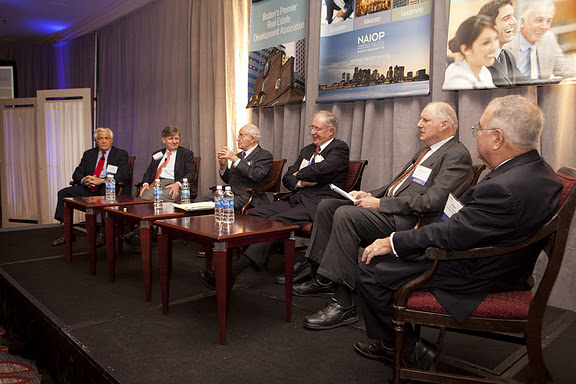
At NAIOP’s recent program, Get Inspired with Gerald Blakeley and the Icons of Boston Real Estate, panelists and CC& F alumni discussed the culture at Cabot, Cabot & Forbes and why it resulted in launching the careers of so many of today’s local and national icons of commercial real estate.
View the video highlights.

Many younger real estate professionals may not realize that CC&F was the national pioneer of over 20 million SF of suburban master planned business parks.  During the program, Gerry Blakely, CC&F’s former CEO, described his start leading the company.  Back then, the land use for industrial properties was either building footprint or paved parking.  Very different from today, there were virtually no setbacks, landscaping, or design covenants.  CC&F’s new model was a commercial business park that established development restrictions and dimensional requirements more strict than the underlying zoning.  Although few banks wanted to risk lending for such a radical and risky venture, CC&F was able to get started and soon proved the profitability of this new concept. In 1948, CC&F opened The New England Industrial Center – the country’s first master-planned business park.  With the preservation of natural site amenities and consistent design standards, this facility quickly became a prototype for business parks that has been emulated worldwide.

CC&F was also responsible for creating millions of square feet of first-class office space across the country.  Their Boston landmark properties include 60 State Street, One Boston Place, 100 Summer Street, and 28 State Street.

As Bill McCall, President of McCall & Almy, pointed out, the people that Gerry attracted to the company were the brightest around who all shared a strong drive to succeed.  These were entrepreneurs taking charge of their own particular divisions within CC&F, whether it was for the industrial, office, or national build-to-suit markets.

The obvious risk was that they were hiring the kind of personalities that would ultimately want to do this work on their own behalf.   Although that proved true for many of the alumni, the company benefitted from that intense, productive energy.

The list of CC&F graduates is impressive and includes: Don Chiofaro, President, The Chiofaro Companies; Ferdinand “Moose” Colloredo-Mansfeld, Senior Advisor, Cabot Properties, Inc.; Terry Considine, CEO, AIMCO; Arturo Gutierrez, Chairman, The Gutierrez Company; Mort Zuckerman, Chairman; and Ed Linde, former CEO, Boston Properties.

The legacy of Blakeley and CC&F lives on with so many of the alumni actively involved as leaders in our industry.  At the conclusion of our program, NAIOP presented the chapter’s first ever Lifetime Achievement Award to Gerry Blakeley for his contribution to the industry and his impact on Greater Boston.

Take NAIOP’s Communications Survey and Win!

Have you taken the 2011 NAIOP Massachusetts Communications survey yet? If not, please take a moment to answer this brief questionnaire, which will provide invaluable feedback as we evaluate and update our communications plan. In return, we’ll enter your name to win one of 10 tickets to a 2011 Main Event breakfast program!

Surveys must be completed no later than Friday, August 5, and a valid email address must be included to be eligible to win. If you have any questions or additional comments on the survey, please contact me, Diana Chaban Griffith, at 781-453-6900 x6.

Millenials and the Alternative Workplace: The Future of the Commercial Real Estate Industry

At a recent NAIOP Massachusetts program, a panel of leading professionals discussed the changing workplace that is being driven, in part, by a new demographic – the Millennials.

As Martha (Marty) O’Mara, PhD, CRE, Managing Director of Corporate Portfolio Analytics, said about this influential category, “they are no longer our kids, but our co-workers.”

This shift is bound to have an impact as they enter the workforce, and Marty’s presentation outlined some surprising facts about this group:

  • Only 15% of Millennials (age 19-29) say having a high-paying career is their top priority.  They place parenthood (52%) and a successful marriage (32%) much higher.
  • 63% have graduated from college, or plan to graduate.
  • Most in the workforce have already experienced bouts of unemployment.
  • Only 61% grew up in a household with both parents.
  • 38% have a tattoo.
  • 8/10 sleep with their cellphone.

They are a powerful market driver and their communication and work style preferences (consuming “experiences” rather than “things”, for example) are already shaping the commercial real estate industry.   

Marty’s bottom line:  “Don’t let a Boomer make a real estate decision.”  More and more companies are recognizing this and designing an “Alternative Workplace” as they plan for the future.

In a short slideshow, Marc Margulies, Margulies Perruzzi Architects shared the key elements of the new Alternative Workplace:

  • Few/no high wall cubicles
  • Multiple workplace environments
  • Density at 165 RSF/person
  • Amenity-rich
  • Dynamic

A panel of experts including Marty and Marc, as well as Bob Richards of Richards Barry Joyce & Partners; Janet Nicholas of Dassault Systèmes; and Greg Lewis of Shire Human Genetic Therapies, then discussed what all of this really means.  

Highlights and things to think about:

  • The Alternative Workplace is designed to support diverse demographics and to be conducive to multiple work styles (mobility being an important element.) 
  • Producing a corporate community that increases productivity through collaboration and interactivity is accomplished through a dramatic change from the historically private spaces (individual worksettings ) to ”neighborhoods” (more collaborative community spaces).
  • The new term is “benching,” providing bench space that can be shared, moved, configured.  The amount of space per employee can change based on the users from a 1.3:1 ratio that efficiently utilizes vacant space due to normal absenteeism, to up to 3:1 for a group that has higher sales and/or consulting staff that travels.
  • Lastly the “town common” area has plenty of amenities.  Picture this as the Kendall Square within the company where different specialties come together as a community in a social, casual area.  These tend to be food oriented, nature focused, bright, and inspirational.

Many of these changes are already being seen in the new designs and renovations of firms throughout the region, but this is just the tip of the iceberg, according to O’Mara and the other speakers.  Big changes are on the horizon for anyone involved in corporate real estate, and those changes will create countless opportunities for the firms who are ready.

Did you attend Wednesday’s program? Share your key takeaways and questions in the comments below!

Political Notes from Israel

Editor’s Note: NAIOP CEO David Begelfer traveled with Governor Patrick’s Trade Mission to Israel; this is his update from day 4 of the trip.

The following are a few notes from my final day with the Trade Mission – there is truly too much going on to report it here, but I hope this gives some insights into the progress Governor Patrick and the delegation made in building relationships that could translate into real economic development opportunities for the Commonwealth.

Meeting Prime Minister Dan Meridor

1) Deputy Prime Minister Dan Meridor
After a very candid presentation of the political environment, the Minister (who oversees intelligence) answered a question about the effect of political uncertainty and previous conflicts on Israeli investments. According to him, there are no problems, with strong investments continuing due to strengths in innovation economy, $8 billion in trade surpluses, and a strengthening currency. 

2) U.S. Consul General Daniel Rubinstein
West Bank GDP is 8%. (higher in Gaza, but off an extremely low base,) Foreign donations and foreign Palestinian investments total$900 million annually. Social media expanding in both Gaza and West Bank. 90% literacy throughout Palestinian Territories. Housing costs are growing very fast with an increase of more than 40% over last few years. However, there is less concern over “bubble” due to underwriting with 35% down and limitations on multiple home ownership. Most young families require parental assistance. 

3) Jerusalem Mayor Nir Barkat
Coming from the private sector as a successful founder & CEO of a computer software company and a venture capital firm, he retired 8 years ago at age 40. In 2008 he was elected mayor – a truly visionary and dynamic leader. He enlisted Michael Porter to help strategize based on Jerusalem being the best location, best known brand. Leveraging Jerusalem’s competitive advantages, Mayor Barkat is developing the business cluster and tourism together. His goal is 10 million tourists (3 now,) health & sciences cluster expansion, and looking to the future with patient-centric vs. hospital-centric care.

Governor Patrick Meets with President Shimon Peres

4) President Shimon Peres
At 87 years old, and personally representing the whole history of the State of Israel, President Peres spoke and answered questions on his view of the past, present, and future here and relations with the U.S. Answering a question about what contributed to the phenomenal growth of the economy from the start, he said it began in earnest with defense. Without planes, Israel was forced to build their own, requiring research, precision manufacturing, and the need to produce a superior product in order to survive.

5) Industry, Trade and Labor Minister Shalom Simhon
Governor Patrick and the Minister signed a Memorandum of Understanding for collaboration in research and development between the Commonwealth’s and Israeli companies. The Minister’s office and the office of Chief Scientist will identify existing programs that can be scaled up to an international level. There is hope that the Kinesset will pass legislation allowing the Chief Scientist to invest in a foreign program or academic program, which could benefit Massachusetts schools and businesses.

You can hear more about these opportunities at NAIOP’s upcoming program, The Boston-Israel Connection, featuring fellow trip participants David Abromowitz and Thomas O’Brien, as well as participants from the 2010 City to City trip to Haifa, Thomas Palmer and Robert Buckley. Learn more about that program, held Tuesday, March 29th, at the offices of the Combined Jewish Philanthropies.

A few other photos from the trip:

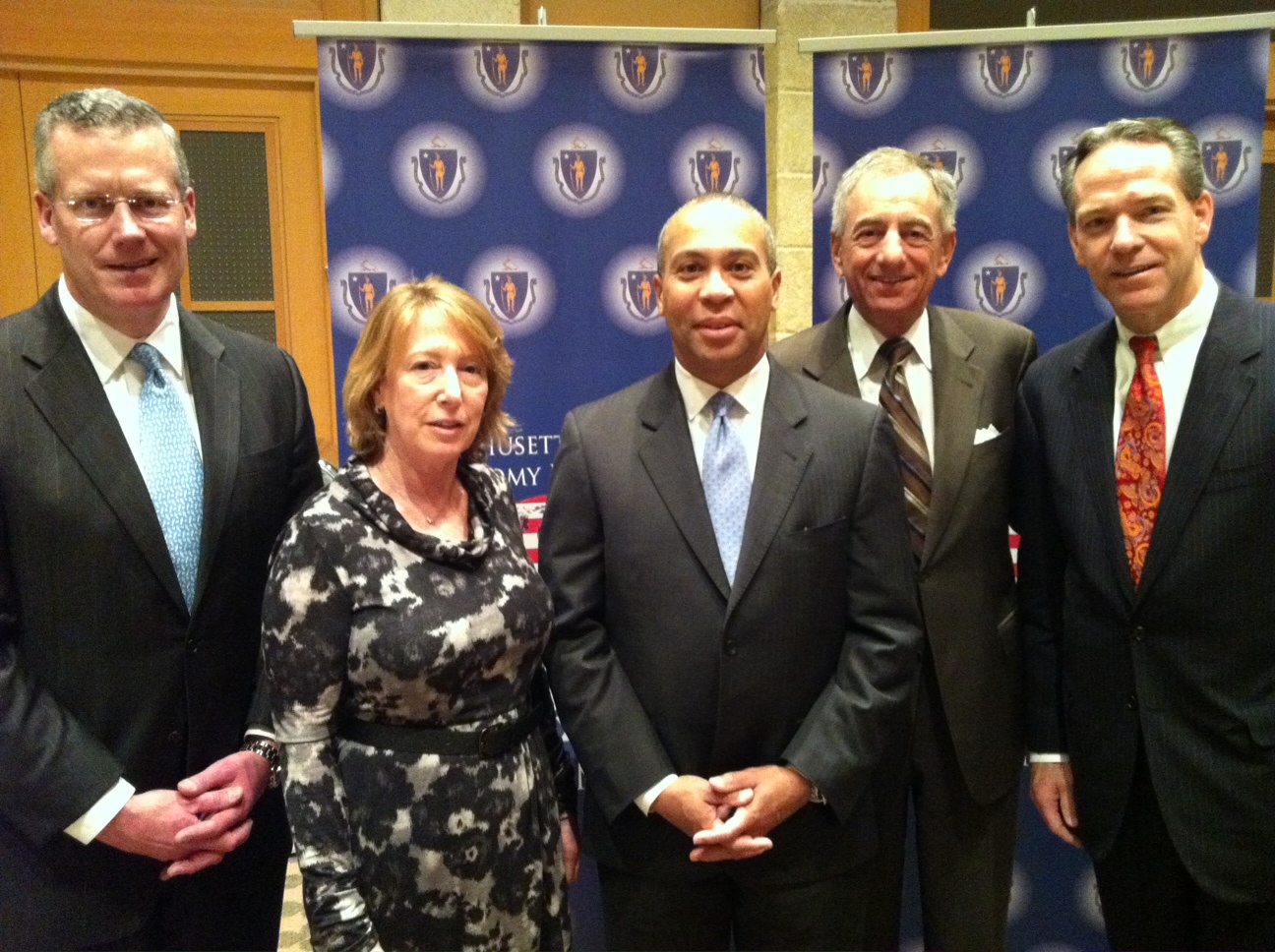
Governor with NAIOP CEO David Begelfer, and NAIOP members John Fish, Tom O'Brien & Helene Solomon

    David Begelfer with cabinet Secretaries Greg Bialecki & Rick Sullivan