Breaking Ground in Back Bay

The following blog post was submitted by Sheridan Wachtel, Marketing Assistant at Solomon McCown.

On May 31, experts from all sides of the real estate industry joined us at the Sheraton Hotel to discuss one of Boston’s most iconic and sought-after neighborhoods, the Back Bay. The program, “Breaking Ground in Back Bay,” discussed the future opportunities for retail, residential, office and hotel in the neighborhood that has been the epicenter of the city for decades.

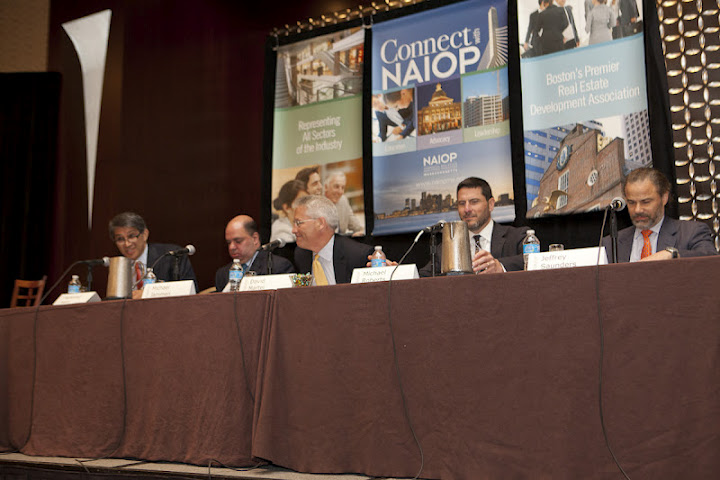
The panel included Peter Meade, Director of the Boston Redevelopment Authority; Michael Jammen, Principal, UrbanMeritage, LLC; David Martel, Executive Director of Cushman & Wakefield of Massachusetts, Inc.; Michael Roberts, Vice President Development of AvalonBay Communities, Inc.; Jeffrey Saunders, President of Saunders Hotel Group, LLC; and was moderated by Leggat McCall Properties LLC Executive Vice President, Mahmood Malihi.
Meade set the table for the discussion citing the pipeline of projects slated for the Back Bay including the redevelopment of the Christian Science Plaza, 888 Boylston, Chanel’s new retail store, and Copley Place residential building—which will be the tallest building in the Back Bay once completed.

Jammen, one of the architects of the Newbury Line Program, discussed the “red hot” retail scene in the Back Bay and more specifically, Newbury Street. “Constrained by being only eight blocks in length, retail real estate on Newbury street is seeing more demand than supply,” said Jammen in light of the fact that the street’s architecture isn’t traditionally window-display friendly. “It doesn’t have the windows like Rodeo Drive and other luxury retail streets of the world…but no one is going to build another Newbury street anytime soon,” said Jammen.

Having represented some of Boston’s most notable office spaces including The Hancock Tower, Martel discussed the increasing value of Back Bay’s office properties. “We have seen a quantum shift in office space demand in the Back Bay since 2008,” said Martel explaining how the coveted 24/7 lifestyle of the neighborhood is an increasingly important factor to office tenants to attract and retain talent—a factor that sets it apart from both contemporary urban areas like the Seaport and traditional office space properties like the Financial District and suburban areas.

With a growing desire to work in the Back Bay, residential real estate in the area has only increased in value. Roberts commented on the demographic shift that has made residential real estate in the Back Bay boom. “Young professionals landing a majority of newly created jobs, along with empty nesters wishing to return to city-livingare the key demographics in residential real estate in this area,” said Roberts.

And, according to Roberts, residents of the Back Bay aren’t planning to move out of the Back Bay anytime soon, citing residential properties in the neighborhood see half the turnover rate than all other neighborhoods in their portfolio.

Rounding out the panel was long-time hotelier Saunders, who discussed the resiliency of hotel occupancy in Boston’s Back Bay despite the influx of new hotels in Boston’s Seaport district. “Back Bay continues to be ground zero for people who want to visit the city,” said Saunders whose hotels operate at 90+ percent occupancy rate in the summer months and projecting 2012 to yield its highest occupancy rates in recent years.

With a full spectrum of real estate development projects underway and even more projected in 2013 and 2014, real estate in the Back Bay will continue to be hot commodity and a place where residents, tenants, tourists and developers want to be.

Watch a video of the panelists, or view photos from the event.

Getting Real in Affordable Housing

The following blog post was submitted by Anne Baker, Account Executive at Solomon McCown.


It’s all about perception versus reality.

That was the takeaway message from NAIOP’s Affordable Housing: Challenges and Initiatives panel on May 23.  The panel included Howard Cohen, Chief Executive Officer at Beacon Communities; Lawrence Curtis, President at WinnDevelopment; Tony Fracasso, Senior Vice President at MassDevelopment; Bart Mitchell, President & CEO at The Community Builders, Inc.; Jeanne Pinado, Chief Executive Officer at Madison Park Development Corporation; and was moderated by Solomon McCown CEO Helene Solomon.

The meeting was kicked off by Aaron Gornstein, the newly appointed undersecretary for the Department of Housing and Community Development (DHCD).   Gornstein outlined his plans for DHCD, emphasizing that the agency is planning ahead for growth in the state.  Streamlining the permitting process, giving support to promising communities, marketing the opportunities available to developers and building needed infrastructure are all essential elements of Gornstein’s affordable housing plans.

But while some may only see affordable housing as a social issue, Gornstein was clear that the high cost of living in Massachusetts has serious long-term ramifications for whether businesses decide to locate here and that the construction of affordable housing creates needed jobs.

False perceptions were also a constant theme throughout the panel discussion. The public is not aware that family homelessness is a relatively recent problem and that it’s easily solved through the construction of affordable housing, Pinado said.  Mitchell and Fracasso both emphasized the creative financing options that are available to affordable housing developers who are looking for them.

Curtis argued passionately that while the construction of affordable housing is important, it alone can solve the housing gap in Massachusetts; we must work together for the preservation of existing low-income and affordable housing.  Cohen also noted that while many upscale communities fight affordable housing developments out of a fear for negative impacts on their school systems, there is little evidence to suggest that is reality. It’s all about overcoming how local communities often approach affordable housing and making the case that inclusion will benefit us all.

View video of Affordable Housing panelists.

NAIOP Bus Tour: 10 Facts Learned on the Trial Run

The following blog post was submitted by Duncan Gratton, Senior Managing Director, Principal at Cassidy Turley FHO.

This year marks the 10th Anniversary of NAIOP’s Bus Tour, and as the Vice President of the Bus Tour Committee, I had a hand in planning and designing it. The 2012 Bus Tour, What’s Big and Breaking in Greater Boston, is a fast-paced live market update on some of the most dynamic markets in the area, including Boston’s Seaport, Fenway, Longwood and Cambridge.

The actual date of the Bus Tour is May 2, but this week – along with Bus Tour Captains and NAIOP staff – I went on a dry run of the route. We saw a lot of projects breaking ground and learned several interesting facts from the knowledgeable Bus Tour Captains! Here are the ten I found most interesting:

  1. The largest private construction project in the US is located at Fan Pier. The Vertex buildings are 1,100,000 SF and $900,000,000!
  2. Three of the largest academic/medical clusters in the US are located in Boston. They are:MGH/Partners

    Longwood Medical/Harvard

    Boston Medical Center/Boston University

  3. Kendall Square in Cambridge was supposed to be the original site of NASA. After JFK was assassinated, Lyndon Johnson became President and being from Texas, he chose Houston as the new location.
  4. Boston University is one of the largest landlords in Back Bay/Fenway. They control over 1,000,000 SF of commercial and non-academic real estate.
  5. There are three new life science buildings under construction in Kendall Square (Pfizer, Novartis and Broad Institute) and two new office buildings (Biogen Idec). All are 100% leased.
  6. Rents in Kendall Square and the Seaport District have jumped over 10% in the last 12 months.
  7. New apartment construction is booming – at least six new projects are underway or about to start in Boston!
  8. New Balance has announced plans for four new buildings at Brighton Landing, including a new 250,000 SF world headquarters building. In addition, they are planning a 345,000 SF sports facility that will include a hockey rink and track.
  9. Harvard is constructing an ‘Innovation Lab’ in the former WGBH buildings on Western Avenue in Allston.
  10. Boston University has announced that construction will commence this summer on a new lacrosse stadium on Babcock Street, thanks in part to a $3,000,000 donation from New Balance.

I hope you will join us on May 2 to learn more about What’s Big and Breaking in Greater Boston. Get a sneak peek of what’s in store.

The Future of Multifamily

This blog post was submitted by Allyson Quinby, Account Executive at Solomon McCown & Company.

On Wednesday, April 4, industry experts gathered at Boston’s Seaport Hotel to discuss the future of Boston’s apartment market at NAIOP’s Future of Multifamily breakfast program. The panel featured experts in the industry including, Raymond Torto, Chief Global Economist at CBRE; Kent Larson, Principal Research Scientist at MIT Media Lab; Julie Smith, President of The Bozzuto Group; Simon Butler, Executive Vice President at CBRE New England; and James Gray, Principal at ADD Inc,  as moderator. View panelist video.

Torto kicked off the panel and set the table for the discussion by explaining that from 2007 to 2012, there was an influx of graduating students in Boston. That, compounded with the fact that more individuals chose renting over homeownership skyrocketed Boston to the 7th largest multifamily market in the country—and counting.

Butler expanded on the supply side of the multifamily trend. According to Butler, Greater Boston’s supply of multifamily housing will continue to increase over the next three years.  Currently, there are only a handful of residential construction projects underway in Boston and Cambridge metro areas. However, by 2014 these projects will be completed and almost double that number will be in the pipeline.

Smith addressed the demographic of individuals influencing the multifamily boom. Similar to Baltimore, New York and DC, Boston’s market is made up of single people, divorcees, and those in the 25-40 age group moving into the urban area and opting to rent over buying. Additionally, there is a demographic of individuals between the ages of 50 and 60—frequently empty-nesters—who are moving into luxury apartments. While varying in age, these demographics both expect hotel-like lobbies, energy-efficient appliances, common spaces and fitness centers all within a 30-minute commute to work.

Larson rounded out the panel by wowing the audience with his answer to the growing demand for personalized, high-quality and affordable units. Through the use of robotic walls, smaller apartments can now have multiple functions turning a full dining room into a bedroom with a touch of a button. MIT is providing the technology for these transformable environments that meet the popular need for spaces that can serve as the home and the workplace.

The factors that sustain the multifamily boom are just as interesting as the factors that led to this real estate trend. Rooted in job growth and urbanization, and perpetuated by the growing number of individuals opting to rent over homeownership, the emerging multifamily trend requires architects, developers and marketers to develop new strategies for building and filling these units.

What the Future Holds for Cambridge, MA – The Innovation Capital of the World

This blog post was submitted by Allyson Quinby, Account Executive at Solomon McCown & Company.

NAIOP Massachusetts’ “Cambridge: Ready, Set, Go!” breakfast event on February 15 featured a well-versed panel of real estate executives who spoke on “What’s new and what’s next for this hot market.”  Mary Lentz, McCall & Almy, moderated the expert panel that included Tom Andrews, Alexandria Real Estate Equities; Michael Cantalupa, Boston Properties; Shawn Hurley, Skanska USA Commercial Development; Steven Marsh, MIT Investment Management Company; and Thomas O’Brien, The HYM Investment Group.

View photos and event presentation slides.

Marsh noted how the world is changing every day, and that the U.S. along with many other superpowers such as China and India, continues to look for new ways to compete. For example, the U.S. aggressively leads the way when it comes to innovation, and as Marsh discussed, Cambridge has long been the epicenter of innovation productivity.

Due to Vertex’s move to Boston’s Seaport district, many in the real estate industry worry that the Cambridge market no longer holds the same stature it once did. However, NAIOP’s expert panelists assured us that we are in a natural state in Cambridge, and as stated by Cantalupa, “If you can afford to be next to MIT, you will be.” The lab market is steady, and many developers like Skanska USA Commercial Development are currently taking time to re-evaluate outdated space to create real estate opportunities that will fit all types of tenant needs in the future.

Home to two of the finest institutions of higher education in the world, Harvard and MIT, the panelists argued that Cambridge has gained and will maintain a prominent reputation. Companies in the life-sciences, technology, bio-pharmacology, education and innovation sectors, along with many startups, have found their homes in Cambridge. Due to the competitive advantage that comes with a Cambridge address, real estate firms have experienced a tremendous amount of success leasing space in this market. As the panelists noted, there is still an active demand and we continue to see new development activity in this market today.

Marsh and Andrews also spoke about the importance of proximity for lab space to MIT and other academic buildings. It is crucial that all facilities continue to collaborate, creating an environment that fosters innovation. Hurley also noted how mixed-use space needs to continue to be developed; it is important that we connect lab to retail and public spaces.

O’Brien discussed the next generation workforce and the need to build corporate and residential spaces that attract young professionals. His firm is developing the NorthPoint neighborhood, a mixed-use campus with flexibility – one that allows people to live and work in the same place.

Cantalupa and Hurley spoke on how real estate developers need to build flexible buildings that can adjust to market demands. Hurley noted how Skanska’s plan behind 150 Second Street was to deliver a Class-A, highly flexible property with a sustainable design that had features all tenants could enjoy. The building was also designed to accommodate either one or multiple tenants.

As stated by Marsh (and I agree), “Cambridge is special – it goes well beyond real estate” – and it is here that we want to continue the innovation story.

Note from NAIOP: Learn more about the dynamic Cambridge market by attending our 10th Anniversary Bus Tour, Big & Breaking in Greater Boston. Cambridge, along with Fenway, Longwood, Boston’s Seaport and Allston will be featured during this fast-paced and informative live market update bus tour.

The Uptick in Tech – part one

This blog post was submitted by Ben Breslau, Managing Director, Americas Research at Jones Lang LaSalle.

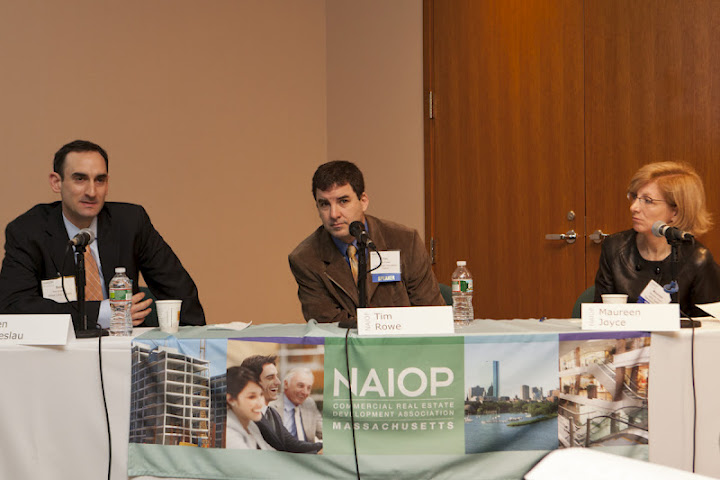
Last week I spoke at a NAIOP event titled Boston: Hub of the Future? Technology’s Impact on Commercial Real Estate.  I was joined by Maureen Joyce, AEW and Tim Rowe, Cambridge Innovation Center (see event photos). The focus on technology and real estate is not a new one. In fact, parts of the topic are very reminiscent of the technology boom of the late 1990’s. There are some clear differences too. My talk focused on three primary ways that I see technology impacting the commercial real estate landscape.

The first is through space demand. Tech companies are the fastest growing members of the office tenant base as we analyze demand across the country. As a result, the top tech markets like Silicon Valley, San Francisco, Boston, Austin, and Seattle are among those leading the office recovery.

It’s the tech submarkets within those metros that are really hot. Rental rates last year grew 25% in Palo Alto, 35% in south of San Fran, and 20% right here in Cambridge. The tech services sector and specifically mobile, social media, search, cloud, and gaming that are the most active. They are recruiting young creative tech talent, and have to be in the urban tech hot spots with “creative” space to find and keep them.

The second way technology is impacting real estate is through our business. I see it plainly in my research world, where real time interactive digital content is rapidly replacing traditional quarterly PDF reports. Blogs like this one are the norm. Social media and mobile apps are changing how we connect with and engage clients, prospects, and our own people. There are many other examples, but one thing for sure is that as more millennials enter our industry, technology will play a bigger and bigger role in how we work. View event presentation.

What Made CC&F an Incubator For So Many Development Companies?

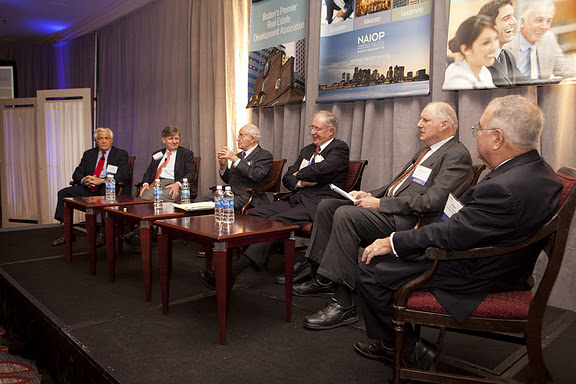
At NAIOP’s recent program, Get Inspired with Gerald Blakeley and the Icons of Boston Real Estate, panelists and CC& F alumni discussed the culture at Cabot, Cabot & Forbes and why it resulted in launching the careers of so many of today’s local and national icons of commercial real estate.
View the video highlights.

Many younger real estate professionals may not realize that CC&F was the national pioneer of over 20 million SF of suburban master planned business parks.  During the program, Gerry Blakely, CC&F’s former CEO, described his start leading the company.  Back then, the land use for industrial properties was either building footprint or paved parking.  Very different from today, there were virtually no setbacks, landscaping, or design covenants.  CC&F’s new model was a commercial business park that established development restrictions and dimensional requirements more strict than the underlying zoning.  Although few banks wanted to risk lending for such a radical and risky venture, CC&F was able to get started and soon proved the profitability of this new concept. In 1948, CC&F opened The New England Industrial Center – the country’s first master-planned business park.  With the preservation of natural site amenities and consistent design standards, this facility quickly became a prototype for business parks that has been emulated worldwide.

CC&F was also responsible for creating millions of square feet of first-class office space across the country.  Their Boston landmark properties include 60 State Street, One Boston Place, 100 Summer Street, and 28 State Street.

As Bill McCall, President of McCall & Almy, pointed out, the people that Gerry attracted to the company were the brightest around who all shared a strong drive to succeed.  These were entrepreneurs taking charge of their own particular divisions within CC&F, whether it was for the industrial, office, or national build-to-suit markets.

The obvious risk was that they were hiring the kind of personalities that would ultimately want to do this work on their own behalf.   Although that proved true for many of the alumni, the company benefitted from that intense, productive energy.

The list of CC&F graduates is impressive and includes: Don Chiofaro, President, The Chiofaro Companies; Ferdinand “Moose” Colloredo-Mansfeld, Senior Advisor, Cabot Properties, Inc.; Terry Considine, CEO, AIMCO; Arturo Gutierrez, Chairman, The Gutierrez Company; Mort Zuckerman, Chairman; and Ed Linde, former CEO, Boston Properties.

The legacy of Blakeley and CC&F lives on with so many of the alumni actively involved as leaders in our industry.  At the conclusion of our program, NAIOP presented the chapter’s first ever Lifetime Achievement Award to Gerry Blakeley for his contribution to the industry and his impact on Greater Boston.

Hank Spaulding in Memoriam

The real estate industry lost an icon with the passing of Hank Spaulding this past week.  Even that statement does not do justice to the impact this man had on our region and our industry.

He was one of the many influential alumni from the master real estate development firm, Cabot, Cabot & Forbes that included Gerald Blakeley, Mort Zuckerman, Ed Linde, Moose Mansfeld, Don Chiofaro, Terry Considine, Arturo Gutierrez, and others. (NAIOP will be honoring Gerry Blakely and CC&F’s “offspring” at NAIOP’s Annual Meeting on Thursday, December 15.) He then went on to co-found Spaulding & Slye, one of the most prolific full service real estate companies.

His influence on the cityscape of this area was already established by then, but his influence around the world was set into motion with his establishment of the MIT Center for Real Estate that opened in 1984. Hank knew that our business was becoming more complex and required a broader understanding of the numerous components that went into creating housing and commercial spaces. What it needed was a graduate program designed to train real estate developers. The school has been a tremendous success educating real estate professionals from around the world.

Hank Spaulding gained the respect of everyone he ever dealt with through his generosity and wisdom. He will be missed by all of us who knew him.

Place Your Bets on Opening Dates for Massachusetts Casinos

With Governor Patrick signing the first ever, full-scale casino bill, the race is on to develop three resort casinos and one slot parlor.

However, this will be more like a steeple chase race with many obstacles to overcome.  There are the procedural steps of choosing a chairman and members of the yet to be formed gaming commission, and developing the regulations and processes for applicants.  Each potential developer will have to gain control of a potential site, obtain all local approvals, commit and fund the off-site infrastructure improvements, and show financial wherewithal to complete the development plans.  Then there are the public “threats” that already include one local developer’s lawsuit challenging the fairness of the law, the possibility of a ballot initiative to overturn the statute, and the likely local appeals from abutters and other citizen suits.

Welcome to the world of the real estate developer.  There are reasons why Massachusetts projects take longer to permit and build.

That being said, there are highly motivated, well-funded, and patient corporations that have already lined up and others that will be announcing their interest over the next few weeks. Let the games begin!

To learn more about this process and the players, don’t miss NAIOP’s January 19th breakfast program, Casino Gambling Coming to the Commonwealth, at the Westin Waterfront Hotel.

Seaport, the hottest neighborhood in Boston – Part Two

In yesterday’s post I looked at the history of Boston’s Seaport Area and the new Innovation District, with insights from last week’s “Windows on the Waterfront” program. Today I finish up with a closer look at residential and retail activity, Liberty Wharf, and what to expect next as projects make the move from drawing board to construction site.

The Silver Line helped Boston's Seaport become a viable destination to work, shop, play, and live.

Interest in residential use dates back to artists’ lofts in Fort Point Channel, which  eventually led to Beacon Partners’ development of Channel Center with over 200 new condominiums.   Then came the award-winning FP3 residences and restaurants developed by Berkeley Investments.

It was Liberty Wharf, though, that brought a whole new group of visitors to the Seaport with its 70,000 sq. ft. office and retail development that includes Legal Harborside, Del Frisco’s, Temazcal Tequila Cantina, and Jerry Remy’s Sports Bar & Grille. Two-hour waits and a vibrant neighborhood buzzing with excitement are the result. Ed Nardi, working with Massport and the Jimmy’s Restaurant family was able to produce a concept that not only satisfied stakeholders, but far surpassed their expectations.  Hot off this success, Cresset recently committed to purchasing another property in the area for redevelopment.

In an excellent overview of the neighborhood’s history and future promise, architect David Manfredi gave the NAIOP audience a summary of the last 10 years of development in the area:

  • Work:    2.3 million square feet of new office space
  • Live:       750+ new residences
  • Play:      +4.7 acres of new public park and the extended Harborwalk
  • Visit:      1,639 guest rooms
  • Learn:   ICA & BCEC
  • Dine:     40 restaurants, cafes, food venues
  • Shop:    Louis

What’s coming next?

  • 1,160,000 square feet of innovation space
  • 1,500+ residences
  • BCEC expansion
  • More restaurants, cafes, food venues
  • 360,000+ square feet retail

New apartments are arriving with John Drew and HYM Development at Waterside Place, Steve Karp with Hanover Company at Pier 4, and John Hynes at Seaport Square. Innovation centers for start-up companies will be built by Drew and Hynes. And retail is finally on the drawing board for Waterside Place and a major joint venture with W/S Development at Seaport Square.  Who will get the first supermarket?  Both companies report they are currently in talks with grocery chains.

The hotel question still lingers.  With the Waterfront Renaissance Hotel in foreclosure, it is clear the market is not ready for a new hotel right now.  Some feel the elephant in the room is the BCEC expansion and that new hotel(s) will be dependent on the deal cut with the convention center.

As for the office market, as Charles Reid from Boston Global Investors indicated, there are a lot of parking lots right now and it will take some time before the Financial District feels the pinch as the Seaport lots get transformed into new development.  Other than build-to-suits (e.g. Vertex), spec development is highly unlikely in the near future.  However, there are some large blocks of space coming up for renewal in downtown – it’s possible one of those businesses could decide to relocate to a new state-of-the-art building in the Innovation District.

The bottom line is that the Innovation District has come a long way from the days when Anthony’s, Jimmy’s, and the No Name were the only major draws to cross the Fort Point Channel.  And while it may be a long way from its final build-out, there is no doubt this hot new neighborhood is here to stay.