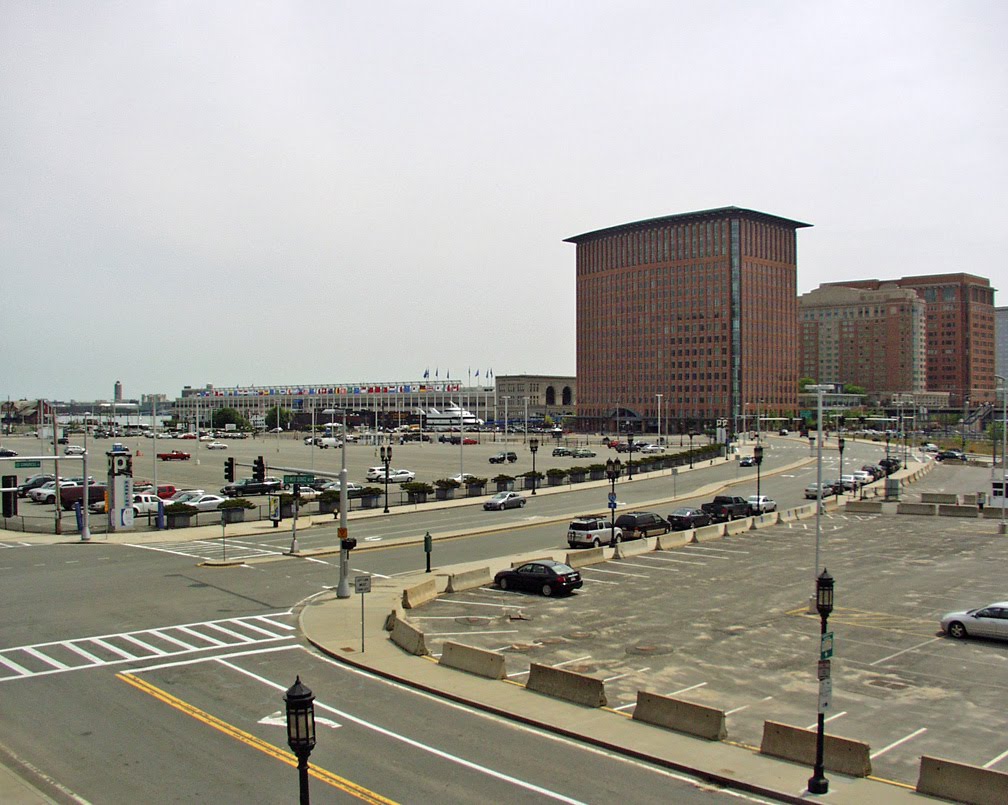
Air Rights Over the Mass Turnpike

Could this be the right time to finally heal the remaining gashes to the Boston cityscape caused 45 years ago by the construction of the Mass Turnpike?  I am optimistic that the answer is yes. The Boston Redevelopment Authority has reopened the process to review certain air rights project proposals. Although the focus is on the sites at the corner of Boylston Street and Massachusetts Avenue, there are also two other major development sites that could and should move forward: the Kenmore Square project proposed by John Rosenthal and the former Columbus Center project.

There are no redeeming features to having a highway canyon in the middle of one of the most historic and architecturally vibrant cities in the country.  The neighborhoods that were split by this chasm deserve better and the city certainly could use some new, exciting, revenue enhancing developments.

There is no question that residents should have input into the process.  However, the city needs to be a strong advocate for these complex and costly developments to become realities.  Set guidelines that offer sufficient density to allow these projects to work financially and give investors sufficient confidence that they will get through the approval process in a timely fashion.

It’s time to heal the traffic wound and create a thriving community.

NAIOP Submits Comments on Eastern Box Turtle Conservation Plan

Last fall, revisions were made to the MESA (Massachusetts Endangered Species Act) regulations affecting countless projects  in all regions of Massachusetts.  The changes, supported by NAIOP, extended the habitat mapping cycle by two years and  provided more flexibility with species of special concern (e.g. Box Turtle), as well as other important changes.

As a result of these changes, the Natural Heritage and Endangered Species Program (NHESP) recently issued a draft Conservation Plan for the Eastern Box Turtle.  The Eastern Box Turtle has long been a source of frustration for developers who encounter the species in Massachusetts.  Given its prevalence, NAIOP has strongly advocated for delisting the species.

While the Conservation Plan does not delist the species, it sets benchmarks which would allow regions to effectively delist the species once certain habitat thresholds are achieved.  The Draft Plan creates Conservation Protection Zones (CPZs) where projects  would be required to provide greater protection to the species and would require a more intensive permitting process through the Conservation and Management Permit (“CMP”).  Projects outside of the CPZs would have more flexibility.  A major improvement included in the Plan is the establishment of habitat banking as offsite mitigation.

Overall, NAIOP supports the concepts proposed in the Plan, but we believe changes are needed. Specifically, we urge the NHESP to:
•consider a reduction in the area of land protected within CPZs;
•allow property owners within CPZs to realize fair value for their property by allowing them to mitigate project impacts through offsite mitigation contributions;
•notify landowners, in advance, who own property within the CPZs allowing them an opportunity to provide input on the Conservation Plan.

NAIOP applauds the Division of Fisheries & Wildlife, the Department of Fish & Game and the NHESP for drafting the plan and proceeding in the right direction. NAIOP’s full comment letter  provides additional information on the concepts proposed in the plan and our thoughts on how it could be improved.  A final plan is expected this fall.

Workforce Housing, Not Zoning Bills, Key to Economic Growth

Earlier this week I testified before the Legislature’s Joint Committee on Municipalities & Regional Government on two “zoning reform” bills, the Land Use Partnership Act (LUPA) and the Comprehensive Land Use Reform Partnership Act (CLURPA).  Supporters of both bills claim that the legislation would encourage real estate development in Massachusetts.  Representatives from the real estate industry, however, disagree.  NAIOP believes that these bills contain many problematic elements which could hinder economic development at a time when it is needed most.

The bills make a number of changes to Chapter 40A; some would apply statewide and other changes would apply only in “opt-in” communities.  The legislation does have some positive aspects: zoning protections to special permits and site plan approvals, and limiting subdivision rules and regulations to subjects not already covered elsewhere by local ordinance or bylaw (e.g., stormwater management, off-site traffic impacts.)  However, other parts of the bill would reduce existing predictability and add financial risks for new business growth.

The most concerning aspect of the legislation would significantly alter the zoning freeze that exists under current subdivision law.  It would limit the zoning freeze to a specific proposed development plan, rather than just the land shown on a plan.  As a result, the freeze would be lost with any change in project use and/or density.  This would be a serious problem for commercial real estate developers who would be unable to respond to a changing market. 

Commercial projects require large initial investments in land, site work, and infrastructure for developments that are generally phased and take many years to complete. Without the protections of a subdivision zoning freeze that allows for flexibility in project uses as the markets change, financing would be very difficult to achieve and fewer projects would move forward. 

To truly encourage economic growth, the focus should instead be on creating workforce housing.  While housing costs have dropped recently, a lack of single family, smaller scale, higher density homes fuels the exodus of 23-40 year olds – a key population demographic for economic growth.  This is an issue of great concern to business leaders who struggle to attract the best talent when competing with other states that provide such housing opportunities.

If the Legislature is intent on addressing the Commonwealth’s competitiveness and its housing, it needs to take a different approach.  We urge the Legislature to work with the Patrick Administration, municipalities, and the business community to create a new program establishing zoning districts that permit the construction of a modest number of affordable, small, single-family homes.  The future of our workforce depends on it.

If You Zone It, They Could Come

In order to spur new development in a place not widely known for its commercial activity, the City Council of Leominster is considering rezoning sections of the city.  The goal is to add flexibility to its land use controls in order to attract new businesses into Leominster while encouraging existing companies to expand.

This is not the first local government to realize that growing its tax base starts with rethinking how it zones and permits development.  Two other recent examples illustrate the importance of this self-appraisal process.

For many years, the town of Westwood had an anti-development reputation.  While virtually all of the land along the 128 Technology Highway bustled with new development activity, countless properties along University Ave in Westwood sat vacant or underutilized. This area, starting at the commuter rail station and continuing throughout a large industrial park – with direct access to the highway, was frozen in the 1960’s.

Recognizing that the town had to make significant changes to attract economic development, Westwood officials invited businesses, developers, consultants, and site selectors to tell them what changes were needed.  As a result of this process, the town’s economic development committee went to Town Meeting and changed Westwood’s zoning by-laws.  Soon after, a massive area of the park was purchased and one of the region’s largest mixed use developments was approved.  Unfortunately, the Grand Recession put the project on hold for the time being.  However, there is no doubt this will be one of the first projects to move forward once the recovery is in full swing.

The other municipality to undertake this self-critique was Lexington.  Its Board of Selectmen started a visioning process that brought in a wide range of experts to see what it would take to encourage further economic development in a town with limited growth areas.  As a result of the town’s new commitment to attracting businesses, Lexington passed a remarkable “up-zoning” at Town Meeting, which more than doubled the commercial density in the Hartwell Avenue area, allowing for a potential 2.9 million square feet of development.

With municipal budgets being slashed, more communities are realizing that they need to compete for new business growth, but they are ill prepared to attract development due to archaic zoning and permitting regulations.  While towns may not be able to guarantee new growth if they follow Lexington and Westwood, if they do not bring predictability, timeliness, and clarity to their permitting, most businesses will be looking elsewhere.

Yes, In Your Back Yard

Paul McMorrow’s recent op ed in The Boston Globe discussed the impacts of the recent decision issued by the Massachusetts Supreme Judicial Court on a zoning dispute in Chatham (Kenner v. Zoning Board of Appeals of Chatham).  This case brought to light an issue developers in Massachusetts have known for years – a few dissatisfied residents have the power to stall development projects in the court system for years, many times without proper standing.

In most cases, the project opponents have not sustained actual harm (the primary qualification for challenging a local zoning decision), but they still have the ability to slow and potentially kill a new development.  At least, that is, until now.    

With its decision in this case, the SJC raised the bar for NIMBY (Not In My Back Yard) lawsuits.  The typical NIMBY suit is based on the litigant’s perception that a proposed development will impact them.  With this ruling, the SJC clearly stated that for a suit to move forward there must be true and measurable harm to the aggrieved party.

The SJC gave more authority to the Land Court to make decisions regarding the proper standing of a party to bring a law suit in opposition to a project.  In so doing, they basically took away the ability of the state appeals court to question the Land Court’s judgment on standing.

This decision is not going do away with all project appeals, nor will it screen out all frivolous appeals.  However, this is one of the clearest messages we have seen in years from the courts.  It recognizes that it is unfair to allow a local minority to use litigation for the sole purpose of preventing approval of development projects that were fully vetted through a legitimate public permitting process.  NAIOP applauds the decision!

Without “Bricks,” Boston’s Greenway Needs Vision

With the YMCA’s decision to pull the plug on their Boston Greenway site, the dream of non-profit institutional involvement to activate this vast swath of open space finally comes to an end. It all sounded quite optimistic a few years ago, but reality dashed those early hopes.  Although the groups that sought these sites were quite different, they all failed for some similar reasons – some within their control, but others well outside their influence. 

Most of the proponents developed their concepts at a very different time – a bull market economy.  There was a sense that endless funding would be readily available from “flush” donors. Therefore, the plans were grand and the prospects of success seemingly assured.  But even without the financial crash, there were far too many institutional capital campaigns already in the works (universities, hospitals, and cultural/arts) to allow these new projects any realistic hope of being funded, no matter how strong Greater Boston’s philanthropic community. The recession killed off all but those campaigns that were in their last phases (e.g. MFA.), leaving the Greenway projects out in the cold.

Another problem was that the state basically ran out of money on the Big Dig.  That meant that some aspects of the project suffered.  In particular, the ramps now stand out as an orphan in search of a benefactor.  The costs to cover the ramps and fully deliver a seamless parkland were too expensive for the Turnpike, so the costs were transferred to eager non-profits who were looking for downtown sites.  Unfortunately, these groups had no idea as to the ultimate premiums they would be forced to absorb.  At one point, the Turnpike actually hoped they might even be paid for the rights to develop these “challenged” sites. Now the state has to accept that these open sores will most likely remain for the foreseeable future.

Finally, we are all left with a serious problem.  Open space is simply not sufficient to attract the public to activate this long stretch of parkland.  On any given day during the summer, it is rare to see the area stretching from China Town to the Zakim Bridge used anywhere close to the extent of other city parks.  

We may not be able to attract institutional interest to the Greenway any time soon, but we must to work to find a way to make this civic space as usable and attractive as our Emerald Necklace.  Readers – what do you suggest?

Parking in the Seaport: Here today, gone tomorrow.

Interesting Op-ed piece in the Boston Globe October 23rd by Paul McMorrow talking about the changing requirements for parking in Boston, more specifically in the Seaport District.  Basically, Paul is saying the BRA is moving more to a concept of a maximum allotment for parking for new developments rather than a minimum.  This is supposedly due to the changing commuting dynamics with employees living closer to work (and, therefore, not as dependent on the automobile.)

Parking in the Seaport

More interesting is that as the Seaport is developed, using primarily Joe Fallon’s and John Hynes’ surface parking sites, there will be less and less space available for the drivers currently using these lots.  And who are these people and where do they work?  Well, if you look over to the Financial District what you will see is a densely built office environment without much parking.  There is a parking freeze in that district which the city insists is working very well – a model for the Seaport parking freeze, as a matter of fact.

The problem is that the freeze works in the Financial District because of the availability of so much low cost parking in the Seaport.  So, when that inventory of “cheap” long term parking disappears, the businesses in the Financial District will have a problem on their hands as their employees jockey for the remaining handful of parking spots. That is, unless there is a massive investment in mass transit over the decade.  I leave you to contemplate the chances of that! (Leave your prognostications in a comment, below)

Filenes Site in Downtown Crossing: “Let’s Get Real”

In a recent Boston Globe OpEd, Paul McMorrow supports the proposal suggested earlier in the year by the developers Vornado and Gale to phase in the redevelopment of the Filenes site in Downtown Crossing.

Their concept was to construct not just the garage and the retail space as originally proposed, but also the foundations necessary to accommodate the future development of the towers. What a great idea!  Not only does this resolve the city’s frustration with the open “hole”, but it gives a shot in the arm for the retail activity in the area.

An earlier rendering of the site

An artists rendering of the site

It is easy to throw verbal rocks at the developer for their failure to honor commitments made before the downturn to move forward with this project. But let’s get real. This is the worst national recession since the Great Depression.  You can look around the whole country and I will challenge you to find a single major speculative office building starting construction.

The city of Boston will be a big winner with this alternative approach. They get the project started, new jobs are created, retail gets a boost, and much needed tax revenues will be maximized once the second phase gets built.

Let’s encourage the start of phase one of this project and allow the market to recover before we make an unreasonable demand to the owners to make a failed investment ahead of its time.

No Turkeys Here

Banker & Tradesman’s “Turkey Hunt” column (September 20) unfairly took aim at some of the city’s most innovative real estate projects. The premise was that too many development projects have languished over the years because of “do-nothing” developers whose approvals should be “terminated” by the city to allow other developers a chance to build in Boston.

I think we need to set the record straight about permitting and developing in Boston.

First, permitting is a lengthy process for major projects – from land acquisition, feasibility studies, and discussions with the BRA, to endless meetings with neighborhood groups, and renegotiating the design proposal… all before the formal permitting process can begin. Then there is the city’s Article 80 process and the state’s permitting and MEPA review. 

Many years of negotiation and planning are required before a developer can get to a final approval. Because the process takes so long, a developer cannot know if there will be a market for their project when they finally get the necessary permits. That reality can cause serious delays. The recent credit crisis freezing projects all over the country for the past two years is proof of this. 

These are not “do-nothing” developers.  These investors want to move forward, but they can’t without financing and a ready and willing market.  No developer can avoid market realities.

The good news is that, as a result of the Permit Extension Act, many projects will now be able to maintain their permits so they will be “shovel-ready” when the market improves – avoiding another 5-7 years spent reapplying for permits and missing another market cycle.

As any good hunter knows, before you start hunting for turkeys you better know what you’re looking for.

Permit Me to Glow: The Permit Extension Act Will Help Massachusetts Grow

On August 5, Governor Deval Patrick signed into law an economic development bill (Chapter 240 of the Acts of 2010) that included the Permit Extension Act (Section 173 of the new law).  In response to the credit crisis and market crash of late 2008, NAIOP Massachusetts promoted the Permit Extension Act from the very first day of the legislative session in January 2009.

At that time, none of us could have imagined how or if the country would emerge from one of the worst downturns since the Great Depression.  What was clear was that it would be a long time before any of us would see any new construction from the private or institutional sectors. 

It seemed obvious that if this Commonwealth was to have “shovel-ready” projects set to move forward when the economy turns, those projects could not lose the many permits and licenses already issued by either the local or state authorities.  

It takes years to get a new project approved – starting with numerous local hearings and going through everything from zoning changes, to special permits, to wetlands permits, to traffic mitigation, to environmental reviews at the state MEPA office.  Compound this with numerous appeals, and then you miss your economic cycle! Allowing these permits and approvals to expire would have killed countless projects.

The Permit Extension Act:

  • Extends permits in effect at anytime between 8/15/08 – 8/15/10 for two years (including those that expired during this time).
  • Takes effect immediately for projects that had approvals in place for even a single day of the two year window.
  • Applies to a wide range of permits including wetlands, MEPA, building permits, waterways, and approvals under Chapter 21, 40A, 40R, 43D, as well as variances, and all local bylaws and ordinances. 
  • Goes into effect automatically and no approval is needed by the state or local permitting authority.

Continue reading