Konnichiwa from Tokyo – Low Vacancy Rates & New Development

TOKYO_2013

I came to Tokyo expecting to find an aging office stock with little new construction and extremely high vacancy rates. I am surprised to report that not only are there magnificently designed, new, mixed-use projects, especially in the Shiodome area, vacancies are at levels that would make us envious. It turns out that vacancy rates in the 7% range (including the older stock) are considered dangerously high. Historically, rates have been under 4% in the Tokyo prime markets, only rising in response to major global impacts like the “dot com bubble” or the recent recession started by the U.S. subprime mortgage crisis. Curiously, real rents have not grown that much. With vacancies like this in Boston, rents would be spiking. Clearly, it’s a different economy!

Where Did All the Parking Go?


The city-owned Winthrop Square Parking Garage, at 240 Devonshire Street, recently closed due to serious structural problems. Built in the 1960s, this Boston garage accommodated 550 cars at discounted rates from the much higher priced private facilities.

This now further exacerbates the commuter parking problem, already destabilized by the continuing loss of surface parking spaces due to the heated development activities in the Seaport area. Employers may soon start to hear the complaints, as workers begin to personally absorb these increased costs.

The “dirty secret” is that the only reason the Financial District’s parking freeze has worked for so long was that there was a large surplus of low-cost parking nearby.  The same goes for the Seaport’s parking freeze.  As more buildings eat up the surface lots, fewer spaces will remain – as demand increases substantially.

Commercial parking freezes are an ineffective means of providing cleaner air, especially when they are targeted exclusively at a particular municipality.  An unintentional result of a parking freeze is its negative effect on economic development, limiting the ability of new businesses to create jobs, existing businesses to expand, and leading, in many cases, to shifting growth to areas without such restrictions.

Maybe now is the time to rethink this outdated method of controlling auto emissions.


2013 Bus Tour Recap: The Suburban Transformation

The following blog post was submitted by David Fleming, Principal at PACE Communications Group, a marketing and PR firm that specializes in commercial real estate and retail.Elisif_20130501_0150

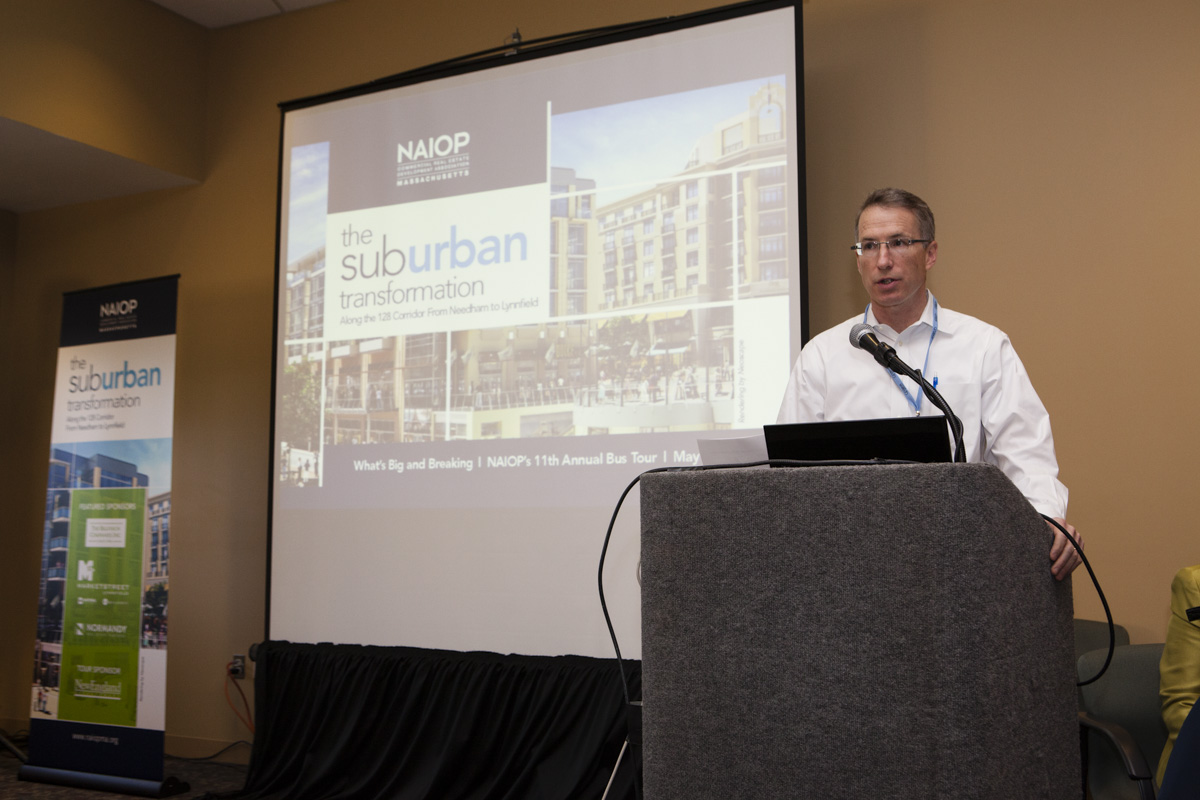
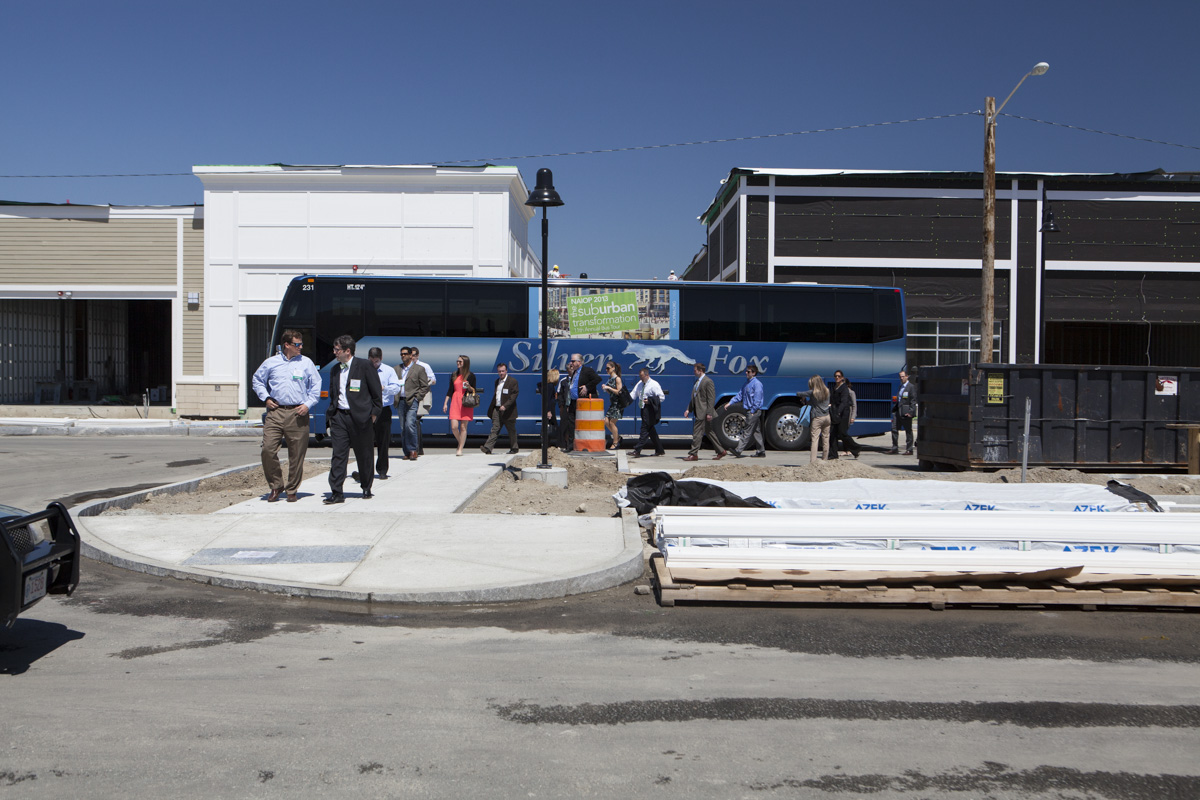
Three signs that spring has finally arrived in Boston: 1) green grass on the Esplanade, 2) the Red Sox back at Fenway Park, and 3) NAIOP MA’s Annual Bus Tour. The 11th edition of the tour took place on Wednesday as more than 250 people aboard five buses toured properties along what is suddenly one of the hottest stretches in commercial real estate in the region: the Route 128 Corridor from Needham to Lynnfield. Here’s a summary:

Elisif_20130501_0115Kickoff at Needham Crossing

  • Needham’s Economic Development Director Devra Bailin, discussed efforts to rebrand the former New England Business Center as Needham Crossing
  • Justin Krebs and Mark Roopenian described two of Normandy Real Estate Partners’ projects along the route:
    • Center 128, which will redevelop Needham’s former New England Business Center into an 825,000-square-foot “super-park,” including a Marriott Residence Inn Hotel
    • Station at Riverside, which will transform MBTA’s Riverside Station into a mixed-use development featuring 295 apartments, a 10-story 225,000 square foot office building, and a 20,000 square foot retail village
    • Mike Wilcox of The Bulfinch Companies discussed development at Needham Crossing and the branding and leasing efforts at Atrium Center. Wilcox concluded with an exciting Atrium Center video that you can see here.
    • In his market overview, Jeremy Grossman of CBRE/Grossman Retail Advisors noted the “flight to quality” among retailers, New Urbanism, the continued expansion of restaurants, the intensifying battle among grocers, and the strengthening of regional markets such as Chestnut Hill, Lynnfield, and Northborough as key trends

Elisif_20130501_0215Bus Tour Highlights

Six tour buses, escorted by members of the MA State Police, traveled along Route 128 beginning in the Needham/Newton area and ending in Lynnfield. Here are a few highlights:


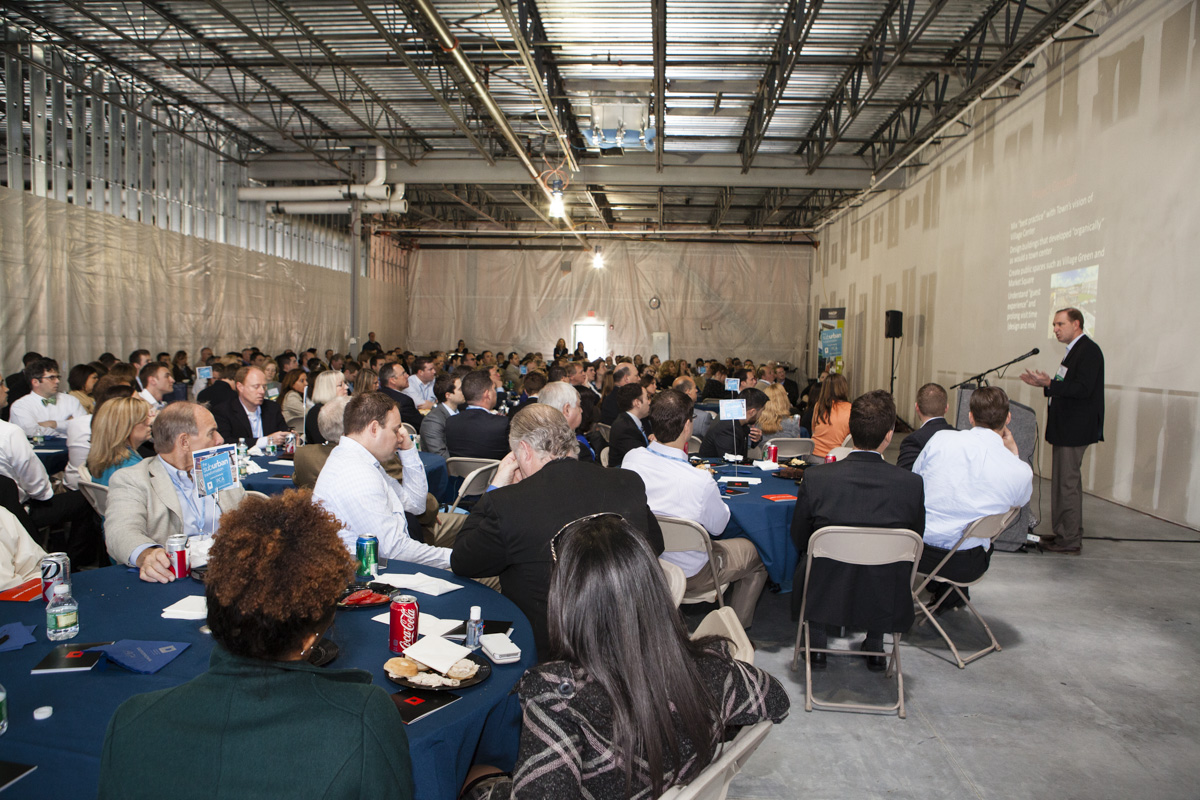
Elisif_20130501_0268Lunch and Learn at MarketStreet Lynnfield

The tour stopped in Lynnfield for lunch at MarketStreet Lynnfield, a 680,000 square foot mixed-use development currently under construction. Inside a space that will become a Shoe Market store, WS Development’s Tom DeSimone and National Development’s Ted Tye shared details of the joint venture scheduled to open in August 2013.

When complete, MarketStreet Lynnfield will include 395,000 square feet of shops and restaurants, 80,000 square feet of office space, 180 residential apartments known as Arborpoint at MarketStreet, and the 9-hole King Rail Reserve golf course.

Elisif_20130501_0282Voices on Tour

I caught up with a few people on tour. Here’s what they had to say:

  • Tom DeSimone, partner, WS Development: “There’s no better way to understand real estate than to actually be there. The NAIOP Bus Tour gets you closer to the real estate by providing an introduction. Then you can go back and look at whatever may have peaked your interest.”
  • Ted Tye, managing partner, National Development: “It’s great to people out here having a nice day, getting out from behind their desks, and seeing some projects that are being built. And, it’s incredible that in 2013 that we actually have things being built.”
  • David Chilinski, co-founder and president, PCA: “The best part of the NAIOP Bus Tour is that you really get a sense of what’s happening and, importantly, what’s new in the marketplace.  We all know the tried and true properties, but the tour lets you see new projects as well as cases where people are reinventing or adding to projects. That’s the importance of this tour.”
  • Sarah Walker Weatherbee, managing director, Keller Augusta: “You get a sense of history as well as what the future holds for the Boston-area markets like the ones we saw today. And, the networking that the Bus Tour enables is unique to NAIOP—that really makes the day exceptional.”


While here, please read David’s important post below about National Development’s Roseann Sdoia, who was seriously injured in the Boston Marathon bombings. David includes a link to
Roseann’s Recovery Fund for those who wish to donate toward expenses for Roseann’s treatment and recovery.

Hurricane Sandy’s Message for Boston

A recent Boston Globe Editorial, “After a near-miss with Sandy, more preparations are needed,” advocated for policy makers to focus on climate adaptation measures to protect Boston from future storms and flooding.  NAIOP wholeheartedly supports convening public and private interests to discuss short-term and long-term solutions that are practical and feasible.

An important first step would be to create incentives for building owners and developers that would make climate change planning part of their design process.  Focusing on carrots instead of sticks will be an important first step in changing the way some in the industry view this issue.  As an example, we should be encouraging, not penalizing, the relocation of utility spaces to upper floors.  This relatively simple step would have preserved many of the systems that were destroyed in New York and New Jersey.  However, current codes do not exempt these areas from the allowable building envelope, causing landlords to worry about losing rentable space to mechanical equipment.  A change should be made that would provide additional square footage for those developers that commit to doing this.

The Globe editorial suggested that restrictions be put on ground-floor uses in areas that will be prone to flooding.  However, as with the scenario above, it is critical that the impact of decreased rental income and increased construction costs be mitigated.   Furthermore, some of our current laws would prevent such a policy.  As an example, our Chapter 91 statute mandates the use of the first floor space for public access.

Yes, we need to find ways to efficiently prepare our coastal cities for the increased frequency of powerful storms, but we should also be ready to adjust our policies to incentivize the public and private sectors to make appropriate infrastructure and building redesigns, not penalize them with red tape and unnecessary costs.

Will We See More Development Over the Pike?

A recent editorial in The Boston Globe spoke about the successful conclusion of the permitting for Fenway Center, the $450 million mixed-use project over the Mass. Turnpike.   The gist of the piece was that developing air rights is no easy matter.  Besides the very high cost of developing over an eight lane highway, there are the inevitable lawsuits that can stretch an approval process out by 2-3 years.  The Fenway Center case was finally resolved in appeals court.

Columbus Center, another very worthwhile project involving air rights, was not so lucky.  While the financial crisis played a role in its demise, one of the real reasons that it did not move forward was due to the lengthy delays caused by well over 100 public meetings.  No one can deny the appropriateness of having community involvement, but there must be some limit on that process.  Are the city and neighborhood really better off with the scar of an urban highway canyon dividing the Back Bay and the South End than it would have been with a mixed-use project including affordable housing?

The Globe said that “These projects shouldn’t be the last along the Pike.”  However, predictability and transparency are necessary before any developer will be willing to risk capital on a speculative urban development involving air rights.  A few suggestions:

  1. Establish some clear guidelines for developers interested in responding to RFPs for future air rights parcels;
  2. Set a limit on the number of public hearings with the appropriate neighborhood groups within a limited time period;
  3. Allow the developer to opt in to the Permitting Session of the Land Court for any appeals;
  4. Require appellants to post a bond if they choose to appeal the decision of the court;
  5. Allow developers to count some portion of the cost of the infrastructure associated with the air rights project as part of their community betterment payments.

BIDS: Taxation Without Representation

The new “Jobs bill” recently passed by the Massachusetts House and Senate, and now awaiting the Governor’s signature, has a lot of “goodies” for economic development. However, there is a little surprise for businesses who are in, or might be in, a Business Improvement District (BID).

Currently, the BID law does not require every business in the district to contribute to the BID. However, with the new law, if 60% of the businesses in the district vote to form a BID, every business will be required to pay.

What this might mean is that existing BIDs (e.g. Downtown Crossing in Boston) and future proposed BIDs (e.g. Rose Fitzgerald Kennedy Greenway) will be able to force commercial landlords to pay into these districts.  If the city can convince/coerce 60% of the owners of a district to accept this, the others will have no say.  This can also lead to some interesting “Gerrymandering”, creating boundaries to capture large properties. Owners that may be further away from the core area will be obligated to new property tax surcharges to fund maintenance, security, and marketing initiatives for areas not necessarily benefiting these outlier properties.

That sounds like the situation with the current Downtown Crossing BID, and is part of the impetus behind this legislative action.  Some property owners further away from Washington Street, decided not to participate, to the consternation of the city.

What we may now see is new taxation for new services benefiting some, but paid for by many more.

Kids Are Not Toxic Waste

There have been many studies on the state of housing in the Commonwealth.  What is very clear from these, and the numerous opinion pieces on the subject, is that we have very high barriers to the development of housing in general, and affordable and family housing, in particular.  What is also apparent is that the economy cannot fully recover without the support of highly talented, college graduates that continue to leave the state.

Paul McMorrow wrote a column in The Boston Globe on April 24th that lays out the problem.  Massachusetts has not been able to keep up with the current housing demand.  This results in slower job creation and volatile housing prices.  As Paul points out, without sufficient supply, the recovery is going to result, once again, in an explosion in housing prices.  According to a report by the Donahue Institute at the University of Massachusetts, if the current pace of development is maintained, there will be a deficiency in our housing stock of 46,000 units.  We are already seeing this problem with an inadequate rental stock, driving rents to record highs.

The problem is rooted in several areas that include “home rule,” large lot requirements, lengthy permitting, frequent appeals, and an anti-children attitude.

  • The economic needs of the Commonwealth have been stymied by local regulations that continue to encourage large, expensive homes and discourage the production of more affordable “starter” housing.
  • With minimum lot requirements in many towns of 1-2 acres, it is very difficult to economically justify building smaller scaled homes.  (Few of these municipalities even offer cluster zoning.)
  • Permitting requirements have become more onerous with local rules and special by-laws making the development process longer and more unpredictable.
  • Even with local approvals, there are the frequent appeals that delay the start of a project by 1-2 years (sometimes effectively killing the project.)
  • Lastly, many housing proposals that would attract families with school age kids are denied at the local level.  The often heard justification is that adding any number of children to the system will break the back of the school budget.  Oddly, this argument occurs in communities that project future reductions in the school age population.  Frequently, it seems that communities would be more welcoming to an asphalt batching plant than to new children.

As Paul McMorrow so eloquently states, “The state’s technology sectors demand steady supplies of young talent. But over the last decade, while the Massachusetts population was growing at a meager 3-percent clip, it lost 9 percent of its 25- to 34-year-olds. These are the recent college graduates and young families that the state’s economic future is built on. They’re also the population that’s most sensitive to the state’s deeply ingrained affordability crisis. And they’re voting with their feet.”

Our future is our young families and our children.  It’s time we stop viewing children as the equivalent of toxic waste and start building the housing we need.  Otherwise, we will only have ourselves to blame for a failed economy.

Westwood Station: A New Name, a New Team, and a Different Time

The transformation begins.  Westwood Station at University Avenue on Route 128 will now be known as University Station.  A new team, led by New England Development along with Eastern Real Estate, National Development/Charles River Realty Investors, and Clarion Partners recently purchased the 135- acre prime development site. The first phase of the new University Station is expected to open in 2014.  The project had been on hold since the market crashed and the previous development team of CC&F/ Commonfund sold the property in 2010 after its lender, Anglo Irish Bank, went bankrupt and was acquired by the Irish government.

While this latest announcement is exciting for the region, credit is due to CC&F for amassing such a large tract of land with direct access to Route 128 and a major transit station and permitting a 4 million square foot, mixed-use, transit-oriented, energy efficient master plan.  With an improving economy, the time is right for this landmark project to move forward.

So, what has changed beside the name?

  • The project will remain a mixed-use project comprised of retail, housing, office and hotel uses.  The market, however, has clearly changed and appears ready for multi-family rental housing and a retail center. It will remain to be seen how much of the development will be office and hotel and when that could happen.
  • A supermarket is almost certain to occupy space here.  Again, this is not a change in plans, especially with Wegmans expected to be the designee for this location.  It will not be surprising if other local grocery store chains continue to oppose such a proposal.
  • The state will continue to invest in the highway infrastructure improvements in and around the University Avenue/Route 128 intersection.
  • The project will be a multi-modal transit oriented development, taking advantage of the Amtrak/MBTA Commuter Rail station and Interstate Route 95 and State Route 128.  Before Westwood Station’s plans, the density of development at this location was one of the lowest of any intersection along Route 128, underutilizing the excellent transit opportunities.
  • Although, probably too early to have financing in place, the debt market is sure to be open to investments such as this.  Now is a very different economy from the late 2008 economic disaster that began with sub-prime home loans, led to debt swap defaults, and ended in the near collapse of the financial markets.

With the development team set, a strong financing market in place, a growing demand for retail and residential space, and a prime location for corporate build-to-suit office sites, University Station should be the first mega-project to break ground within the next 12 months. Congratulations and best of luck to all involved!

Making Air Rights Development Work

I applaud Matt Kiefer at Goulston &Storrs for his recent article in Commonwealth Magazine regarding the Columbus Center development fiasco and the potential role of government to prevent a similar outcome on future economic development projects.

What first struck me about the difficulty in getting this project through the permitting process in a reasonable amount of time was the lack of public support from the state, city, and neighborhoods.

One would expect loud cheering for a developer who presented a plan to knit back neighborhoods separated for decades and heal a visible, ugly, noisy, urban scar produced by an open sunken turnpike. However, after over 130 public meetings and several years, this project was sufficiently delayed until the development was no longer financially viable. Even with changing design requirements, increasing construction costs, and enormous engineering challenges, the developers still tried to make this project work, requesting state assistance with infrastructure and the affordable housing component. Finally, however, it was a national recession that sealed Columbus Center’s fate.

More recently, other proposed air rights projects have also fallen by the wayside. Four non-profit proposals to build over the Greenway land or exit ramps have failed to move forward. A prime culprit was underestimating the costs to construct over the expressway. And yet, the then-Mass Turnpike Authority continued to consider those and other similar sites as valuable assets worth millions of “up-front” dollars, rather than the liabilities they were to any developer considering construction.

It is challenging enough to commit to build a sizable development in Boston given the high construction costs associated with dense, urban projects.  Add to that the obligation to fund city infrastructure, make linkage payments for affordable housing, and the uncertainty of where the market will be after a lengthy permitting process, and you have a serious set of impediments to growth.

I agree with Matt’s recommendations:

•             MassDOT should look towards ground rents and/or sharing in the profits realized from a sale or refinancing, rather than pressing for larger acquisition costs.  Massport has successfully helped produce many major development projects in the Seaport area using this approach.

•             Building over air-rights is very complicated and costly. Government incentives and a predictable permitting process will be necessary to make the sites over the Turnpike and the Greenway ramps feasible.  The result will be increased tax revenues and a better city.

•             MassDOT should consider outsourcing the oversight for the development of air rights projects to MassDevelopment. It has a proven track record helping to guide development projects throughout the state.

Now is the time to start preparing for an upswing in development interest. If we do not fix these problems now, it could be many years before this highway blight is replaced with productive, well designed, urban mixed use projects.

Time for Change at Mass Historical Commission

The spotlight story on the Massachusetts Historical Commission (MHC) appearing in the recent edition of MassINC’s CommonWealth magazine is not a surprise to anyone who has had to deal with this agency.

It is a shame that a well-respected, growing business like Meditech should have been treated in such a manner to cause them to question doing business in the Commonwealth.  But this goes beyond this one company, and the outrage should not be focused only on the resolution of this particular site-specific problem.

The problems include the lack of transparency throughout the permitting process, the lack of regulations and timelines relative to the review of sites listed on the MHC Inventory of Historic Places, and the purposely limited opportunities to meet with this agency.  MHC should begin by allowing full, convenient public access to all of its files, as most every other agency is required to provide. These issues must be addressed to provide for a fair and predictable system.

Without these changes, the MHC will continue to be viewed as a political tool, unaccountable to the general public.