

This post was written by Mike Hoban of Hoban Communications.

Ten years ago, when NAIOP Massachusetts launched its first ‘Women of Influence Luncheon’, the commercial real estate industry in Boston (and NAIOP) looked pretty much like the floor of the U.S. Senate – approximately 10 percent women with few people of color. Today, the Boston CRE industry still very much resembles the Senate, but given that the number of women in that chamber has grown to 25 percent and people of color now constitute 10 percent of Senators, it is clearly a step in the right direction for both constituencies. For NAIOP (whose membership is now 27 percent women), that change has been reflected in leadership as well, with 20 of the 49 (40 percent) members on the board of directors for the 1,650 member organization are either women or people of color.
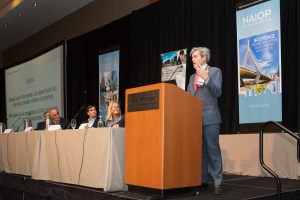
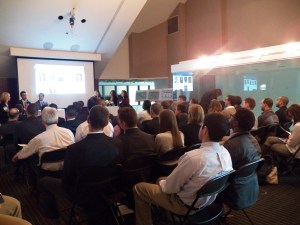
Last week, NAIOP again held its annual Women of Influence luncheon, hosted at the home office of Nutter McClennen & Fish, LLP in the Seaport. The sold out event attracted nearly 200 (mostly women) participants, and its theme, “Changing the Game for Women in Commercial Real Estate,” reflected just how much the conversation around women in the industry has changed in the last decade. “This is our tenth anniversary and we wanted to change things up,” said Reesa Fischer, executive director of NAIOP Massachusetts. “This is no longer about seeing what your career path is and how you get there. It’s about women providing opportunities for other women and strategies for achieving equitable workplaces.”
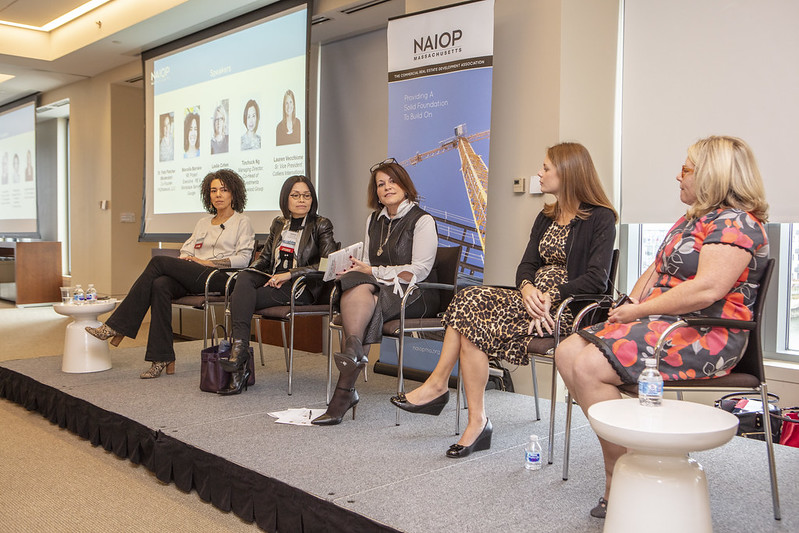
The panel discussion was moderated by Dr. Patti Fletcher, CEO of PSD Network LLC (which advises corporations and female executives), and author of “Disrupters: Success Strategies from Women Who Break the Mold”. The panel included Marcella Barrière, LEED AP, project executive for real estate & workplace services for Google; Leslie Cohen, COO and head of asset management for Samuels & Associates; Tinchuck Ng, managing director and co-head of investments at the Cottonwood Group; and Lauren Vecchione, senior VP for Colliers International.
Fletcher told the gathering that changing the workplace dynamic is not about just working harder or “leaning in more” – which has long been the go-to strategy for professional women in the workplace. Instead, she says, “We have to get real about what we’re facing, and we also have get real that blaming and shaming of men and trying to ‘fix’ them does not work. What does work is understanding where that systemic bias is and creating a new, more efficient and equitable status quo where everyone can thrive.”
Cohen emphasized the importance of mentorship and sponsorship for women, particularly those just entering the field. She joined CREW Boston (then NEWiRE) nearly two decades ago, and participated in a program that paired her with a female mentor in Dallas. The two worked together for a year on a development plan that was practical and “intentional about where I was going to go and how I was going to get there,” said Cohen. The mentor also stressed the importance of overcoming fears around networking, a skill which eventually led to her assuming the role of president of both CREW and NAIOP at different points in her career. And she still talks to her mentor on a monthly basis. “It’s been hugely beneficial to get advice and an outside opinion to help me not only to navigate, but to keep me challenging myself to keep growing,” said Cohen.

In addition to mentors, panelists discussed the importance of having advocates within the industry – both male and female – to support and champion them as difference makers. Barrière, who is African-American, said that due to the lack of black women in senior leadership positions in commercial real estate, there is a shortage of available mentors for her, so she seeks out advocates instead. “And the difference for me is, ‘Who is going to walk into the room when I’m not there and talk about what great work I did?’ A mentor is going to talk to me about how to overcome situations, and that’s a private conversation. That is coaching and that is guidance. An advocate is going to walk into the room when I’m not there and say, ‘This person has earned a shot. Their work is great and they need to be promoted or they need to be put on this project’.”
Vecchione added that women can become advocates for other women by practicing “echoing” during meetings. “One thing I was taught by Kristin (Blount, Collier executive VP/partner) was that we need to echo for one another,” she said. “When you’re not the only woman in the room, and you do have a good idea, it’s not always acknowledged, unfortunately. So what is helpful to your other female colleagues is just echoing what they’ve said if you do think it’s a good idea. And the more that we can do that, the more we have each other’s backs, and it can go a long way towards helping all of us.”
One of the difficulties for many professional women in the workplace, said Fletcher, is overcoming “imposter syndrome” – the belief that one is inadequate despite ample evidence to the contrary. Often fueled by perfectionism, Fletcher’s research indicates that imposter syndrome is three times more likely to be experienced by women than men, and seven times more likely by women of color. Multiple panelists shared that despite their track records of success (including being included on the prestigious NAIOP panel) they can still experience those feelings of inadequacy in the workplace.
Barrière suggested that the best way to overcome imposter syndrome is by “silencing it, calling it out, and just saying to (oneself), ‘If I was invited into this room, then I belong here,’ and leave it at that. Move forward from there without questioning that fact. On a level playing field, mindset and tenacity will win the day.”

Ng said the key to succeeding in the environment from an external standpoint is focusing on what really matters to the task at hand – and always bringing the conversation back to the deal. “You’ll get looked at differently. Trust me,” said Ng. “As someone who’s trained as an architect, is a woman and Chinese, I bring diversity to that room no matter what, and that’s my value-add. Call it out. Humor helps enormously, at least in my case, but at the end of the day, what’s going to get you the level of respect is going back to the point of, ‘this is a better solution because it generates ‘X’ return’.”
Vecchione and Ng both emphasized that while there are disadvantages to being a women or person of color in the industry, there are also a number of positives. Vecchione said that she focuses a lot more on the advantages because it’s what she can control, and reminded the audience that “we all have the ability to stand out in a crowd and create a brand for ourselves.” Ng suggested that one way to distinguish yourself from the pack was to carve out a niche. In her case, it was to become expert in cross-border tax implications for real estate acquisitions and dispositions. She told the audience that it was easier for her establish a level of confidence regarding expertise about cross border transactions, “because I look different, even though I’ve lived here for 25 years,” she joked, and encouraged the audience to “take what is sometime perceived as differences – I wouldn’t call them disadvantages – and ask yourself if that can become your niche.”
While the CRE industry and society as a whole has a long way to go in terms of equity along race and gender lines, Cohen sees a good deal of “forward progress” in commercial real estate. When she began her career with Samuels 17 years ago, she was often the only women in the room. Currently she is working on a development project with Harvard University where nearly all of the people in leadership positions are women. “If I can think of the future work that we have in front of us, it’s getting more women in the room, into that very close circle, who are making decisions, particularly hiring decisions – and I think that’s the important one that still needs to happen – but I think there’s been a lot of progress,” said Cohen.




 The Coworking industry grew 50% between 2016 and 2018 and the variety of options within this market segment is staggering. Boston is no exception, currently, there are around 2.3 million square feet of coworking space in Boston and Cambridge. Last week
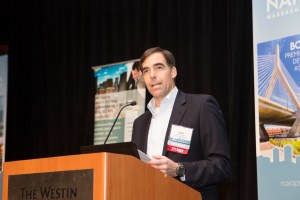
 Fueled by one of the strongest economies in the nation, the Boston commercial real estate market should continue to thrive for the foreseeable future. That was the conclusion of the enthusiastic panel at the 2017 NAIOP/SIOR Annual Market Forecast held last week at the Westin Waterfront Hotel before a crowd of 450 CRE professionals.
 But despite the positive outlook, there is a looming threat to the overall health of Greater Boston economy, he cautioned. “The housing stock is limited and growing too slowly to meet the demand, and as a result, home prices and rents continue to rise,” said Bluestone, who is one of the co-authors of the
  JLL’s Heath led off the program with an overview of the Cambridge office and lab markets. “The Cambridge market is one of the strongest markets that we track globally at JLL, and it continues to be driven by this incredible demand from the tech and life science clusters,” she stated, adding that the demand is coming not only from organically grown companies, but outside firms seeking to establish an R&D presence in close proximity to
  Colliers’ Carroll reported that “the suburbs are alive and well”, as the market has added over five million SF of positive absorption since the downturn. There has also been a steady increase in rent growth in the Class A office market, approximately 10 percent since 2009, with new construction in Waltham achieving rents in the low $50s. The Class B market is not faring as well (although there is some rent growth occurring in select markets), with some of the older building stock being slated for repositioning or demolition to make way for senior living, hotel and other non-office uses (including 450,000 SF of properties in Chelmsford). One particularly bright spot is the emergence of biotech in the suburbs.
  Citing the enormous amount of commercial, residential, retail and restaurant development underway in the Seaport and other Boston locations, Avison Young’s Perry observed that “Boston is clearly a different city today than it was even five years ago.” The in-migration to the city by firms seeking talent continues, he said, citing the recent relocations by
  NKF’s McDonald reported on the industrial market – the newfound darling of investors and developers – noting the transformational effect that Amazon and e-commerce has had on the product type. With 12.8 percent average annual returns to investors over the last five years, industrial has outperformed both retail (12.1) and multifamily (9.9), driven by feverish demand for “last mile” properties located in urban and infill submarkets. That demand has driven rents “way beyond the norms” of what had traditionally been $5 to $6 psf to the “high single digits and low teens” for buildings such as 480 Sprague St. in Dedham, a 234,000 SF warehouse that straddles the Boston line. And warehouse space located within the urban market, such as 202 Southampton St. in the South End (which lacks basics such as air-conditioning), is fetching $20 psf, based solely on location.
 HFF’s Sayles addressed the ‘When will the cycle end?’ question early on his presentation. “End of cycle concerns have largely abated,” he reassured the gathering. “Nobody is really talking about that right now, instead, what people’s biggest concern is, ‘If I sell, what am I going to do with that capital?” He expects pricing for assets to remain flat in the near term with cap rates trending downward. Financing for assets is up by 17 percent from Q3 2016 to Q3 2017, but investment sales for that period declined by approximately 8.0 percent as buyers are choosing longer term holds. Sales volume for Boston is expected to be approximately $13 billion for 2017, with foreign capital again accounting for a significant portion of those transactions.


 On Wednesday, Nov 9th NAIOP hosted a Members-Only Leadership Luncheon at
  The newly constructed 17-story, 440,000 RSF, LEED Platinum state-of-the-art office building was developed by SKANKSA USA Commercial Development Team in Boston. Highlights included a chilled beam mechanical system, triple glazing curtain wall, 300 underground parking spaces, world class retail by


 NAIOP Policy and Trends Watch