Unknown's avatar

About Tamara Small

Tamara Small is the CEO of NAIOP Massachusetts.

Boston Federal Reserve President Eric Rosengren Speaks at NAIOP Event

This morning, Dr. Eric Rosengren, President and Chief Executive Officer of the Federal Reserve Bank of Boston, provided the keynote address at NAIOP’s well attended and informative program, “Banking on Real Estate: Capital Flows and the State of CRE Lending.”

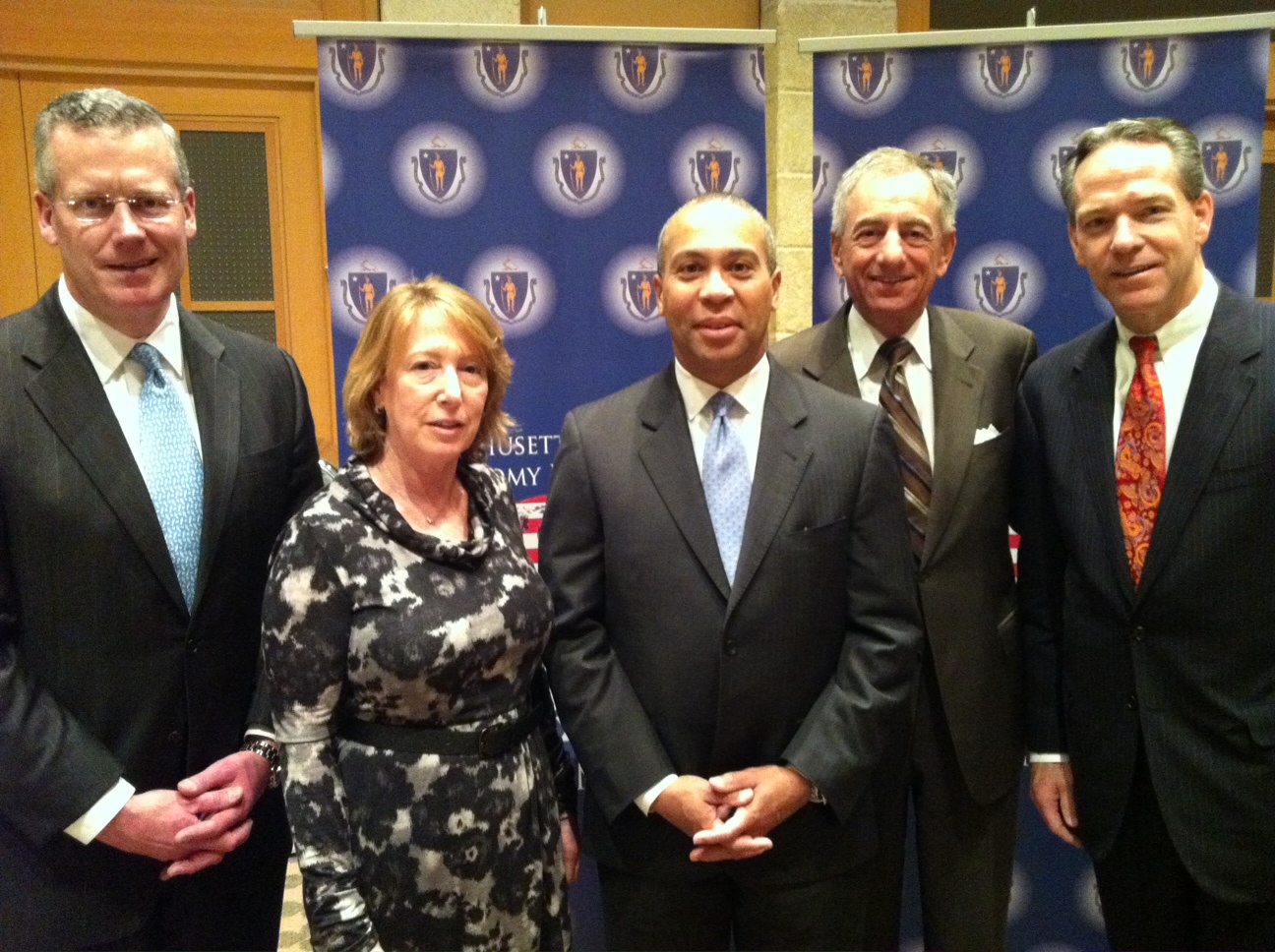
David Begelfer & Dr. Eric Rosengren

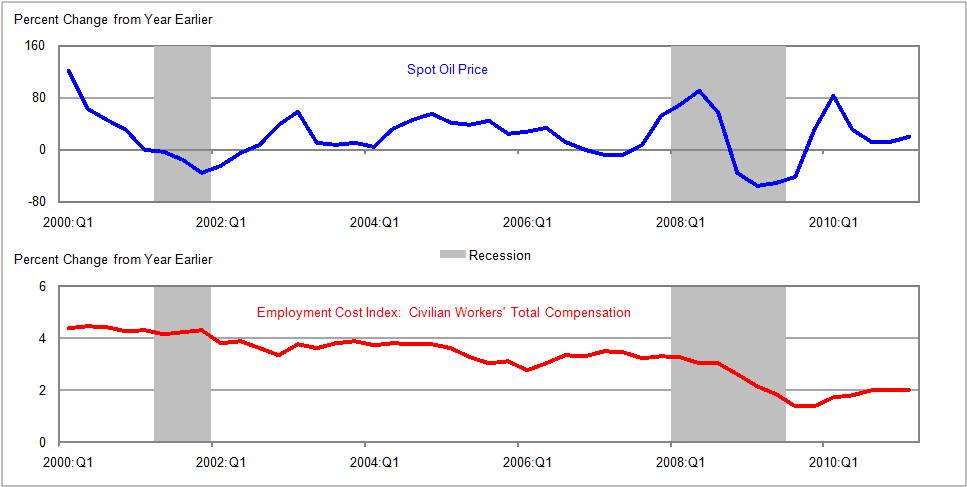
His comments provided insight into how the Fed views world events like Japan’s recent earthquake and political unrest in the Middle East and their potential impact on the United States economy.  He indicated that the fear of inflation resulting from energy and food “supply shocks” seems to be unfounded.  Over the past 25 years, there does not appear to be much evidence of commodity price spikes dramatically affecting the core inflation rate or wages and salaries. These shocks have been transitory, with limited long-term effects on inflation and business/consumer expectations.

As a result, until there is progress on the Fed’s mandates of stable prices and employment, he believes that the current Fed accommodative monetary policy is appropriate. For now, there is no reason to slow the economy down with a tighter monetary policy.

That said, he indicated that the Fed would, most likely, take decisive and forceful action if inflation expectations start to rise.

Based on Dr. Rosengren’s comments, I would say that all indications are that this period of historically low interest rates will continue for the foreseeable future.  This is probably good news for current commercial real estate owners that are worried about the FDIC’s eventual implementation of a “mark to market” policy.  Having to refinance property, with falling rental revenue, would be all the more difficult with rising interest rates.  On the other hand, investors sitting on a lot of cash on the sidelines may still be sitting for a while longer.

OIL PRICES AND WAGES 

                      Source:  WSJ, BLS, NBER / Haver Analytics

It’s a bright time for solar

If there ever was a time to consider investing in solar photovoltaic (PV) projects in Massachusetts, it is now. There are a number of federal and state financial incentives that may not be around for long. 

  1. First, the developer can take advantage of a Federal U.S. Treasury “Cash Grant” based on 30% of the total value within 60 days of the project becoming operational.  This benefit expires on the end of this year. Or, as an alternative, the owner can take a Federal Investment Tax Credit of 30% of the project value. Tax credit can be carried back 1 year and carried forward 20 years.  This incentive expires December 31, 2016.
  2.  Second, the owner can benefit from a 100% bonus depreciation. This is based on the total value in the year that the project is placed into service. This will also expire the end of this year, but will continue for another year with a 50% bonus depreciation.
  3.  Lastly, project developers can benefit from the Massachusetts solar renewable energy certificates (SRECs.)  The market for SRECs is currently trading at more than $500/MWH (there is a $300 floor.) This is value priced annually.

Maybe this is the right thing to do for the environment; but it looks like, for now, it is the smart thing to do for your bottom line.

If You Zone It, They Could Come

In order to spur new development in a place not widely known for its commercial activity, the City Council of Leominster is considering rezoning sections of the city.  The goal is to add flexibility to its land use controls in order to attract new businesses into Leominster while encouraging existing companies to expand.

This is not the first local government to realize that growing its tax base starts with rethinking how it zones and permits development.  Two other recent examples illustrate the importance of this self-appraisal process.

For many years, the town of Westwood had an anti-development reputation.  While virtually all of the land along the 128 Technology Highway bustled with new development activity, countless properties along University Ave in Westwood sat vacant or underutilized. This area, starting at the commuter rail station and continuing throughout a large industrial park – with direct access to the highway, was frozen in the 1960’s.

Recognizing that the town had to make significant changes to attract economic development, Westwood officials invited businesses, developers, consultants, and site selectors to tell them what changes were needed.  As a result of this process, the town’s economic development committee went to Town Meeting and changed Westwood’s zoning by-laws.  Soon after, a massive area of the park was purchased and one of the region’s largest mixed use developments was approved.  Unfortunately, the Grand Recession put the project on hold for the time being.  However, there is no doubt this will be one of the first projects to move forward once the recovery is in full swing.

The other municipality to undertake this self-critique was Lexington.  Its Board of Selectmen started a visioning process that brought in a wide range of experts to see what it would take to encourage further economic development in a town with limited growth areas.  As a result of the town’s new commitment to attracting businesses, Lexington passed a remarkable “up-zoning” at Town Meeting, which more than doubled the commercial density in the Hartwell Avenue area, allowing for a potential 2.9 million square feet of development.

With municipal budgets being slashed, more communities are realizing that they need to compete for new business growth, but they are ill prepared to attract development due to archaic zoning and permitting regulations.  While towns may not be able to guarantee new growth if they follow Lexington and Westwood, if they do not bring predictability, timeliness, and clarity to their permitting, most businesses will be looking elsewhere.

NAIOP Welcomes New MassDevelopment CEO

We are very excited that Marty Jones will be the new President and CEO of MassDevelopment 

The MassDevelopment Board made a great strategic move by attracting such an experienced real estate professional to this position. There is no question she will be a tremendous asset to the organization. 

Many of us know Marty through her longstanding role as President of the Boston-based Corcoran Jennison Companies where she oversaw development and management operations.  Recently, Marty was elected to the NAIOP Massachusetts Board of Directors.

With its substantial financial and human resources, MassDevelopment will play an integral role in the Administration’s recently restructured Economic Development operations. MassDevelopment will be critical to stimulating growth across the Commonwealth. 

We look forward to working with Marty in her new position and continuing our collaborative working relationship with MassDevelopment.

The Changing Face of Retail

Yesterday’s NAIOP Main Event, New Rules for Retail: The Post-Recession Reality, had a standing room only crowd, and for a good reason. (See event photos here.)  The retail landscape is changing more quickly than ever before due, in part, from the influence of the internet and the changing demands of the consumer.  ICSC and NAIOP members heard from a panel of industry experts: David Smookler, Principal, The Dartmouth Company; Tom DeSimone, Executive Vice President, WS Development; Jeff Gellerman, Director Real Estate, Lowes Home Improvement, and Bill Moscarelli, Vice President Real Estate, National Amusements

Legacy Place (photo by Michael Blanchard)

Based on the presentations, it’s clear that the cookie-cutter approach to retail development is history.  To succeed, new retail development must be customized to the community, the site, and the market.  The design of the successful Legacy Place is not going to be replicated in Lynnfield’s mixed use partnership with WS Development and National Development – it will be its own unique blend of uses and public spaces.  The stand-alone Cineplex developed by National Amusements has changed dramatically in just 15 years.  Stadium seating, 3-D movies and restaurant-style dining have made going to the movies a totally different experience. And there seems to be no doubt that even with hundreds of channels on TV and endless options for shopping and entertainment online, people will still continue to go out to have fun.  

That said, the influence of the internet continues to expand and cannot be ignored.  Shoppers are doing much of their “homework” online and shopping experiences (good, but mostly bad) are shared through social media channels and can quickly go viral. Lowes discussed the importance of staying ahead of the curve by offering customers tutorials on home improvement projects with links to purchase the supplies needed to complete the job.  

When it comes to retail, what seems to be the rule now, as before, is that change will continue to be a critical part of this industry.

Trade Missions Should be Viewed Over Long Term

I just had an op ed published in Mass High Tech on Governor Deval Patrick’s recent 10-day Innovation Economy Partnership Mission to Israel and the U.K.

Too often, the sole criteria used to judge whether a trade mission is a success is jobs.  Unfortunately, this is short-sighted. Economic development strategies must be designed for the long-term.

The Commonwealth’s economic plan needs to have at its core a focus on growing its local, existing business base, while still looking beyond its borders for strategic global opportunities. The right missions, such as this one, are key to our future success.

Yes, In Your Back Yard

Paul McMorrow’s recent op ed in The Boston Globe discussed the impacts of the recent decision issued by the Massachusetts Supreme Judicial Court on a zoning dispute in Chatham (Kenner v. Zoning Board of Appeals of Chatham).  This case brought to light an issue developers in Massachusetts have known for years – a few dissatisfied residents have the power to stall development projects in the court system for years, many times without proper standing.

In most cases, the project opponents have not sustained actual harm (the primary qualification for challenging a local zoning decision), but they still have the ability to slow and potentially kill a new development.  At least, that is, until now.    

With its decision in this case, the SJC raised the bar for NIMBY (Not In My Back Yard) lawsuits.  The typical NIMBY suit is based on the litigant’s perception that a proposed development will impact them.  With this ruling, the SJC clearly stated that for a suit to move forward there must be true and measurable harm to the aggrieved party.

The SJC gave more authority to the Land Court to make decisions regarding the proper standing of a party to bring a law suit in opposition to a project.  In so doing, they basically took away the ability of the state appeals court to question the Land Court’s judgment on standing.

This decision is not going do away with all project appeals, nor will it screen out all frivolous appeals.  However, this is one of the clearest messages we have seen in years from the courts.  It recognizes that it is unfair to allow a local minority to use litigation for the sole purpose of preventing approval of development projects that were fully vetted through a legitimate public permitting process.  NAIOP applauds the decision!

“It’s Getting Better all the Time”, The Beatles

At the well-attended NAIOP Developing Leaders breakfast this morning, a panel presented “Booming In Beantown: Why Boston Remains One of CRE’s Hottest Markets.”

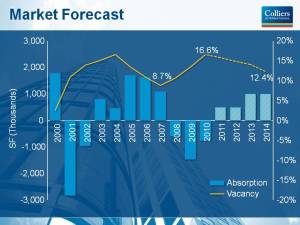
I was particularly interested in three slides that certainly left me and the other attendees sighing with relief about our future.  The first two slides were from Yanni Tsipis, Senior Vice President of Development & Consulting Services, at Colliers International.  The Market Forecast shows the historic run-up of the vacancy in Boston to a 10 year high of 16.6%.  However, they are forecasting positive absorption over the next four years, dropping the vacancy rate to 12.4%.  That might not be the low single digits, but it is in the range to start pushing up the rental rates.

The next slide should not come as a great surprise regarding the relative health of the commercial real estate investment market.  It does, though, show how bad off are the other regions of the country.  The delinquent or special service loans are under 5% for the Boston market.  However, take a look at some of the other metro markets like Phoenix, Riverside-Ontario, and Seattle.  New York and Washington, the other “stars” are a bit worse off than Boston.  It has been many a recession ago since we were not the poster child for being the worst affected region.

Finally, Peter Merrigan, President & CEO of Taurus Investment Holdings provided a chart showing Boston’s advantage in terms of employment gains.  This may be the first time Boston has ever been in any top grouping regarding employment (other than loss of.)  Not only is Boston ranked third with over 1.3% twelve month gains, but the Commonwealth is ranked fourth in actual raw employment numbers!

Bring out your old records and enjoy the refrain: “It’s getting better all the time.”  And hopefully for the foreseeable future too.

Fidelity’s Marlborough Closure in Perspective

Fidelity recently announced it will be closing its Marlborough location over the next 2 years and relocating 1,100 employees to the remaining 3 regional locations in downtown Boston, Smithfield, RI and Merrimac, NH.  The company’s staff has been reduced significantly over the past few years and this decision was made as part of the company’s worldwide reductions during the recent global economic crisis.

What is interesting to me has been the immediate reaction in the press. For the most part, the story has been about Fidelity’s “ingratitude” and the need for the state to punish the company for making such a decision. 

Fidelity still remains one of the largest employers in the Commonwealth with thousands of workers. They, unlike many Fortune 500 firms, maintain their headquarters here. 

What we have is a global company that makes a business decision to relocate some of its employees and to close a regional office. Shouldn’t we be asking what we can do to make us more competitive?  

Beating up on an employer and an industry is probably not the best way to keep them here over the long term. Let’s do a better job at listening to our employers and understanding their problems, before they become ours.

Political Notes from Israel

Editor’s Note: NAIOP CEO David Begelfer traveled with Governor Patrick’s Trade Mission to Israel; this is his update from day 4 of the trip.

The following are a few notes from my final day with the Trade Mission – there is truly too much going on to report it here, but I hope this gives some insights into the progress Governor Patrick and the delegation made in building relationships that could translate into real economic development opportunities for the Commonwealth.

Meeting Prime Minister Dan Meridor

1) Deputy Prime Minister Dan Meridor
After a very candid presentation of the political environment, the Minister (who oversees intelligence) answered a question about the effect of political uncertainty and previous conflicts on Israeli investments. According to him, there are no problems, with strong investments continuing due to strengths in innovation economy, $8 billion in trade surpluses, and a strengthening currency. 

2) U.S. Consul General Daniel Rubinstein
West Bank GDP is 8%. (higher in Gaza, but off an extremely low base,) Foreign donations and foreign Palestinian investments total$900 million annually. Social media expanding in both Gaza and West Bank. 90% literacy throughout Palestinian Territories. Housing costs are growing very fast with an increase of more than 40% over last few years. However, there is less concern over “bubble” due to underwriting with 35% down and limitations on multiple home ownership. Most young families require parental assistance. 

3) Jerusalem Mayor Nir Barkat
Coming from the private sector as a successful founder & CEO of a computer software company and a venture capital firm, he retired 8 years ago at age 40. In 2008 he was elected mayor – a truly visionary and dynamic leader. He enlisted Michael Porter to help strategize based on Jerusalem being the best location, best known brand. Leveraging Jerusalem’s competitive advantages, Mayor Barkat is developing the business cluster and tourism together. His goal is 10 million tourists (3 now,) health & sciences cluster expansion, and looking to the future with patient-centric vs. hospital-centric care.

Governor Patrick Meets with President Shimon Peres

4) President Shimon Peres
At 87 years old, and personally representing the whole history of the State of Israel, President Peres spoke and answered questions on his view of the past, present, and future here and relations with the U.S. Answering a question about what contributed to the phenomenal growth of the economy from the start, he said it began in earnest with defense. Without planes, Israel was forced to build their own, requiring research, precision manufacturing, and the need to produce a superior product in order to survive.

5) Industry, Trade and Labor Minister Shalom Simhon
Governor Patrick and the Minister signed a Memorandum of Understanding for collaboration in research and development between the Commonwealth’s and Israeli companies. The Minister’s office and the office of Chief Scientist will identify existing programs that can be scaled up to an international level. There is hope that the Kinesset will pass legislation allowing the Chief Scientist to invest in a foreign program or academic program, which could benefit Massachusetts schools and businesses.

You can hear more about these opportunities at NAIOP’s upcoming program, The Boston-Israel Connection, featuring fellow trip participants David Abromowitz and Thomas O’Brien, as well as participants from the 2010 City to City trip to Haifa, Thomas Palmer and Robert Buckley. Learn more about that program, held Tuesday, March 29th, at the offices of the Combined Jewish Philanthropies.

A few other photos from the trip:

Governor with NAIOP CEO David Begelfer, and NAIOP members John Fish, Tom O'Brien & Helene Solomon

    David Begelfer with cabinet Secretaries Greg Bialecki & Rick Sullivan