This guest blog post was written by Mike Hoban of Hoban Communications.
 Fueled by one of the strongest economies in the nation, the Boston commercial real estate market should continue to thrive for the foreseeable future. That was the conclusion of the enthusiastic panel at the 2017 NAIOP/SIOR Annual Market Forecast held last week at the Westin Waterfront Hotel before a crowd of 450 CRE professionals.
Moderated by David Begelfer, CEO of NAIOP Massachusetts, the panel included Molly Heath, Executive VP, JLL (Cambridge); Ben Sayles, Director, HFF (Capital Markets); John Carroll, Executive VP, Colliers International (Suburbs); Ron Perry, Principal, Avison Young (Downtown); and JR McDonald, Executive Managing Director, Newmark Knight Frank (Industrial). Barry Bluestone, Professor of Public Policy at Northeastern University and Senior Fellow at The Boston Foundation, set the table for the program with an economic forecast that – with one major caveat – bodes well for the long-term health of Greater Boston CRE.
Bolstered by the highly educated workforce provided by the educational and medical institutions located in Greater Boston, the Massachusetts economy has outperformed the U.S. economy nearly every year since 2009. GDP growth for the Commonwealth has generally been in the 2.5 to 3.0 percent range since 2010, a figure that is significantly above the national average of 2.0 during that period. The Bay State has added 355,600 jobs since the recession (including 62,500 last year), an 11.2 percent increase since 2009. The 4.2 percent unemployment rate has led to virtual full employment, and with the tight labor markets, average wages are beginning to increase, albeit slowly. And none of the factors that typically contribute to a slowdown are in evidence.
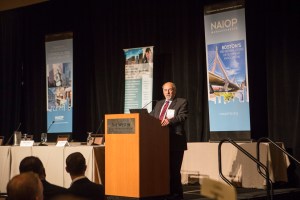 But despite the positive outlook, there is a looming threat to the overall health of Greater Boston economy, he cautioned. “The housing stock is limited and growing too slowly to meet the demand, and as a result, home prices and rents continue to rise,” said Bluestone, who is one of the co-authors of the Boston Foundation’s 2017 Greater Boston Housing Report Card. The price of housing is pushing workers farther away from the urban core, causing housing prices in traditionally affordable communities to escalate, as well as putting a strain on an overburdened public transit system. The Housing Report Card estimates that the region will need an additional 160,000 housing units by 2030 to accommodate its expanding population (an additional 342,000), “and that is going to be a challenge,” Bluestone concluded.
 JLL’s Heath led off the program with an overview of the Cambridge office and lab markets. “The Cambridge market is one of the strongest markets that we track globally at JLL, and it continues to be driven by this incredible demand from the tech and life science clusters,” she stated, adding that the demand is coming not only from organically grown companies, but outside firms seeking to establish an R&D presence in close proximity to MIT, Harvard, and the educated workforce. With a vacancy rate below 3.0 percent, there continues to be upward pressure on rental rates, with office (by 13 percent) and lab (23 percent) soaring well above previous highs. Achieved rents for office space in E. Cambridge are now in the low $90’s (gross), with lab space in the low $80s (NNN). And due to the lack of supply in the market, “we really do believe that there is room (for rents) to run,” said Heath.
 Colliers’ Carroll reported that “the suburbs are alive and well”, as the market has added over five million SF of positive absorption since the downturn. There has also been a steady increase in rent growth in the Class A office market, approximately 10 percent since 2009, with new construction in Waltham achieving rents in the low $50s. The Class B market is not faring as well (although there is some rent growth occurring in select markets), with some of the older building stock being slated for repositioning or demolition to make way for senior living, hotel and other non-office uses (including 450,000 SF of properties in Chelmsford). One particularly bright spot is the emergence of biotech in the suburbs. The Gutierrez Company is currently constructing a five-story, 350,000 SF building for EMD Millipore (2018 Q3 completion) in Burlington, Alkermes is “close to signing” a lease for a 250,000 SF build-to-suit in Waltham, and Waltham-based Tesaro is in the market for a 300,000-500,000 SF suburban campus.
 Citing the enormous amount of commercial, residential, retail and restaurant development underway in the Seaport and other Boston locations, Avison Young’s Perry observed that “Boston is clearly a different city today than it was even five years ago.” The in-migration to the city by firms seeking talent continues, he said, citing the recent relocations by Reebok, PTC and Alexion to the Seaport, as well as Amazon’s establishment of a Boston presence with the 150,000 SF lease at 253 Summer St. and Rapid7’s relocation to North Station. Demand remains strong Downtown, with over 4.5 million SF of requirements in the market, including nine companies seeking 100,000-500,000 SF. CBD Class A rents range from the mid $40s to the mid $80s (Back Bay high-rise), and vacancy rates in the top floors of the towers (10 percent) are nearly in equilibrium with the lower floors (9.4 percent), as tech companies continue to absorb space on the lower tiers.
 NKF’s McDonald reported on the industrial market – the newfound darling of investors and developers – noting the transformational effect that Amazon and e-commerce has had on the product type. With 12.8 percent average annual returns to investors over the last five years, industrial has outperformed both retail (12.1) and multifamily (9.9), driven by feverish demand for “last mile” properties located in urban and infill submarkets. That demand has driven rents “way beyond the norms” of what had traditionally been $5 to $6 psf to the “high single digits and low teens” for buildings such as 480 Sprague St. in Dedham, a 234,000 SF warehouse that straddles the Boston line. And warehouse space located within the urban market, such as 202 Southampton St. in the South End (which lacks basics such as air-conditioning), is fetching $20 psf, based solely on location.
 HFF’s Sayles addressed the ‘When will the cycle end?’ question early on his presentation. “End of cycle concerns have largely abated,” he reassured the gathering. “Nobody is really talking about that right now, instead, what people’s biggest concern is, ‘If I sell, what am I going to do with that capital?” He expects pricing for assets to remain flat in the near term with cap rates trending downward. Financing for assets is up by 17 percent from Q3 2016 to Q3 2017, but investment sales for that period declined by approximately 8.0 percent as buyers are choosing longer term holds. Sales volume for Boston is expected to be approximately $13 billion for 2017, with foreign capital again accounting for a significant portion of those transactions.
Begelfer was in full agreement with Sayles’ assessment of the cycle concerns. “Boston is pretty unique. There are only a handful of cities around the country that are experiencing this kind of strong growth,” he observed. “Any slowdown that we see is probably not going to come from the economy, it will be from the cost of construction and land costs, or the pricing of assets. It won’t be caused by a recession, but by our own success,”



 NAIOP Policy and Trends Watch