
NAIOP Raises $151,500 for Heading Home

This post was submitted by Marc Margulies, principal at Margulies Perruzzi Architects and president of Heading Home’s Board of Directors
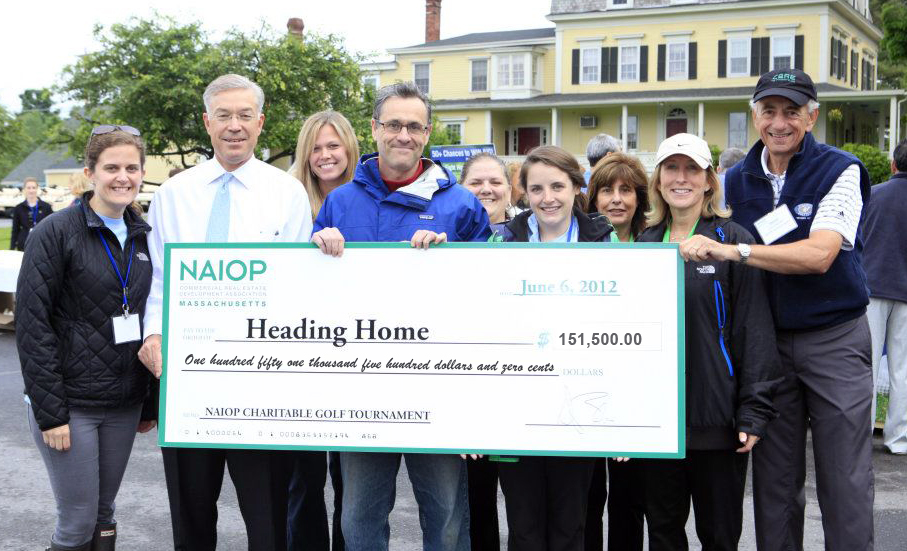
On June 6th, NAIOP Massachusetts held its 24th Annual Charitable Golf Tournament to benefit Heading Home, raising $151,500 to support programs to end homelessness in Greater Boston. This record-breaking sum is the largest in the tournament’s history, bringing the total donated to Heading Home to more than $1.85 million. The commercial real estate community should be proud
that its steadfast commitment to Heading Home reaps real rewards for homeless families.

In 2011, Heading Home helped more than 2,000 homeless people in Greater Boston by providing them a place to call home and opportunities for self-sufficiency. Two-hundred and fifty units of housing have been created since 2006, with 61 new units created in the past year alone.  More than 400 volunteers annually commit their time and energy to Heading Home, and the commercial real estate community provides a large number of those volunteers. The monies raised by NAIOP will continue to support Heading Home’s programs to end homelessness locally.

Andrew Hoar, president of CB Richard Ellis/New England and chair of the 2012 NAIOP Massachusetts Charitable Events Committee, led the effort to make this record-breaking donation possible. Andy has been on the Heading Home Board of Directors since 2007, and he, his wife, and his firm are longtime contributors to the organization. Andy’s efforts this year hit the fundraising goals out of the park!

Another ardent Heading Home supporter who deserves special recognition is NAIOP Massachusetts CEO, David Begelfer. David has been actively involved in the struggle to end homelessness for more than 24 years, and started the annual NAIOP golf tournament to support Heading Home. In 2010, David received the Bob Ray Partnership Award from the Massachusetts Housing and Shelter Alliance for his commitment to ending homelessness. His support of Heading Home, including serving on the organization’s Advisory Council, has been unwavering through the years.

Since the first NAIOP Golf Tournament that raised $5,000 for Heading Home, the commercial real estate industry has continued to come together to show support for homeless families and individuals. Thank you to NAIOP’s member volunteers, staff, and generous donors who helped to raise this record-breaking donation for Heading Home. It is only through their support that the tournament is able to raise funds needed to help Heading Home accomplish its goal of ending family homelessness.
View pictures from the event.

Boston’s parking freeze needs to be thawed

This Letter to the Editor appeared in the June 14, 2012 edition of Boston Business Journal.

To the editor:
The viewpoint expressed in your recent article titled “Seaport Squeeze” piqued my interest. I find it worrisome that the Seaport area will soon transition from servicing commuter parking for downtown Boston, to an area servicing parking for its new residents and businesses.

We should all be a bit more concerned about the results of this impending transition. The parking freeze was initially proposed in the early 1970s for downtown Boston and Logan Airport. Subsequently, parking freezes were adopted in Cambridge, East Boston and other parts of Boston. With the growth of the office market over the past three decades, many workers have certainly taken advantage of Boston’s mass transit system, but those who commute by car benefit from the low-cost parking in the undeveloped Seaport area.

With a parking inventory freeze in the Seaport, long-term availability of satellite surface parking is at odds with the construction of high-rise apartments and offices. As the amount of commuter parking diminishes, the stress on businesses in the Financial District, to keep their commuting employees, increases. Mass transit cannot absorb all these commuters. At some point, companies that have relied upon employees that commute to work may be forced to look elsewhere for office space.

There are two areas that need attention. Firstly, Boston businesses are highly dependent on the MBTA and the legislature needs to act, not just with a short-term fix, but with a multiyear plan to reduce the T’s burdensome debt, and increase the long-deferred investments to enhance, expand, and improve ridership capacity and satisfaction.

Secondly, a myriad of programs have been implemented nationwide to reduce parking and transportation demand that do not depend on freezes. Even the city of Cambridge has abandoned its parking freeze approach and implemented a Vehicle Trip Reduction programs to address parking, traffic and air-quality issues.

Maybe the time has come to take reevaluate the city’s parking freeze policy, which is one of the very few left in this country.

David Begelfer
CEO of NAIOP Massachusetts

Breaking Ground in Back Bay

The following blog post was submitted by Sheridan Wachtel, Marketing Assistant at Solomon McCown.

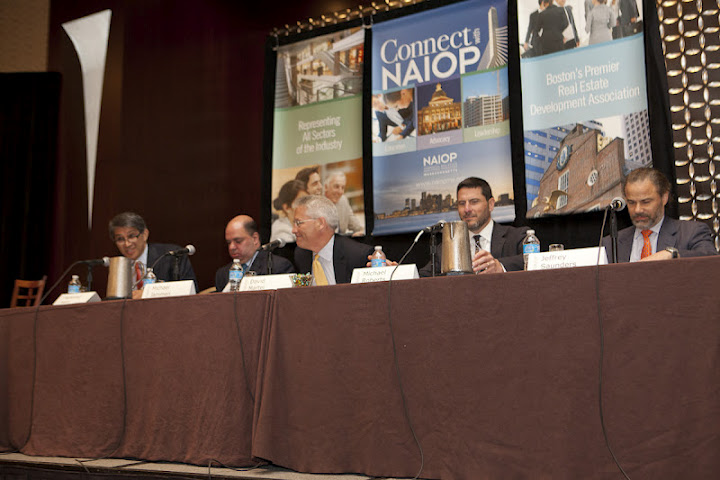
On May 31, experts from all sides of the real estate industry joined us at the Sheraton Hotel to discuss one of Boston’s most iconic and sought-after neighborhoods, the Back Bay. The program, “Breaking Ground in Back Bay,” discussed the future opportunities for retail, residential, office and hotel in the neighborhood that has been the epicenter of the city for decades.

The panel included Peter Meade, Director of the Boston Redevelopment Authority; Michael Jammen, Principal, UrbanMeritage, LLC; David Martel, Executive Director of Cushman & Wakefield of Massachusetts, Inc.; Michael Roberts, Vice President Development of AvalonBay Communities, Inc.; Jeffrey Saunders, President of Saunders Hotel Group, LLC; and was moderated by Leggat McCall Properties LLC Executive Vice President, Mahmood Malihi.
Meade set the table for the discussion citing the pipeline of projects slated for the Back Bay including the redevelopment of the Christian Science Plaza, 888 Boylston, Chanel’s new retail store, and Copley Place residential building—which will be the tallest building in the Back Bay once completed.

Jammen, one of the architects of the Newbury Line Program, discussed the “red hot” retail scene in the Back Bay and more specifically, Newbury Street. “Constrained by being only eight blocks in length, retail real estate on Newbury street is seeing more demand than supply,” said Jammen in light of the fact that the street’s architecture isn’t traditionally window-display friendly. “It doesn’t have the windows like Rodeo Drive and other luxury retail streets of the world…but no one is going to build another Newbury street anytime soon,” said Jammen.

Having represented some of Boston’s most notable office spaces including The Hancock Tower, Martel discussed the increasing value of Back Bay’s office properties. “We have seen a quantum shift in office space demand in the Back Bay since 2008,” said Martel explaining how the coveted 24/7 lifestyle of the neighborhood is an increasingly important factor to office tenants to attract and retain talent—a factor that sets it apart from both contemporary urban areas like the Seaport and traditional office space properties like the Financial District and suburban areas.

With a growing desire to work in the Back Bay, residential real estate in the area has only increased in value. Roberts commented on the demographic shift that has made residential real estate in the Back Bay boom. “Young professionals landing a majority of newly created jobs, along with empty nesters wishing to return to city-livingare the key demographics in residential real estate in this area,” said Roberts.

And, according to Roberts, residents of the Back Bay aren’t planning to move out of the Back Bay anytime soon, citing residential properties in the neighborhood see half the turnover rate than all other neighborhoods in their portfolio.

Rounding out the panel was long-time hotelier Saunders, who discussed the resiliency of hotel occupancy in Boston’s Back Bay despite the influx of new hotels in Boston’s Seaport district. “Back Bay continues to be ground zero for people who want to visit the city,” said Saunders whose hotels operate at 90+ percent occupancy rate in the summer months and projecting 2012 to yield its highest occupancy rates in recent years.

With a full spectrum of real estate development projects underway and even more projected in 2013 and 2014, real estate in the Back Bay will continue to be hot commodity and a place where residents, tenants, tourists and developers want to be.

Watch a video of the panelists, or view photos from the event.

Stretch Code Changes Have Developers Seeing Red, Not Green

This article appeared in the May 28, 2012 edition of Banker & Tradesman.

“Green building” is a term that can be broadly defined. For some, it may mean building a LEED Platinum building. For others, it could be installing water and energy saving measures. There is no question, however, that most developers are more conscious of green building practices. The question is how to encourage this movement? The industry believes the market should be allowed to lead the way when it comes to green building. Mandates imposed by the government requiring specific technologies or energy efficiency measures are not the most effective way to get there. They will only increase costs and slow development of all building types.

The Stretch Energy Code mandate passed in 2009 is one example of government’s attempt to promote energy efficiency. This local option code applies to both residential and commercial buildings. More than 100 communities have adopted it to date. Under the Stretch Energy Code, commercial buildings are required to meet higher energy efficiency standards – approximately 20 percent more than the current statewide energy code.

In 2012, the statewide energy code, as required under the Green Communities Act passed in 2008, will be updated to comply with the more energy efficient International Energy Conservation Code (IECC 2012) – an energy efficiency increase of approximately 20 percent over existing standards. Massachusetts will be leading the way by adopting this new energy code (only two other states have adopted the IECC 2012 to date). Furthermore, the statewide energy code must be updated within one year of any revision to the IECC – contributing to the commonwealth’s current position as the national leader in energy efficiency.

Change Is Coming

However, a change is being proposed to the Stretch Energy Code that will jeopardize our recent, modest economic recovery. In June, the Massachusetts Department of Energy Resources (DOER) is planning to propose a 15 percent increase to the current Stretch Energy Code (to take effect when the IECC 2012 is adopted for the rest of the state). In other words, the new Stretch Code would require buildings to be 35 percent more energy efficient than the current statewide code. Such a change would increase the cost of the construction and maintenance of residential and commercial buildings. Current rents, even in traditionally high rent communities, would be challenged to cover the increased costs associated with such projects. In addition, the change would dramatically alter project design, affecting their marketability to tenants.

Many communities chose to adopt the Stretch Energy Code in order to qualify as a Green Community. By earning this designation, they became eligible for grant money that could be used to make energy efficient upgrades in public buildings. Green Communities are required to minimize the life cycle costs of buildings by utilizing “energy efficiency, water conservation and other renewable or alternative energy technologies,” but this requirement could be achieved by adopting the IECC 2012 rather than the Stretch Energy Code.

Most of these Stretch Code communities believed that once the statewide building code was upgraded to the IECC 2012, the entire state would be on a level playing field. Unfortunately, many cities and towns are now discovering that the changes to the stretch code will take effect automatically in all Stretch Code communities without any vote by City Council or Town Meeting. Furthermore, many Stretch Code communities were not aware that they would continually be subject to an automatic upgrade every three years.

Given the impact this extreme proposal will have on housing production, jobs and a very fragile economic recovery, it is time to recognize its unintended consequences. Maintaining the commonwealth’s lead in energy efficiency should not come with a price tag we cannot afford – the loss of jobs and economic growth.