Making Air Rights Development Work

I applaud Matt Kiefer at Goulston &Storrs for his recent article in Commonwealth Magazine regarding the Columbus Center development fiasco and the potential role of government to prevent a similar outcome on future economic development projects.

What first struck me about the difficulty in getting this project through the permitting process in a reasonable amount of time was the lack of public support from the state, city, and neighborhoods.

One would expect loud cheering for a developer who presented a plan to knit back neighborhoods separated for decades and heal a visible, ugly, noisy, urban scar produced by an open sunken turnpike. However, after over 130 public meetings and several years, this project was sufficiently delayed until the development was no longer financially viable. Even with changing design requirements, increasing construction costs, and enormous engineering challenges, the developers still tried to make this project work, requesting state assistance with infrastructure and the affordable housing component. Finally, however, it was a national recession that sealed Columbus Center’s fate.

More recently, other proposed air rights projects have also fallen by the wayside. Four non-profit proposals to build over the Greenway land or exit ramps have failed to move forward. A prime culprit was underestimating the costs to construct over the expressway. And yet, the then-Mass Turnpike Authority continued to consider those and other similar sites as valuable assets worth millions of “up-front” dollars, rather than the liabilities they were to any developer considering construction.

It is challenging enough to commit to build a sizable development in Boston given the high construction costs associated with dense, urban projects.  Add to that the obligation to fund city infrastructure, make linkage payments for affordable housing, and the uncertainty of where the market will be after a lengthy permitting process, and you have a serious set of impediments to growth.

I agree with Matt’s recommendations:

•             MassDOT should look towards ground rents and/or sharing in the profits realized from a sale or refinancing, rather than pressing for larger acquisition costs.  Massport has successfully helped produce many major development projects in the Seaport area using this approach.

•             Building over air-rights is very complicated and costly. Government incentives and a predictable permitting process will be necessary to make the sites over the Turnpike and the Greenway ramps feasible.  The result will be increased tax revenues and a better city.

•             MassDOT should consider outsourcing the oversight for the development of air rights projects to MassDevelopment. It has a proven track record helping to guide development projects throughout the state.

Now is the time to start preparing for an upswing in development interest. If we do not fix these problems now, it could be many years before this highway blight is replaced with productive, well designed, urban mixed use projects.

What the Future Holds for Cambridge, MA – The Innovation Capital of the World

This blog post was submitted by Allyson Quinby, Account Executive at Solomon McCown & Company.

NAIOP Massachusetts’ “Cambridge: Ready, Set, Go!” breakfast event on February 15 featured a well-versed panel of real estate executives who spoke on “What’s new and what’s next for this hot market.”  Mary Lentz, McCall & Almy, moderated the expert panel that included Tom Andrews, Alexandria Real Estate Equities; Michael Cantalupa, Boston Properties; Shawn Hurley, Skanska USA Commercial Development; Steven Marsh, MIT Investment Management Company; and Thomas O’Brien, The HYM Investment Group.

View photos and event presentation slides.

Marsh noted how the world is changing every day, and that the U.S. along with many other superpowers such as China and India, continues to look for new ways to compete. For example, the U.S. aggressively leads the way when it comes to innovation, and as Marsh discussed, Cambridge has long been the epicenter of innovation productivity.

Due to Vertex’s move to Boston’s Seaport district, many in the real estate industry worry that the Cambridge market no longer holds the same stature it once did. However, NAIOP’s expert panelists assured us that we are in a natural state in Cambridge, and as stated by Cantalupa, “If you can afford to be next to MIT, you will be.” The lab market is steady, and many developers like Skanska USA Commercial Development are currently taking time to re-evaluate outdated space to create real estate opportunities that will fit all types of tenant needs in the future.

Home to two of the finest institutions of higher education in the world, Harvard and MIT, the panelists argued that Cambridge has gained and will maintain a prominent reputation. Companies in the life-sciences, technology, bio-pharmacology, education and innovation sectors, along with many startups, have found their homes in Cambridge. Due to the competitive advantage that comes with a Cambridge address, real estate firms have experienced a tremendous amount of success leasing space in this market. As the panelists noted, there is still an active demand and we continue to see new development activity in this market today.

Marsh and Andrews also spoke about the importance of proximity for lab space to MIT and other academic buildings. It is crucial that all facilities continue to collaborate, creating an environment that fosters innovation. Hurley also noted how mixed-use space needs to continue to be developed; it is important that we connect lab to retail and public spaces.

O’Brien discussed the next generation workforce and the need to build corporate and residential spaces that attract young professionals. His firm is developing the NorthPoint neighborhood, a mixed-use campus with flexibility – one that allows people to live and work in the same place.

Cantalupa and Hurley spoke on how real estate developers need to build flexible buildings that can adjust to market demands. Hurley noted how Skanska’s plan behind 150 Second Street was to deliver a Class-A, highly flexible property with a sustainable design that had features all tenants could enjoy. The building was also designed to accommodate either one or multiple tenants.

As stated by Marsh (and I agree), “Cambridge is special – it goes well beyond real estate” – and it is here that we want to continue the innovation story.

Note from NAIOP: Learn more about the dynamic Cambridge market by attending our 10th Anniversary Bus Tour, Big & Breaking in Greater Boston. Cambridge, along with Fenway, Longwood, Boston’s Seaport and Allston will be featured during this fast-paced and informative live market update bus tour.

The Uptick in Tech – part two

This blog post was submitted by Ben Breslau, Managing Director, Americas Research at Jones Lang LaSalle.

The third impact of technology on our markets is through the workplace. Here the confluence of demographics and improving technology is enabling and inspiring progressive companies to redesign how we think of space. Employees are clearly more mobile, as technology allows the flexibility to work from anywhere and on any device. But even within the space, tenants are harnessing more open, collaborative, flexible, efficient, and sustainable workplaces.

The driving force for tenants in the past was typically cost, but now in addition to driving efficiency the space itself is being looked at as a way to enable productivity as well as recruit top talent. These trends likely mean lower demand for commodity office space, and a redefinition of the characteristics driving space demand. Office space is not going away, but the target is moving.

One question that I always get is whether the tech boom is just the tech bubble 2.0. Is it sustainable? We recently did an analysis of technology P/E ratios as compared to the dot com bubble and found that valuations remain near the lows of the last 15 years. Today’s tech companies are cash rich and startups have been funded more conservatively. I won’t pretend to know what they all do, but many are making products that enhance and improve the lives of people and the productivity of businesses.

We think this tech wave is still in its early to mid stage with plenty of room to run.

The Uptick in Tech – part one

This blog post was submitted by Ben Breslau, Managing Director, Americas Research at Jones Lang LaSalle.

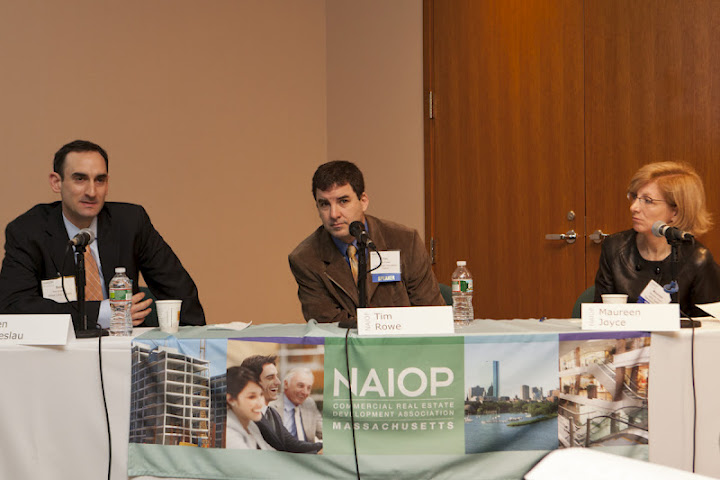
Last week I spoke at a NAIOP event titled Boston: Hub of the Future? Technology’s Impact on Commercial Real Estate.  I was joined by Maureen Joyce, AEW and Tim Rowe, Cambridge Innovation Center (see event photos). The focus on technology and real estate is not a new one. In fact, parts of the topic are very reminiscent of the technology boom of the late 1990’s. There are some clear differences too. My talk focused on three primary ways that I see technology impacting the commercial real estate landscape.

The first is through space demand. Tech companies are the fastest growing members of the office tenant base as we analyze demand across the country. As a result, the top tech markets like Silicon Valley, San Francisco, Boston, Austin, and Seattle are among those leading the office recovery.

It’s the tech submarkets within those metros that are really hot. Rental rates last year grew 25% in Palo Alto, 35% in south of San Fran, and 20% right here in Cambridge. The tech services sector and specifically mobile, social media, search, cloud, and gaming that are the most active. They are recruiting young creative tech talent, and have to be in the urban tech hot spots with “creative” space to find and keep them.

The second way technology is impacting real estate is through our business. I see it plainly in my research world, where real time interactive digital content is rapidly replacing traditional quarterly PDF reports. Blogs like this one are the norm. Social media and mobile apps are changing how we connect with and engage clients, prospects, and our own people. There are many other examples, but one thing for sure is that as more millennials enter our industry, technology will play a bigger and bigger role in how we work. View event presentation.

Lowell Richards: A Boston Leader & Visionary Who Will be Missed

Lowell Richards, Chief Development Officer for the Massachusetts Port Authority, died suddenly this past weekend. This tragic loss is very hard to grasp for many of us that knew him as an energized, dedicated, well-liked advocate and friend, committed to public service throughout his life.

It is very difficult to know the extent of Lowell’s involvement in economic development in Boston and throughout the Commonwealth.  He was not a “grand-stander,” preferring to work quietly behind the scenes making things happen, giving others the spotlight. Lowell enjoyed solving problems, and in development and in politics, there are plenty. The advantages that Lowell brought to the table were his deep understanding of the complex political environment, a clear focus on the public policy objectives, a keen mind regarding finances, and the negotiation skills needed to close the deal.

Lowell graduated from Dartmouth College in 1969, earned a Master’s in City Planning from MIT in 1971, and a J.D. from Harvard Law School.  He began his distinguished career as a college intern at the Boston Redevelopment Authority.

Within Mayor Kevin White’s administration from 1976 to 1984, Lowell served as Collector-Treasurer, and then Deputy Mayor for Fiscal Affairs. (Just last week, he served as a part of the honor guard during the memorial services for Mayor White.)

Lowell’s private sector experience included senior responsibilities at Cabot, Cabot & Forbes, the commercial real estate development company based in Boston.

From 1994 to 1999, under Governor William Weld, Lowell served as Assistant Secretary for Capital Resources of the Executive Office of Administration and Finance, and then Chief Development Officer for the Commonwealth.

He joined Massport in 1999, where he ultimately became the agency’s Chief Development Officer. There, he was responsible for its agency-wide strategic and master planning activities, including the airports and the seaport, as well as Massport’s private commercial and residential real estate development in South Boston, East Boston, and Charlestown.

Under his direction, Massport received MEPA certification for the Commonwealth Flats Development Area (including the newly designated Boston Innovation District), authorizing development of over 3 million square feet of hotel, office, retail and residential development. During his tenure, construction commenced on over 3 million square feet of maritime industrial, commercial office and apartment development on Massport property leased to developers. He also directed third party development at Massport’s three airports.

Lowell had many friends who are now stunned by his departure.  It’s hard to imagine this city without him, but we are fortunate that he left an indelible mark on Boston.  His presence will remain with us as we travel through this great city each day.

Massachusetts Community Colleges Need to be Up to the Challenge

The Massachusetts Community College system is getting some well-deserved attention in Governor Patrick’s State of the Commonwealth address, the recent Boston Foundation report, and various news articles and editorials.

Primary concerns voiced by many are their underperformance and the current mismatch between the skills taught through our state higher education system in general (and community colleges in particular), and the middle-skilled jobs currently unfilled or expected to be available in the coming years.

One clear indicator of the problem is that graduation rates at the state’s community colleges are very low, especially as compared to other systems across the country.

The Boston Globe editorializes that the community college system needs to focus on being a “springboard to a productive career,” preparing students for gainful employment, especially “in an economy where competition for jobs is fierce.”

“Everyone without a job in Massachusetts today is likely to need more education, more training, directly relevant to employment opportunities, before they find one.” With over 240,000 people unemployed in the Commonwealth, community colleges have a very large pool of potential students to help.

The question becomes: what needs to be done to bring the existing system of community colleges in better alignment with the needs of employers in today’s economy?

To start the process, in 2010 Governor Deval Patrick established the “Vision Project” initiative using data to align higher education with workforce needs, with the objectives of:

  • Improving college readiness;
  • Improving student completion rates;
  • Aligning degrees with workforce needs;
  • Improving student learning; and
  • Decreasing gaps between different groups of students

The Boston Foundation study (The Case for Community Colleges: Aligning Higher Education and Workforce Needs in Massachusetts) developed the following recommendations as a strategic blueprint for “building a system that effectively leverages the capacity of community colleges to be leaders in meeting the workforce needs of Massachusetts”:

  • Clarify the mission of community colleges, with a priority on preparing students to meet critical labor market needs.
  • Strengthen overall community college system governance and accountability.
  • Adopt performance metrics.
  • Better prepare students for community college-level work and graduation.
  • Stabilize community college funding.
  • Form a Community College Coalition.

Now is the time to focus on this critical component of the state’s economic development strategy, by boldly working to reform and strengthen the state’s community college system. We need to make it more accountable and performance driven as a strategic path for workforce development.

In a global economy, education will be the prime differential determining the winners and losers. We can and will rise to the challenges of tomorrow, if we make the right choices today.