Casinos Coming to Massachusetts – An Inside Look at What the Future May Bring

NAIOP just had its gaming program: Casinos Coming to Massachusetts: Spinning the Wheel – What this New Industry Means for the Commonwealth. The event attracted a large crowd and generated significant media coverage. It was the first program of its kind since the casino legislation was signed into law and it was the first public speaking opportunity for Steve Crosby, the Chairman-Designate of the newly established Massachusetts Gaming Commission.

During his presentation, Steve indicated that there were eight guiding principles that came out of the legislation:

  1. The public must have confidence in the selection and oversight process.
  2. There will not be a local referendum until there is a signed agreement with the casino operator/developer and the municipal leadership.
  3. Financial stability of the development must be proven.
  4. Lottery revenues need to be maintained.
  5. Job growth and economic development should be maximized.
  6. Small businesses and local tourism in the surrounding areas need to be protected.
  7. Revenues must be generated for the Commonwealth.
  8. Any potential negative consequences should be mitigated.

Steve sees this as a great opportunity to leverage what might be a $2-4 billion private investment into the Commonwealth for the public good. He also hopes that the individual project designs will enhance the culture, social values, and history of the local areas.

Finally, he pointed out that the Commission was just created. Four other members still need to be selected and an executive director needs to be hired before they can even begin establishing regulations and rules, or issue requests for proposals. He guessed that it would take 12-18 months to accomplish all of that with another 6-9 months, at the earliest, before an initial decision on a specific project could be made. The exception to that might be the one slot parlor, which could be on a faster track.

So, casinos are coming, but just not this year!
View event photos.

Time for Change at Mass Historical Commission

The spotlight story on the Massachusetts Historical Commission (MHC) appearing in the recent edition of MassINC’s CommonWealth magazine is not a surprise to anyone who has had to deal with this agency.

It is a shame that a well-respected, growing business like Meditech should have been treated in such a manner to cause them to question doing business in the Commonwealth.  But this goes beyond this one company, and the outrage should not be focused only on the resolution of this particular site-specific problem.

The problems include the lack of transparency throughout the permitting process, the lack of regulations and timelines relative to the review of sites listed on the MHC Inventory of Historic Places, and the purposely limited opportunities to meet with this agency.  MHC should begin by allowing full, convenient public access to all of its files, as most every other agency is required to provide. These issues must be addressed to provide for a fair and predictable system.

Without these changes, the MHC will continue to be viewed as a political tool, unaccountable to the general public.

A Giant Leap in Online Teaching

At the end of this past year, I had the pleasure of attending the Pioneer Institute’s Lovett C. Peters Lecture in Public Policy honoring Sal Khan, Founder of Khan Academy. The Khan Academy is a free, online education platform that has produced over 2,700 popular instructional videos, viewed 90 million times by students all over the world.

Listening to Sal Khan speak is inspirational.  Here is someone born and raised in New Orleans, who earned three degrees from the MIT, an MBA from Harvard, and who then went to work as a hedge fund analyst.  For family members and friends, Khan began tutoring using Yahoo!’s Doodle notepad.  Once these lessons hit YouTube, their popularity soared and Khan quit finance and established the Khan Academy.

It is a not-for-profit educational organization with the mission of “providing a high quality education to anyone, anywhere.”  I realize that this sounds a bit over-the-top, but it is very real and the Academy has developed a free on-line library with micro lectures via video tutorials teaching Mathematics, History, Healthcare & Medicine, Finance, Physics, Chemistry, Biology, Astronomy, Economics, Cosmology and Computer Science. The Khan Academy also provides a web-based exercise system that generates problems for students based on skill level and performance.

This project has attracted funding from the major names in technology and venture capital with donations from the Bill & Melinda Gates Foundation, Google, and John Doerr.  Recent investments will allow the translation of this library into the world’s most widely spoken languages.

An exciting offshoot is Khan’s involvement with existing public schools. Khan wants to overhaul the traditional classroom by using technology to provide for basic teaching, allowing the teacher to focus on the individual students’ struggles. The tutorials allow the students to stay with a lesson until it is mastered, something that cannot be easily accomplished through an hour classroom lecture.

Have your kids “test drive” these video tutorials and see what happens.  However, don’t miss the opportunity to experience for yourself the magic of these new-age, conversational tutorials with step-by-step doodles and diagrams using an electronic blackboard.

What Made CC&F an Incubator For So Many Development Companies?

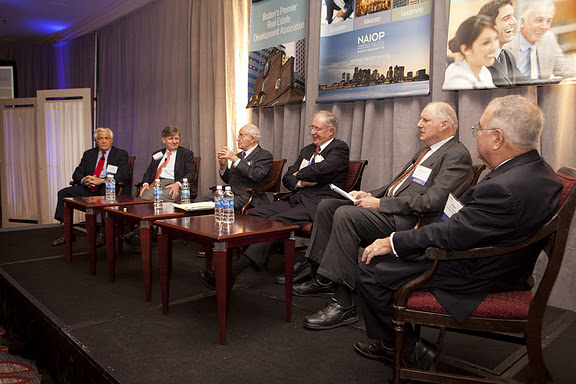
At NAIOP’s recent program, Get Inspired with Gerald Blakeley and the Icons of Boston Real Estate, panelists and CC& F alumni discussed the culture at Cabot, Cabot & Forbes and why it resulted in launching the careers of so many of today’s local and national icons of commercial real estate.
View the video highlights.

Many younger real estate professionals may not realize that CC&F was the national pioneer of over 20 million SF of suburban master planned business parks.  During the program, Gerry Blakely, CC&F’s former CEO, described his start leading the company.  Back then, the land use for industrial properties was either building footprint or paved parking.  Very different from today, there were virtually no setbacks, landscaping, or design covenants.  CC&F’s new model was a commercial business park that established development restrictions and dimensional requirements more strict than the underlying zoning.  Although few banks wanted to risk lending for such a radical and risky venture, CC&F was able to get started and soon proved the profitability of this new concept. In 1948, CC&F opened The New England Industrial Center – the country’s first master-planned business park.  With the preservation of natural site amenities and consistent design standards, this facility quickly became a prototype for business parks that has been emulated worldwide.

CC&F was also responsible for creating millions of square feet of first-class office space across the country.  Their Boston landmark properties include 60 State Street, One Boston Place, 100 Summer Street, and 28 State Street.

As Bill McCall, President of McCall & Almy, pointed out, the people that Gerry attracted to the company were the brightest around who all shared a strong drive to succeed.  These were entrepreneurs taking charge of their own particular divisions within CC&F, whether it was for the industrial, office, or national build-to-suit markets.

The obvious risk was that they were hiring the kind of personalities that would ultimately want to do this work on their own behalf.   Although that proved true for many of the alumni, the company benefitted from that intense, productive energy.

The list of CC&F graduates is impressive and includes: Don Chiofaro, President, The Chiofaro Companies; Ferdinand “Moose” Colloredo-Mansfeld, Senior Advisor, Cabot Properties, Inc.; Terry Considine, CEO, AIMCO; Arturo Gutierrez, Chairman, The Gutierrez Company; Mort Zuckerman, Chairman; and Ed Linde, former CEO, Boston Properties.

The legacy of Blakeley and CC&F lives on with so many of the alumni actively involved as leaders in our industry.  At the conclusion of our program, NAIOP presented the chapter’s first ever Lifetime Achievement Award to Gerry Blakeley for his contribution to the industry and his impact on Greater Boston.

MassDOT Looking for Opportunities

On December 6, MassDOT Secretary and Chief Executive Officer Richard Davey spoke at NAIOP’s Government Affairs Roundup.  He discussed a number of his priorities as Secretary.  First and foremost, he is committed to supporting innovation within the agency.  He is encouraging employees to do things differently and to come up with creative solutions to some of the challenges facing MassDOT.  His energy and passion for the job are clear.

A top priority for the agency has been the implementation of the transportation reform legislation passed in 2009. The impetus for that bill was the mandate that there be reform before any discussion of new revenues.  Although there was no discussion of new revenue streams at the NAIOP program, Davey made it very clear that MassDOT cannot continue to maintain current services (and certainly not expand services), given the significant reductions in budgets and staffing.

One particular area of discussion was the agency’s cataloging of its real estate holdings to determine what opportunities might be available, including public/private partnerships.  NAIOP will be closely monitoring such opportunities.  Another priority is electronic tolling.  Currently being used in a number of other states, only e-tolls will be used on the Tobin Bridge starting next year.

His remarks also illustrated the need for a complete financial restructuring of the MBTA if it wants to continue to provide current services or consider any expansion plans.  Debt is the major problem for the MBTA, with 50 cents of every $1 of revenue going to debt service.

Secretary Davey is optimistic regarding the future of MassDOT, but he is also a realist who understands that reforms can only get you so far.  We encourage a rational discussion about the historic, existing, and future requirements for infrastructure.  If we do not invest in our future, we will ultimately pay a higher price in lost businesses and jobs.

Hank Spaulding in Memoriam

The real estate industry lost an icon with the passing of Hank Spaulding this past week.  Even that statement does not do justice to the impact this man had on our region and our industry.

He was one of the many influential alumni from the master real estate development firm, Cabot, Cabot & Forbes that included Gerald Blakeley, Mort Zuckerman, Ed Linde, Moose Mansfeld, Don Chiofaro, Terry Considine, Arturo Gutierrez, and others. (NAIOP will be honoring Gerry Blakely and CC&F’s “offspring” at NAIOP’s Annual Meeting on Thursday, December 15.) He then went on to co-found Spaulding & Slye, one of the most prolific full service real estate companies.

His influence on the cityscape of this area was already established by then, but his influence around the world was set into motion with his establishment of the MIT Center for Real Estate that opened in 1984. Hank knew that our business was becoming more complex and required a broader understanding of the numerous components that went into creating housing and commercial spaces. What it needed was a graduate program designed to train real estate developers. The school has been a tremendous success educating real estate professionals from around the world.

Hank Spaulding gained the respect of everyone he ever dealt with through his generosity and wisdom. He will be missed by all of us who knew him.

Place Your Bets on Opening Dates for Massachusetts Casinos

With Governor Patrick signing the first ever, full-scale casino bill, the race is on to develop three resort casinos and one slot parlor.

However, this will be more like a steeple chase race with many obstacles to overcome.  There are the procedural steps of choosing a chairman and members of the yet to be formed gaming commission, and developing the regulations and processes for applicants.  Each potential developer will have to gain control of a potential site, obtain all local approvals, commit and fund the off-site infrastructure improvements, and show financial wherewithal to complete the development plans.  Then there are the public “threats” that already include one local developer’s lawsuit challenging the fairness of the law, the possibility of a ballot initiative to overturn the statute, and the likely local appeals from abutters and other citizen suits.

Welcome to the world of the real estate developer.  There are reasons why Massachusetts projects take longer to permit and build.

That being said, there are highly motivated, well-funded, and patient corporations that have already lined up and others that will be announcing their interest over the next few weeks. Let the games begin!

To learn more about this process and the players, don’t miss NAIOP’s January 19th breakfast program, Casino Gambling Coming to the Commonwealth, at the Westin Waterfront Hotel.

If You Build It, They Will Come: Demand Exists for More Multifamily Housing in Greater Boston

A recent article in The Boston Globe talked of the recent surge in apartment construction, identifying 11 developments either under construction or about to receive final approvals. Although not as many, there are also large multifamily projects underway in the suburbs, including John M. Corcoran’s development in SouthField (the former Weymouth Naval Air Base) that Rick High described at NAIOP’s recent lunch program.

Some skeptics believe that the weak economy and high supply will result in an oversupply of multifamily housing. I disagree. There is no doubt we have room in the market for quite a few more projects, both in Boston and the surrounding communities.

Since the recession began in 2009, the vacancy rates for rental housing have plummeted and, not surprisingly,  the rents have pushed upwards.  Boston now has one of the lowest vacancy rates in the country. With higher rents and interest rates remaining historically low, new multifamily developments are finally viable.  Though the costs of housing production in Massachusetts are still among the highest in the nation, due in part to labor costs, these projects are profitable (by some rather thin margins, though.)

If you believe the increased demand is only due to the burst of the single family housing bubble and the resulting foreclosures, you need only look at the other drivers in this area. The research firm REIS has reported that the net absorption in this market is the highest on record since it started tracking the data in 1980!

As reported by Cushman & Wakefield, there are a number of factors contributing to the growth of the rental housing market in the Boston area:

  •  Job Growth: With a conservative 35,000 jobs a year projected to be created, there will be an additional 35,000 households over the next 5 years;
  • Change of Ownership: 87,000 rental households are needed to fulfill the demand created by the shift in ownership from single family to rental;
  • Increase of Echo Boomers (ages 21-34): 27,000 rental units are needed to satisfy the demand created by this generation. Approximately 75% of this population are renters and this demographic is expected to grow by 2.2% over 5 years.

Bottom line – that’s a lot of demand!  And even with all of the construction planned, the vacancy rate is still projected to drop.  Certainly good news for developers and the Massachusetts economy!

Retainage Legislation Increases Risks and Hinders Development

Yesterday I testified before the Legislature’s Joint Committee on Labor & Workforce Development in opposition to legislation that would make substantial changes to contractor retainage payments. NAIOP believes that the legislation, An Act Relative to Fair Retainage Payments in Private Construction – H. 1401 and S. 956, would hinder economic development at a time when the construction and development sectors are still reeling from the worst recession in a generation.

The bill sets an outside limit of 5% (reduced from the standard practice of 10%) for approved contract payments that can be withheld for retainage.  Retainage is traditionally held until final completion of a project in order to incentivize prompt completion of the project and guarantee that the contract is fulfilled as agreed.  The legislation changes the final payment date to within 30 days after “substantial completion” (a phrase that is unclear and likely to be the source of many legal battles) and it would create enormous uncertainty for developers.

Very few development projects are moving forward.  Financing, especially for larger projects, is extremely difficult to obtain.  Anything that increases uncertainty could make financing a project even more difficult.

Finally, though supported by the Associated Subcontractors of Massachusetts, this legislation could actually have a negative impact on the smaller, less established subcontractors.  Without adequate retainage, developers will not be willing to take a risk with a lesser known subcontractor.  As a result, the legislation would give an advantage to the bigger subcontractors.

Given the current economy, the Commonwealth should be doing all it can to encourage job creation, not find ways to slow or hinder economic development.  Though we do not think the legislation has a high likelihood of passage, we will continue to advocate against it through the remainder of the legislative session.

MassINC Has Some Serious Fun – Menino Stars as The Godfather

MassINC recently celebrated its 15th anniversary at the Kennedy Library with an evening of political humor (intentional humor, that is!) billed as “Serious Fun.”

I am a board member of this public policy think tank and I am very proud of the work that this organization has done through its research and its highly respected CommonWealth magazine. MassINC was built around the conviction that better outcomes would be achieved if policy makers and opinion leaders were armed with credible data and analysis about key issues surrounding quality of life in Massachusetts.

As the State House News Service described it, “The event was everything the Saint Patrick’s Day breakfast once was.” Leading political figures from yesterday and today all let their hair down and joked around at themselves and their peers.

You must watch the opening video parodying “The Godfather” with Mayor Menino.

MassINC President Greg Torres said it well,“We thought a lot about the tone of the political discourse these days. And we thought, maybe it was time to just take a break.Maybe it was time to step back and have a little fun at the expense of ourselves and everybody else in town.”

Congratulations to the MassINC team and its 15 years of success.  Massachusetts is a better place to live and work thanks to you!