Climate change legislation will cause a flood of regulations

The following Op Ed appeared in the Boston Business Journal on July 31, 2015.

As we saw in New York City with Hurricane Sandy, climate change can have significant impacts affecting the overall economy; directly, by damaging structures, and indirectly, by compromising transportation systems, communications, and utilities. An increasing number of extreme weather events and future sea level rise may lead to more frequent and extensive flooding along the East Coast.

A primary role for city and state governments should be to ensure the continuity and protection of public infrastructure and public safety. The business community, and the community at large, need to have a clear understanding of the government’s responsibilities and its plans for preparing infrastructure and critical services for these potentially cataclysmic events.

NAIOP Massachusetts, The Commercial Real Estate Development Association, has long been one of the leading business groups advocating for a coordinated approach between the public and private sectors with respect to climate change planning.

However, we are very concerned about a bill that was recently passed by the Senate to establish a far reaching planning and regulatory process for addressing climate change. Senate Bill 1979 contains very subjective, vague, and expansive language that could have extremely negative consequences for the Massachusetts economy today and into the future.

We believe the open-ended language the bill contains could lead to widely varying interpretations of how the legislation should be implemented, creating uncertainty and potentially stalling projects for years to come. While we believe that climate change planning is an important issue, this bill is not the solution. Under the legislation, all grants, permits, licenses, approvals, or actions of any kind for any proposed projects, uses or activities issued by any state agency or state authority could be challenged and held hostage to these ambiguous goals. This would open the “regulatory door” to a wide range of proposals, substantially changing and exceeding well established standards and procedures – with few having any direct connection to climate change.

Given how this vague and confusing language could be interpreted, the potential for lengthy and costly legal challenges is quite high.

For these and many other reasons, the bill, as written, cannot and should not be passed into law.

Addressing climate change and sea level rise requires coordination at the highest level of state government and the participation of many state agencies. There needs to be a balance of adequate planning and a risk-based, cost-benefit analysis to ensure that funds are prudently expended by the public and private sectors when considering climate change-related investments. Through such an effort, climate change resiliency will become a more attainable goal.

NAIOP Applauds Legislature for Budget with Important T Reforms

Last night a $38.1 billion state budget (H. 3650) was released from conference committee. NAIOP applauds the conference committee members (House Ways and Means Chairman Brian Dempsey, Senate Ways and Means Chairwoman Karen Spilka, Sens. Sal DiDomenico and Vinny deMacedo and Reps. Stephen Kulik and Todd Smola), Senate President Stan Rosenberg, and Speaker of the House Robert DeLeo for their leadership in passing a bill that includes important reforms for the MBTA.

One of the most important aspects of the bill (and something NAIOP has championed) is the creation of a MBTA Fiscal and Management Control Board chaired by the Secretary of MassDOT. The budget states that the Fiscal and Management Control Board shall “initiate and assure the implementation of appropriate measures to secure the fiscal, operational and managerial stability of the authority and shall continue in existence until June 30, 2018.” A two year extension beyond 2018 could be granted if needed. The Board shall formulate and recommend a plan to the secretary of transportation to stabilize and strengthen the finances, management, operations and asset condition of the authority. The Fiscal and Management Control Board will also develop performance metrics and measure items included in the plan. NAIOP believes the creation of the Control Board will provide greater accountability and transparency for the T’s governance and management practices and is critical to ensure a safe, reliable, fiscally stable, modern transit system for Massachusetts.

The budget also suspends the Pacheco Law for three years. The Pacheco Law requires a vetting process before privatization of services at the MBTA and, according to a report released today by the Pioneer Institute, it has cost the MBTA at least $450 million since 1997. NAIOP strongly supports this important reform.

The House and Senate are expected to approve the budget today and then it goes to Governor Baker for his review. He then has 10 days to review it review it before signing it and announcing amendments and vetoes.

NAIOP will continue to actively advocate for transportation reforms that support roads, bridges, public transit – and economic growth.

NAIOP Testifies in Support of Transportation Legislation

Yesterday, building off of our ongoing advocacy on this issue and the statement we recently signed with 24 other business groups, NAIOP testified before the Joint Committee on Transportation urging legislative leaders to fix the the Commonwealth’s broken public transit system by adopting the recommendations outlined by the Governor’s Special Panel to Review the MBTA. We will continue to work with the Baker Administration, legislative leaders and business groups to advocate for real reforms that will quickly address the needs of the Commonwealth’s citizens and businesses.

NAIOP’s testimony from the hearing follows:

NAIOP Massachusetts, The Commercial Real Estate Development Association, Supports House Bill 3347
May 11, 2015

NAIOP Massachusetts, The Commercial Real Estate Development Association, would like to express its support for House Bill 3347, An Act Relative to a Reliable, Sustainable Massachusetts Bay Transportation Authority.

NAIOP Massachusetts represents the interests of companies involved with the development, ownership, management, and financing of commercial properties. NAIOP’s 1,600 members are involved with more than 240 million square feet of office, research & development, industrial, mixed use, retail and institutional space in the Commonwealth.

This winter, businesses across Massachusetts felt the impact of the Commonwealth’s failing transportation infrastructure. Employees simply could not get to work. The T, in particular, illustrated the negative impact an unreliable transit system has on the economy. Those who normally relied on the T, but had the option of driving, caused roadways to be more congested and commuting times to grow exponentially. There is no question that without a reliable public transit system, the economic wellbeing of the Commonwealth will continue to suffer. The time for action is now.

NAIOP and 24 other business organizations from across the state recently signed a statement urging policymakers to act quickly to make the changes needed to transform the MBTA into a modern, world-class public transit system. House Bill 3347, which includes many of the recommendations outlined by the Governor’s Special Panel to Review the MBTA, would be an important first step in the right direction.

The bill contains a number of important provisions. It will provide greater accountability and transparency for the T’s governance and management practices through the establishment of a Fiscal and Management Control Board. It sets performance metrics so progress can be measured and goals can be achieved in a reasonable amount of time. It addresses the T’s procurement and maintenance practices so that the system is safe, reliable and in a state of good repair. Most importantly, it requires the Control Board to implement a plan designed to stabilize and strengthen the finances, management, operations and asset condition of the MBTA and to ensure a safe, reliable, fiscally stable, modern transit system for Massachusetts.

We urge the Committee to give this bill a favorable report and to take the steps needed to create a world class public transit system that will meet today’s needs and accommodate the growing demands of future economic growth.

President Obama Signs Energy Efficiency Improvement Act of 2015

Energy BillPresident Obama recently signed into law the Energy Efficiency Improvement Act of 2015 (S. 535), which creates a new “Tenant Star” to encourage energy efficiency in leased commercial spaces. Tenant energy usage can account for 50 percent or more of a building’s total energy usage. Like its predecessor, “Energy Star”, Tenant Star is a voluntary, market based, cost free program that is expected to encourage optimum energy efficiency in leased commercial spaces, helping the environment by cutting greenhouse gases.

This program has been championed by the real estate industry through the direct efforts of the Real Estate Roundtable. The U.S. Environmental Protection Agency, in consultation with Department of Energy, will start developing standards for the Tenant Star designation within 180 days.

Along with Energy Star (which is aimed at encouraging energy efficiency within the building core), this new designation will encourage office tenants with their landlords to design and construct cost-effective energy investments in the building’s leased spaces.

NAIOP believes that the Tenant Star program can be an effective educational program that leads to voluntary, smart, cost-effective energy efficiency investments.

Business Coalition Urges Governor and Legislature to Create World-Class Transit System

A broad coalition of 25 business associations representing large and small employers from a wide range of industries today issued the following statement urging the Governor and the Legislature to adopt the recent recommendations made by the Special Panel to Review the MBTA and to swiftly begin the task of fixing the state’s public transit system:

Business Coalition Statement in Support of a World-Class Transit System

The Challenge
The winter of 2015 highlighted the Commonwealth’s transportation vulnerabilities, particularly for the MBTA. While school and business cancellations, a dramatic drop in retail sales, and an increase in public safety risks result from many major winter storms, the complete shutdown of the MBTA followed by a prolonged reduction in services for the subways and commuter rails are not the norm.
The unreliability of our public transit system caused many businesses to lose substantial revenues from the loss of productivity due to delays and/or the inability of workers to get to work. Many hourly workers forfeited wages; many retailers forfeited sales; many restaurants forfeited patrons; and the Commonwealth forfeited the income, sales and meals tax associated therewith. A sub-optimal public transit system also caused roadways to be more congested than usual and commuting times to grow to unreasonable lengths for those who opted to drive or were transporting goods. The adverse financial impacts totaled in the billions of dollars. This is unacceptable and must not be repeated.

The Framework
Due to the urgency of fixing the MBTA and the need for the public transit system to be reliable and fully functional, the undersigned business organizations are requesting policy makers to address the following issues:
• Make the T a customer-focused organization that provides first-rate service and clear communication while instilling confidence in its ridership.
• Provide greater accountability and transparency for the T’s governance and management practices to ensure the entity is efficiently and effectively run while employing a productive workforce.
• Develop a long-term strategic and capital plan for the T that efficiently uses its resources to enhance the current capabilities and future needs of the T, businesses and workers, while providing sufficient funding to cover the costs.
• Overhaul the T’s procurement and maintenance practices so that the system is safe, reliable and in a state of good repair.
• Establish metrics, milestones and regular reporting to ensure proper implementation of the T reforms within a reasonable period of time.
• Ensure that the T balances its operating budget without the need for ever-increasing state assistance each year.

The Solution
The undersigned support this position and urge the Governor and the Legislature to act swiftly so we can begin the arduous task of fixing the state’s public transit system.

Following a thorough analysis of the various recommendations from the Governor’s Special Panel to Review the MBTA, and measured against the principles outlined above, we endorse the Panel’s proposal and urge the Legislature to adopt the plan immediately.

The following business organizations support this statement:
495/MetroWest Partnership
Affiliated Chambers of Commerce of Greater Springfield
American Council of Engineering Companies of Massachusetts
Associated Industries of Massachusetts
Associated Subcontractors of Massachusetts
Construction Industries of Massachusetts
Environmental Business Council
Greater Boston Chamber of Commerce
Greater Boston Real Estate Board
Massachusetts Biotechnology Council
Massachusetts Chemistry & Technology Alliance
Massachusetts High Tech Council
Massachusetts Lodging Association
Massachusetts Petroleum Council
Massachusetts Restaurant Association
Massachusetts Taxpayers Foundation
Massachusetts Technology Leadership Council
Massachusetts Business Roundtable
Metro South Chamber of Commerce
NAIOP Massachusetts, The Commercial Real Estate Development Association
National Federation of Independent Businesses
Neponset Valley Chamber of Commerce
North Shore Chamber of Commerce
Retailers Association of Massachusetts
South Shore Chamber of Commerce

Quotes from Business Coalition Members:
“The unreliability of the public transit system has caused many businesses to lose substantial revenues from the loss of productivity due to delays and the inability of workers to get to work,” said Richard Lord, President and Chief Executive Officer of Associated Industries of Massachusetts (AIM).

Eileen McAnneny, President of the Massachusetts Taxpayers Foundation, said, “Now that the breadth and severity of the problems confronting the MBTA have been revealed and the price of inaction is evident, we have a real opportunity to move forward with a plan for transforming the MBTA into a modern, world-class public transit system.”

“The transit system experienced a ‘stress test’ and failed. The time is right to not only fix today’s MBTA, but ensure that it will meet future demands,” said David Begelfer, CEO of NAIOP Massachusetts, The Commercial Real Estate Development Association.

“The MBTA is critical to Greater Boston’s economy. Workers, customers, patients, students and tourists depend on it every day. We need to take the T to the next level right away,” said Paul Guzzi, President and CEO of the Greater Boston Chamber of Commerce.

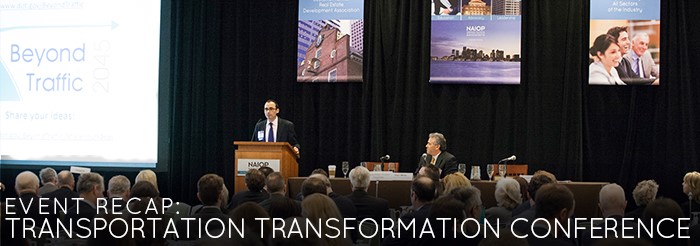
Transportation Transformation: Event Recap & Support for MBTA Reforms

On Thursday, April 9, NAIOP hosted the Transportation Transformation Conference, which featured federal and state transportation officials as well as national experts who discussed the role of transportation in a growing Massachusetts economy; new technology and other innovative solutions to transportation challenges; and what the future holds for the nation and Massachusetts.

The event was held the day after Governor Baker’s Special Panel to Review the MBTA released its detailed report on a plan of action to reform and improve the MBTA. MassDOT Secretary Stephanie Pollack discussed the report’s findings at the event. NAIOP supports the recommendations outlined in the report and looks forward to working with the Baker Administration, Legislature and the business community to create a reliable and safe public transit system.

The following is a guest blog and event recap by Fred Wagner, Principal at Beveridge & Diamond, former Chief Counsel of the Federal Highway Administration (FHWA), and moderator at the Transportation Transformation Conference. The post originally appeared on Enviro Structure.

TRANSPORTATION TRANSFORMATION RECAPThe NAIOP Massachusetts Transportation Transformation conference held on April 9 was one of those rare trade association meetings where you didn’t want the sessions to end.  Ideas flowed from the podium and from the audience faster than the New England melting snow flowed into the Charles River.

Perhaps unwittingly, transportation thought leaders from local, state and federal agencies echoed the philosophy of legendary architect Daniel Burnham (D.C.’s Union Station, NYC’s Flatiron Building):  “Make no little plans; they have no magic to stir men’s blood and probably themselves will not be realized.  Make big plans, aim high in hope and work, remembering that a noble, logical diagram once recorded will not die, but long after we are gone be a living thing, asserting itself with ever-growing insistence.”

Over 300 attendees heard Vinn White, Senior Policy Advisor to the U.S. Department of Transportation Secretary Anthony Foxx, describe the draft “Beyond Traffic” report  and how the challenges of demographic and technological trends will shape our transportation network looking 30 years into the future.  After showing this well-viewed YouTube video showing traffic flow in Ethiopia’s Meskel Square, he asked what these images of chaos had in common with what you’d see in Davis Square in Somerville, Massachusetts.  The answer?  People.  People living their lives, trying get to work, bringing kids to school, or visiting friends and family.  In short, Mr. White suggested, even if our major intersections thankfully don’t resemble the bedlam from Meskel Square, we may have more in common than we think.

Newly confirmed MassDOT Secretary Stephanie Pollack described how in her view, there was no such thing as a transportation plan that existed in isolation.  Rather, she wanted to know from communities what they thought their biggest challenges were, and then look to transportation infrastructure to help solve those challenges.  “Don’t just pull projects off the shelf that have been there for 30 years,” she has instructed her new staff.  “There’s probably a reason they’ve been up on that shelf for so long.”

Secretary Pollock’s views were supported by Jay Ash, the new Secretary of Housing and Economic Development in Massachusetts Governor Baker’s Administration.  He commented to the receptive audience how unusual it must be for them to hear a Transportation Secretary and an economic development executive being so much on the same page.  Secretary Ash reiterated how he had, over the course of his career in public service and in his new role, visited communities all over the Commonwealth with visionary plans.  All of them demanded to some extent an improved transportation network to convey people to new centers of commerce, education, or recreation.

Finally, Gabe Klein, the former head of Washington, D.C.’s and Chicago’s Departments of Transportation, and Harriet Tregoning, the Director of the U.S. Housing and Urban Development Office of Economic Resilience, both provided a glimpse into the future of urban/suburban transportation.  Pedestrians, bicyclists, streetcars, and yes, even automobiles, living in harmony, operating on re-engineered streets that provide safe and reliable means of mobility.

“Change is coming faster than we believe,” Mr. Klein predicted.  Autonomous vehicles could be a reality in less than 5 years, given the current pace of technological advances and investment by huge companies like Google and Amazon.  Parking downtown could be a thing of the past, as people share solar-powered, self-driving cars, moving seamlessly between work and errands, never really needing a place to leave an empty, under-utilized vehicle.  Imagine planning a new mixed-used development without the burden of complying with a parking ratio?  Not quite worthy of a John Lennon lyric, perhaps, but even so…

Gatherings like this serve as a reminder why all of us in the development sector love our work.  We get to “make big plans” and, with any luck, see them come to life.

View event photos

Farewell to Real Estate Icon Norman Leventhal

NBLNorman B. Leventhal passed away April 5, 2015 and his loss is being felt not only by those who knew him, worked with him, and admired him, but by so many of the residents and workers in the state, who benefited by his vision and skills as a master builder.

He created landmarks throughout the City of Boston and in many of its surrounding communities. Each stands out as a thoughtful creation, built to endure throughout the ages.

The list of his projects would populate any list of Boston’s great buildings: Rowes Wharf, Center Plaza, 75 State Street, One Post Office Square, Meridien Hotel, South Station, and the Post Office Square park/garage.

Norman was passionate about his work, his family, and his city. His philanthropic interests were far and wide. He never stopped caring.

Our condolences go out to his wife and family.

Beyond Traffic: Imagining a Brighter Infrastructure Future

The following is a guest blog by Fred Wagner, Principal at Beveridge & Diamond, former Chief Counsel of the Federal Highway Administration (FHWA), and moderator at the upcoming NAIOP Transportation Transformation Conference in Boston on April 9.The post originally appeared on Enviro Structure. The Beyond Traffic report will be one of many topics discussed at the upcoming event. We hope to see you there!

U.S. Department of Transportation Secretary Anthony Foxx has a favorite saying that he attributes to one of his public school teachers:  “Having no plan is a plan.”  Well, now the USDOT has a plan, or, as it calls it, a “framework,” to create the foundation for transportation infrastructure improvement for the next 30 years.  It’s called “Beyond Traffic,” a remarkably comprehensive analysis of existing data, expected trends, and policy suggestions for the entire spectrum of future transportation choices.

On April 9, NAIOP Massachusetts, The Commercial Real Estate Development Association, will host a forward-thinking conference  -“Transportation Transformation” – examining the role of transportation in a growing Massachusetts economy and its impact on real estate development.  A representative of the USDOT’s Office of Policy will kick off the NAIOP event by describing the Beyond Traffic framework and offering ideas on how the concepts reflected in Beyond Traffic could be applied to regional and local transportation planning efforts. Beveridge & Diamond is proud to sponsor this important event.

While it’s difficult to summarize a 300+ page document in one blog post, I’ll give it a go.  The over-arching theme could be this:  “Let’s make infrastructure investment decisions based on the reality of what is and what is likely to be, rather than simply based on short-term fixes to maddening congestion challenges.”

What are some of those realities?

  • We face an aging transportation system that desperately needs attention.
  • More and more Americans will be settling in “mega-regions” around the country, potentially exacerbating congestion in our already most populated cities.
  • Younger people will likely continue to drive less, and look to alternative means of mobility.
  • At the same time, the proportion of older Americans will continue to grow, placing greater demands on travel for work and leisure in that segment of our population.
  • Innovation will alter the way we think about commuting, from ride-sharing options, to increased telecommuting, to autonomous vehicles.
  • Our changing climate will demand that we stress adaptation for some of our most crucial transportation infrastructure.

Some of the data revealed in Beyond Traffic is no doubt sobering.  The U.S. population is expected to increase by 70 million by 2045.  Transportation costs will continue to be the second largest expense for U.S. households (besides shelter) and, at the same time, will likely remain the second highest source of GHG emissions.  We face a huge investment gap at the same time a political solution to long-term funding at the federal level remains a daunting challenge.

Yet, for every significant challenge, great opportunities exist.  Technological advances have resulted in a doubling of vehicle fuel efficiency standards.  Americans have much greater flexibility in how and where they work.  GPS technology tells us where we need to go, but can also be used to help us find parking spaces downtown or in garages more efficiently.  Autonomous vehicles can potentially allow even more vehicles to use our highways and streets, but do so more safely and efficiently.  (Never mind getting additional work done while your car drives you to your destination.)  Freight shipments will also become more efficient as automation connects ports to rails to trucks.

Beyond Traffic challenges all of us to confront how future policy choices could either complement or conflict with these trends.  While the USDOT stresses that this framework is not an action plan, it cries out for all of us to consider how to create such a plan.  Anyone interested in this topic should go to www.dot.gov/beyondtraffic to offer comments before a final version of the report is published later this year.

Good to Great: Creating a Long-term Vision for the Commonwealth’s Transportation Needs

On April 9, NAIOP will host Transportation Transformation, a thought provoking conference addressing the challenges and opportunities facing Massachusetts as we plan for the transportation system of the future. MassDOT Secretary Stephanie Pollack and Secretary of Housing & Economic Development Jay Ash will discuss the role of transportation in a growing Massachusetts economy. Vinn White, Senior Policy Advisor, Office of the Secretary, US Department of Transportation will discuss how demographic shifts will affect transportation, and nationally recognized transportation experts will discuss lessons learned from other regions, new technologies to consider, and what all of this means for real estate development. If you fought to get to work this winter, then this conference is for you!

Building off of these same themes, we thought this week was a good week to share our Good to Great recommendations to MassDOT. Special thanks to Marilyn Swartz-Lloyd, President and Chief Executive Officer, of the Medical, Academic, Scientific Community Organization (MASCO) for her input on this. Comments, as always, are encouraged!

Good to Great: Creating a Long-term Vision for the Commonwealth’s Transportation Needs
The Commonwealth’s transportation infrastructure is critical to our state’s economy, quality of life and industrial competitiveness. However, many of its elements have already exceeded capacity constraints with increasing delays on congested highways and transit systems. At the same time, demand has increased and is predicted to continue over the coming years with no major increases in capacity coming soon. Without a serious long-term plan, further declining services, increased travel times, and a degraded environment will be the future of the Massachusetts transportation system.

In 1970, Governor Frank Sargent created the Boston Transportation Planning Review that analyzed and redesigned the entire area-wide transit and highway system. It provided a blueprint for transportation policy and investment that we have been effectively following for the last 40 years. Massachusetts needs a similar long-range visionary thinking that will result in a comprehensive transportation plan for 2040.

A Vision 2040 Transportation plan, endorsed by the Baker Administration, should address tomorrow’s opportunities, focusing on the issues which may arise over the next 25 years, including long term demographic, economic, environmental, technological, cultural and governmental transformations, the potential effects of global climate change on infrastructure, and the development of new modal choices.

To successfully implement such an initiative, NAIOP supports the following guidelines:

  • Connectivity is key: Creating a seamless, reliable connection between air and rail, bus and subway, and the network of roads and transit is necessary for improving the flow of ideas and people.
  • Out-of-the-box thinking is vital: New and “disruptive” technologies are already impacting other parts of society and should be considered, making enhanced transportation information sharing through technology an integral part of the Commonwealth’s hand-held knowledge system.
  • Public Private Partnerships needed: Innovative public private partnerships can leverage the limited state resources to increase capacity to actualize a long-term plan that can be implemented over the next decades.

Good to Great: Developing a Public Private Partnership on Climate Change Resiliency

Yesterday, NAIOP was proud to participate in a Climate Change Resiliency Forum at the State House. NAIOP’s CEO, David Begelfer, joined legislators, climatologists, environmental advocates, a representative from the insurance industry and EEA Secretary Matthew Beaton to discuss this important economic development issue. NAIOP advocated for a public private partnership and echoed the comments we presented to the Baker Administration in the Good to Great report. The following is our weekly excerpt from that report. Comments are encouraged!

Climate change can have significant impacts affecting the overall economy; directly, by damaging structures, and indirectly, by compromising transportation systems, communications, and utilities. An increasing number of extreme weather events and future sea level rise may lead to more frequent and extensive flooding along the coast and inland waterways.

The varying interpretations and projected economic and environmental impacts from climate change and sea level rise demand that the private and public sectors coordinate their common objectives. Unfortunately, to date, there has been a serious lack of coordination or collaboration on this issue. Individual cities and towns are taking their own steps to regulate and respond to climate change and sea level rise. Within MassDEP alone, multiple climate change policies and regulations are being drafted using different climate change projections. All of these regulatory and policy initiatives are focusing on how private development projects should address this issue, and very few have addressed the public sector’s role. For example, capital expenditures will be necessary for equipping existing public infrastructure to meet storm surges. Clearly, having a “climate change proof” building in the middle of a flooded neighborhood, without power or adequate transportation, provides no real public or private benefit.

There is no question this issue will be a significant challenge for the Baker Polito Administration. Addressing climate change and sea level rise requires coordination at the highest level of state government, and the participation of many state agencies. Therefore, NAIOP urges the Administration to consider the following steps to better coordinate how this issue is addressed in order to avoid the calamities that have been suffered by other coastal states:

Create a high level point of contact (Climate Change Chief) for local, state, and federal agencies, as well as the private sector. This position should be located in the Governor’s office or within the Executive Office of Administration & Finance. Given the need for coordination across many facets of state government, and the impact of this issue on the state’s resources, it should not be located in EOEEA. Planning for responses to rising sea levels is an operational and infrastructure challenge, not an environmental policy issue. To ensure consistency across the Administration, the Climate Change Chief should have input on all policies or regulations dealing with climate change. All agency findings and regulations regarding the extent of sea level rise or climate change must not be cost prohibitive to the private sector and should include public funding and participation.

Working closely with the Governor’s office, the Climate Change Chief would pursue the following action items:

  • Establish a structure/partnership with academic and research institutions to identify, develop, test, and incorporate reliable climate change and sea level rise forecasts and climate change preparedness programs.
  • Conduct an inventory of state agency regulations adopted or now under review/proposed dealing with how existing and new public and private development should respond to climate change and sea level rise.
  • Undertake an inventory of state and regional authorities, their threatened assets, and their infrastructure preparedness needs, and identify state monies committed to study climate change and sea level rise. Identify capital funds that should be dedicated to infrastructure upgrades for vital state and regional properties, with a priority toward vulnerable infrastructure.
  • Coordinate the agenda of the state agencies responsible for establishing a target range for sea level rise, determining its effect upon existing infrastructure and future development and developing guidelines for climate preparedness and mitigation planning and review (e.g., MEPA, MassDOT, MBTA, BBRS, MWRA, MassDEP, DPU, Mass Housing, MEMA and CZM).
  • Identify state agency personnel responsible for the review of policies, procedures, and regulations regarding climate change and sea level rise.
  • Ensure that cost-benefit analysis guides policy making. Policymakers should look at programs in terms of maximizing preparedness and resiliency benefits while minimizing burdens on fiscal and other resources.
  • Encourage consistent local efforts to address climate change preparedness including identifying susceptible infrastructure (e.g., mass transit, highways, stormwater systems, energy, fuel, communications, etc.), adopting reliable climate change projections, and establishing guidelines and regulations to incorporate climate change into future planning decisions and outreach programs.

We urge the Governor to coordinate this critical effort to ensure focus and consistency on this economic development issue.