Off to Israel with Governor Patrick

An important part of NAIOP’s mission is to promote overall economic development, which in turn supports the Commonwealth and its business community.  As such, I am honored to represent the members of NAIOP by joining Governor Deval Patrick, along with a coalition of state officials and business leaders, on next week’s Massachusetts Innovation Economy Partnership Mission to Israel. The coalition will explore growth opportunities within the Commonwealth’s innovation-based industries – technology, life sciences, clean energy and financial services – and areas of common interest between the state’s established and emerging partners in Israel.  The coalition will then continue on to the UK.

During the trip, I will join Governor Patrick and members of the delegation in roundtables, company visits, and meetings with government and business officials in Tel Aviv, Haifa, and Jerusalem.  I believe the mission is an important opportunity for the Commonwealth to explore new growth opportunities and business relationships in the global market, which could lead to increased real estate investment and development throughout the state

There are nearly 100 companies with Israeli founders or Israeli-licensed technologies in Massachusetts today.  In 2009, these companies employed nearly 6,000 people and generated $2.4 billion in direct revenue for the state. Local firms exported over $180 million worth of goods to Israel in 2009 and, at 12.35 percent, the United States is Israel’s largest source of imports.

I plan to blog from Israel and provide regular updates about what we learn. When I return, I and other participants from this trip and last fall’s City to City trip will present a program on The Boston-Israel Connection, presenting our findings and exploring the possibilities for growth that will benefit our industry.


NAIOP Comments on Proposed Brownfields Policy

Today NAIOP submitted an extensive comment letter to DEP on its proposed Vapor Intrusion Guidance. NAIOP has significant concerns with the guidance document and the negative impact it would have on the redevelopment of the Commonwealth’s Gateway Cities and brownfield sites. In addition to providing a thorough analysis and review of the document, the comment letter also asks DEP for a detailed response to our comments and concerns.

Brownfields can only be successfully redeveloped when the health of site occupants is protected, the regulatory path is clear, required response actions can be performed in a timely and cost effective manner, and regulatory closure means just that.  In other words, potential developers must be comfortable that these issues can be addressed with a reasonable degree of predictability.  In many places, the draft Guidance does not accomplish these objectives.  As a result, there is a very real risk that a significant portion of the sites that will be subject to the Guidance will not be redeveloped. 

All of NAIOP’s comments are provided with the objective of improving the Guidance in a manner that is consistent with the goals referenced in recent public comments made by DEP Commissioner Kimmell.  We share the Commissioner’s interest in building upon the past success of the Commonwealth’s risk-based, Licensed Site Professional implemented, cleanup program to protect public health while encouraging the redevelopment of contaminated sites.  Unfortunately, we believe the current draft of the Guidance does not achieve these goals.  However, we very much look forward to working with the Commissioner and the Department to develop a final Guidance document that does.

Very special thanks to the members of NAIOP’s 21E Committee, especially committee co-chair Ned Abelson of Goulston & Storrs, who contributed an enormous amount of time to this issue over the past several years.

Regulatory Reform – 10 Principles on Guidance

Recently, there has been much talk about the proliferation of regulations, both on a national and statewide basis.  President Obama mentioned it in his State of the Union speech and Governor Patrick referenced it in his Inauguration speech.

There is no doubt that there needs to be a serious review of many regulations at the state and federal levels.  Beyond traditional regulations, however, there is an area of “shadow” regulations that has been expanding through the state’s agencies – regulatory “guidance.”  NAIOP has been concerned for some time about the unlimited growth of guidance.  Guidance is taking on the power of statutes (which can only be enacted by the legislature and the Governor), and/or the authority of regulations (which must be promulgated by the agency under strict controls of the Administrative Procedures Act, including public hearing and provision for judicial review). The purpose of guidance should be to aid in the interpretation of previously existing rules and regulations; not to provide an alternative means to impose new rules without full notice and comment through “rule-making.”

Certainly, there is a place for appropriate guidance, so NAIOP would like to propose ten general principles to be followed when drafting and adopting regulatory guidance:

  1. Guidance should be issued to clarify the interpretation of existing rules and regulations.
  2. A second purpose would be to assist the agency in its review of applications and evaluation of a project’s ability to meet applicable performance standards.
  3. Guidance should be clear and user-friendly.
  4. Guidance documents should state expressly that they are for the purpose of “guidance only,” and that failure to follow guidance does not expose one to the denial of a permit application, penalties, or other sanctions.
  5. Under no circumstance should guidance expand the agency’s jurisdiction (subject matter or geographic) beyond that authorized by statute or regulation. 
  6. Guidance should be drafted with input from stakeholders. 
  7. Following internal and stakeholder review, the agency should submit the document for general public comment, allowing affected individuals to comment on the practical and procedural implications of the guidance.
  8. Agencies should add a three-year sunset clause to all guidance, after which it must either lapse or be reissued following an opportunity for stakeholder and public comment.
  9. All guidance should be clearly indexed and easily accessed on the agency’s web page.
  10. Guidance should be uniformly applied throughout all agency regional offices. Guidance should not be developed and issued by one region without the full support and backing of the entire agency.

In a recent blog, Seth Jaffe, a Partner at Foley Hoag, pointed out that this issue is clearly getting national attention with a recent court decision in National Mining Association v. Jackson.  The judge stated that EPA guidance was being treated as binding and that the guidance constituted “legislative rules because they seemingly have altered the permitting procedures under the Clean Water Act by changing the codified administrative review process.”  The Court found that EPA’s guidance exceeded its authority. 

Bottom line, to reduce the excessive cost of doing business in the Commonwealth, let’s make working on regulatory reform a priority. However, we must also make sure that we don’t offset those gains by piling on unnecessary guidance.

Creating Energy Efficient Buildings – the Right Way and the Wrong Way

President Obama recently proposed a new campaign to make commercial building space 20 percent more energy efficient by 2020.  The good news is that this is not an unfunded mandate to the industry, but a plan utilizing incentives such as tax credits.

The “Better Buildings Initiative” has a goal of making commercial buildings more energy efficient over the next decade. A new and more effective tax incentive for building owners seeking to upgrade, by rewarding companies for performance improvements, so the credit amount would be based on the actual energy improvements made in a specific building.

This is a more practical means of encouraging energy efficiency retrofits than forcing owners to make marginal returns on large capital investments or by labeling their buildings to highlight their inefficiencies.  Especially during a recessionary period, making these latter policy choices can only hurt a fragile commercial real estate recovery.

NAIOP will be looking forward to further details on this new initiative. In the meantime, we recently submitted comments in opposition to the proposed Energy Asset Labeling Program for Commercial Buildings in Massachusetts and we will continue to urge the Patrick Administration not to move forward with this program.

Economic Development Strategies for Patrick’s Second Term

Governor Deval Patrick

Governor Deval Patrick

Kudos to Governor Patrick for his focus on jobs and economic development for his second term. Travelling within the Commonwealth, across the country, and globally to attract economic development to the state can be an effective way to market the benefits of one of the top concentrations of skilled talent in the world.

In addition, opportunities for improving the Commonwealth’s economic environment exist here at home. Recently, John Schneider wrote in MassINC’s “INCSPOT blog” about three suggestions for the Administration:

  1. Conduct a top to bottom review of regulations that affect the state’s business environment.
  2. Make higher education reform a cornerstone of your second term.
  3. Get a handle on rising costs, especially health care, energy, and local government.

I completely agree with these ideas, especially regarding the cost of doing business in the Commonwealth. Many of us know about the direct costs: taxes, fees, health care and unemployment insurance. However, the cost in both time and money that arise from the multiple layers of regulations for existing businesses are an enormous burden and make us less competitive for new growth.

We should encourage our political leaders to get out of the office and aggressively market Massachusetts, but at the same time, we need to do a top-to-bottom assessment of the rules we impose on business. The better we do on the latter, the more success we will have attracting businesses to Massachusetts.

Mismatch in the Labor Market

A newly published study by Alicia Sasser Modestino from the New England Policy Center of the Federal Reserve Bank of Boston points to a growing mismatch with the supply and demand for an important component of our skilled labor pool, “middle-skilled” jobs.  A gap of 780,000 workers could exist by 2018.  She observes that:

  • Since 1990, the region’s population of working-age adults with any postsecondary education has been growing slower than that in the rest of the US due to slower population growth and greater net domestic out-migration.  Over time, New England’s labor force will likely shrink, while that of the nation is likely to grow.
  • While the region has led the nation in terms of increasing the “high-skill” share of its population, it has consistently under-performed in terms of increasing the share of “middle-skill” workers (individuals with some college or an associate’s degree). The supply of skilled workers will not grow fast enough to keep pace with demand once the economy recovers.

According to the report, we need to ”grow our own talent” by increasing postsecondary educational attainment – especially utilizing the Community College system – through career-oriented programs that focus on preparing students for high demand middle-skill jobs. 

However, with limited state resources, putting more funding into community colleges must be tied with the responsibility to make sure that those resources are spent efficiently and effectively.

Suggested actions include:

  • Programs in other states have shown that financial aid along with offering stipends, child care, and transportation during periods of study can boost completion rates.
  • Greater communication between firms that hire “middle-skill” workers and the institutions that educate them could better align training curriculum with employer needs.
  • Better collaboration among community colleges could provide a cost effective, strategic direction needed to achieve these goals.
  • A single, unified system of community colleges could be an important part of an overall workforce development strategy, including other postsecondary education and training options such as employer and vocational training, certificate and apprenticeship programs, career centers, and ESL programs.


Strengthening community colleges can be a win-win-win for students, employers, and the region.

Barriers to an Economic Recovery in Massachusetts

I just finished reading a recent interview with Northeastern University’s Andrew Sum in MassINC’s CommonWealth Magazine.  Andrew is the Director of the Center for Labor Market Studies, which he founded in 1971, so he is no newcomer to the issues plaguing the Commonwealth.

In the interview, Sum makes some powerful observations that illustrate the serious challenges facing the Massachusetts economy:

We are still down 240,000 jobs below where we were in 2001.  We have the fifth worst job creation record in the country. If you take it back to 1988, we are up only 13,000 [net] jobs from where we were 22 years ago.  Back in 1984 in Massachusetts, we were making a recovery back to full employment faster than just about any state in the country.  That year we created 140,000 jobs.  We created the equivalent of 13,000 a month. And that’s how many we’ve created in the last 22 years.

Clearly, we have a long-standing problem that has affected our economic activity for over two decades.

A few other points from Andrew that should catch your interest:

  • We had the highest ratio of male job loss from the end of 2007 through the end of 2009 in the entire country — there was nobody close to us.
  • Out-of-wedlock birthrates have risen and now represent over half the births to women under 30.  That means more single parent families facing severe income inadequacy.  These kids have a very high drop-out rate, very low college attendance rate, and an even lower college graduation rate.
  • Teenagers are working at the lowest rate since World War II. (And there is a direct correlation between work experience at an early age and success in school and work.)

There are no simple solutions, and quick fixes without funding are not going to make a dent in the problem.  Avoiding these issues will only create additional barriers to growth.  Now is the time to determine the full range of action steps needed to end this downward trend. The future of the Commonwealth depends on it.

The Boston – Haifa Connection for Innovation

This is the final report on Boston’s “City to City” trip to Israel to learn about the best management practices of the major two cities in Israel to successfully attract and grow innovative businesses. 

I am not sure what the City of Boston can do to transform the Seaport District into an Innovation Zone.  There will be many more meetings of this group to discuss that goal.  However, what is very clear to me is that there is a great opportunity to attract Israeli businesses to the Commonwealth, in general, and to Boston, in particular.

A recent study by Stax Inc. showed that Israeli entrepreneurship is a significant driver of the Massachusetts economy with 100 Israeli companies employing nearly 6,000 Massachusetts workers, generating more than $2.4 billion in direct revenues in 2009 alone.

Israel is a global leader in innovation and this has not gone unnoticed by many other state economic development agencies.  California, Georgia, Virginia, New York, New Jersey, and Maryland have established strong ties with Israel.  Though 83% of respondents to the Stax survey indicated that Massachusetts is their top choice to locate their businesses, our advantage may be at risk unless we do more to create a true economic partnership. 

On a human services basis, we have had a Boston-Haifa Connection for years established through the local agency, the Combined Jewish Philanthropies, and I can tell you that the leadership in Haifa very much appreciates that partnership.  However, the City of Boston needs to take the next step to formalize an economic development relationship.

Just a few recommendations from the Stax report:

  • Open a trade office in Israel (the Mayor of Haifa has offered Boston free office space!)
  • Send trade delegations
  • Form strategic industry partnerships (e.g. life sciences and clean-tech) with the Israeli government
  • Promote direct flights to Tel Aviv from Boston
  • Enhance our academic exchange programs
  • Promote Massachusetts tourism in Israel

Israeli businesses are innovative and benefit from the support they get at home. However, when it comes time to grow their businesses globally, they first look to the United States.  By implementing the recommendations listed above and by publicly advocating such a partnership, I believe we make Boston their only choice!

City to City: Universities & the Innovation Economy

I’m in Tel Aviv, Israel after several days in Haifa as our “City to City” team completes its investigation of this country’s experience with start ups and  innovation.

Israel leads the world in percent of GDP spending on civilian R&D and in the number of engineers, scientists, & PhDs per capita. It also has more companies listed on NASDAQ than any country other than the US.

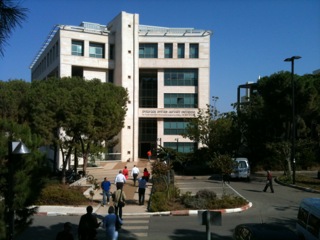
Technion, Israel's University of Technology

The universities play a critical role and one we should emulate. The first is obvious – they emphasize science and math in K-12 and produce more engineers and scientists! I am a big fan of liberal arts education, but in this digital world, the new industries require more PhDs in these areas.

Second, their universities drive innovation and technology transfer to the private sector. We met with the president of Technion (Israel’s MIT), the president of Haifa University, and local entrepreneurs. The schools encourage the creation of start ups, and have structured a support system that is coordinated with a national initiative that reviews and funds new ideas.

We have more schools per capita than any other state. We need to follow Israel’s lead and ensure these types of partnerships exist at many other schools besides just MIT. Connecting our colleges and universities with an economic development strategy will secure our position as an innovative leader now and in the future.

Boston-Haifa Innovation Zones

I’m on a Boston-Haifa “City to City” tour to help Boston get insights for the creation of an Innovation Zone in its Seaport District.

A group of 27 members of the Boston business and civic community are meeting with municipal, technology, and university leaders in Haifa and Tel Aviv, Israel through the City to City program run by Northeastern University and Mayor Menino.

Israel is one of the world leaders in producing a high quality skilled workforce that has attracted many of the leading global technology companies including Intel, who has here its largest R&D/production facility outside the US. (A great read: the new book: “Start-up Nation.”)

The first day we spent time with Haifa’s Mayor Yonah Yakov and the city’s Haifa Economic Corp. (HEC). To get companies to invest in their tech park, the City offers a 20% discount on municipal taxes. In their incubator building, start-ups get 3 years income tax free and 1:1 investment match with the government up to $200,000.

The Mayor was very generous with his time. He is a visionary, willing to risk political & infrastructure capital to get major projects started. Need a permit in 3 weeks? He can deliver. He took an abandoned area of the downtown, put in public areas and walkways, brought a new college into the district with classrooms and dorms and 2,500 students in only 3 years. Now they have restaurants, shops and galleries moving in.

Haifa is on the move!